Some games explode in their first month and slowly fade. Hunt: Showdown did the exact opposite: it launched in a state that was painful to watch, spent a year and a half at rock bottom, and then set its all time player record six and a half years after release. That shape of graph almost never happens in this industry.
- It started as a completely different game
- Crytek hits bottom
- Second birth: May 2017
- 22 February 2018: the launch that nearly finished it
- Thirty frames on the best hardware money could buy
- The graph that explains everything
- Why Crytek was making a shooter at all
- About those voxels: how it actually works
- Is the light really being calculated while you play?
- The engine is ten years old and still better looking than the new ones
- A game of chess where any piece can take the king
- Sound is the main weapon
- The hunting mechanic: clues and Dark Sight
- Who lives on the map
- Bosses and banishing: a reward you pay for
- The real hunt starts after the bounty
- There were two bosses, now there are six
- Traits: how a player reshapes the game around themselves
- How many weapons Hunt actually has
- Ballistics: the numbers that decide it
- The real originals: why the numbers look like that
- Cheaters: a war that does not end
- Hit registration: killed after you took cover
- Where that leaves it
This is the story of how a cancelled co-op monster hunting game turned into the best shooter ever built around a single shot. About an engine that is ten years old and still out-looks multiplayer games half its age. About rifles that each have a real nineteenth century original behind them. And about a studio that could not pay its own staff while the game was being made.
It started as a completely different game
In June 2014, at E3, Crytek showed Hunt: Horrors of the Gilded Age. If you know today's Hunt, you will struggle to recognise it in that one.
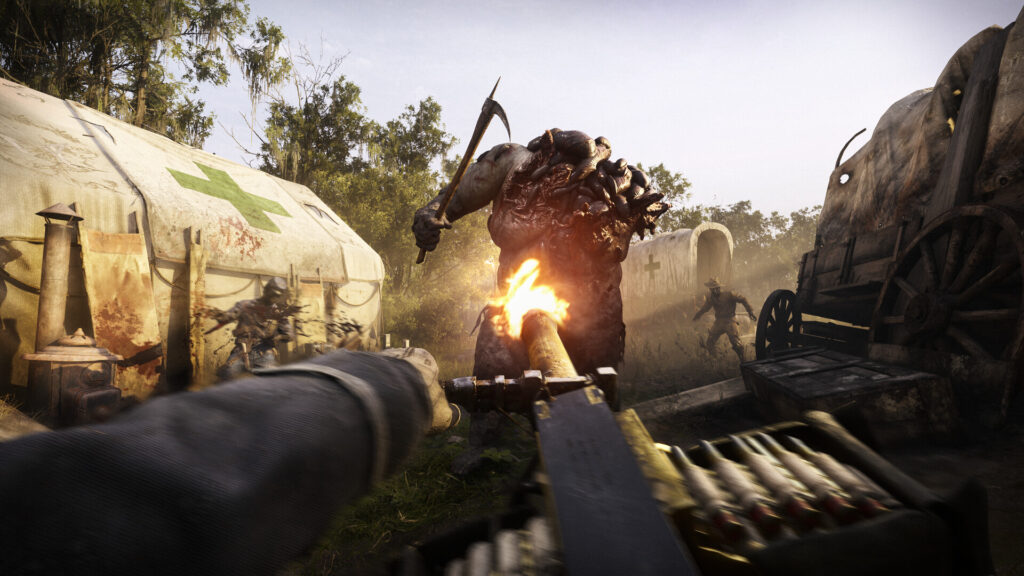
It was a third person action RPG. Camera over the shoulder, four player co-op against the computer, late nineteenth century America, a squad of hunters clearing out monster lairs. Procedurally generated levels, bosses, loot. The plan was to give it away free and monetise later.
It was made by Crytek USA, a studio in Austin. Crytek assembled it in 2013 from people left jobless by the collapse of THQ: the team from Vigil Games, the people behind Darksiders. David Adams, director of the first Darksiders, led the project, and he said plainly what he was after.
We definitely wanted to do four-player Darksiders. Hunt is very much a shooter with an over the shoulder camera view, whereas Darksiders was an action game in the old school sense.
David Adams, Eurogamer, 6 June 2014
The plan was laid out: a closed beta late in 2014, then a release on PlayStation 4 and Xbox One. Neither the beta nor that release ever happened.
If you want to see for yourself how different it was, watch IGN's coverage from that show. Camera over the shoulder, four in a squad, none of the tension that comes from other people being on the map, because there are no other people yet.
And then the trouble started, not with the game, but with the company.

Crytek hits bottom
By 2016 Crytek was in a situation you can only call a disaster. Salary delays began in May. By December staff still had not been paid for October and November. People talked about it publicly because there was no other way left to change anything.
The company owned seven studios around the world. In autumn 2016 it announced the closure of five of them: Austin, Budapest, Sofia, Seoul, Istanbul. Only Frankfurt and Kyiv survived. Around two hundred and fifty people lost their jobs.
Austin closed along with the project. Hunt: Horrors of the Gilded Age vanished: the work moved to Frankfurt, and the team that had come up with all of it scattered. Formally the game was never cancelled. In practice what remained was a folder of assets and a general idea.
The game we know today was built by people who were not being paid, at a company losing one studio after another. Worth keeping in mind when we get to the technical level of the result.
Second birth: May 2017
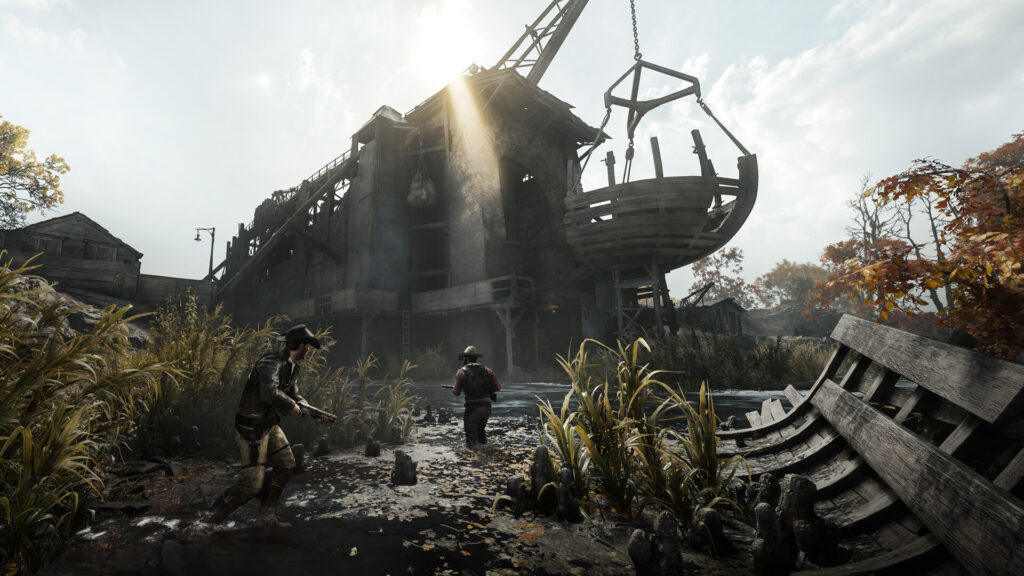
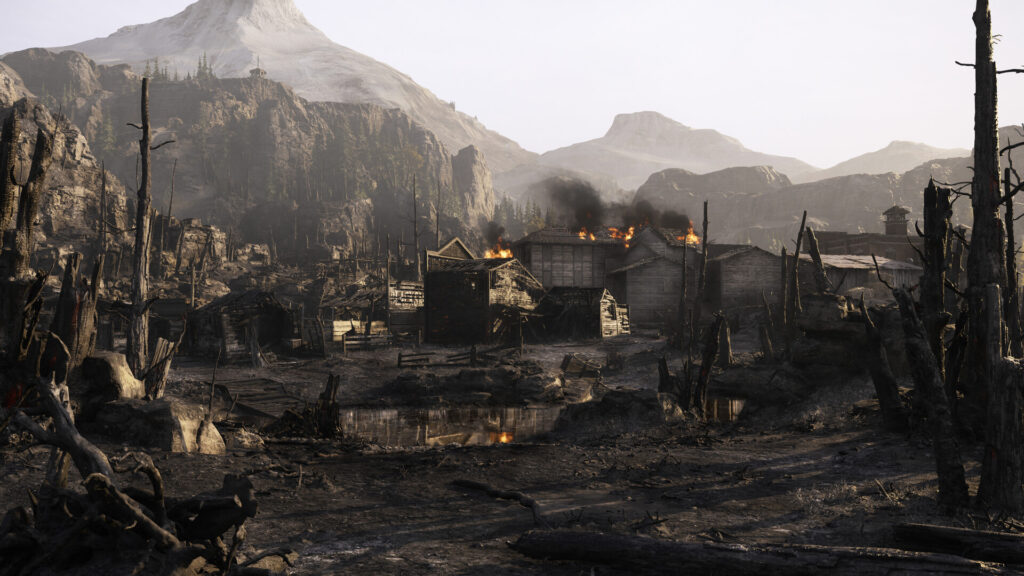
In May 2017 Crytek revealed Hunt: Showdown. What survived from the old version was the setting, the Louisiana swamps and the monsters. Everything else was rewritten, including where the player looks at the world from.
| Planned in 2014 | What it became in 2017 |
|---|---|
| Third person, camera over the shoulder | First person |
| Action RPG with shooting | A shooter where one shot settles the match |
| Four player co-op against the computer | Several teams of two or three, people against people and against the computer |
| Free to play | A normal purchase |
| Beta late 2014, release on PS4 and Xbox One | Early access in 2018, consoles in 2019 and 2020 |
| Crytek USA, Austin | Crytek, Frankfurt |
Co-op against the computer turned into a format that barely had a name back then and is now called an extraction shooter. Several teams of two or three enter the map. Everyone is looking for the same target. Finding it is not enough: you have to kill the boss, run the banishing ritual and reach an extraction point. The other hunters know where you are the whole time, because the ritual lights up for the entire map.
Formally it is PvPvE. In practice it is a game where people, zombies and your own greed are all trying to kill you at once.
22 February 2018: the launch that nearly finished it
Hunt entered early access on 22 February 2018. It came, honestly, straight out of alpha. There was no open beta, the closed tests drew a small audience, and the first mass wave of players met a build that was not ready for a mass wave of players.
- crashes to desktop in the middle of a match, no message, no loot saved
- a black screen instead of a loading screen, fixable only by restarting the client
- matchmaking that could search for ten minutes and find nobody
- connection error codes the community had to build its own decoder tables for
- losing a hunter and all their gear to a dropped connection, and a hunter in Hunt dies for good
That last point deserves its own explanation, because it turns a technical fault into a personal tragedy. There is no respawn in Hunt. A dead hunter is struck off your roster along with everything they were carrying and every skill they had earned. When the game loses one to its own bug, there is no worse feeling available.
But even that was not the main problem. The main problem was that the game ran terribly.
Thirty frames on the best hardware money could buy
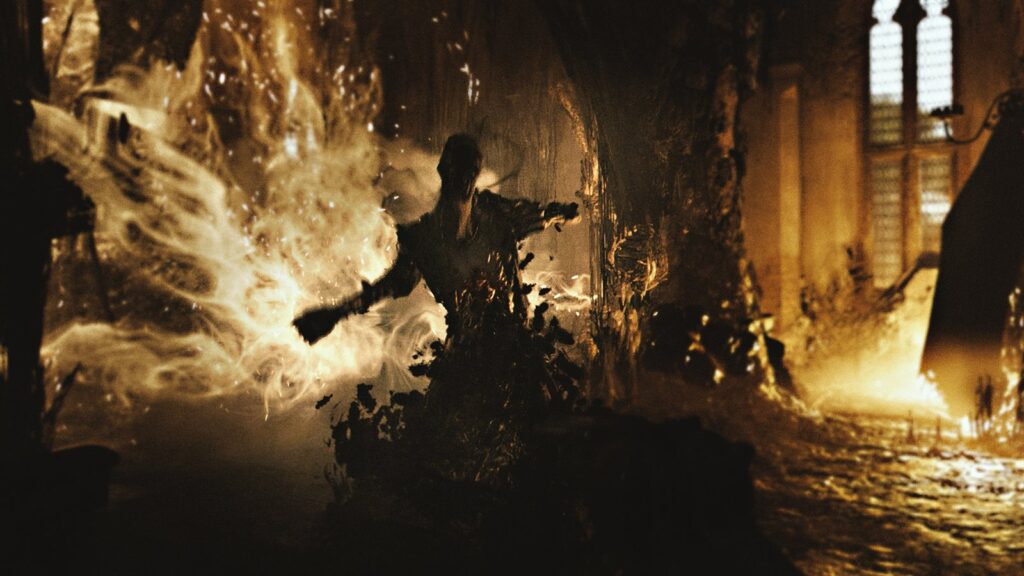
Crytek itself acknowledged that Hunt was CPU bound on most configurations, and that the graphics options were there for comfort more than for frame rate. In practice that looked like this: people with the best components of 2018 were getting numbers that would earn a refund today.
Within days of the early access launch, forum reports looked like this: Core i7-6700K and GeForce GTX 1080 Ti, 1920 by 1080, medium settings, 35 to 40 frames. The flagship card of its generation could not hold sixty at medium in Full HD. The wording in those posts was not flattering.
Streamers had it twice as bad, for an obvious reason. A broadcast is encoded on the same machine, and Hunt was strangling exactly the CPU the stream also needed. The person showing the game to an audience got the same picture as everyone else, only slower, and live.
In a shooter decided by fractions of a second, thirty frames is not a cosmetic problem. It is the point where you physically cannot keep up with your opponent, and no amount of skill covers for it.
How heavy the game stayed even later shows in the benchmarks from the 1.0 release in August 2019: a locked sixty frames at 2560 by 1440 was held only by an RTX 2080 Ti, the most expensive card on the market. That was after a year and a half of optimisation.
The first impressions all said roughly the same thing: great idea, raw state, come back in six months. And readers listened.
The graph that explains everything
A new game almost always peaks in its first month. After that the curve goes down, and the only question is how gently. Comparing different games by absolute numbers means little, but comparing the shape of the curve means a lot.
Hunt's curve is broken in both directions. The bad one first.
| Month | Event | Peak players | Average players |
|---|---|---|---|
| February 2018 | early access launch | 10,296 | 1,394 |
| March 2018 | 8,206 | 2,480 | |
| April 2018 | 2,262 | 1,012 | |
| April 2019 | rock bottom | 2,663 | 1,258 |
| August 2019 | version 1.0 | 11,862 | 4,129 |
| February 2020 | PlayStation 4 release | 12,428 | 5,488 |
| October 2023 | 41,197 | 20,157 | |
| August 2024 | relaunch as Hunt: Showdown 1896 | 59,968 | 19,541 |
| June 2026 | 43,371 | 17,761 | |
| July 2026 | 33,468 | 16,068 |
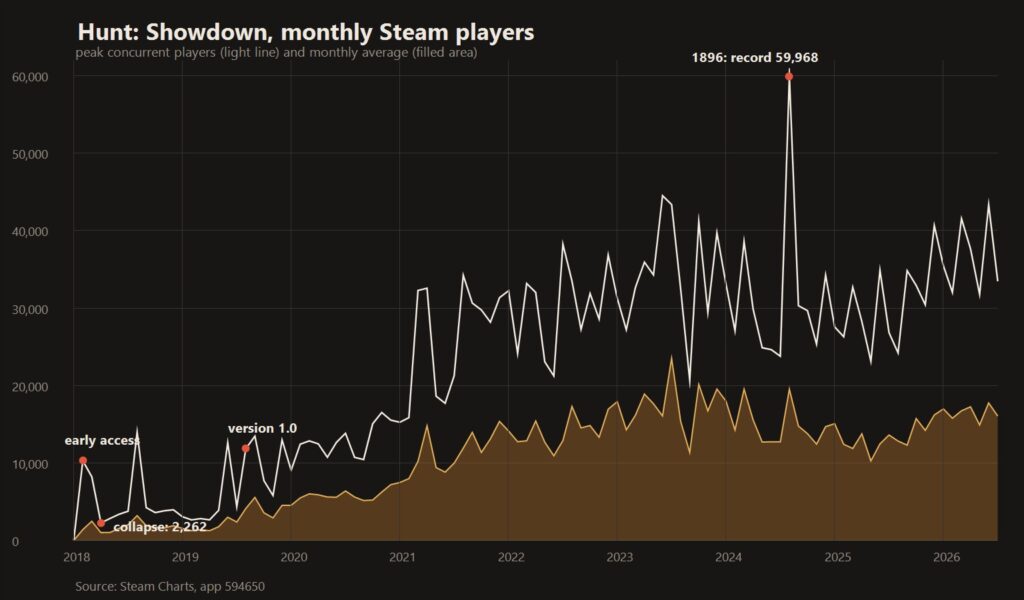
Look at what happens. The launch peak of 10,296 is modest on its own: for a loud game from a famous studio that is not much. Then it gets worse. In two months the peak falls to 2,262, a drop of 78 percent. The average in April 2018 is a little over a thousand people. A thousand. For a game by the company that made Crysis.
And this was not a brief dip. Through all of 2019 up to August the game sits at an average of about 1,300. In April 2019, fourteen months after launch, the average is 1,258. That is the level at which shutting the servers down usually gets discussed.
For a Crytek that had just closed five studios and was dealing with unpaid wages, this was a very bad moment for very bad numbers.
Now the other broken direction. Hunt set its all time record in August 2024: 59,968 players at once. That is almost six times the launch peak, six and a half years later. By the summer of 2026 the game holds an average of around sixteen thousand and monthly peaks above thirty thousand, roughly thirteen times higher than at the bottom.
You can count on your fingers the games whose all time player record landed in their seventh year. Usually it means the game was rescued not by marketing but by itself: people held on until the technology stopped getting in the way.
Why Crytek was making a shooter at all
Crytek was never simply a studio that makes games. It sells an engine. Crysis in 2007 was less a shooter than a demonstration: look what CryEngine can do, come and license it. The old joke about whether your PC can run Crysis was born right there.
Hunt was built on the same logic, only the task was harder. Plenty of studios could show a beautiful single player game with lighting calculated in advance. Crytek wanted to show something else: dynamic global illumination computed in real time, working on a large open map, surviving destruction, and still holding up a twelve player networked shooter.
The technology is called SVOGI: Sparse Voxel Octree Global Illumination. The name sounds frightening, the idea is simple.
About those voxels: how it actually works
Care is needed here, because a claim circulates around CryEngine that it is "the only engine in the world with voxel rather than pixel rendering". It is a nice line, but it is not accurate, and understanding it beats repeating it.
CryEngine draws its picture the same way everyone does: by rasterising triangles into pixels. There is no voxel rendering, meaning no image built out of volume cubes instead of polygons. The voxels live somewhere else, and that somewhere is the interesting part.
The engine builds a volumetric grid of cubes from the scene, an octree in which empty space is not stored at all, hence the word sparse. It traces cones of light through that grid and works out how light bounces from surface to surface. It is not calculating the direct beam from a lamp but the secondary light: why the shade under an awning is not absolute black, why a wall next to a red barn picks up a hint of red, why light from a window lands as a patch on the floor and lifts the ceiling.
Then come the two things this was all for.
- There are no lightmaps. In games of that era the secondary light was computed in advance, when the level was built, and saved into textures. It looked good but it was dead: that light cannot be switched off or changed, it is part of the picture. SVOGI computes it while you play and bakes nothing.
- It worked before the fashionable equivalents existed. Hunt showed this in 2018. Lumen in Unreal Engine 5, which solves exactly the same problem in a similar way, became available to everyone in 2022.
So the honest version is duller but stronger: CryEngine was one of the first engines to use voxels for real time global illumination, and in 2018 that was rare. It was not the only one in the world then and it certainly is not now. What it was, is early to the party.
Is the light really being calculated while you play?
A fair question, because "real time lighting" turned into a marketing sticker a long time ago and gets slapped on anything. With Hunt it can be checked, in two independent ways.
First, the graphics settings. Hunt has a separate Global Illumination option, and it is one of the most expensive settings in the game in frame rate terms. Baked light cannot be switched off with a slider, it is painted into the textures and costs nothing. If both the picture and the frame rate change when you toggle it, something is being computed right now.
Second, somebody else's analysis. Digital Foundry took Hunt: Showdown 1896 apart on consoles and confirmed SVOGI runs on all three, Series S included. They call Hunt's lighting one of the best showcases in gaming.
Now the caveats, without which this would be a flattering picture rather than a true one.
- What is computed live is the secondary light, not all of it. Direct sun and the shadows it casts are ordinary shadow maps, exactly as everywhere else. SVOGI handles the bounced light: why the shade under an awning is not absolute black, and why a wall beside a red building picks up a tint.
- It is software tracing, not RT hardware. The rays travel through the voxel grid using ordinary compute, no hardware ray tracing required. That is why Hunt runs happily on cards with no RT blocks, and for a networked shooter it was the only sensible call.
- It is a setting, not a constant. On low, most of the effect disappears. Competitive players cut it deliberately for frames and for visibility in shadow, and their picture is noticeably flatter. Living light is what you get on high settings, not what the person playing at two hundred and forty frames is looking at.
In the 1896 relaunch Crytek added a light cache and specular tracing on top of this, so bounced light now lands on glossy surfaces too, not only matte ones. Plus multiple bounces: the light gets to travel more than once.
The engine is ten years old and still better looking than the new ones
CryEngine V shipped in 2016. By industry standards that is old age. And yet Hunt still looks better than a good share of the multiplayer shooters that came out after it.
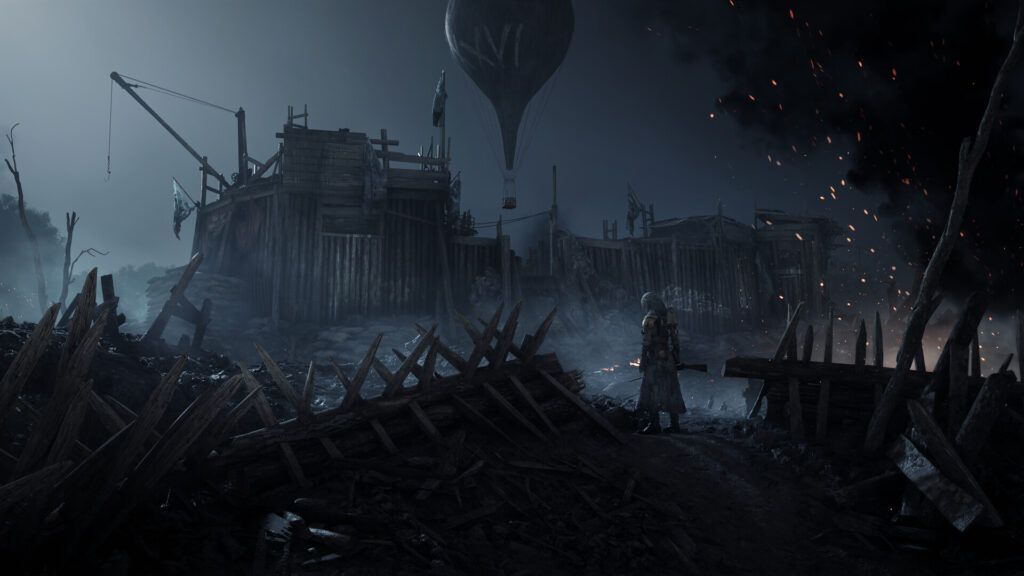
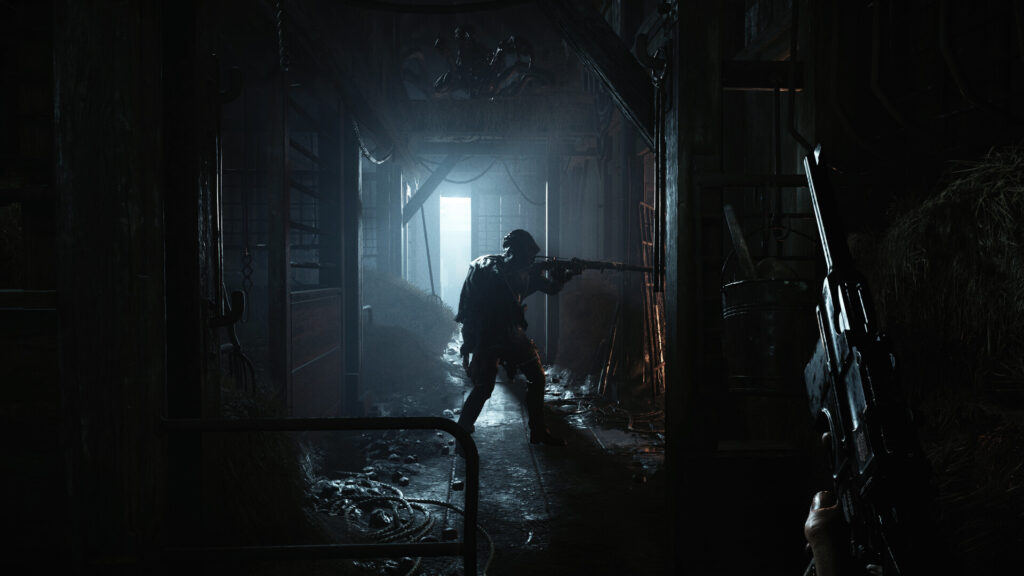
The reason is not polygon counts or texture resolution. The reason is light and air. Morning fog over water in which a human silhouette registers a second before you work out who it is. A dusty shaft of light through a gap in a barn roof. A thunderstorm that turns the map white for a fraction of a second and then black again, and in that instant you realise somebody was standing twenty metres away. Beauty in Hunt is functional: it directly decides whether you see the enemy or not.
And here is a detail people usually skip. For all those years Hunt did not run on a current CryEngine but on its own branch of the engine, split off back in the early access days. It got small, targeted updates, because swapping the foundations under a live networked shooter is frightening. A game of the mid twenties ran on late tens technology, and still looked better than many of its contemporaries.
In August 2024 that was fixed in one jump. Hunt: Showdown 1896 is not a sequel but the same project moved onto the internal CryEngine 5.11 with DirectX 12 and modern upscalers. The work took the studio several years, and it is a rare thing: almost nobody changes the engine under a live networked game, because it is expensive and dangerous.
Crytek also cut off the previous console generation. PS4 and Xbox One were left behind, only PS5 and Xbox Series X|S are supported, but now at sixty frames instead of thirty. A debatable call for owners of the older machines and absolutely the right one for the picture. That same month produced the record of 59,968 players.
A game of chess where any piece can take the king
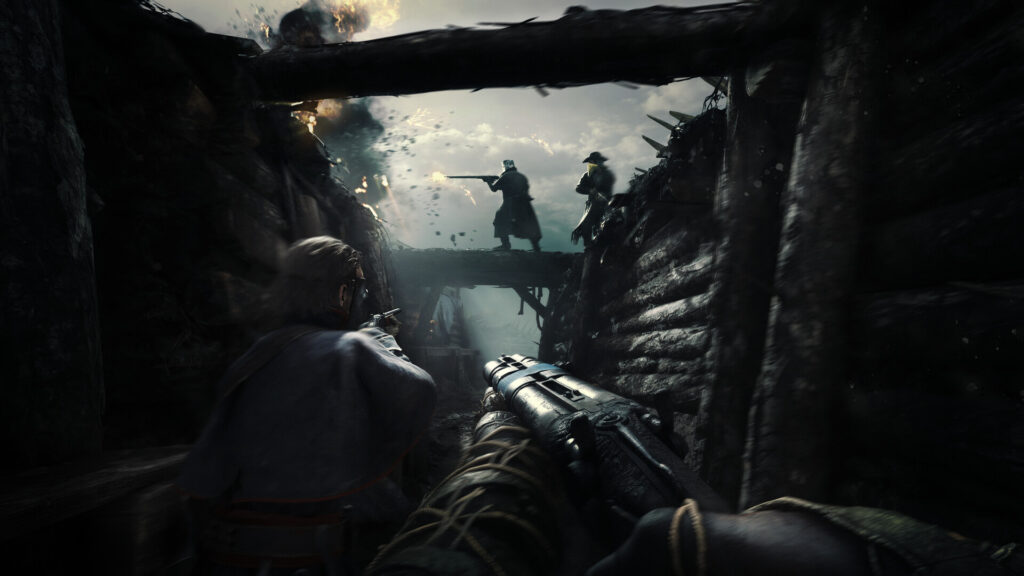
The main difference between Hunt and every other shooter fits in one line: any shot can end your match.
A hunter has 150 health, split into chunks. A headshot from almost any weapon kills instantly. A body hit from a heavy rifle leaves very little of you. No armour, no shields, no hero who leaps behind cover and regenerates in three seconds. There are medkits, but they heal slowly, loudly, and they do not resurrect.
Out of this grows a completely different tempo. In an ordinary networked shooter you run forward because death costs ten seconds of waiting. In Hunt you stand behind a tree for four minutes and listen. Because death costs a hunter, their gear, and every bit of loot you have already collected.
The chess comparison is not decoration. In chess a pawn takes the queen if the queen stands in the wrong square. In Hunt a newcomer with a cheap shotgun kills a player with a thousand hours if that player rounds the corner half a second early.
Reaction time and aim matter less in Hunt than in the average shooter, while position, information and patience matter more. Hence the game's reputation: it is frightening to start and hard to leave.
Sound is the main weapon
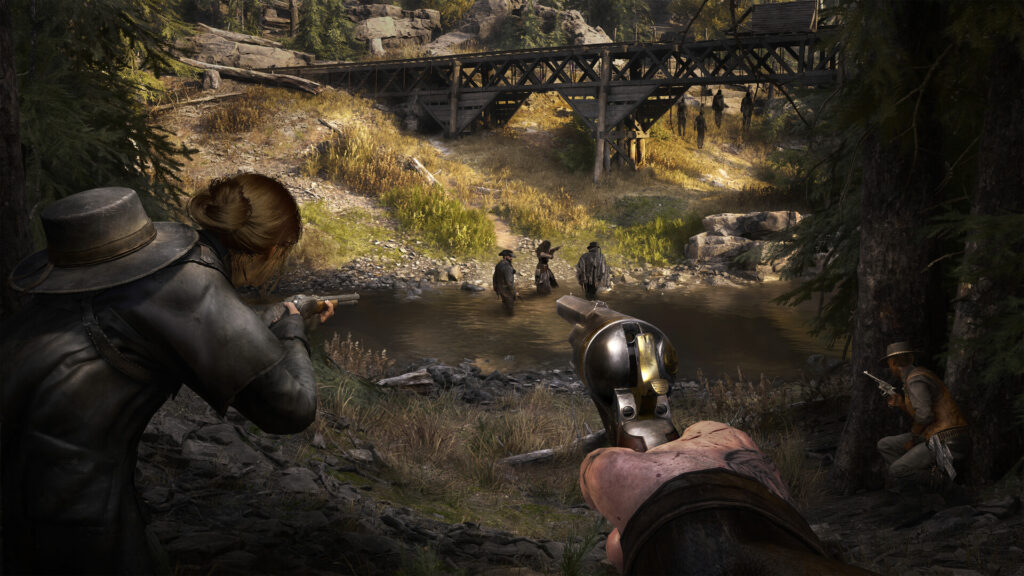
In Hunt your headphones give you more information than your screen. The map is built so that crossing it quietly is nearly impossible, and all the trap wildlife works as an alarm system for the neighbours.
- Crows. They sit on trees and fences and launch with a scream if you come within about fifteen metres. Audible from very far away and it means exactly one thing: somebody is moving there.
- Chained dogs. They start barking and do not stop. You can kill them, but killing them makes noise too.
- Broken glass and scrap metal. Deliberately scattered on the approaches to buildings. Running across it is announcing yourself through a megaphone.
- Water. It sounds different depending on depth. Ankle deep is a rustle, waist deep is a splash the whole area hears.
- Doors and windows. They creak. You can open them quietly only by opening them slowly.
The computer controlled enemies have their own audio design. They have several states: calm, alert, fighting, dying. Each one sounds different. An experienced player who hears zombies in a distant compound shift from calm to fighting already knows three things: there are people there, they are making noise, and they will be busy for the next thirty seconds.
The result is a second layer on top of an ordinary shooter. You are not so much shooting as reading a sound map, while trying not to appear on somebody else's.
The hunting mechanic: clues and Dark Sight
The name of the game is not about hunting people. It is about the fact that the target has to be found first, and that is a separate mechanic other shooters simply do not have.
Clues are scattered across the map. To see them the hunter switches to Dark Sight: the screen dims and the relevant points start glowing. Each clue you collect strikes part of the map out of the search area. After the third one the circle shrinks to a single compound and you know exactly where the lair is.
The elegance of it is that it works against you exactly as much as for you. While you collect clues you are running around the map making noise. And you are not alone: another team is collecting the same clues from the other side and shrinking the same circle. The closer you get to the target, the higher the chance of meeting people who came for the same thing. By the third clue you both know where you are going, and you both know the boss will not be the only thing waiting.
Who lives on the map
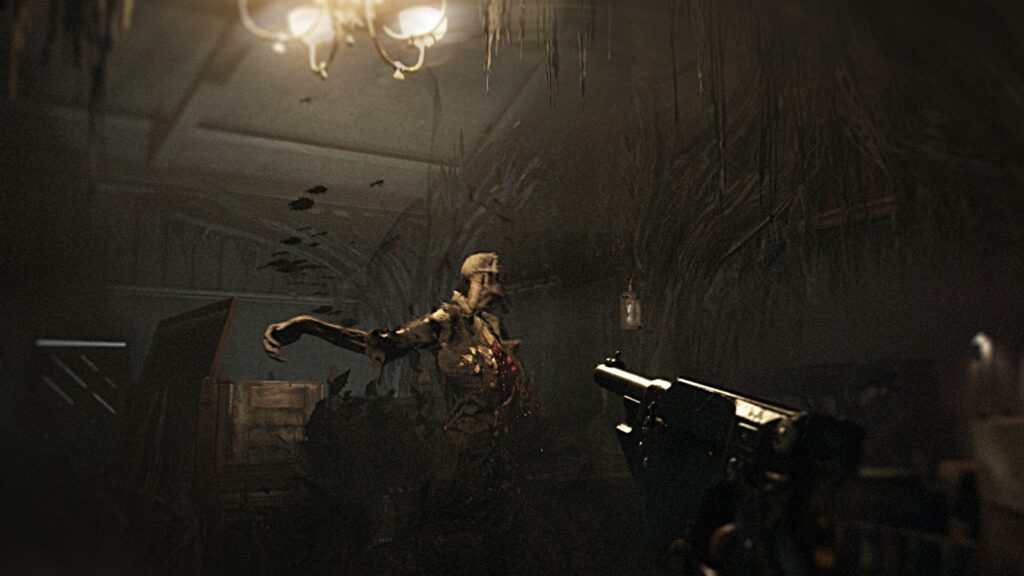
The monsters in Hunt are not scenery and not filler for a kill counter. Each type has a job, and almost always that job is to get you heard.
And this is where the variety genuinely surprises, especially remembering that this is a networked shooter and not a single player campaign. Usually such a game has one enemy type, maybe two: a dummy that runs at you and swings. Hunt has around fifteen, and they are built on fundamentally different principles.
One just shuffles and makes noise. Another breaks into a sprint and runs you down in the open, and you cannot outrun it, only turn and fight. A third releases a swarm of insects that follows you, gets in your eyes and does not leave until you dive into water. A fourth is blind and hunts by sound, so you can slip past it if you have the patience to crawl. A fifth burns and explodes, and its death is heard across half the map. A sixth stops bullets with its body, and shooting it is pointless.
| Who | Why they are dangerous |
|---|---|
| Grunts | Rank and file infected. Harmless one at a time, in a crowd they surround you and wake the neighbourhood |
| Hellhounds | They run in packs and they run fast. You have to kill them at range, and range means a shot, and a shot means noise |
| Immolator | Burns and sets you on fire. Dies in an explosion audible from a long way off |
| Armored | Stops bullets with its body, dealt with in melee or with fire |
| Meathead | A blind mass that hunts using leech scouts. Slipping past quietly is possible but hard |
| Hive | Releases a swarm of bees that chases and blinds |
| Water devil | Lives in the water and drags down anyone who decides to wade across a river |
Bosses and banishing: a reward you pay for
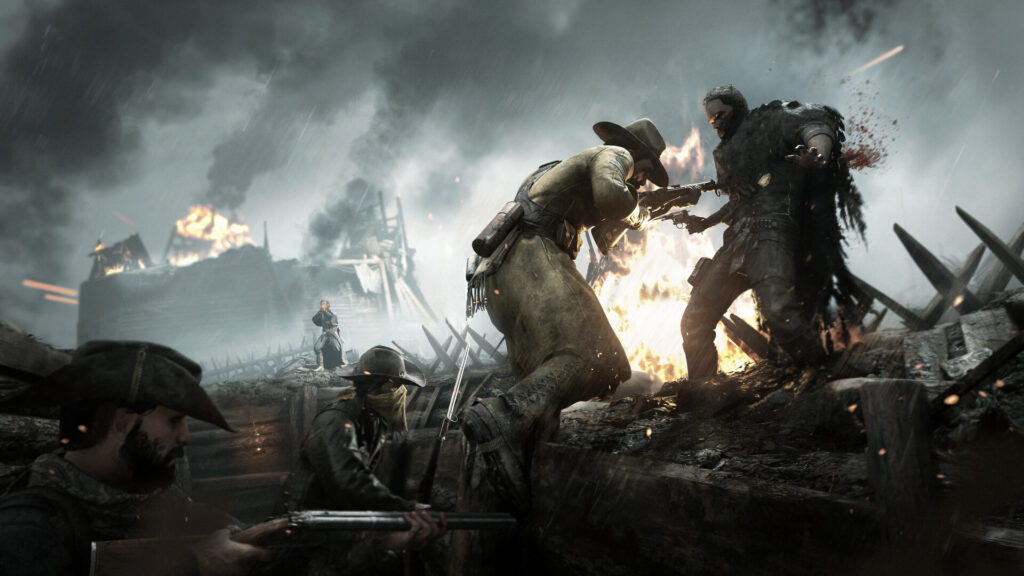
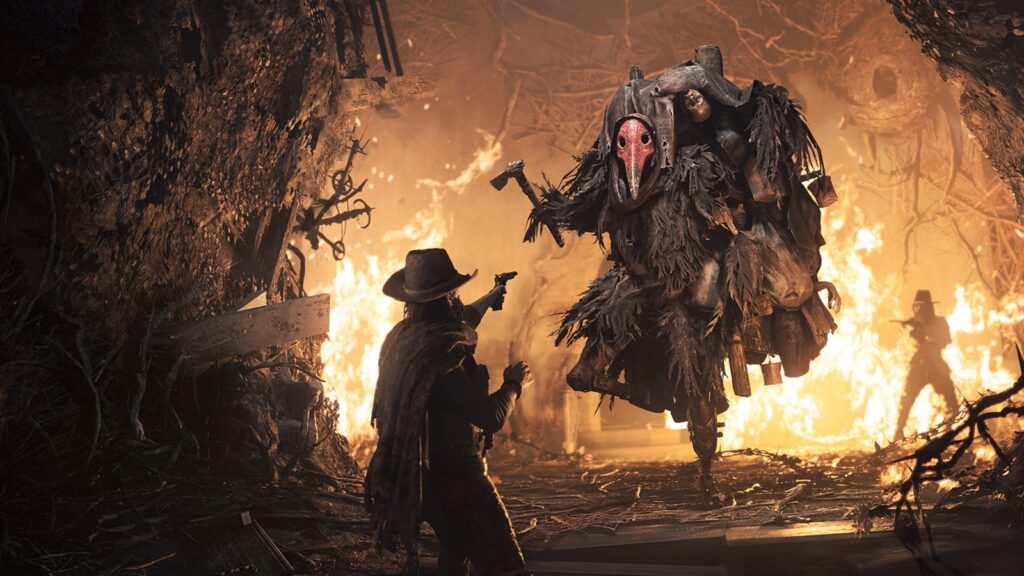
A boss sits in the lair. Several have accumulated over the years: the Butcher with his hook and brazier, the Spider running across walls and ceilings, the Assassin who dissolves into a swarm of insects, and Scrapbeak with claws made of scrap metal. Each demands its own tactics, and each fights in an enclosed space with nowhere to scatter.
And now the interesting part. Killing the boss is half the job. Then you have to run the banishing, and here the game plays its best card.
A banishing in progress is marked on every player's map. You have just won the hardest fight of the match and your reward is a glowing dot reading "we are here" for everyone else.
The ritual takes minutes, you have to stay near it the whole time, and everyone who was hunting the same target converges on you from all sides. Taking the reward is not enough, you also have to carry it to an extraction point, and more hunters die on that stretch than on everything before it.
The economy is simple and cruel. You do not have to take the bounty at all: you may leave the map at any moment, and the experience for clues found and enemies killed stays with you. But only the boss token really pays. So every match is a bet: leave with a little now, or stay and try to take it all.
If a hunter dies, they die for good, together with their gear and their progression. That is exactly why the price of one wrong step in Hunt feels nothing like it does in a game with respawns.
The real hunt starts after the bounty
This deserves a longer stop, because the title of the game earns itself precisely at this moment, and plenty of people who have watched a couple of videos never realise it.
While you are looking for clues and fighting the boss, you are the hunter. The moment you pick up the bounty token, the roles swap. Your position is marked on the map for every living player. In Dark Sight, lightning strikes the ground where the tokens are, visible from far away. The game literally puts a marker on you and shows it to everyone still alive.
The hunters become the hunted. That is not a figure of speech, it is a description of what happens to you mechanically the second you bend down and pick the token up.
Now you have to reach an extraction point. And everyone else has to intercept you, and they know exactly where to go. More than that, they know which way you are heading, because there are only a few extractions and they sit at the edges of the map. An experienced team does not chase you, it gets ahead of you and sits where you have to appear.
Because of that the last minutes of a match are built completely differently from everything before them. A moment ago you were creeping and listening. Now you are running with a marker on your back, knowing there is an ambush ahead, deciding whether to go straight through or take a detour across half the map through the swamp.
You are not left defenceless. The bounty carrier gets tools, but those are built as a choice rather than a gift.
- Instinct. While you hold the token, an orange glow warns you about enemy hunters within 75 metres. Passive, automatic, nothing to press.
- Dark Sight Boost. Lets you see enemy hunters through walls at up to 150 metres, as orange silhouettes. Except you get five seconds per token, and that is all.
- How to get them back. Spent seconds return for looting dead hunters and for clues from the second boss. So to see your enemies better you first have to kill somebody.
Five seconds for the whole trip to the exit. Spend them now and learn where the ambush is, or carry them to the end and trigger them at the moment the ambush seems to have started. It is one of the best decisions in the game: the resource is so small that every activation is a bet.
There were two bosses, now there are six
It is worth showing separately how the game grew, because at launch it was far more modest. In February 2018 there were exactly two bosses: the Butcher and the Spider. That was it. You followed the clues knowing one of two things waited in the lair, and after a couple of hundred hours that started to wear thin.
| Boss | Added | What makes it dangerous |
|---|---|---|
| Butcher | February 2018, early access launch | hook, brazier, fire in a cramped room |
| Spider | February 2018, early access launch | runs on walls and ceilings, leaps, poisons |
| Assassin | 2 May 2019, update 6.0 | scatters into a swarm of insects and reforms, spawns decoys |
| Scrapbeak | 30 March 2021 | claws of scrap metal, more armour than the rest |
| Rotjaw | June 2023 | the first boss without a lair, lives in the water and comes to you |
| Hellborn | 15 August 2024, with the 1896 relaunch | a fire target, also roaming, not tied to a compound |
Look at the gaps. Fourteen months passed between the second boss and the third, and that is exactly the period when a little over a thousand people were playing. Crytek kept adding content to a project that by every external sign was dying. In hindsight it looks like stubbornness that paid off.
Traits: how a player reshapes the game around themselves
Another layer that is invisible from the outside. A hunter has traits, bought with upgrade points as the hunter grows. There are 85 of them right now, and a single hunter can carry up to fifteen at once.
These are not passive plus five percent damage bonuses. Almost every trait changes a specific rule of the game, and together they assemble into different styles.
- Quartermaster gives an extra weapon slot, so instead of a sensible loadout you carry two heavy guns.
- Fanning lets you cock a revolver with your palm and empty the cylinder in a second, turning a close range duel into a lottery.
- Necromancer raises a downed teammate from a distance, and the team you thought you had finished stands up behind you.
- Serpent lets you pull loot toward you without approaching it, meaning you can lift a bounty from under the nose of whoever is guarding it.
- Silent Killer removes the death scream, so the person nearby never learns their partner is gone.
- Lightfoot and Mariner mute your steps on glass and in water, which is a direct attack on the game's own sound system.
Then the same brutal arithmetic applies as everywhere else. Traits live on the hunter, and the hunter dies permanently. Build the perfect character across fifteen traits, pour hours into them, walk through the wrong door, and that is that, start again. Which is why the better your hunter, the more carefully you play, and the game tightens its own tension without a single line of interface.
How many weapons Hunt actually has
Counting the arsenal in a shooter is usually dull, because half the entries are the same rifle with a different scope. In Hunt the count is worth doing.
| Base weapons | 55 |
| Variants built on them | 92 |
| Total entries in the arsenal | 147 |
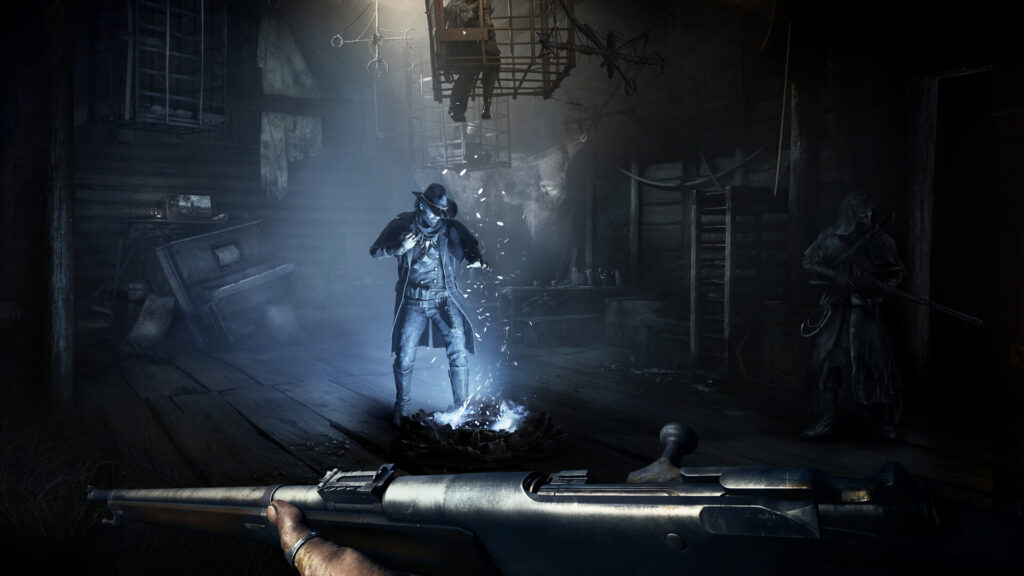
Then comes the part that makes this worth mentioning. Every base weapon has its own model, its own reload animation, its own gunshot and its own iron sight. Not a shared template with a repainted barrel, but a separately made object.
The sights deserve their own note, because there is almost no optics in this game and you aim with the standard iron sights. The Winfield has one arrangement, the Mosin-Nagant another, the Martini-Henry a third. Each blocks a different part of the screen and behaves differently at distance. Switching from one gun to another is not changing numbers on a stat sheet, it is retraining your eye.
Variants follow the same logic. A Shorty is a cut down barrel with a different animation and a different sound, a Silencer changes both the sound and how far it carries, Aperture and Deadeye are a different front sight or sighting rail. So 92 variants are not 92 rows in a table, they are 92 different feels in the hand.
For a game that in 2019 was held up by fifteen hundred concurrent players, that is an indecent amount of handmade work.

Ballistics: the numbers that decide it
In Hunt the bullet travels. Not an instant hitscan ray as in most networked shooters, but a physical object with its own speed and its own arc. At fifty metres you do not notice. At two hundred you aim above the target, and against a moving opponent you lead the shot.
Every gun has its own set of numbers, and they are not invented: rate of fire and damage follow fairly closely what the real weapons were.
| Weapon | Damage | Muzzle velocity, m/s | Range, m | Rounds per minute |
|---|---|---|---|---|
| Romero 77 (shotgun) | 220 | 450 | 30 | 16 |
| Sparks LRR | 149 | 533 | 145 | 13 |
| Springfield 1866 | 139 | 490 | 160 | 19 |
| Mosin-Nagant M1891 | 136 | 615 | 135 | 26 |
| Lebel 1886 | 132 | 630 | 140 | 20 |
| Winfield 1873 (Ranger) | 110 | 400 | 140 | 31 |
| Nagant M1895 (revolver) | 91 | 330 | 70 | 21 |
| Bornheim No. 3 (pistol) | 74 | 380 | 80 | 65 |
Look at the rifle rows. The Sparks LRR deals 149 damage against a health pool of 150. One point short. This is not an accident or a developer typo, it is a design decision that borders on cruelty: the most powerful rifle in the game kills anyone with a body shot except a hunter at full health. That hunter survives on one point, crawls behind cover and heals. And you, at that moment, are reloading a gun whose cycle takes almost five seconds.
The second interesting point is bullet speed. The fastest are the Lebel 1886 and the Mosin-Nagant M1891, at 630 and 615 metres per second. The slowest is the Sparks, at 533. And this is where the game unexpectedly turns into a history lesson.
The real originals: why the numbers look like that
Almost every weapon in Hunt is a genuine nineteenth century design under a slightly altered name. Sometimes the name was not even changed.
| In game | Real original | Year |
|---|---|---|
| Winfield 1873 | Winchester Model 1873, the gun that won the West | 1873 |
| Sparks LRR | the Sharps rifle, weapon of the buffalo hunters | 1874 |
| Springfield 1866 | Springfield Model 1866, the Allin trapdoor conversion | 1866 |
| Martini-Henry IC1 | Martini-Henry, the standard British army rifle | 1871 |
| Lebel 1886 | Lebel Mle 1886, the first military rifle on smokeless powder | 1886 |
| Mosin-Nagant M1891 | the Mosin rifle, the name was not changed at all | 1891 |
| Nagant M1895 | the gas seal Nagant revolver, also under its own name | 1895 |
| Dolch 96 | Mauser C96, wooden holster stock and all | 1896 |
| Caldwell Conversion Pistol | Colt 1851 Navy, converted from percussion to cartridge | 1851 |
Now put the table of originals next to the table of ballistics, and you can see that Crytek did not invent the numbers, it copied the logic.
- The Lebel is fastest because it really was fastest. The Mle 1886 was the first military rifle to use smokeless powder, and that gave it a muzzle velocity black powder could not reach. In the game it leads at 630 m/s, and that is historically honest.
- The Mosin sits right beside it because it is smokeless too. 1891, same principle, the same 615 m/s.
- The Sparks hits hardest and flies slowest because the Sharps was exactly like that. A huge lead bullet on black powder: heavy, slow, stops a buffalo. Hence 149 damage at a modest 533 m/s.
- The Nagant is the weakest firearm for a reason. The gas seal revolver cartridge was a compromise, and 91 damage at 330 m/s is precisely what it was in real life.
Which produces a rare thing: to understand the weapons in Hunt it helps to read about real weapons. And the other way round, after playing Hunt you unexpectedly understand why the move to smokeless powder in 1886 was a revolution rather than a small improvement.
Cheaters: a war that does not end
Now for the thing enthusiastic articles usually stay quiet about. Hunt has a cheating problem, and it has had one for a long time.
The game is built so that a cheater costs more here than in an ordinary shooter. In Call of Duty you get killed unfairly and lose ten seconds. In Hunt you lose a hunter with all their gear, forty minutes of loot and accumulated skills, and none of it comes back. On top of that the clue mechanic works against the honest player: Dark Sight already highlights points on the map, and someone with third party software only has to take one step further and see the people too.
Crytek fights this, and unlike many it does so in the open, publishing reports.
- Easy Anti-Cheat as the base. It runs at kernel level. After update 2.0 the studio rebuilt both the service and the workflows around it, and reported more than 2,300 bans.
- Their own behaviour analysis. Crytek separately tracks suspicious behaviour patterns specific to Hunt, which a third party anti-cheat is not obliged to catch.
- A dedicated group. The Fair Play Task Force handles detection, report review and the penalty system. Reports come out regularly, the latest in June 2026.
- Manual review. Every player report is reviewed by hand by the support team rather than by an automated system. Slower, but fewer mistakes.
And the newest part: in April 2026 Crytek brought in Anybrain, an external system that collects in game input from mouse, keyboard and controller and looks for abnormal behaviour in it. Put simply, it does not look into process memory, it looks at how a person moves their hand, and tells a living movement from a software assisted one.
It was pointed at consoles first, where it catches mouse and keyboard play disguised as a controller. That is now a bannable offence, and 296 bans had been issued as of the report. On PC the system is being trained to catch aimbots and scripts, but Crytek is deliberately holding back mass sanctions: first the criteria get tuned, so that legitimate players are not swept up.
The goal has always been the same: protect legitimate players and make absolutely sure we are banning the right ones, and not penalising skillful players making incredible shots.
Crytek, Fair Play Task Force report, April 2026
The studio also noted separately that the system is GDPR compliant and collects no social models, no mood tracking and no personal data. Given how news about AI powered anti-cheat usually sounds, the clarification is not superfluous.
The problem is not solved, though. It has got smaller and better tracked, but writing it off would be premature.
Hit registration: killed after you took cover
The second long standing sore point is familiar to anyone who has played Hunt. You duck around a corner, you can already see the wall in front of you on your screen, and at that moment you die. It feels appalling, because it looks like cheating or like a broken game.
It is not broken. Crytek explained the mechanism itself, and the explanation is worth knowing, because it changes how you feel about it.
Because of network latency, nobody in a match sees the same thing. You see the world as it was forty milliseconds ago, the server sees it differently, your opponent sees a third version. When somebody shoots, the dispute is settled by the hit validation system on the server, and it is forced to take a side. Hunt, like most networked shooters, takes the shooter's side.
The server rewinds the world state back to the moment the shooter saw, and checks whether the hit was legitimate. The higher the shooter's latency, the further back the rewind can go, with a hard cap of 800 milliseconds.
The unfortunate side effect of this system is that the Hunter that was shot might appear to already be behind cover when the server decides that a shot was valid, making it seem like you were shot out of nowhere.
Crytek, on the hit registration system
So you are not imagining it and nobody cheated you. On the screen of the person who fired, you were still standing in the open, and the game settled the dispute in their favour.
There have been major fixes: one update revealed that a large number of shots were being invalidated because the server considered the shooter already dead, and things improved noticeably once that was corrected. But it cannot be fully cured while light and cables refuse to travel faster.
And the other half of the problem: server tick rate. Here honesty is needed twice over. On one hand, Crytek does not publish that figure, and every number circulating in the community is somebody's measurement rather than official data. On the other hand, people have been measuring since 2018 and the picture repeats: the rate is not so much low as unstable. Peaks go above a hundred, everything sags under load, and players describe it as feeling like twenty or thirty updates a second.
The tick rate complaint is one of the oldest complaints about Hunt, it is now in its eighth year, and it has not been retired. Formally you cannot say "Hunt has a bad tick rate", because there is no official number. Based on how the game feels, you want to say it fairly often.
Put it all together and it becomes clear why this hurts more in Hunt than in neighbouring shooters. The bullet here is physical and takes its time. The rewind reaches 800 milliseconds. The tick rate floats. And the price of one hit is an entire hunter. In any other game that combination would produce unpleasant moments. Here it produces moments you remember for a long time, and not fondly.
In a game where any hit can end the match, the cost of such a small thing is higher than anywhere else, and complaints about hit registration follow Hunt to this day.
Where that leaves it
Hunt: Showdown is a game that by every law of the genre should have been shut down. The project was rebuilt twice, the first version died along with its studio, the company was not paying wages while it was being made, the launch was a technical failure, and fourteen months after release a little over a thousand people were playing it at once.
Instead of shutting down it set its all time player record in 2024 and lives today with twenty times the population it had at the bottom. The reason seems to be exactly one: underneath all the bugs and failures lay an idea you cannot get anywhere else. A shooter where a shot is an event, where you listen more than you fire, where an old engine keeps the light alive and the rifles behave like their real originals did a century and a half ago.
And here is the thing worth saying plainly: there is nothing else like it. Not in the sense of "the best", but literally: nobody has assembled this combination. The extraction genre is crowded now and has its own big names, but they all run on modern weapons, modern gear and raids about economy. Nobody else has the 1890s, nobody else puts the target in a lair behind a ritual that gives your position to the whole map, nobody else makes sound a separate detection system, and nobody else makes a single shot cost this much. The nearest neighbour in spirit differs from Hunt more than any two ordinary shooters differ from each other.
In eight years nobody has copied it. Usually that means there is nothing to copy. Here it seems to be the opposite: too much of it would have to be built from scratch, including an engine that can compute light the way Hunt does.
If you have never tried it, an honest warning: for the first ten matches you will die without understanding why. On the eleventh you will hear crows over a distant barn, understand what that means, and that is it, you are caught.
Sources
- SteamDB, player charts for Hunt: Showdown 1896
- Steam Charts, monthly statistics for app 594650
- The game's Steam page
- Wikipedia, Hunt: Showdown, platform release dates
- Eurogamer, interview with David Adams, 6 June 2014
- Crytek, official site
- CryEngine, SVOGI documentation
- Digital Foundry, technical review of Hunt: Showdown 1896 on consoles, 15 September 2024
- Hunt: Showdown 1896 Wiki, weapon list and stats
- Hunt: Showdown 1896 Wiki, Dark Sight, the bounty marker and detection ranges
- Hunt: Showdown 1896 Wiki, hunter traits
- IGN, Hunt: Horrors of the Gilded Age at E3 2014
- Crytek, update 6.0 with the Assassin boss, 2 May 2019
- Crytek, the Scrapbeak announcement, 30 March 2021
- DSOGaming, Hunt: Showdown performance analysis at the 1.0 release
- Crytek, Fair Play Task Force report and the Anybrain rollout, April 2026
- Crytek, update on the anti-cheat strategy
- Crytek, the state of hit registration in Hunt
- Crytek, hit registration update