This is a review of The Last of Us Part II six years after launch. I have finished it four times: first on PS4 on release day, then on PS5 and on PC. Every screenshot in this article is mine. I will tell you straight away which side I am on: this is one of the best games I have ever played, and for years I defended it in arguments without skipping, I think, a single one.
- December 2016: the reveal that made everyone lose their minds
- E3 2018: a church built for a single game
- June 2020: all of this on an old PS4
- April 2020: the leak that spoiled nothing for me
- Why play if you have seen the show
- Four playthroughs and immersion you cannot tear yourself away from
- The tech: details that are easy to miss
- Glass, ropes and blood: physics that took years
- Contextual emotions: the best thing I noticed all game
- Stealth: grass, dogs and enemies with names
- Exploring pays off: manuals, supplements and workbenches
- Spoilers ahead: what exactly set players off
- Feminism, pregnancy and Abby's muscles: complaints I never understood
- How the story is told: the same three days twice
- Why it is so tense to play
- Which difficulty to pick, and why not the highest
- Atmosphere that builds for hours
- The ending and what comes next
There is a good reason to bring it up now. On September 26, the day the outbreak begins in the story, HBO announced new cast members for season 3 of the show. One of them is Ian Alexander, who voiced Lev in the game. Plenty of people have watched the series by now and decided there is no point in playing. That is exactly what I want to argue with.
December 2016: the reveal that made everyone lose their minds
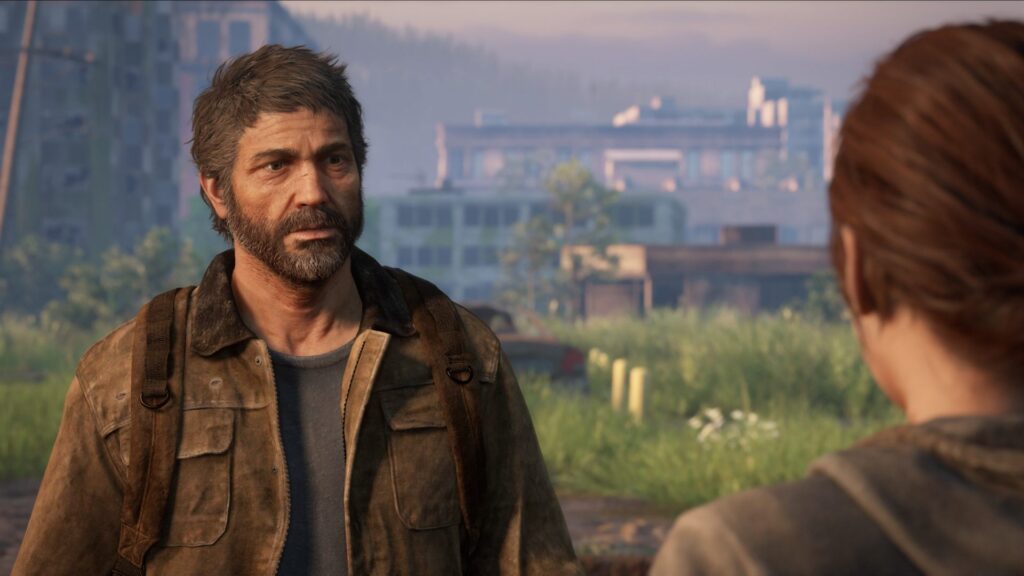
The game was revealed on December 3, 2016, at PlayStation Experience in Anaheim. A trailer without a single gunshot: a grown-up Ellie sits on a bed, tunes a guitar and sings Through the Valley by Shawn James. There are bodies all around her. Joel walks in, asks what she is doing, and Ellie tells him she is going to find them and kill every last one of them. No date was given, and the studio said openly that the game was at a very early stage.
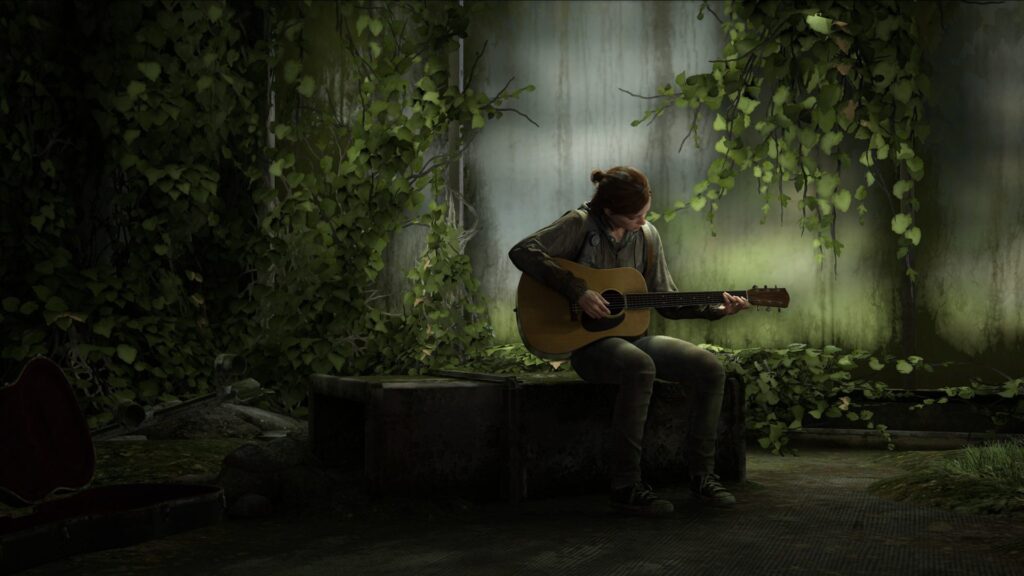
That was enough. The internet spent weeks going through every frame: is Joel alive, who is Ellie going to kill, where did that tattoo on her arm come from. A year later, on October 30, 2017, at Paris Games Week, a second trailer arrived, and it was about something else entirely: strangers, Seattle, hangings, a hammer. Ellie and Joel were not in it at all.
E3 2018: a church built for a single game
The big moment came on June 11, 2018. Sony opened its E3 show not on a stage but in a separate tent built to look like the church from the opening scene of the demo. Guests were led inside, and Gustavo Santaolalla, who scored both games and has two Oscars on his shelf, walked out in a hoodie with a banjo and played the main theme. Then the demo started.
It had everything at once. The dance in Jackson, Ellie and Dina, their kiss, and a second later a brutal fight in the woods where Ellie pulls an arrow out of herself and leaves a bloody handprint on a table. After the showing, the audience spent almost ten minutes being moved from the church to the main hall, and Sony took some flak for that. I think it was worth it.
I still remember watching it on my phone and not believing this was running on a PS4. In scale it was on the level of Uncharted 4 at E3 2015 and God of War at E3 2016. You could feel how much the studio had grown in everything: the faces, the light, the way Ellie moved through a cramped room, brushing against the furniture.
June 2020: all of this on an old PS4
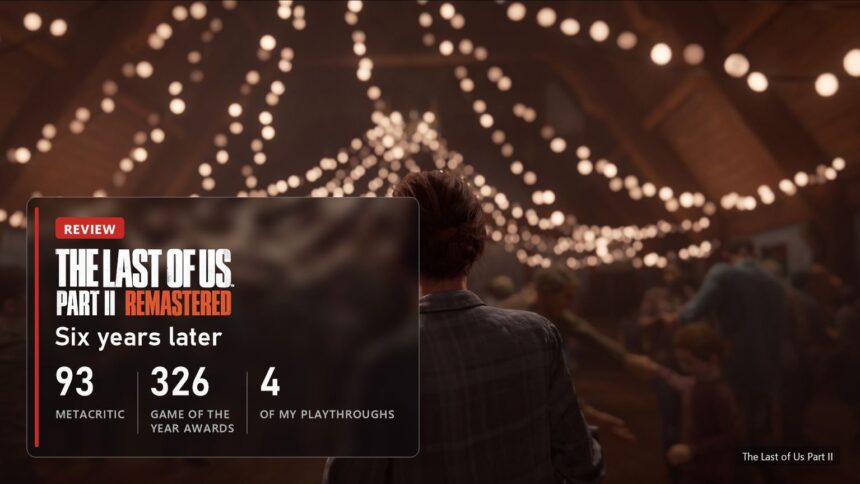
The game came out on June 19, 2020, as a PS4 exclusive, after two delays: from February 21 to May 29, and then indefinitely because of the pandemic. It sold more than 4 million copies in its first three days, a record for a PS4 exclusive at the time. The critics' average on Metacritic is 93.
Was there a downgrade compared with the E3 demo? Yes. Comparison videos appeared a couple of days after launch: the final version has simpler lighting, fewer shadows from dynamic light sources, and foliage that does not react to light the way it did in the demo. But I never noticed any of it while playing. You only start noticing when you put two videos side by side, and you do not play the game side by side with a video.
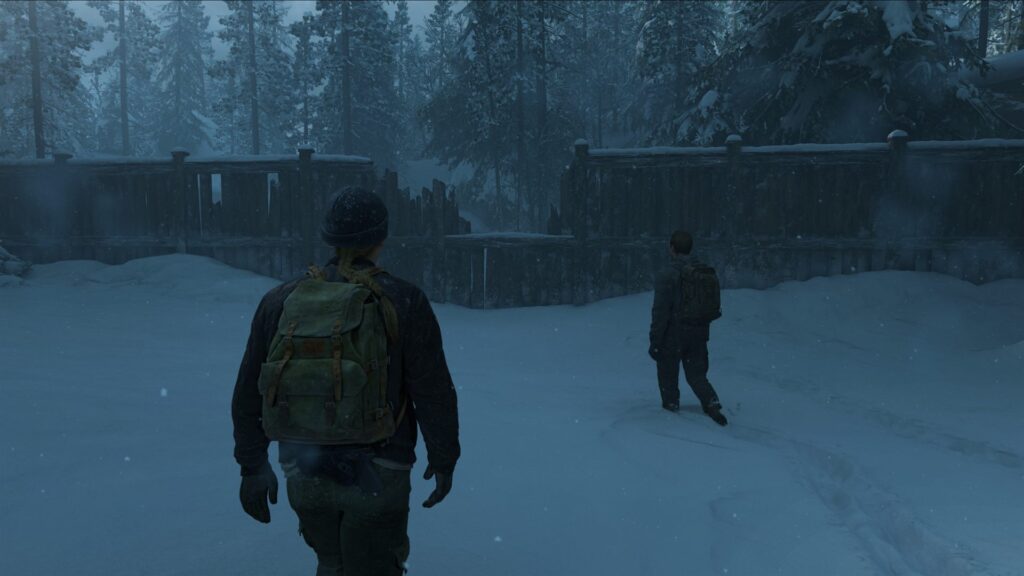
- PS4, June 19, 2020. The original, with enhanced visuals on PS4 Pro.
- PS5, January 19, 2024. Remastered: higher resolution, an unlocked frame rate mode, and the No Return roguelike mode.
- PC, April 3, 2025. Ported by Nixxes and Iron Galaxy. Minimum: Core i3-8100 or Ryzen 3 1300X, GTX 1650 or RX 5500 XT, 16 GB of RAM, 150 GB on an SSD.
- Recommended for PC. Core i5-8600 or Ryzen 5 3600, RTX 3060 or RX 5700, the same 16 GB.
Both games still set the bar for graphics and technical polish, whatever you run them on. On PC that means modest hardware: the GTX 1650 is a 2019 card, and the game runs on it.
On PC the game got a warm but very restrained welcome, and its success was just as restrained. The Steam player peak came on April 6, 2025, the first weekend: 30,690 people at once. That is less than Part I managed with 36,496, even though its port was plainly broken at launch. The reviews are good: right now 91 percent of Steam reviews are positive, 50,803 out of 55,872, rated Very Positive. When I saw those numbers, to be honest, I felt a certain frustration: the game deserved a lot more noise.
April 2020: the leak that spoiled nothing for me
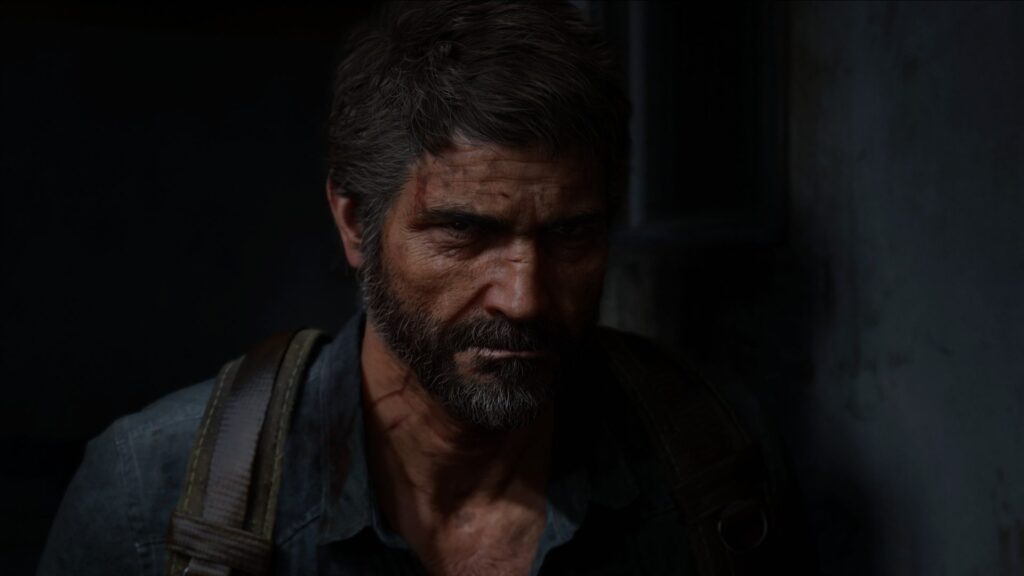
On April 27, 2020, seven weeks before launch, videos with cutscenes and the main plot twists leaked online. The studio was working from home at the time, and the first theory was that someone on the inside had leaked it. It turned out differently. According to Bloomberg and Kotaku, hackers found an access key to Naughty Dog's servers in the final patches of older games, Uncharted 3 and the first The Last of Us, and pulled about a terabyte of data from a server. Nobody at the studio or at Sony was involved. Sony announced the new release date the same day.
How did it affect me? Not at all. The Last of Us is not about plot twists. If you retell the first game in short, it goes like this: Joel saves Ellie, then protects Ellie from everything that moves, and at the end saves Ellie again. The end. It sounds like nothing, and in fact it is one of the best stories in games, because what matters here is how it is lived, not what happens.
Why play if you have seen the show
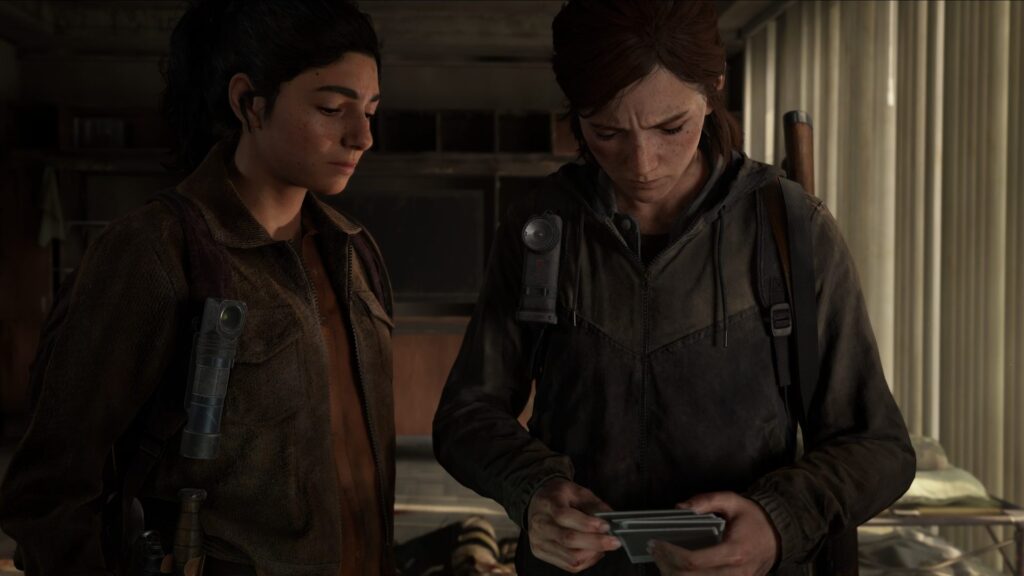
A lot of people make the same mistake today: why would I play it, I have seen the series. The series is good. The game is better, largely because it tries as hard as it can to be a film itself, just one that runs for thirty hours. Conversations in the car, stories by the fire, bickering with Dina on horseback, notes you read in empty apartments: none of that would fit into any film. The show has to choose. The game does not.
And most importantly, in the game you are the one holding what Ellie does in your hands. A scene you watch from the outside in the show has to be played through here, and that is a completely different feeling.
Four playthroughs and immersion you cannot tear yourself away from
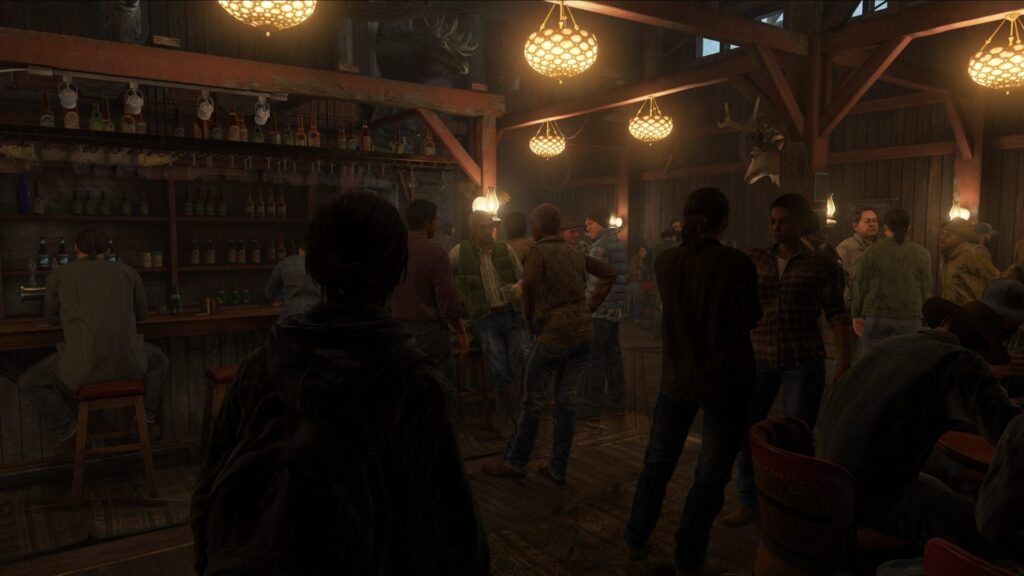
To say the immersion shocked me is an understatement. The game simply grabs you and pulls you into the events, and there is no pulling away. I am not the kind of person who replays the same game again and again, one run is usually enough for me. I have finished The Last of Us Part II four times, and every time I found something I had not seen before.
The funny part is that I was never a big fan of the first game, and when I sat down with the second one I expected nothing. The story turned out to be stunning from every angle. It does not let go for a second, and I could not stay indifferent to what was happening.
The tech: details that are easy to miss
I will start with what many people simply will not notice. The Grounded II documentary, which Naughty Dog released for free, shows how far the studio went on small things. The game took 70 months to make, at its peak 200 people worked on it inside the studio and more than two thousand across all contractors, and the budget is estimated at around 220 million dollars.
The film itself deserves a few words. Grounded II came out on February 2, 2024, runs two hours, and is free on Naughty Dog's channel and in the Remastered menu on PS5. It follows Grounded, the film about making the first game. There is no gloss here: working from home during the pandemic, crunch, the leak, threats against Laura Bailey and her newborn child. And some fascinating things about what the game could have been: at first it was planned as more open and more combat-driven, with an eye on Bloodborne, and in the first version of the ending Ellie killed Abby. If you liked the game, watch it. If you did not, watch it even more: a lot of decisions look different afterwards.
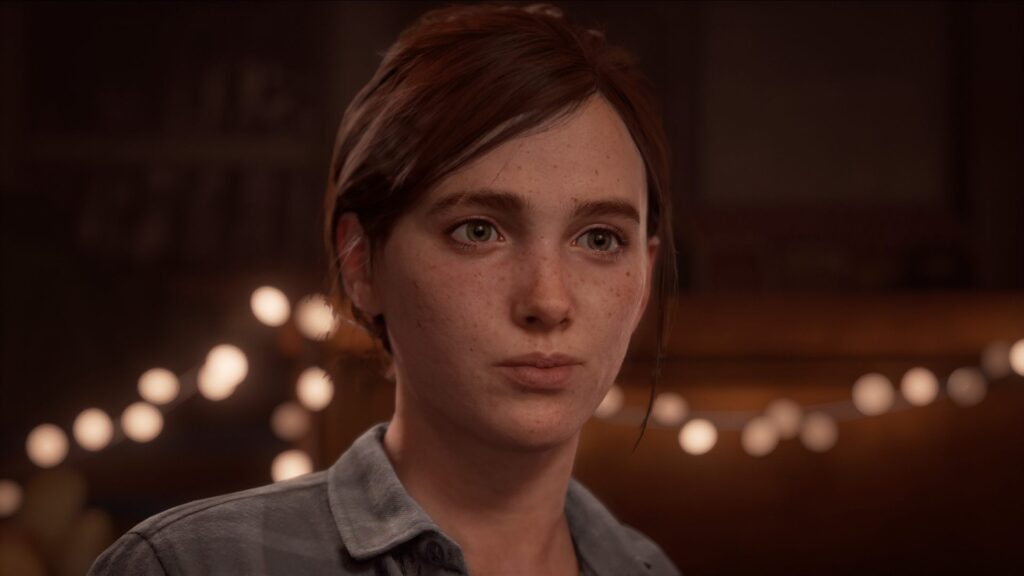
Animation. For the sequel the studio switched to motion matching: movement is not stitched together from pre-recorded pieces but picked from a large database to fit what is happening right now. That is why Ellie turns so naturally, stumbles on a step and leans against a wall. Facial animation is tied to breathing, gaze and posture. Many of these reactions are easy to miss if you do not turn the camera to Ellie's face at the right moment.
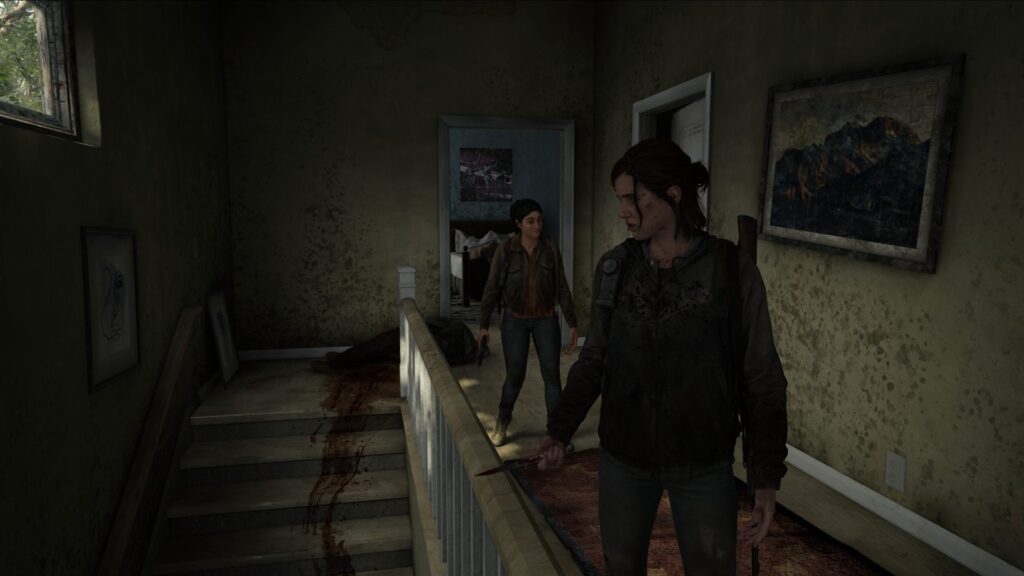
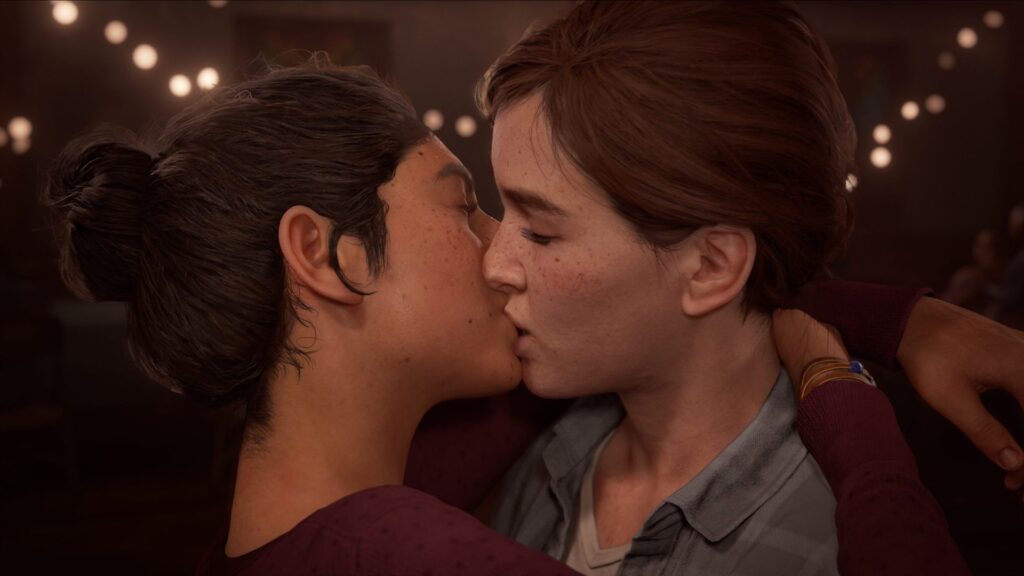
Look at the kiss between Ellie and Dina in the screenshot below. It is a cutscene, but the detail in the faces is astonishing: the lips purse, Ellie's nose presses into Dina's cheek, and the cheek gives under it. A detail like that is easy to miss if you only watch the scene once.
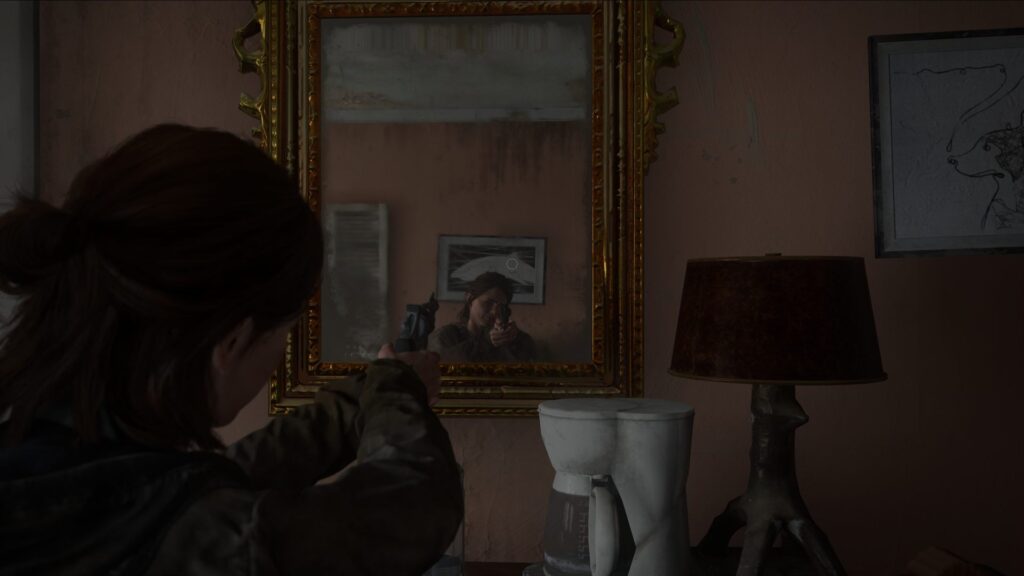
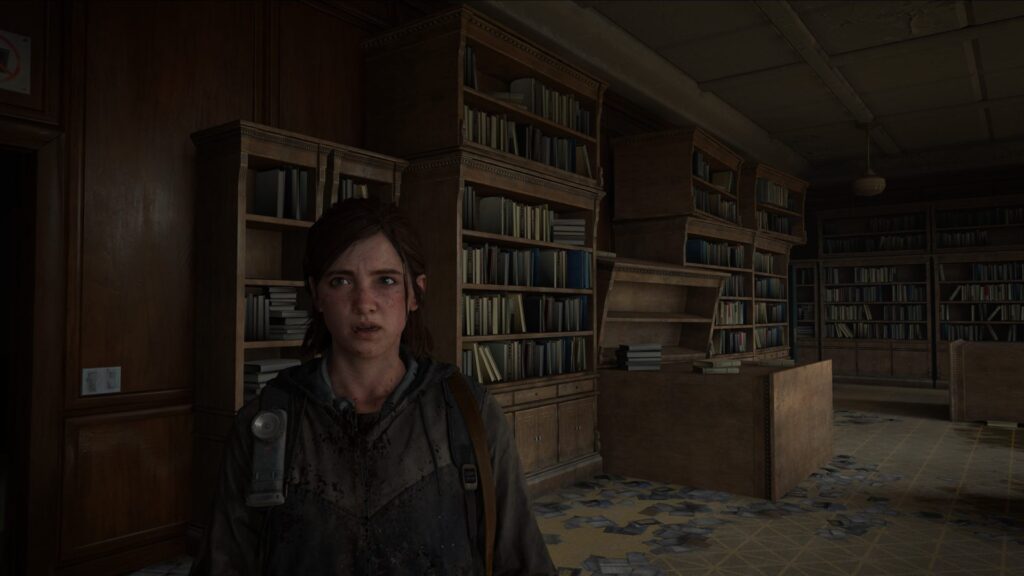
Light and mirrors. The lighting is simply stunning. And the mirrors are real: they reflect Ellie herself and the room around her, as if with ray tracing, only on a PS4. There are a lot of mirrors in the game, and every time I stopped to look.
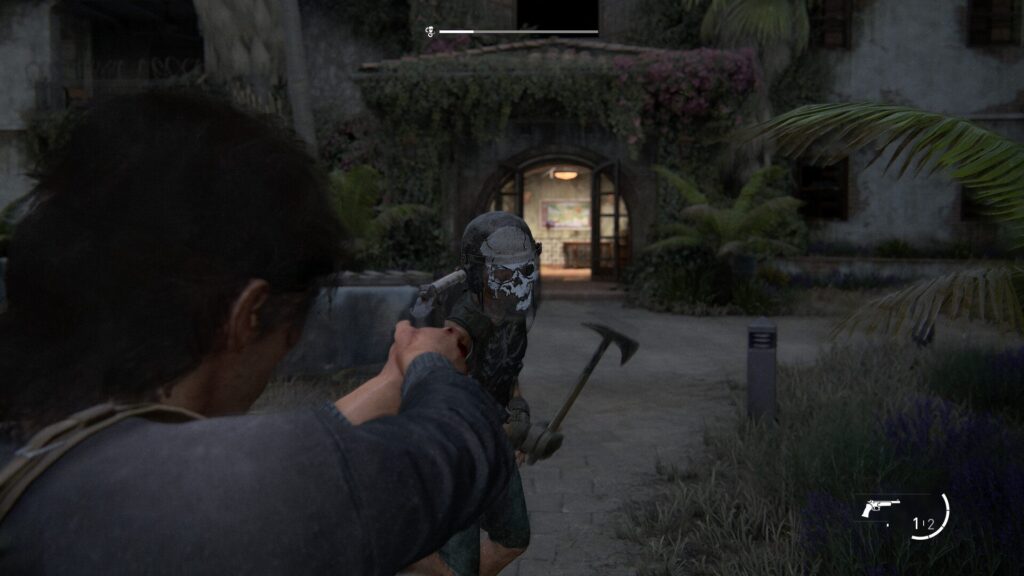
Physics and damage. I still have not fully figured out the damage system for humans and the infected. A shot tears off limbs, an explosion can take off even fingers, and they stay there as separate physical objects. Ellie's hair reacts to the wind, and you can see it even in the screenshot below.
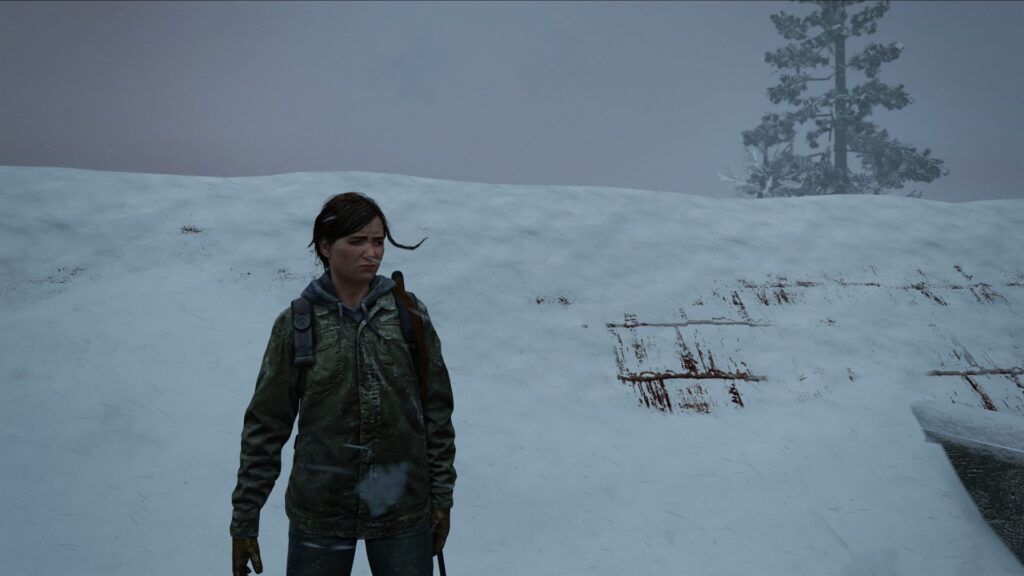
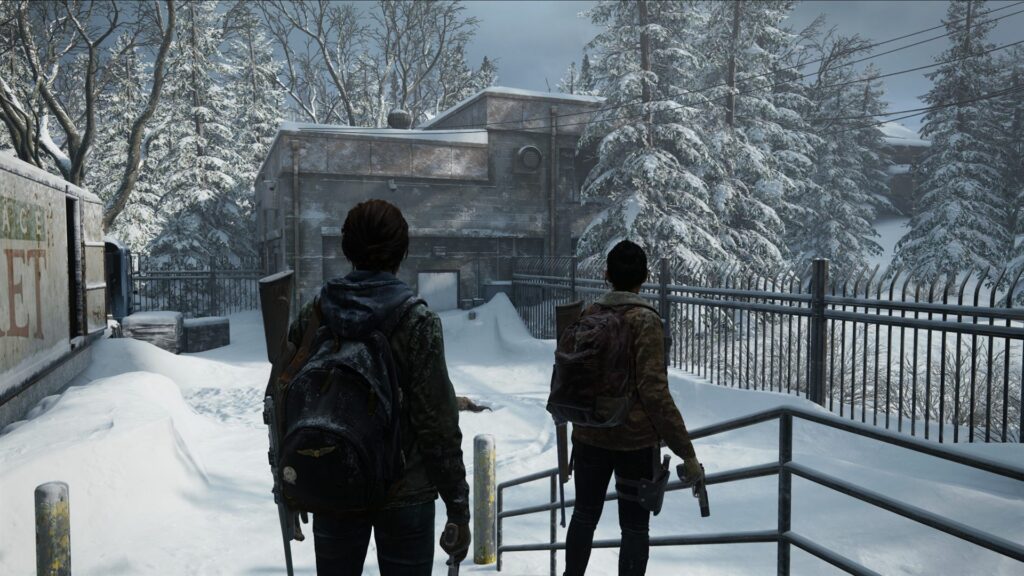
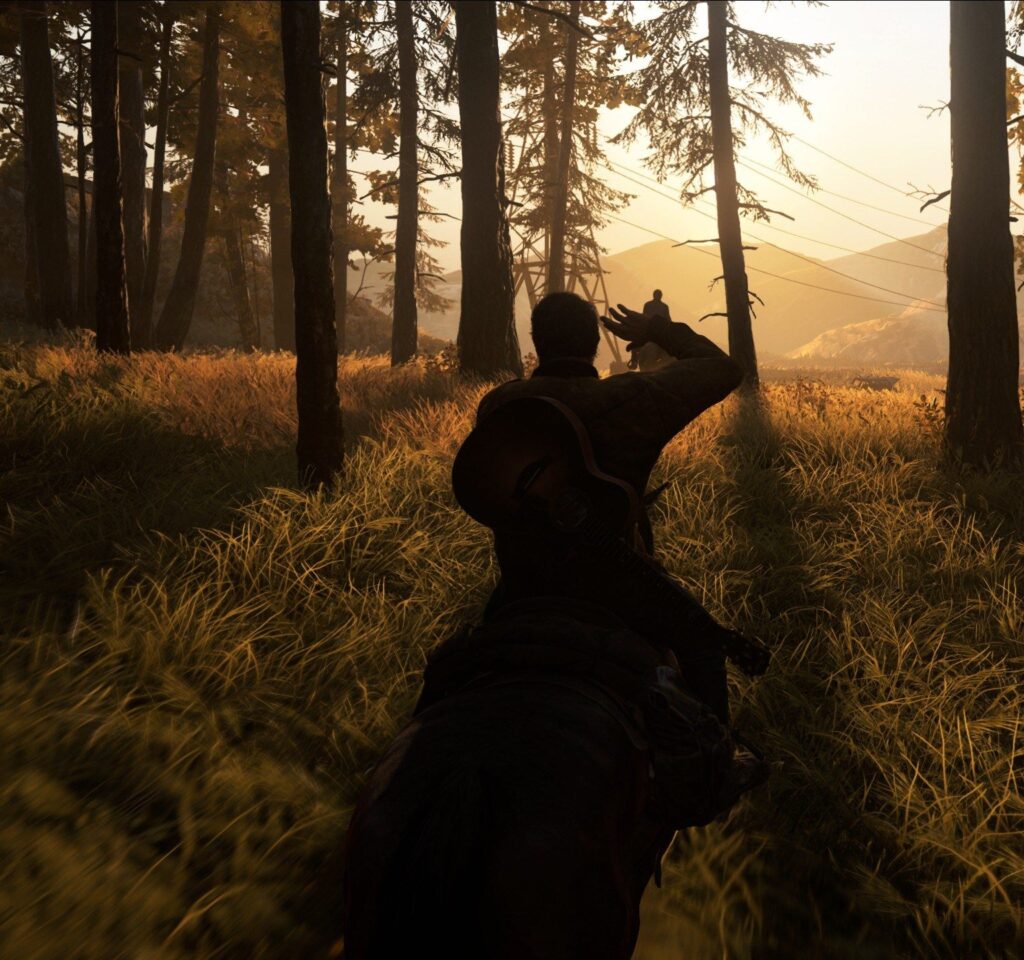
Weather and places. Snow in Jackson, endless rain in Seattle, sun in Santa Barbara, winter mountains, a summer forest. In a downpour, Seattle even sounds different. And I have never seen a forest like this in any game.
Glass, ropes and blood: physics that took years
Glass. Breaking glass in this game is a pleasure of its own. A window cracks where it was hit, shards fly and stay on the floor, and they keep reacting to physics: step on them or brush past, and they shift. The trick is that all the glass in the game is actually broken in advance, with the seams between pieces hidden while it is supposed to look intact. The glass tool was built by technical artists Christophe Desse, Charlotte Francis and Neilan Naicker. Glass is also part of stealth: everyone nearby hears a window break, but you can climb through it or throw a bottle through it.
Ropes. You can throw a rope, sling it over a beam, swing it and climb it, and it behaves like the real thing: it catches on edges, wraps around corners and sags. A rope up to 14 meters long is broken into a chain of connected nodes, each colliding with the world, while a separate system makes sure the line wraps around edges correctly and slides along them. Naughty Dog started building this tech back in 2011, during pre-production on Uncharted 4, where it powered Drake's grappling hook and the jeep winch. According to the developers, three people worked on the rope in the sequel: an animator, physics programmer Jaroslav Sinecky, and the lead gameplay programmer who connected the rope physics to animation.
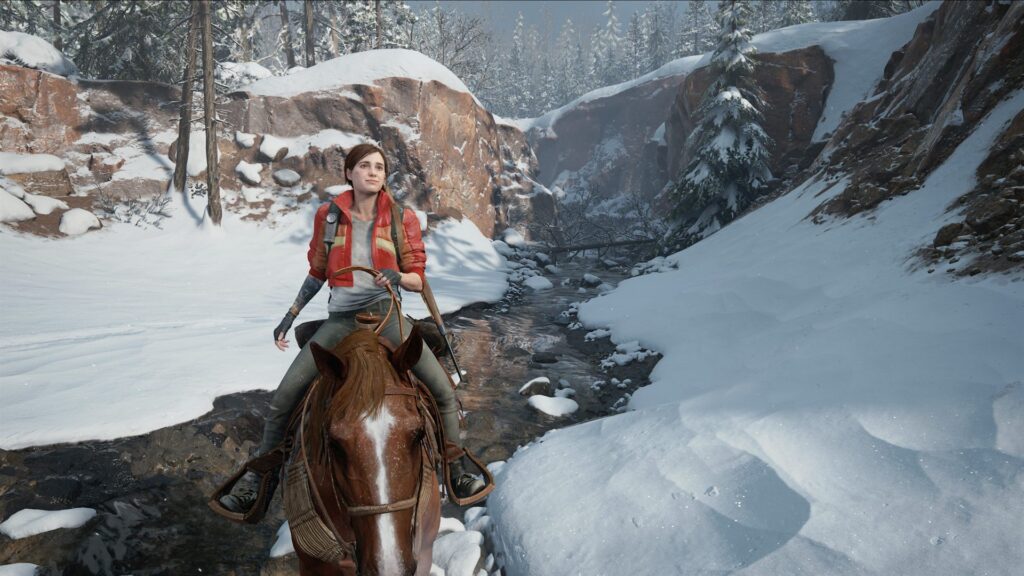
Blood. After a fight, blood does not vanish or sit there as an identical decal. A pool spreads under the body, and the studio built it from footage of real liquid, with flow maps that drive the particles. Walk through a pool and you leave bloody footprints, especially visible in snow. Clothes, skin and weapons have their own system for blood, wetness and mud: Ellie gets soaked in the rain and dirty in the mud, and you see it on her. And if you heal with a med kit, the wound under the bandage keeps bleeding and the bandage slowly turns red. Visual effects artist Kirsten England and her team were in charge of the blood.
And all of this at the same time, on a PS4. According to Sinecky, the game can handle about a thousand live physics objects at once before performance starts to suffer.
Contextual emotions: the best thing I noticed all game
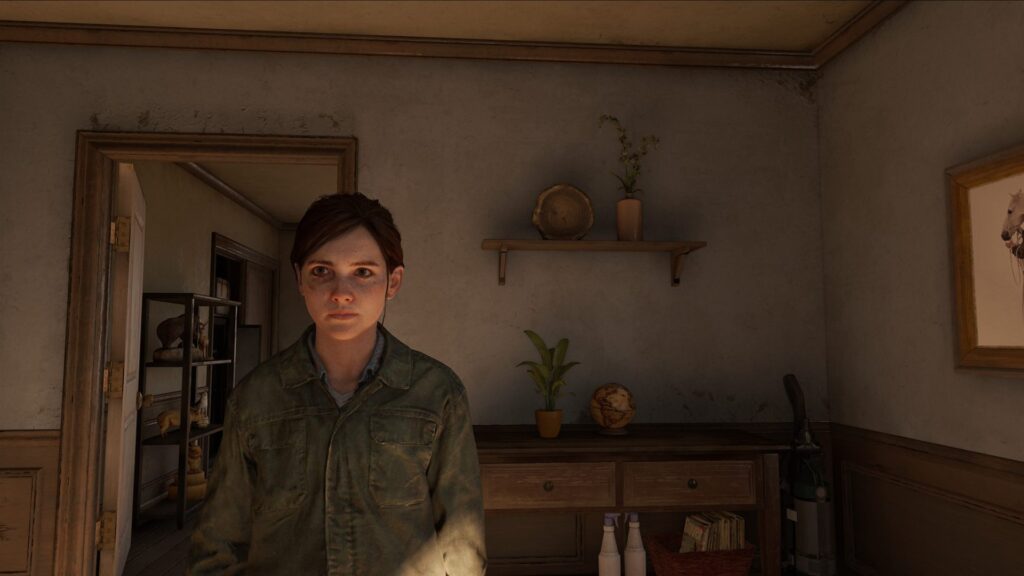
I want to praise this technology separately, because nothing caught my eye more often across the whole game. Ellie's face is alive not only in cutscenes but right in the middle of play, and that brings every gameplay scene to life. The system was built by studio animator Keith Paciello. The 25 main characters have almost 20 emotional states, and by the end of development the studio had about 15,000 hand-sculpted facial expressions.
- Breathing. It has six levels, from calm to completely winded. Near enemies Ellie breathes with her mouth closed to stay quiet, and after a fight she gasps for air.
- Gaze. When Ellie looks at a painting in the synagogue, her eyes make small darting movements, like a person thinking about something rather than just staring at a point.
- Combat and exhaustion. In the fight on the beach, Abby starts out fierce and focused, and afterwards her face shows what it cost her.
- Grief. At Joel's grave, Ellie does not snap back to normal when the cutscene ends and control returns to you. Her face stays tear-stained, and the studio changed the skin textures specifically for that.
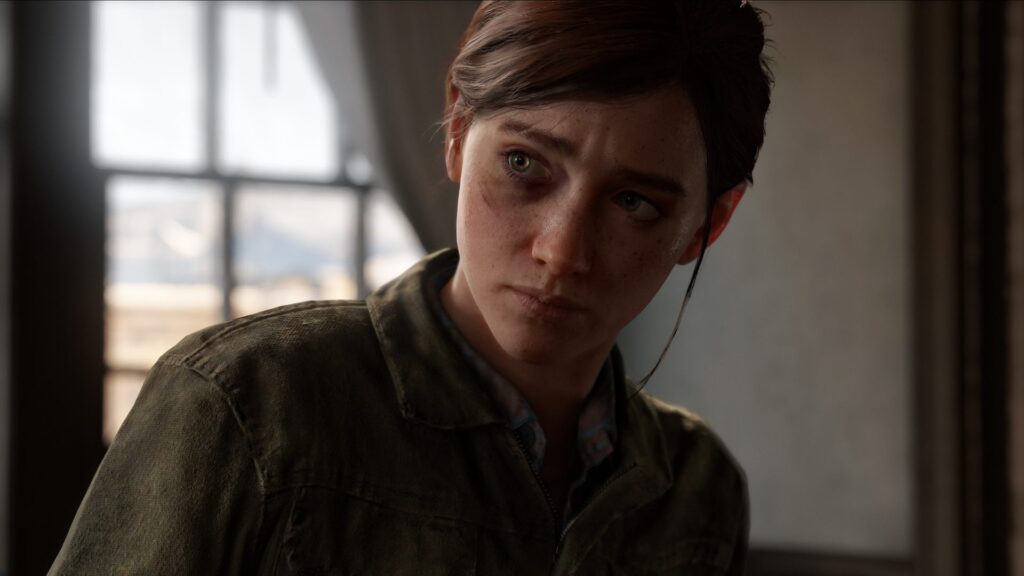
Most of this is easy to miss if you do not turn the camera to the face at the right moment. But even if you are not looking for it, the game always feels alive, and it is precisely because of these small things.
Stealth: grass, dogs and enemies with names
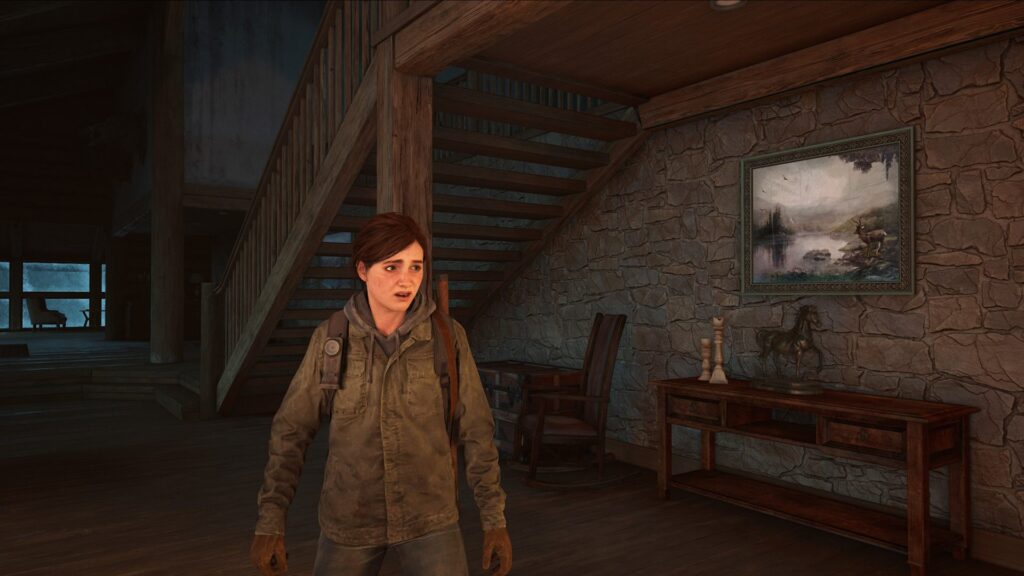
In the sequel Ellie learned to go prone. Tall grass became real cover, and you can lie down in it right under an enemy's feet. A dodge for melee attacks was added, and a fight against three opponents stopped being a death sentence. Listen mode is still there, showing enemies through walls.
- Dogs follow your scent. Ellie's trail stays on the ground, and hiding in the same corner twice will not work.
- Enemies call each other by name. When they find a partner's body, they shout his name, and after that they no longer feel like faceless targets.
- Seraphites talk in whistles. From the whistles you can tell what they have noticed and where they are going.
- Glass breaks. Smashing a window gives you away, but it also opens a new path.
Exploring pays off: manuals, supplements and workbenches
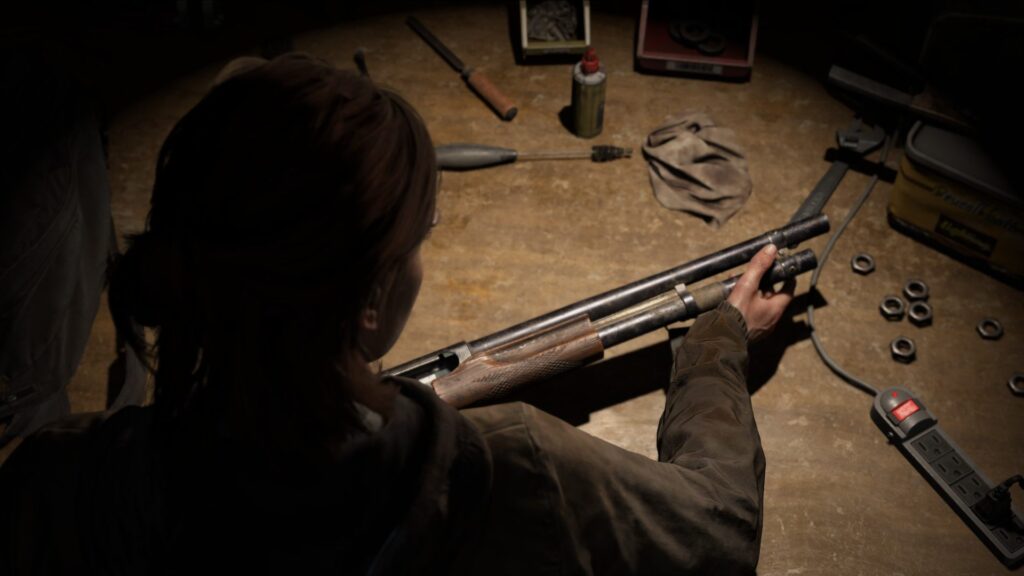
The game always rewards those who look into every corner. Ellie and Abby each have five skill trees, and only one is open from the start. The other four are unlocked by training manuals hidden off the main path. For Ellie they are crafting, stealth, precision and explosives, for Abby covert ops, firearms, close quarters and ordnance. Skills themselves are bought with supplements, which you find in medicine cabinets, most often in bathrooms.
Weapons are upgraded at workbenches with parts, and every upgrade has its own animation: Ellie takes the rifle apart herself and mounts a new scope. Locked safes hold the best supplies, and the codes are in notes nearby. You can run through the game in a straight line, but then you lose half of it.
Spoilers ahead: what exactly set players off
If you have not played the game or watched season 2 of the show, skip this section and the next one.
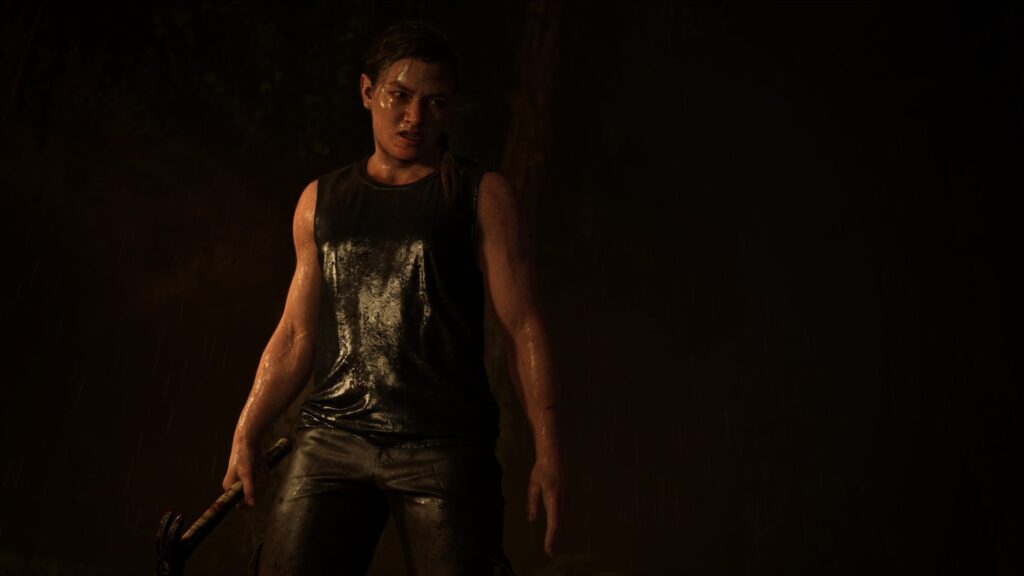
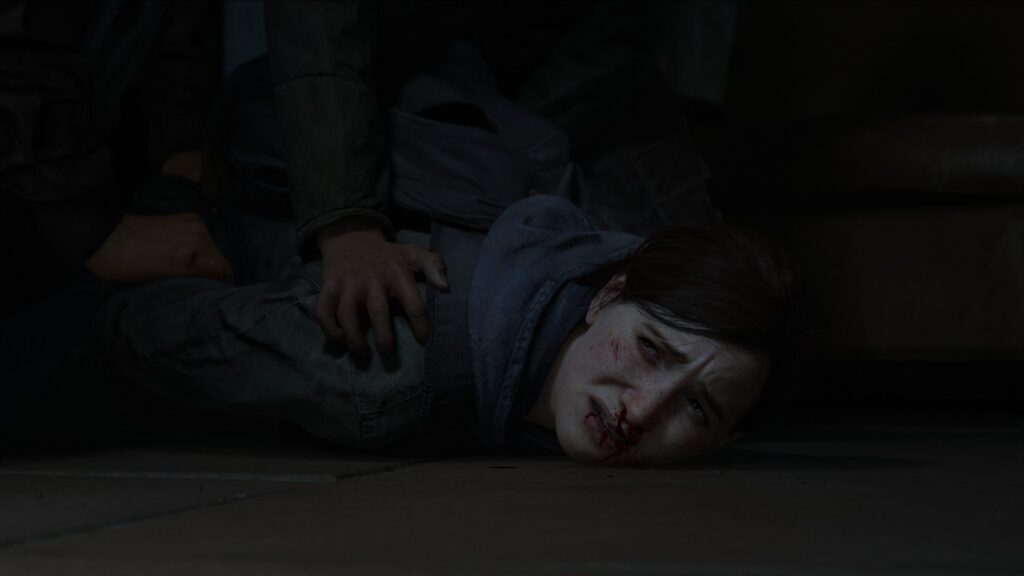
Joel dies within the first couple of hours. He is killed by a stranger named Abby, with a golf club, in front of Ellie, who is held down on the floor. Later you learn why: at the end of the first game, while saving Ellie, Joel killed the surgeon at the Fireflies hospital, and that was Abby's father. For people who had waited seven years for more of Joel and Ellie's story, it was a low blow. And the April 2020 leak spread that scene across the internet seven weeks before launch, without context, as a single clip, so many people hated the game in advance.
The second thing people did not forgive was Abby. You spend half the game as a person you have wanted to kill since the first hours. And an ending without catharsis: in Santa Barbara, Ellie, who has already lost two fingers in the fight, lets Abby go. Nobody is waiting for her at home, and she can no longer play the guitar Joel gave her.
Then things went like this: the user score on Metacritic crashed to 3.4 against 93 from critics, and the site afterwards introduced a rule that user reviews are only accepted 36 hours after release. Laura Bailey, who played Abby, received death threats, and Naughty Dog had to defend her publicly. I never understood any of it. The complaints in arguments were always the same: "they ruined Joel", "they made me play as his killer". In my view, it was supposed to hurt. That is the whole point.
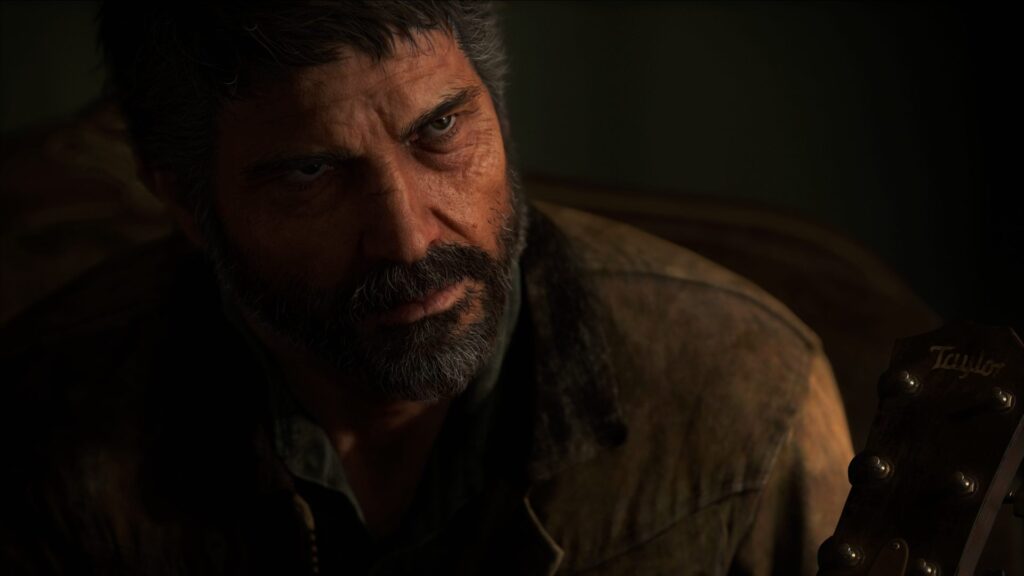
The Joel scene made the most noise of all. I think it is justified overall. The first game hinted in every way that Joel was, to put it mildly, no saint. In Pittsburgh, Ellie asks how he knows it is an ambush, and he says he has been on both sides. Asked whether he killed innocent people, he says: take it however you want. For twenty years after the outbreak he survived alongside his brother, he was a smuggler, and the game never shows outright what he and Tommy were doing back then, but it is not hard to guess. I would happily play a prequel about young Joel that shows it without embellishment.
In the first game he came across as one of us, because we saw everything through his eyes. But a man with a past like that gets the bill one day, and the sequel handed it to him.
Feminism, pregnancy and Abby's muscles: complaints I never understood
Personally, I found no feminism in the game. Maybe if you look for it hard and on purpose, you will find something. But it is not there.
I really do not understand who was surprised that Ellie likes girls. It was clear back in 2014, in Left Behind, the add-on for the first game, where Ellie kisses her friend Riley. The sequel simply continued what had been said six years earlier.
There was also a baffling attack on Mel, Owen's pregnant girlfriend: supposedly she is too active, pregnant women cannot do that. Look at pregnant athletes. Runner Alysia Montaño lined up at the US championships in 2014 and ran the 800 meters at 34 weeks pregnant, with her doctors' permission and encouragement. The body adapts to training and handles more than it seems from the outside.
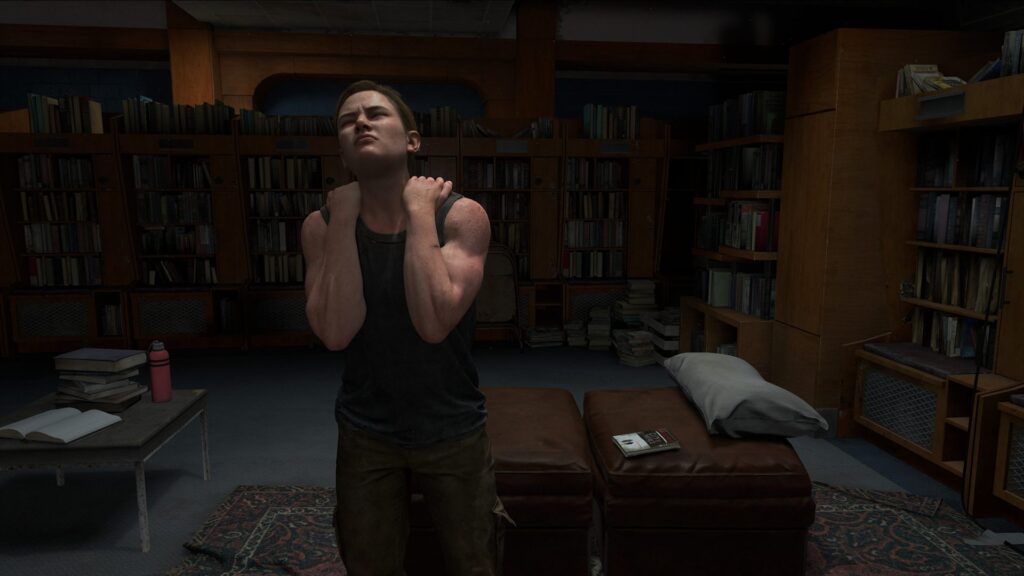
Abby herself shocked a lot of people: too strong, too muscular. I did a lot of sport in the past and saw plenty of strong women in powerlifting. To be honest, next to some of them Abby is not even the biggest. People like that exist, and in a world where the strongest survive, they belong.
And yet the same game collected 326 Game of the Year awards, more than any game before it, until Elden Ring overtook it. At The Game Awards 2020 it won seven awards, including the main one. For comparison, The Witcher 3, which we covered the other day, has 260.
How the story is told: the same three days twice
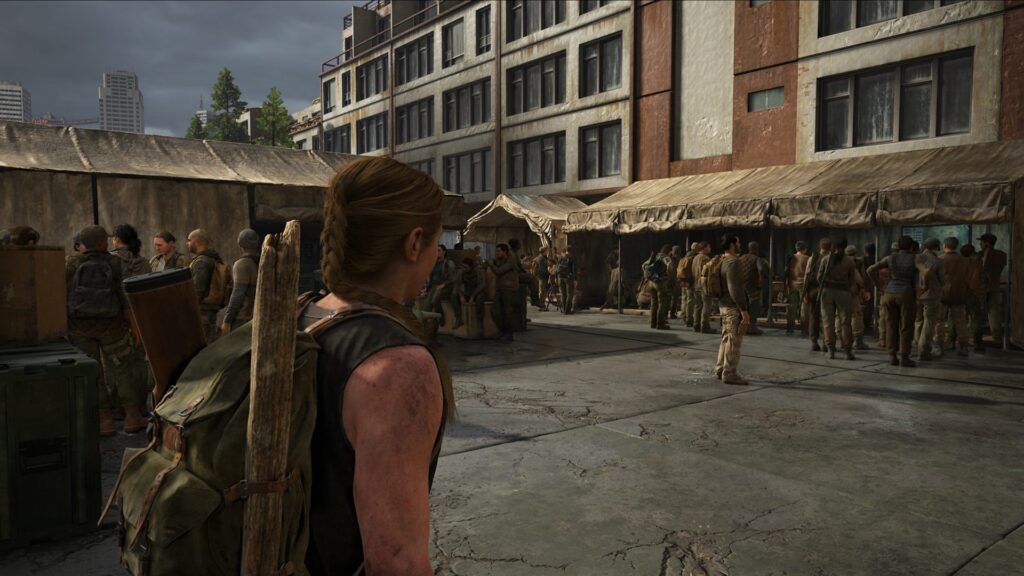
The story is told in a way almost no game had dared before. First you spend three days in Seattle as Ellie, following Abby's friends one by one, and the game spares no detail. At the climax, in the theater, everything cuts off and you are sent back three days. Now you are Abby, and the same days play out from the other side.
And this is where it gets uncomfortable. You get to know the people you just killed as Ellie. Nora, Owen and Mel are no longer targets with names, they have their own jokes, fears and plans. As Abby, you play fetch with Alice the shepherd dog, the same one Ellie killed at the aquarium a few hours earlier.
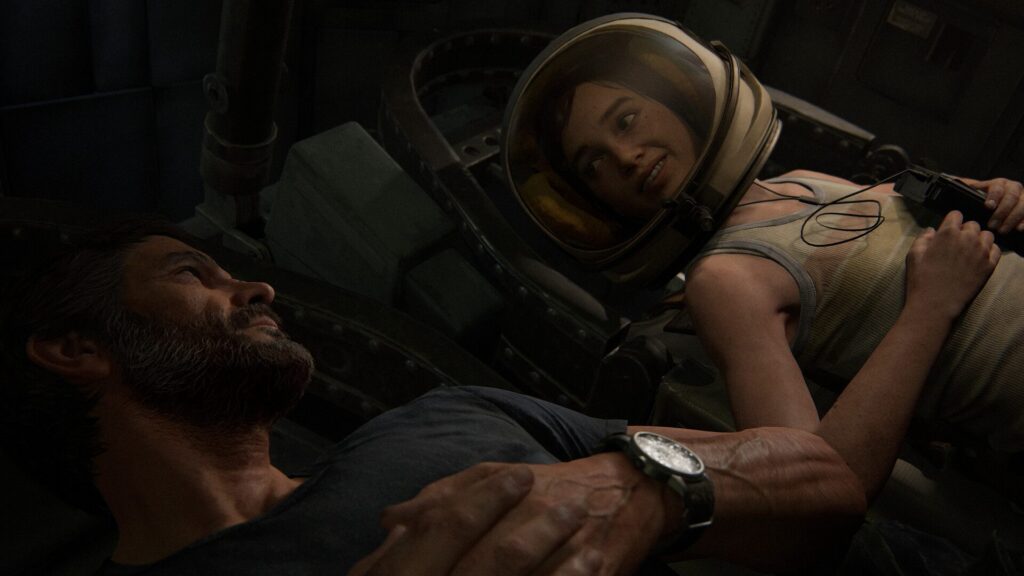
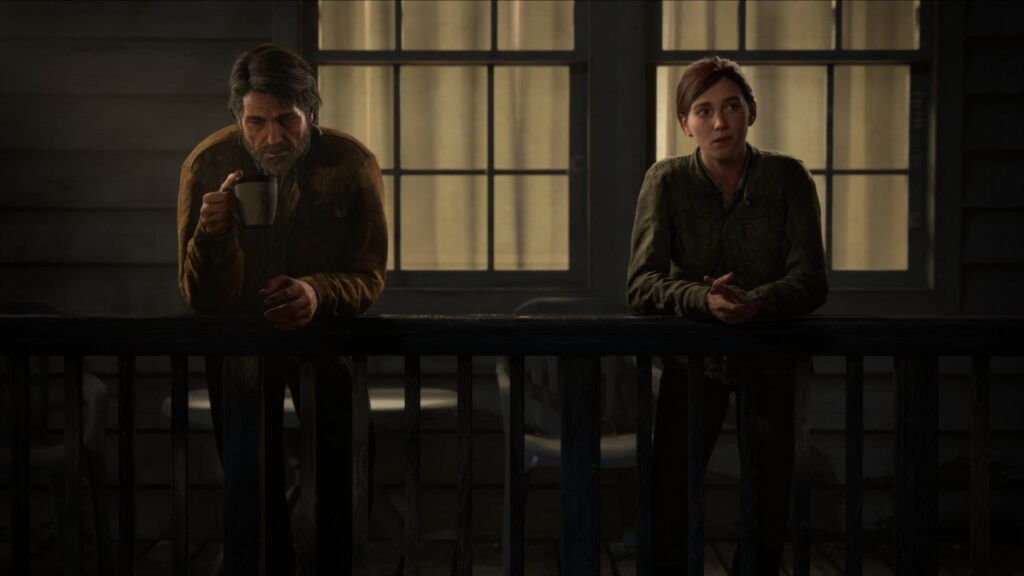
Between chapters come memories of Joel. Joel singing Future Days to Ellie and promising to teach her to play, a birthday at the museum where Ellie in a space helmet climbs into a spacecraft cockpit, and the hardest one, the last conversation on the porch. Each of these memories sits exactly where it hits hardest against what you have just done. The writers knew where to press.
That is why I strongly advise against touching Chronological mode. It was added to Remastered on July 8, 2025, in patch 2.1.0 on PS5 and 1.5 on PC, and it lays out the whole story in the order events happen, flashbacks included. I played the game that way too. It becomes bland and boring: Abby no longer appears at the moment you hate her most, the memories of Joel no longer hit the right spot, and the two runs through the same three days in Seattle stop mirroring each other. In my view this mode is as unsuccessful as it gets, almost a leftover. The whole power of the game is in the order in which it was told, and without it you are left with a long chronicle.
Why it is so tense to play
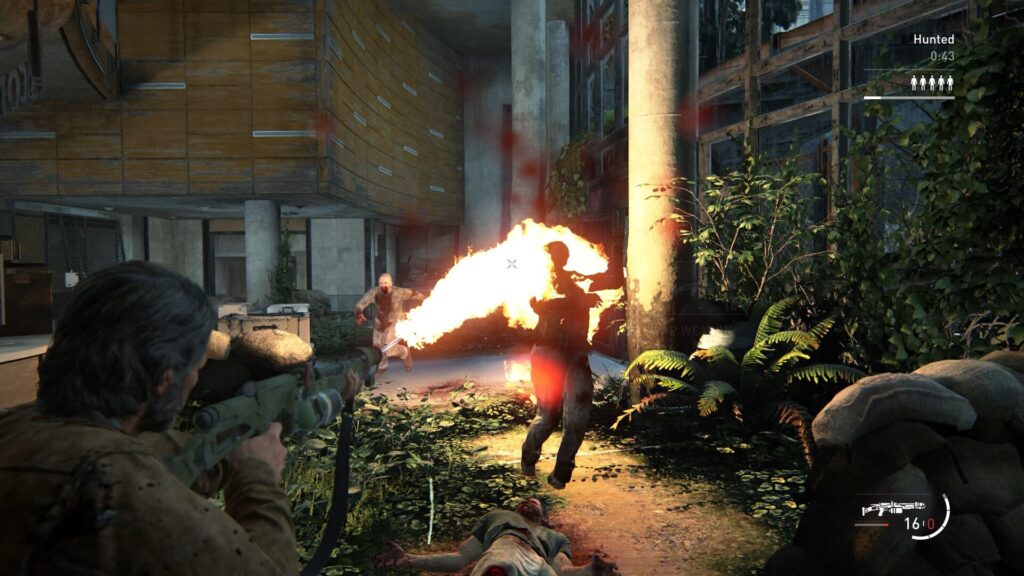
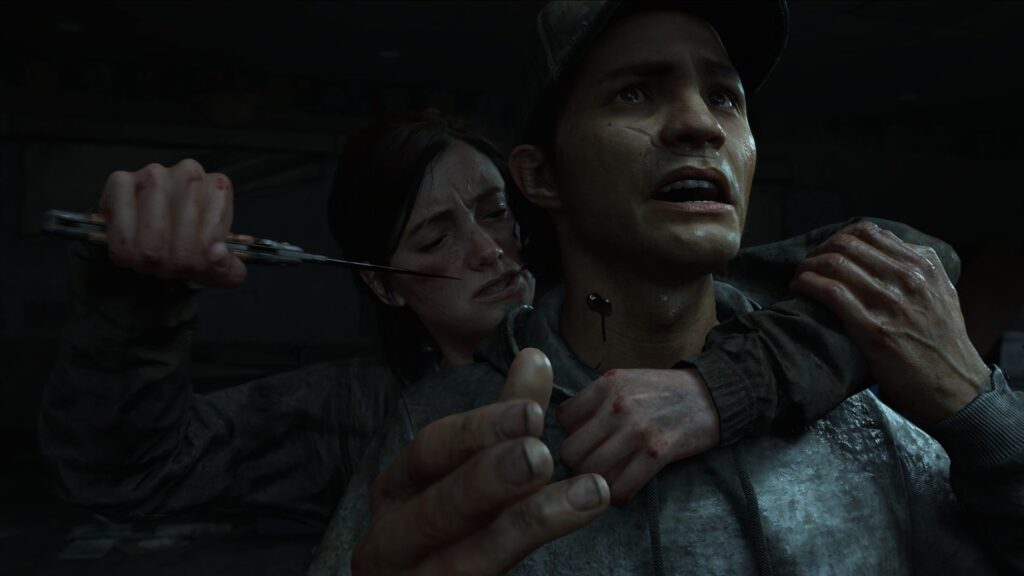
Combat here is survival, not entertainment, and the game keeps reminding you of that. Ammo is almost always scarce, you craft a med kit out of a rag and alcohol in the middle of a firefight, and time does not stop while you do it. Fights are dirty: enemies wheeze, shout the names of the dead, dogs whimper when you hurt them. A kill here does not just tick a counter, every one of them leaves something behind.
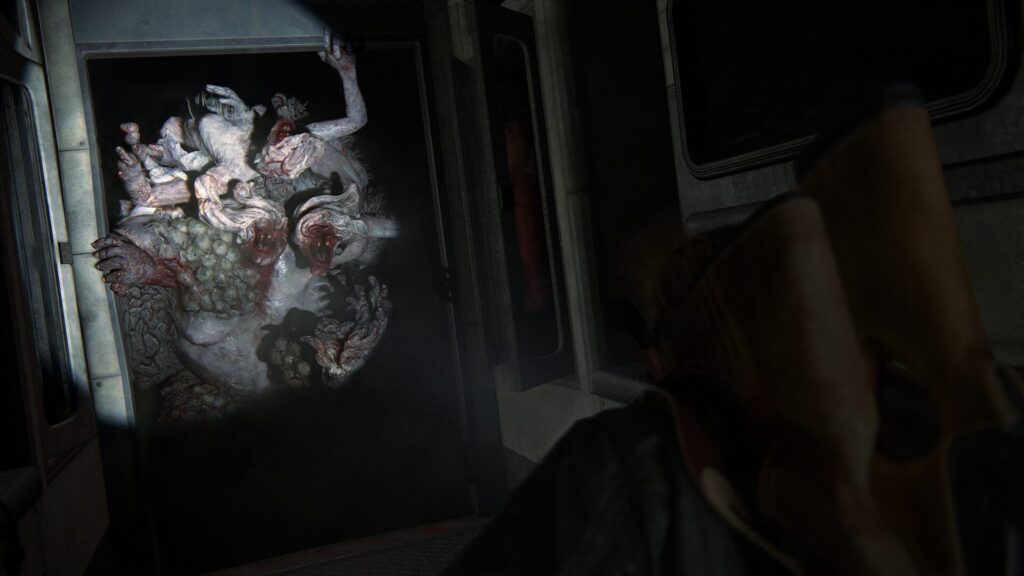
The infected press on you in a different way. Clickers are blind and find you by sound, so in a dark corridor you try not to breathe yourself. Stalkers hide and jump out from around corners. And then there is the Rat King, a fused mass of several bodies in the hospital basement. It is one of the most terrifying encounters in games, full stop.
Which difficulty to pick, and why not the highest
I played the game on moderate, then on the hardest setting, and most recently on Grounded, without permadeath. So here is my advice: do not play your first run on the highest difficulty. There is a real chance you will end up hating the game.
Grounded and permadeath were added in patch 1.05 on August 13, 2020, two months after launch. On Grounded, listen mode and part of the HUD are switched off, ammo and materials are almost nonexistent, and enemies kill you in a couple of hits. For a second run it is a great challenge. For a first run it means twenty deaths in one arena, after which you no longer care about the story. And the story here lives on rhythm: a scene, silence, a fight, a memory. Get stuck in a fight for an hour and the rhythm breaks, and the scene after it no longer lands the way it should.
- First playthrough. Moderate. Fights stay tense and the story does not break apart.
- Want it harder. The game lets you tune difficulty piece by piece: separately for Ellie, enemies, allies, stealth and resources. You can keep enemies nasty without starving for ammo.
- Second run and beyond. This is where Grounded comes in. You already know the story, so you can die in peace for the sake of a good fight.
- Permadeath. Only for those who know the game by heart. You can set it to restart from the beginning of a chapter, an act or the whole game.
On PC I got the platinum, and it was very hard. And here I have an opinion many will not like: sometimes a platinum can turn a favorite game into one you no longer love. A friend of mine adored Kojima's games until he got the platinum in both Death Stranding games. After that, his favorite game stopped being quite so favorite. Once you start clearing an achievement list, you are no longer playing a story but a spreadsheet, and that spoils the memories. So if a game is dear to you, think twice before chasing every trophy.
Atmosphere that builds for hours
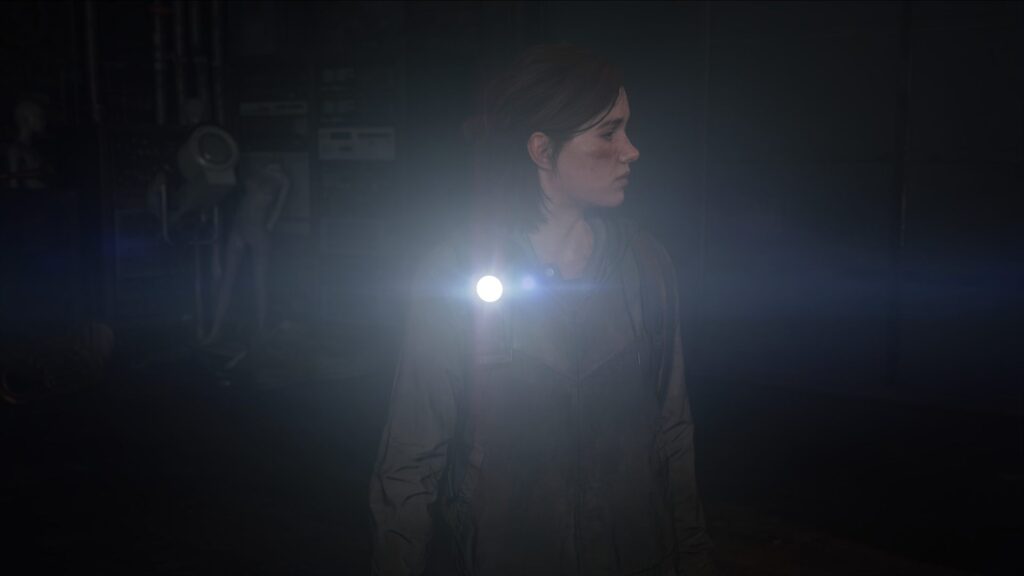
The atmosphere here builds slowly, and that is the whole trick. Long minutes of silence, empty apartments, notes from people long dead, someone's children's drawings on a wall. You walk into a dark stairwell with nothing but the beam of a flashlight. Santaolalla's music barely plays, a couple of guitar notes here and there, and that only makes the silence heavier.
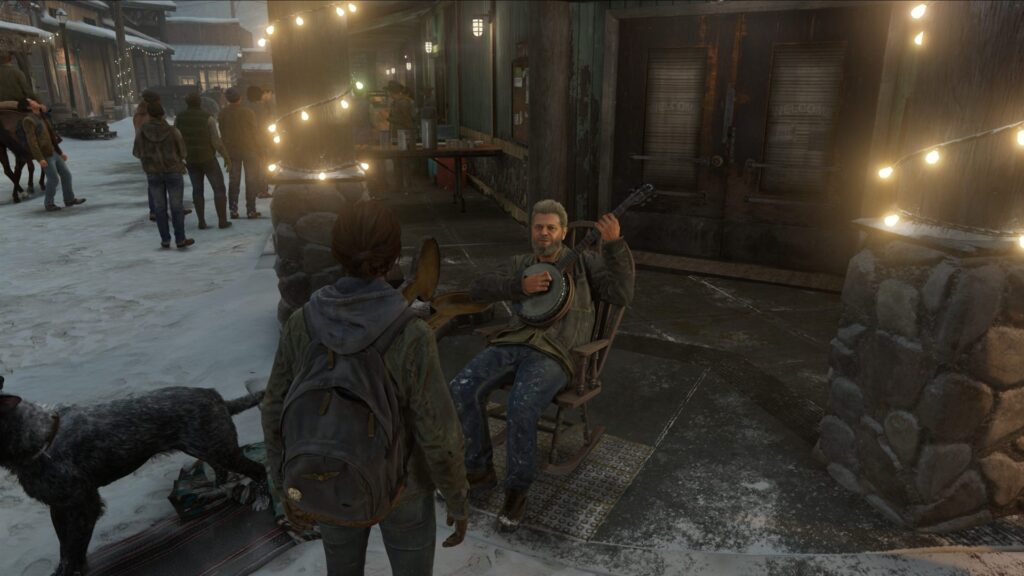
And in contrast there is warm Jackson at the start: string lights, dancing, the bar, a dog you can pet. Behind it, by the way, an old man named Gustavo plays the banjo, a character based on Santaolalla himself. He is easy to miss, because at that moment the game is teaching you the controls. All that coziness is there so that later you have something to lose.
The ending and what comes next
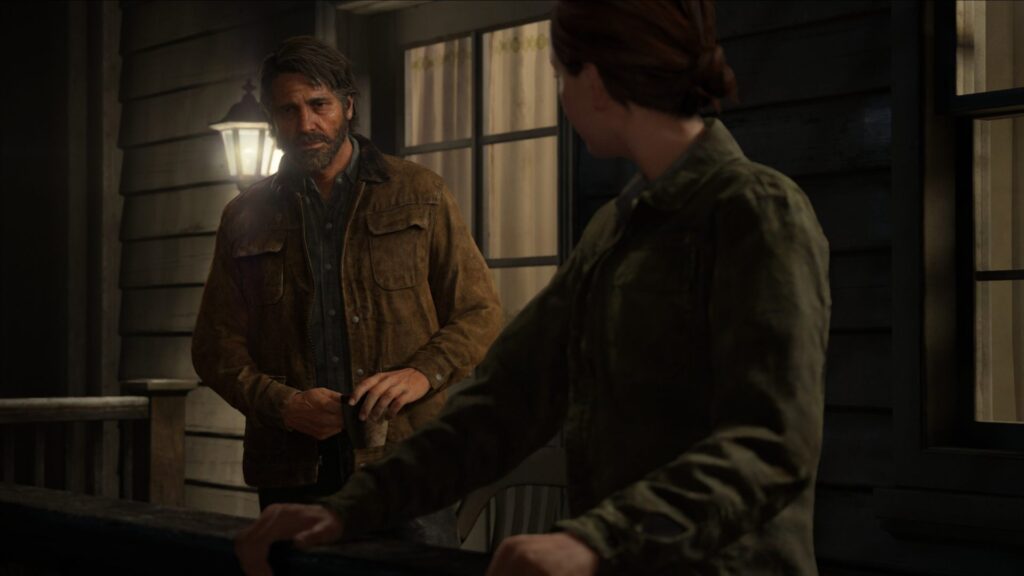
I loved the ending. It is quiet, with no fanfare and no victory. In the final showdown, in the middle of the last fight, the game shows a memory of the night after the dance in Jackson: Joel and Ellie on the porch, and Ellie tells him she does not think she can forgive him for the hospital, but she would like to try. After everything that came in the thirty hours before it, that scene explains why Ellie went to Seattle and why in Santa Barbara she let Abby go after all.
I am really looking forward to a sequel, especially since Neil Druckmann is already thinking about where to take the series. On September 3, in an interview with The Washington Post, he said Naughty Dog is not done with The Last of Us and that a couple of projects are in the works that he will be happy to talk about when the time comes. The words "Part 3" are not in that quote, we took it apart separately, but the very fact that there are ideas makes me happy.
My score is 10 out of 10. The best it could possibly be.
Sources
Reveal, trailer, delay and release dates, sales, budget, team size, awards and the reaction to the story: the Wikipedia article on the game. The church tent and Santaolalla's performance at E3 2018: CGMagazine and DualShockers. How the leak happened: Kotaku and KitGuru, citing Bloomberg. Comparison with the E3 demo: Wccftech. Motion matching: Naughty Dog's GDC 2021 talk. Facial animation and contextual emotions: PlayStation Blog, Keith Paciello's account. Training manuals and skill trees: GameSpot. Glass, ropes, blood and physics: Naughty Dog developers speaking to 80 Level, how the glass works: Game Rant, the hook and winch in Uncharted 4: Inverse. PC system requirements and reviews: the game's Steam page. PC player peak: SteamDB and GamingBolt, Part I's peak: Game Rant. New cast members for the show: The Hollywood Reporter. Grounded difficulty and permadeath: PlayStation Blog post on patch 1.05. The Grounded II film: Push Square and PlayStation Universe. Chronological mode: PlayStation Blog and GameSpot. Gustavo in Jackson: The Last of Us Wiki on Fandom. Joel's line about the ambush: transcript of the Pittsburgh chapter on The Last of Us Wiki. Alysia Montaño: The Washington Post and NBC Sports.
Screenshots: the author, PS4, PS5 and PC. Videos: official PlayStation and Naughty Dog channels.