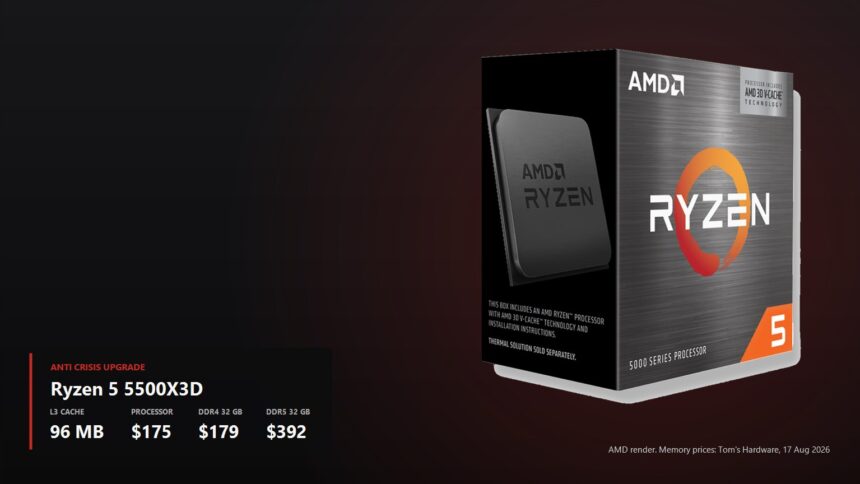
The most expensive part of a gaming PC this autumn is the memory. A 32 GB DDR5 kit costs more than a decent six-core processor, and that is not a joke, that is the retail price. Into that market AMD is quietly pushing the Ryzen 5 5500X3D: six cores, 96 MB of cache, a socket that turned ten this year, and a price of about 175 dollars. An odd product. Right now it makes a kind of sense it would not have made a year ago.
What this processor is and where it came from
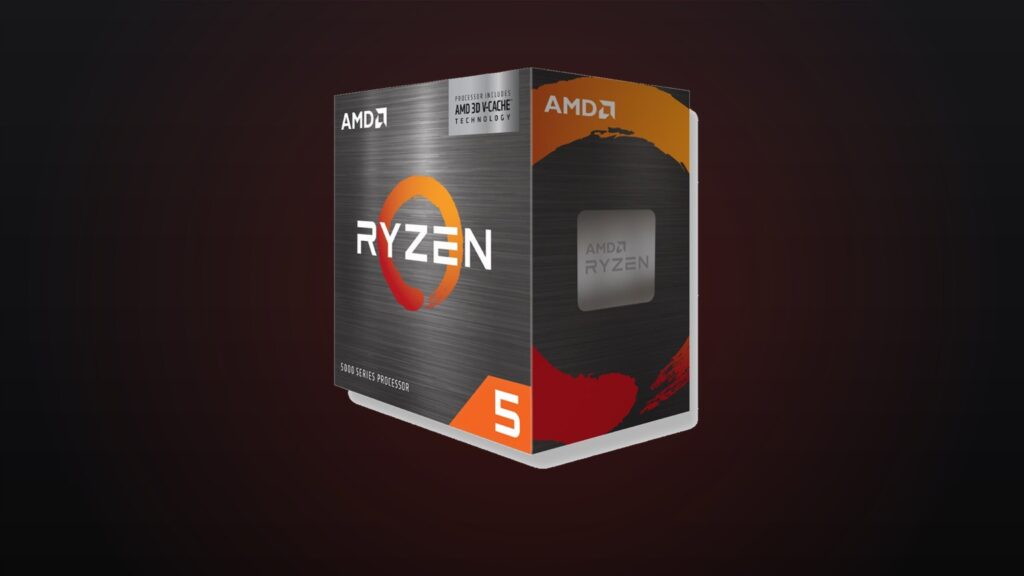
You almost need a diagram for this chip's lineage. April 2022 brought the Ryzen 7 5800X3D, the first gaming processor anywhere with 3D V-Cache, at 449 dollars. A year later AMD switched off two of its cores and handed it to Micro Center as the Ryzen 5 5600X3D. A couple of years after that it took the 5600X3D and pulled the clocks down, boost from 4.4 to 4.0 GHz. Ready to sell for a third time.
GamersNexus did not soften it in their review: this is how you use up silicon that could not hit the higher frequencies. Probably a bit humiliating for the engineers. For a buyer it changes nothing, because the cache is still 96 MB and the price is a lot lower.
| 5500X3D | 5600X3D | 5700X3D | 5800X3D | |
|---|---|---|---|---|
| Cores and threads | 6 / 12 | 6 / 12 | 8 / 16 | 8 / 16 |
| Base clock | 3.0 GHz | 3.3 GHz | 3.0 GHz | 3.4 GHz |
| Max boost | 4.0 GHz | 4.4 GHz | 4.1 GHz | 4.5 GHz |
| L3 cache | 96 MB | 96 MB | 96 MB | 96 MB |
| TDP | 105 W | 105 W | 105 W | 105 W |
| Release | June 2025 | July 2023 | January 2024 | April 2022 |
| Launch price | never officially announced | $230 | $250 | $449 |
Things worth knowing before you order. No cooler in the box. No integrated graphics either, so a card is mandatory. DDR4 only, PCIe 4.0, B550 and X570 boards.
How it gets sold is a strange story on its own. It began as a Latin America exclusive, going for around 240 dollars there in the summer of 2025. In March 2026 it surfaced in China at 1,199 RMB, roughly 175. Then the UK, with pre-orders at 179.99 pounds. The United States still has no official launch, and reviewers ordered theirs from AliExpress for about 180 dollars delivered.
Small thing, but worth saying out loud. In a single-threaded workload GamersNexus recorded a peak of 3,950 MHz against the promised 4,000. Nobody is going to feel fifty megahertz. Still, AMD has not missed its own spec sheet in years.
Why AM4 is still getting processors in 2026
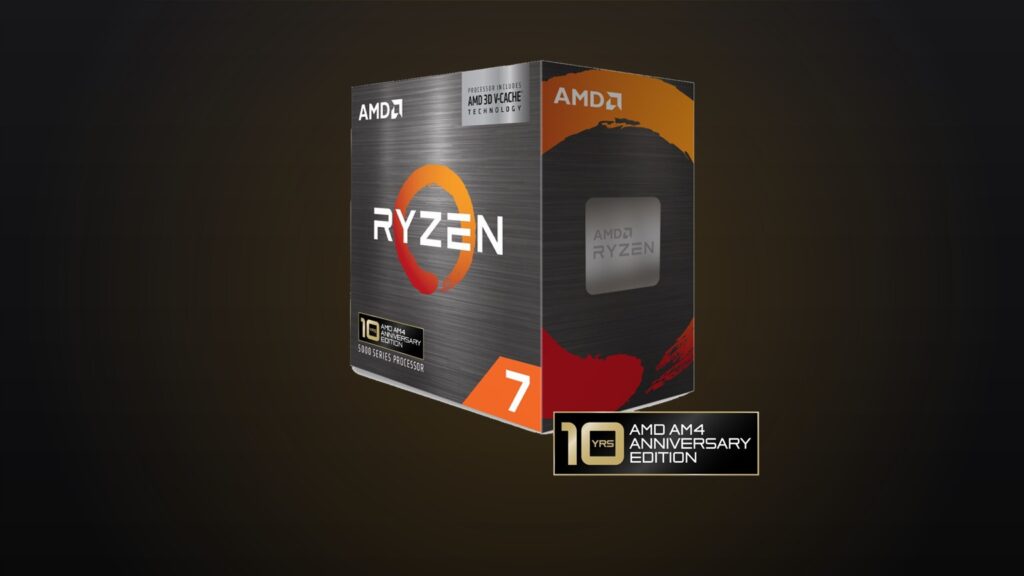
Socket AM4 turns ten this year. It arrived in 2016, the first Ryzen chips went into it in 2017, and AMD still cannot let go. In May, at Computex, the company marked the anniversary by reissuing the 5800X3D as the 10th Anniversary Edition: the same eight Zen 3 cores, 100 MB of total cache, 105 W, with a Carbice Ice Pad thermal interface in the box. It asks 349 dollars and went on sale on 25 June. The original went for 449 in 2022, so four years bought you a discount.
"We're committed to giving gamers high-performance technologies with the flexibility to upgrade their systems over time", said David McAfee, corporate vice president and general manager of AMD's Client Channel and Graphics Business, in the company blog post from Computex 2026.
The same post extended AM5 support through 2029 and held up AM4 as the model. The reasoning behind it is straightforward and fairly cynical. While the old board still works, an upgrade means walking into a shop for another AMD processor instead of sitting down to weigh AMD against Intel all over again.
The second reason is a lot more mundane. GamersNexus talked to board makers and found out where leftover stock from past generations goes: markets outside the US, South America and parts of Asia, where people still want it. The boards avoid the landfill, they stay cheap, and getting into AM4 stays cheap along with them. Which is why the 5500X3D shows up in Brazil and China and not on shelves in the States.
What the 3D cache actually does for this chip
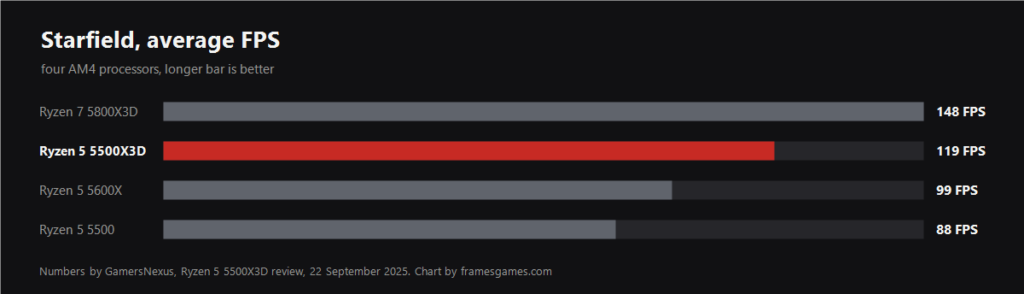
One comparison explains the whole thing: the plain Ryzen 5 5500 against our subject. Six Zen 3 cores each, both cheap. The plain one even clocks higher, 4.25 GHz against 3.95 under real load. The only difference is 16 MB of cache against 96, and in games it gets taken apart.
- Starfield: 119 frames against 88, a 35 percent gap
- Cyberpunk 2077 Phantom Liberty: 164 frames against 123, up 33 percent
- Counter-Strike 2: TechSpot measured the 5500X3D 77 percent ahead of the old Ryzen 7 3800X, and more than twice as fast as a Ryzen 7 2700X
A game keeps hauling the same data around, scene geometry and the state of the world. Once that fits inside the processor cache there is no trip out to system RAM, and latency drops by a wide margin. Which is how a chip this slow on paper keeps up in a game.
Outside games the cache just sits there. Blender runs slower on the 5500X3D than on the plain 5500. 7-Zip decompression puts it below the plain 5500 as well. A Chromium compile took it 337 minutes and left it at the bottom of the chart. Buying this for editing or rendering makes no sense at all, it is a gaming part and that is the end of it.
What that means in frames next to everything else
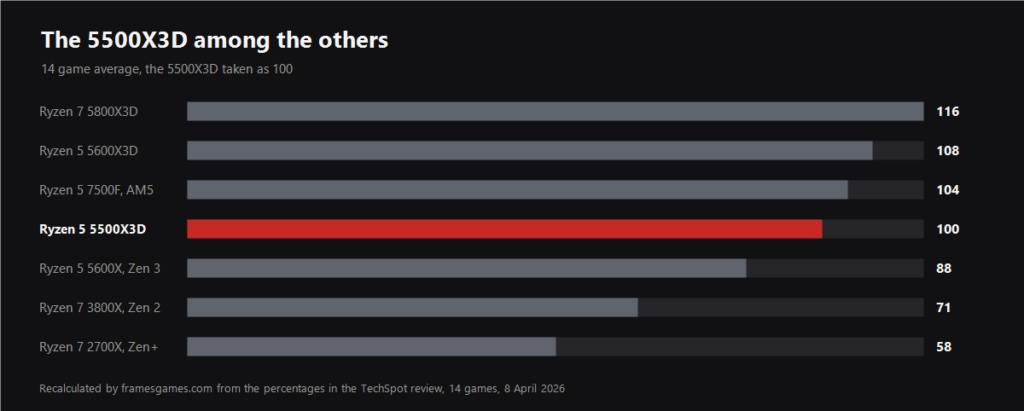
TechSpot ran 14 games and averaged the lot. Off old hardware the jump is real: 71 percent over a Zen+ Ryzen 7 2700X, 40 percent over a Zen 2 Ryzen 7 3800X. Already on Zen 3 and the news gets dull. Against a Ryzen 5 5600X you get 13 to 15 percent. For 175 dollars.
The space above it is crowded with its own family. The 5600X3D is 7 percent quicker, the 5800X3D 14 percent, the Ryzen 5 7500F on AM5 4 percent. Ryzen 5 9600X and Core Ultra 5 250K Plus go further still, though they cost more and they drag a new DDR5 board along with them.
| Game | Average FPS |
|---|---|
| F1 24 | 329 |
| Final Fantasy XIV: Dawntrail | 297 |
| Cyberpunk 2077: Phantom Liberty | 164 |
| Starfield | 119 |
| Baldur's Gate 3 | 102 |
| Dragon's Dogma 2 | 95 |
Do not map those numbers straight onto your own machine. At 1440p, and certainly at 4K, the graphics card becomes the limit and the gaps between processors mostly vanish. We went through all of that when we built three 4K PCs and worked out the price per frame.
Memory: why this is the argument that matters right now
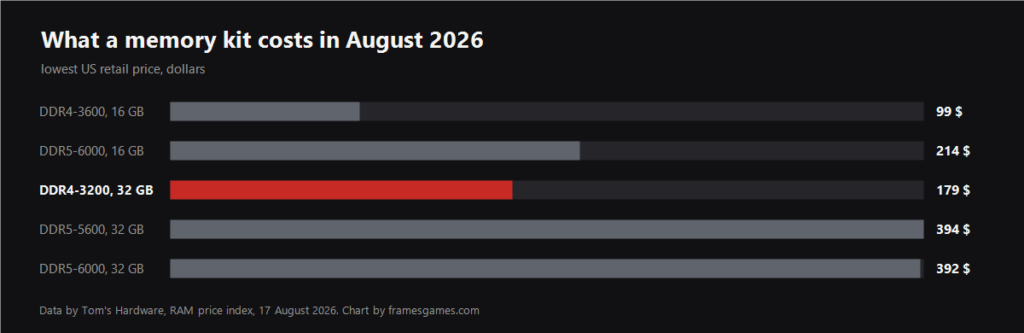
The memory market has gone somewhere strange. Manufacturers turned capacity toward servers and AI accelerators, ordinary DDR5 became scarce, and prices took off. Tom's Hardware keeps an index, and as of 17 August 2026 a 32 GB DDR5-6000 kit starts at 392 dollars. In October 2025 the same kit went for 100 to 200.
DDR4 did not sit this one out either. 32 GB of DDR4-3200 is 179 dollars today against 60 to 90 last autumn. Everything went up, DDR5 just went up twice as hard. Tom's Hardware also point out that building a fresh DDR4 system now is pointless, since there are hardly any processors or boards left to build it with.
Which is where the 5500X3D earns its keep. Anyone with a working AM4 board already has the memory sitting in the machine and buys none at all. Zero dollars against 392. Next to that the processor almost reads as a free extra.
Who this build is for, and who should walk away
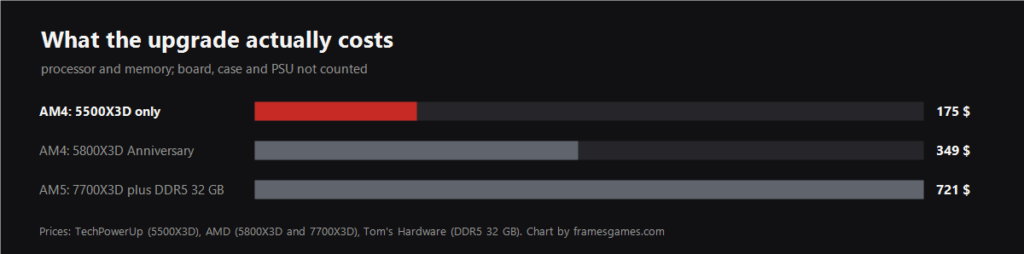
It comes down to one thing: what is in your socket right now.
- AM4 with a Zen+ or Zen 2 chip. Ryzen 1600, 2600, 2700X, 3600, 3800X and the rest of that crowd. This is your case and it does not get better. You change one part for 175 dollars, leave everything else alone, and pick up 40 to 71 percent more frames. Board, memory, case and power supply all stay where they are.
- AM4, but already on Zen 3. Ryzen 5 5600, 5600X, 5700X. Keep walking, thirteen percent is not worth two hundred dollars. If you want the most AM4 can give you, look at the Anniversary 5800X3D at 349: eight cores and 14 percent over our subject.
- Building from scratch. Do not touch it. The Ryzen 5 7500F costs roughly the same, runs 4 percent faster and sits on the living AM5 platform that AMD has committed to through 2029. Yes, it needs 392 dollars of DDR5 and the total comes out far higher. But buying a ten-year-old platform in 2026 is walking into a dead end with your eyes open.
First case, before you order: update the board BIOS to a version that knows the 5000 series. Bring your own cooler. The TDP is 105 W, which a mid-range tower handles without breathing hard.
The graphics card for a machine like this. The memory crisis reached GPUs too: the Radeon RX 9070 XT, which launched at 599 dollars, goes for around 719 in August 2026, and AMD raised its recommended price in China by a full twenty percent. Of the newer cards the RX 9070 GRE is the sensible one to look at, with 48 compute units, 12 GB of memory and a recommended 549 dollars at its 2 June launch. AMD promises an average 21 percent lead over the competition at 1440p, though that number comes from AMD and wants checking against independent tests. Which cards earn their money right now we covered in the guide to graphics cards for 2K and 4K.
The verdict
Remarkable is not a word anyone can attach to the 5500X3D. What it is, is the cheapest entry to 96 MB of gaming cache, and a year ago that argument would have moved nobody, while today, with a memory kit costing as much as a CPU, it suddenly works. For someone on an old AM4 machine, 175 dollars buys 40 to 71 percent more frames and leaves the rest of the system alone. For everyone else there is no case for it, and I am not going to argue the point.
What I actually like here is the plain fact of it. Somebody built a PC in 2017, and today they buy one part and carry on playing. Ten years on one socket. There is plenty AMD deserves criticism for, but they saw AM4 through decently.
Sources
- AMD, Computex 2026 blog post: ten years of AM4, the Ryzen 7 5800X3D 10th Anniversary Edition at 349 dollars from 25 June, AM5 support through 2029, Radeon RX 9070 GRE at 549 dollars
- GamersNexus, Ryzen 5 5500X3D review: gaming and production benchmarks, frequency validation, the explanation of board supply
- TechSpot, Ryzen 5 5500X3D review: the 14 game average, comparisons against older AM4 and against AM5
- TechPowerUp: the China launch at 1,199 RMB, specifications and board support
- Tom's Hardware RAM price index: DDR4 and DDR5 prices as of 17 August 2026