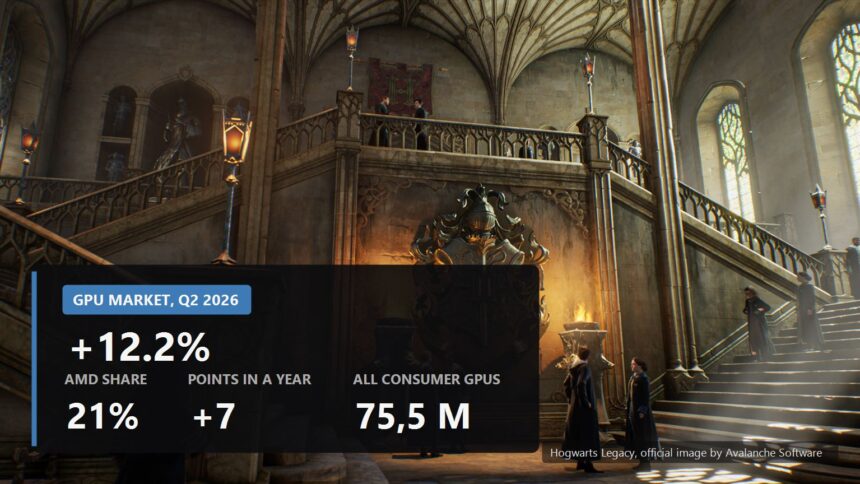
Graphics card shipments grew in the second quarter of 2026, which sounds unremarkable until you add the two things around it. The second quarter is normally the weak one, and component prices were climbing through a memory crisis at the same time.
The numbers come from Jon Peddie Research. The one worth reading twice is not the growth rate, it is AMD gaining seven percentage points of the consumer graphics market in a year.
What moved, and by how much
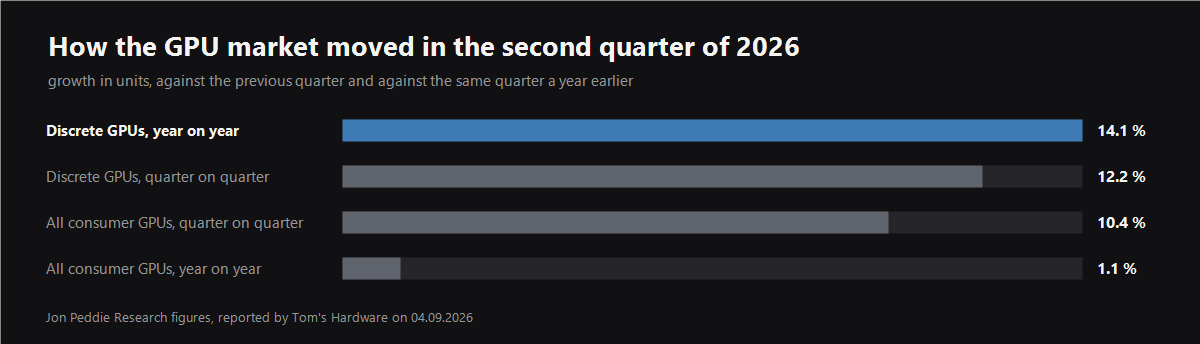
Consumer PC graphics as a whole, meaning integrated and discrete chips across desktops and laptops, came to 75.5 million units in the quarter. That is up 10.4 percent against the previous quarter and 1.1 percent against the same quarter last year, and notebooks did most of the lifting.
Discrete cards did better than that: up 12.2 percent on the quarter and 14.1 percent on the year.
Jon Peddie himself put the oddity plainly: the second quarter is usually down against the first, and this time discrete cards went up while a global memory crisis was sending component prices through the roof. He credits a mix of supply side positioning, artificial demand shocks and local market conditions.
One honest caveat before anyone quotes a total. JPR does not publish an absolute number for discrete cards shipped. The figure circulating as roughly 20 million is an estimate built from attach rates and market share, not a measured count. If you see a precise number for standalone GPU shipments this quarter, ask where it came from.
The seven points

AMD came third in the consumer graphics market with 21 percent, against 14 percent in the same quarter a year earlier. Seven points in a year is a large move in a market that usually shifts by fractions.
Two things stop this from being the headline it looks like.
- This counts integrated graphics too. A share of the whole consumer GPU market includes the chip inside every processor sold, which is why Intel is in front and AMD is third. It is not a measure of graphics cards on shelves.
- The gain rides on processor sales. AMD's growth here is attributed to its consumer processors selling well, and every one of those carries a graphics block. That is a real gain, but it is not people choosing a Radeon over a GeForce.
The number that would answer the card question is the add-in board report, which covers desktop graphics cards specifically. JPR has not published it yet and says it is due later this month. Until then, NVIDIA's lead among actual cards is not in doubt, and its size is not measured.

Why this matches what Steam sees, and where it does not
Put this next to the Steam hardware survey for August and the two tell the same story from opposite ends.
Steam has AMD at 46.47 percent of processors and climbing steadily, which matches AMD's processors selling well. Steam also has AMD at 18.68 percent of graphics cards, barely moved in eighteen months, which matches the fact that the seven point gain above is not really about cards.
Shipments measure what was sold this quarter. Steam measures what people are still using. A gaming PC lasts years, so the second number always lags the first, and when the two disagree it is usually the timescale talking rather than a contradiction.
What it means if you are buying
- Do not read growth as cheaper. Sales grew while prices rose. Demand holding up at high prices is the opposite of a signal that prices are about to fall.
- Memory is the thing to watch. The quarter's context was a memory crisis pushing component costs up. That lands on card prices and on the cost of the rest of the build.
- Laptops carried the quarter. If you are choosing between a desktop and a laptop, the market is telling you where the volume, and therefore the discounting, is likely to be.
We will come back to this when the add-in board report lands, because that is the one that answers what people actually put in their desktops.
Sources
The figure of 75.5 million consumer PC graphics units in the second quarter of 2026, the growth of 10.4 percent quarter on quarter and 1.1 percent year on year, the discrete card growth of 12.2 percent quarter on quarter and 14.1 percent year on year, the note that notebooks drove the quarter, the quote from Dr Jon Peddie about the second quarter usually being down and about supply side positioning, artificial demand shocks and local market dynamics, AMD's 21 percent share of the consumer graphics market against 14 percent a year earlier, the attribution of that gain to consumer processor sales, and the statement that the desktop add-in board report is still to come this month all come from Jon Peddie Research figures as reported by Tom's Hardware on 4 September 2026. The same report states that JPR does not publish absolute discrete GPU shipment numbers and that the figure of around 20 million is an estimate based on attach rates and market share. The Steam figures of 46.47 percent of processors and 18.68 percent of graphics cards are from Valve's Steam Hardware and Software Survey for August 2026. The comparison between shipment data and the Steam installed base, and the reading of what this means for a buyer, are ours.