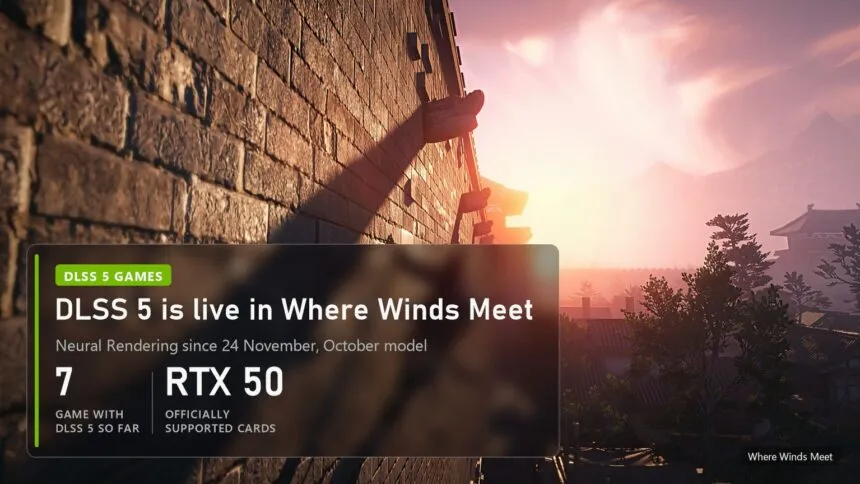
Where Winds Meet is now the seventh game with DLSS 5 Neural Rendering. NVIDIA announced the release on 24 November: the update is live for GeForce RTX 50 graphics cards, RTX Spark laptops and GeForce NOW Ultimate members. The free-to-play wuxia action RPG from NetEase and Everstone Studio already had DLSS Super Resolution and Multi Frame Generation, and now adds the neural pass that redraws lighting and materials on top of the finished frame.
The game uses the October Neural Rendering model, the same one as Hogwarts Legacy. NVIDIA says it is 24% smaller than the previous model (about 118 million parameters), uses 20% less video memory at 4K and runs twice as fast. The Game Ready 621.40 driver released the same day, 24 November, is the one to install for the new mode.
What DLSS 5 changes in the image
In NVIDIA's comparisons the difference is in light passing through materials. Candle flames glow through the wax, sunlight turns bamboo and bush leaves a warm green, old stone and roof tiles gain depth, and shadows get richer ambient occlusion and bounce light. Everstone art director Muzi Li says the network tones down blown-out highlights to recover detail and adds subtle bounce light inside shadows.
That is the developer and the vendor talking. There are no independent comparisons yet: as of 25 November neither ComputerBase, PC Games Hardware nor TechPowerUp had tested the game with DLSS 5. In earlier games reviewers found downsides too, such as artefacts on disoccluded areas in Assetto Corsa Rally.
Hundreds of FPS from NVIDIA, and how many are real
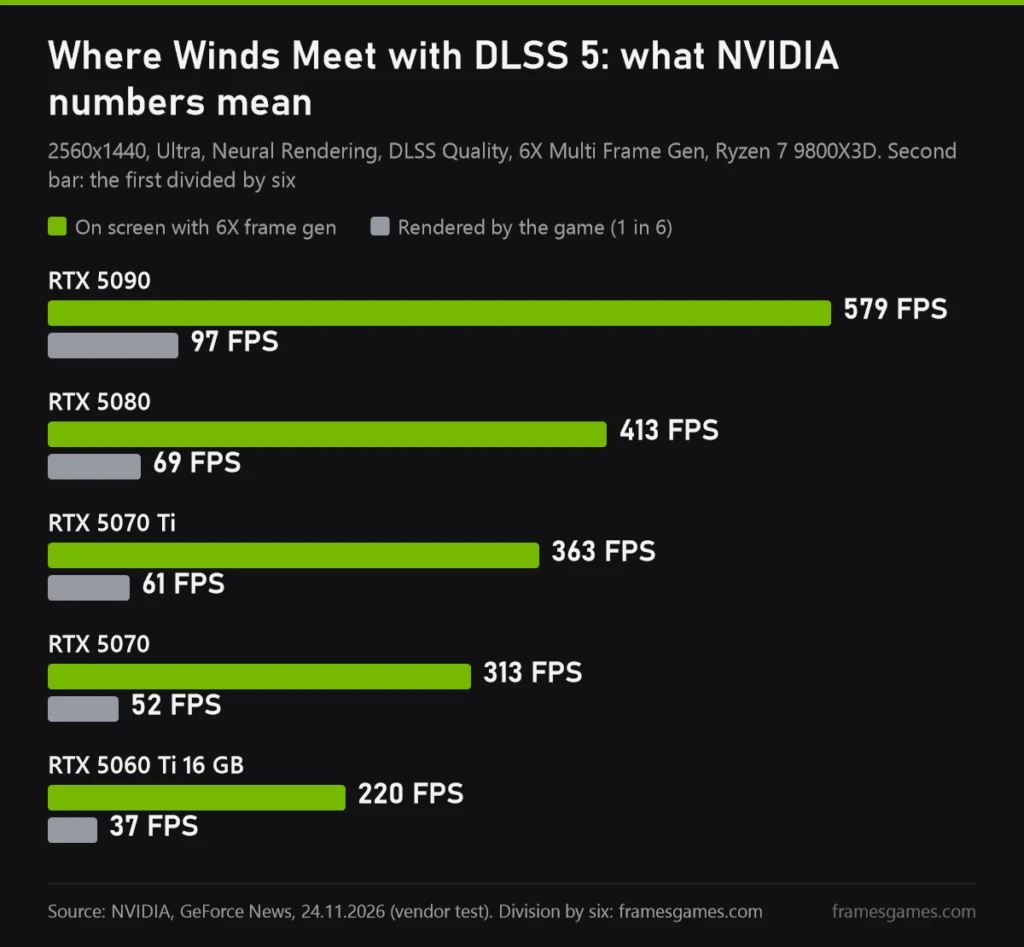
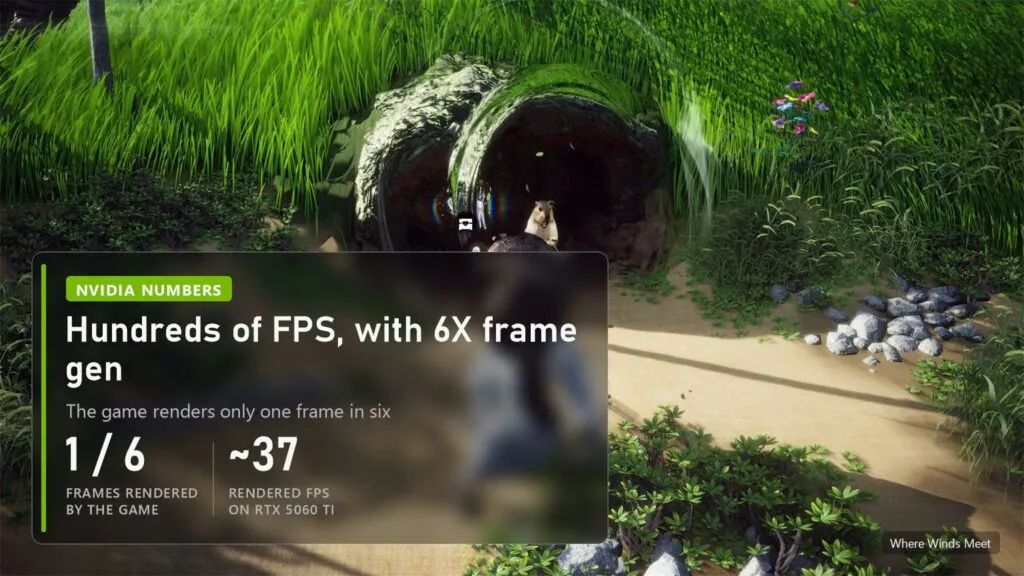
NVIDIA's numbers are big: at 2560x1440 Ultra with DLSS Quality, from 220 FPS on the RTX 5060 Ti 16 GB to 579 on the RTX 5090; at 4K with DLSS Performance, 226 on the RTX 5070 Ti, 273 on the RTX 5080 and 415 on the RTX 5090. The test rig used a Ryzen 7 9800X3D. Every result, though, uses 6X Multi Frame Generation, which means the game renders only one frame in six and the AI fills in the other five. Divide by six and the 1440p results come to 37 to 97 frames the game actually rendered. That number is what decides how responsive the mouse feels.
NVIDIA does not show what Neural Rendering costs on its own. In other games the price is noticeable: ComputerBase measured 75.6 FPS without DLSS 5 and 57.2 with it in Hogwarts Legacy on an RTX 5090 at 4K, a quarter less, and PC Games Hardware saw about 110 FPS without it and just under 60 with it in Assetto Corsa Rally on an RTX 5070 Ti at 4K. For Where Winds Meet we are waiting for the first tests. On an RTX 5060 Ti or RTX 5070 it makes sense to start with 3X or 4X frame generation and see whether the response feels right.
What if your card is not an RTX 50
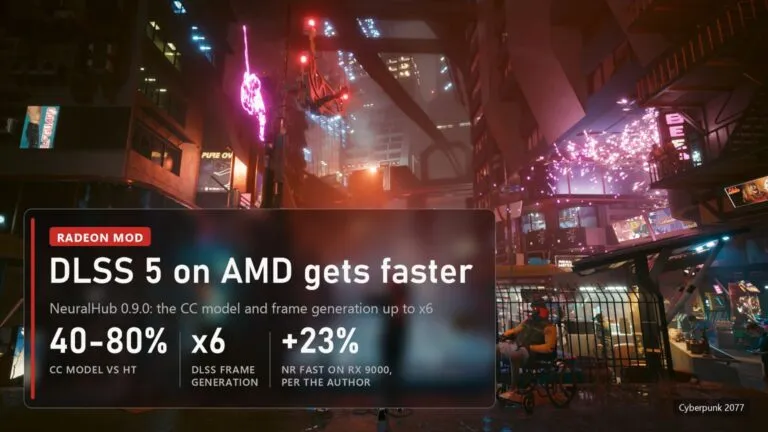
Officially, you are out of luck: NVIDIA promised RTX 40 support back in September without a date, and Radeon and Arc are not in its plans at all. Community mods can run DLSS 5 on RTX 20-40, Radeon and Intel Arc, but nobody has tried them with Where Winds Meet yet. It is also an online game, and swapping files in it could get an account banned, so we would not risk it here. Which methods exist for each card and how they differ is covered in our DLSS 5 guide.
Before Where Winds Meet, DLSS 5 arrived in NBA 2K27, Metro 2033 Redux and Metro: Last Light Redux, Hogwarts Legacy, War Thunder and Assetto Corsa Rally. Three of the seven came in November.
Sources
Where Winds Meet: DLSS 5 With 3D-Guided Neural Rendering Available Now (NVIDIA, GeForce News, 24 November 2026), including the performance charts; Game Ready 621.40 driver (NVIDIA, 24 November 2026). Earlier tests: ComputerBase (Hogwarts Legacy, 5 November 2026), PC Games Hardware (Assetto Corsa Rally, 21 November 2026). Chart and division by six: framesgames.com. Images: Where Winds Meet screenshots from the game's Steam page.
Read next