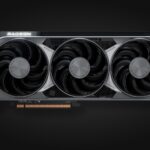
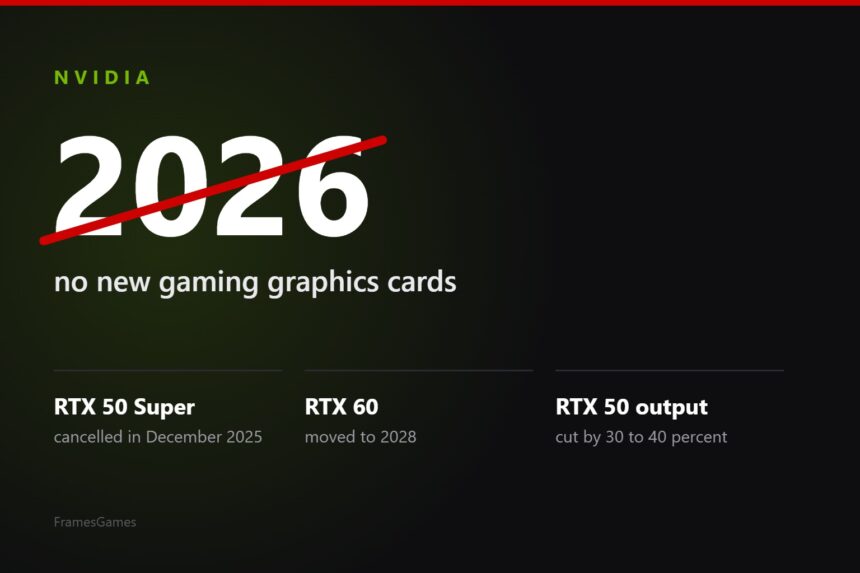
Nvidia will not ship a single new gaming graphics card in 2026. If that holds, it breaks a run stretching back almost thirty years: the company has not skipped a year without a new gaming architecture since the late nineties.
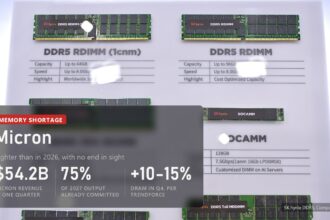
The reason is not games and it is not competition. The reason is memory. A global DRAM and HBM shortage, which the trade press has taken to calling RAMageddon, has pushed Nvidia to send scarce chips where they earn most: into accelerators for artificial intelligence.
What has already moved
- The RTX 50 Super refresh was dropped back in December 2025. Reports say the casualties included a 24GB RTX 5080 Super whose design had already been finished.
- RTX 60 has slipped to 2028. The next generation moved not by months but by two years.
- Output of the current RTX 50 is down 30 to 40 percent against the start of the year.
- Supply to board partners fell by roughly a fifth. It shows most on the RTX 5070 Ti, which has become hard to find on sale.
Why memory decides everything

The RTX 50 runs on GDDR7, and that comes off the same lines as the rest of advanced DRAM. There is not enough capacity to go round, and a data centre accelerator earns incomparably more than a gaming card. The choice is obvious for the company, and it has not been made in favour of players.
This is also where the price rises come from, which we covered separately. When supply is cut by almost a third and demand stays put, the tags climb on their own, with no announcement required.
What we do not know yet
There is no official confirmation. Nvidia has not stated that there will be no gaming releases in 2026. The company has only acknowledged the memory shortage in a comment to Toms Hardware, and the conclusion about a skipped year comes from sources cited by The Information and the analysts who picked the story up.
So the careful phrasing is this: there appears to be no plan for a new gaming card this year. That is not the same as an official cancellation, though it does not sound far off.
What a buyer should do
- Do not wait for the next generation. There is nothing to wait for: the next architecture has moved to 2028.
- Do not wait for prices to fall either. With output cut, nothing is going to get cheaper.
- Look at the previous generation and at Radeon. RDNA 4 has caught up in tracing, and the gap in price matters more right now than the gap in frames.
If you need a card today, buy at the current price and do not count on a better deal in six months. Until the memory shortage ends, there will not be one.