The upscaler argument stopped being technical a long time ago. It became a matter of faith: one camp is certain FSR is a smeared mess, the other that DLSS is marketing. And both are usually comparing versions that no longer exist.
Let us go through it calmly: what FSR has become, what DLSS 4.5 is doing, and above all whether an ordinary person can see the difference. A spoiler on that last point: they can, but not always, and not the difference they think.
How FSR got from sharpening to a neural net
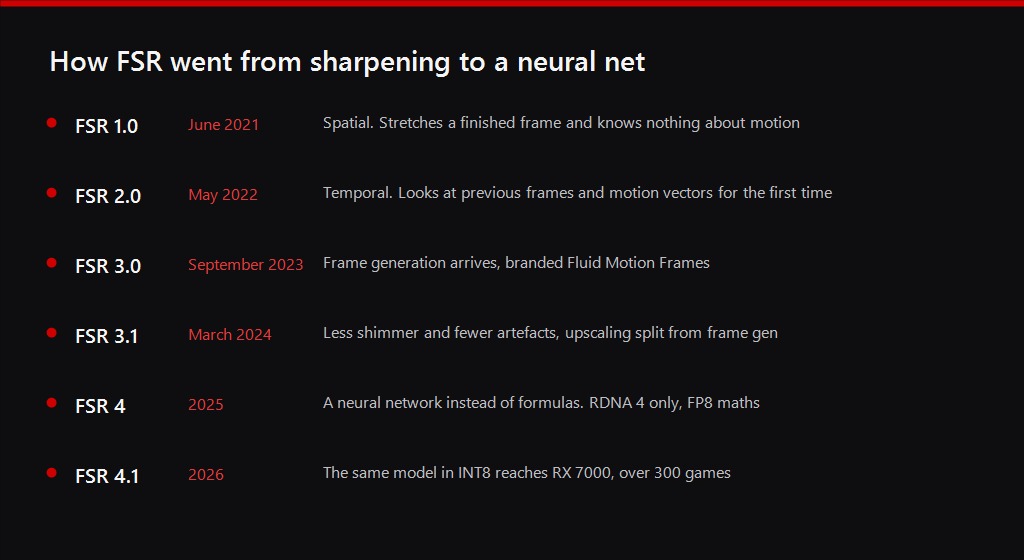
The thing to understand is that four fundamentally different technologies have lived under the name FSR in five years. Complaints that are fair about one of them do not apply to another at all.
FSR 1.0, June 2021. A spatial upscaler: it takes a finished frame and stretches it with a clever sharpening pass. It knows nothing about what the previous frame contained. Hence the reputation, softness in motion and stair steps on thin objects.
FSR 2.0, May 2022, debuting in Deathloop. The move to temporal upscaling: the algorithm looks at several frames in a row and at motion vectors. Quality jumped, but trails appeared behind moving objects, the very problem that took years to fix.
FSR 3.0, September 2023, first seen in Forspoken and Immortals of Aveum. Frame generation arrived, branded Fluid Motion Frames.
FSR 3.1, March 2024. Less shimmer, fewer artefacts, and upscaling split from frame generation so you could run them separately.
FSR 4, 2025, alongside the Radeon RX 9000. This is where it broke with its own past.
What actually changed in FSR 4
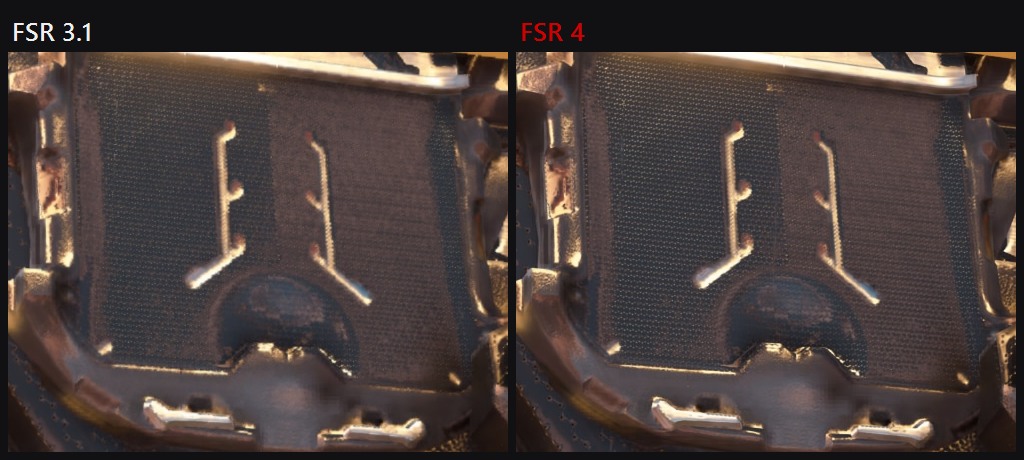
Up to the fourth version FSR was a set of formulas. Engineers described exactly how to blend pixels from neighbouring frames and tuned the coefficients by hand. The more complex the scene, the more often the formula guessed wrong.
FSR 4 works differently: a trained neural network makes the call. Nobody wrote the rule; a model looked at an enormous number of scenes and learned to predict what the pixel should be. It is the same fundamental step Nvidia took earlier.
The price was steep. A model needs hardware that can do reduced precision maths quickly, and at launch FSR 4 ran only on RDNA 4, meaning the Radeon RX 9000, which has FP8.
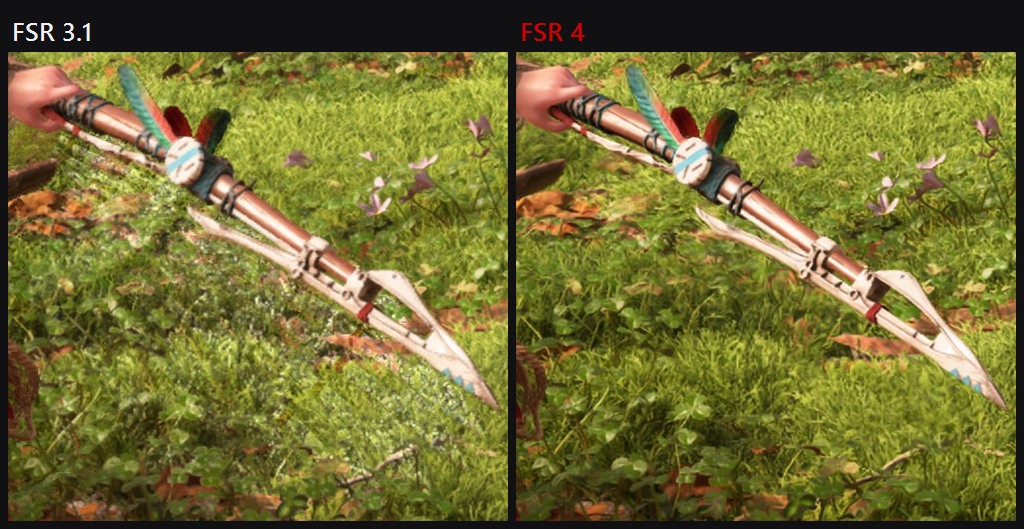
In 2026 that restriction lifted. FSR 4.1 reached the Radeon RX 7000 in the Adrenalin 26.6.2 driver, ahead of the promised date. The model was rebuilt for INT8, because RDNA 3 has no FP8, and AMD says the final image is on par. More than three hundred games are supported, RDNA 3 integrated graphics are next, and RX 6000 owners are being told 2027.
What DLSS 4.5 is doing
Nvidia was not standing still. DLSS 4 moved in early 2025 from a convolutional network to a transformer, the same architecture language models run on. The practical result was roughly a third less ghosting and noticeably steadier fine detail in motion.
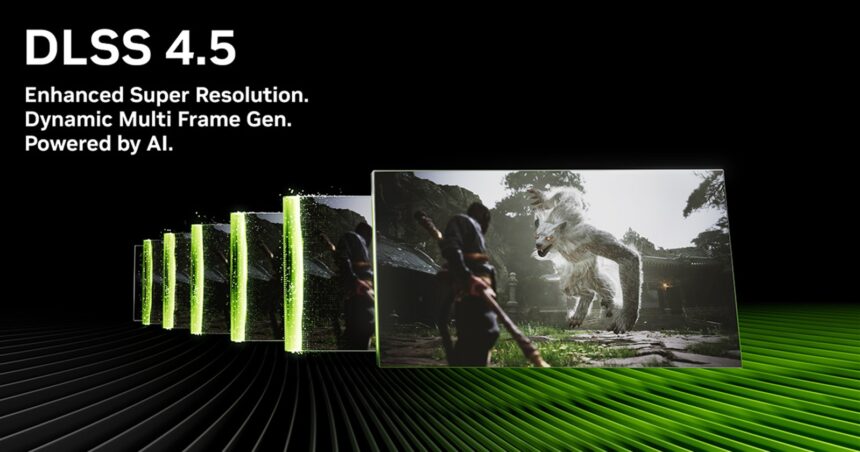
DLSS 4.5 is the second generation of that transformer. The model was trained with five times the compute and on an expanded data set, so that it understands scene context better and handles motion vectors more carefully. Edges and anti-aliasing were tightened separately.
The second half of the announcement has nothing to do with image quality: dynamic frame generation with a multiplier from three to six. That is about 240 Hz monitors and heavy path tracing, and it only runs on the RTX 50.
On reach Nvidia is still ahead: DLSS 4.5 works in over four hundred games, and RTX technologies in general have shipped in more than a thousand games and applications. FSR 4.1 is past three hundred.
So can people see the difference
This is the interesting question, and there is data rather than just opinion.
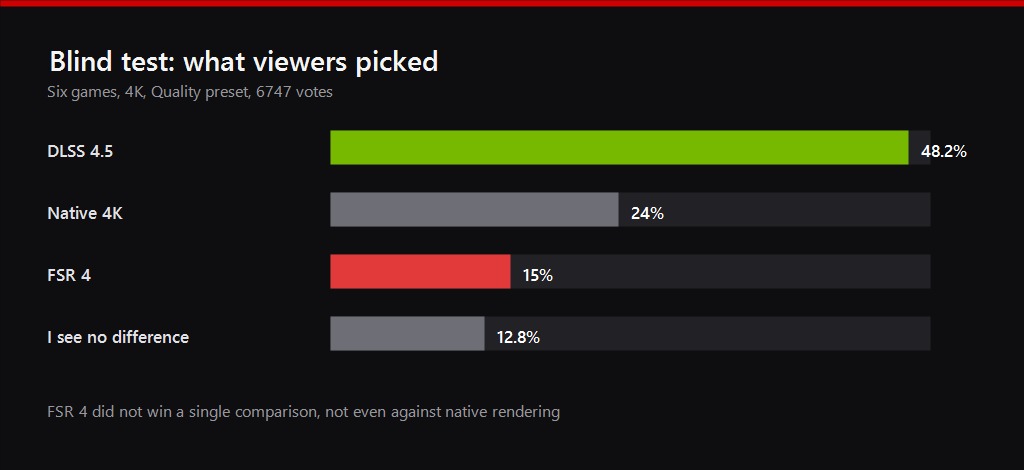
A large blind test gathered over a thousand players and almost seven thousand votes across six games: Anno 117, ARC Raiders, Cyberpunk 2077, Horizon Forbidden West, Satisfactory and The Last of Us Part II. Everyone was shown the same 4K footage in three variants, unlabelled, every upscaler on the Quality preset.
The result is unpleasant reading for AMD. DLSS 4.5 took 48.2 per cent of the votes, native rendering 24 per cent, FSR 4 fifteen. FSR 4 did not win a single comparison in a single game, not even against native rendering. It came closest in The Last of Us Part II: 25.3 per cent against native's 25.9.
And here is the figure that never comes up in these arguments: 12.8 per cent of participants honestly answered that they see no difference between the three at all. One in eight.
The second thing worth noting: native 4K lost to an upscaler. That is not a flaw in the test. Modern upscalers double as anti-aliasing, and a native image in a game using TAA often looks worse.
Where those percentages part ways with reality
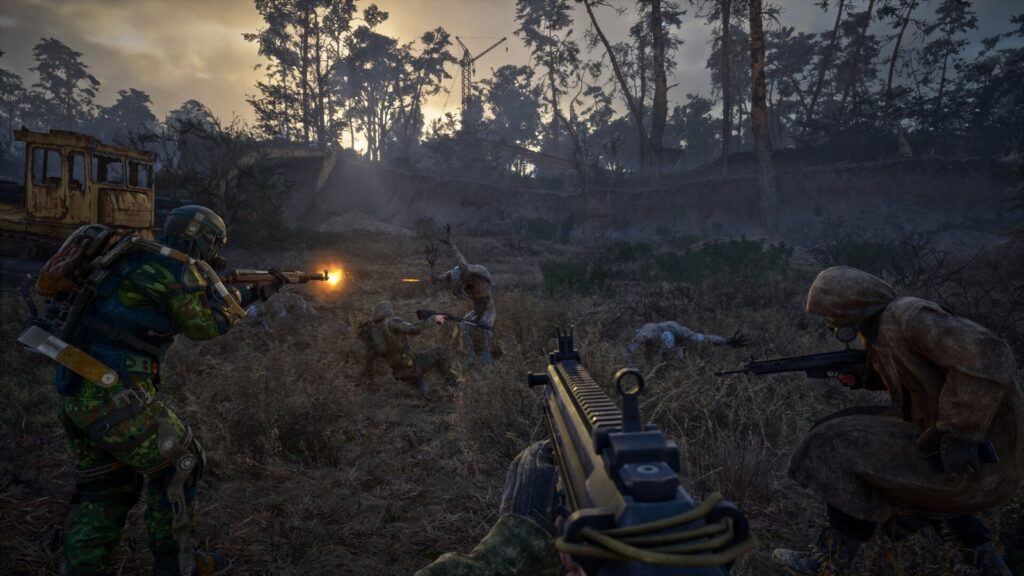
Here is where caution is needed. A blind test shows clips: compressed video, somebody else's monitor, a fixed camera path. A real game looks different, and some of the differences simply do not survive compression.
Tellingly, independent repeats of the exercise land somewhere calmer. The XDA team ran their own blind comparison on their own games and concluded that the landslide everyone talks about did not happen.
TechSpot's testing of FSR 4.1 puts it most precisely: the image got sharper, the gap narrowed, and DLSS is still ahead. That is the honest phrasing as things stand.
- Where almost everyone sees it. Fine mesh, wires, foliage and grass in motion, small text on distant objects.
- Where few see it. Trails behind fast objects: FSR 4 cut them down a great deal, and catching them now means going frame by frame.
- Where almost nobody sees it. A static scene, 1440p and above, Quality preset. Here the argument turns into inspecting screenshots with a magnifying glass.
What this means for you in practice
- You have a Radeon RX 9000. Turn FSR 4 on and stop thinking about it. It is the best AMD has had, and the comparison with native runs in your favour.
- You have a Radeon RX 7000. Update the driver to 26.6.2 or newer and check whether FSR 4.1 is in your game. The difference against FSR 3.1 is visible without squinting.
- You have an RX 6000, or a game without a recent FSR. Officially the wait runs to 2027, but there is a way around it.
- You have a GeForce RTX. DLSS 4.5 updates through the Nvidia app and can be swapped into older games too. Do not skip it.
We covered the way around it separately: OptiScaler lets you feed a game a current upscaler where the developer never shipped one.
The bottom line
The gap between FSR and DLSS narrowed radically in two years. FSR 4 is not an improved FSR 3, it is a different technology, and comparing it to the smeared mess of 2021 is pointless.
But the honest answer to the question in the headline is this: DLSS 4.5 is still better, and a blind test shows it. The difference is no longer a chasm, it is a few per cent of quality in the hard scenes, and one person in eight does not notice it at all.
The practical conclusion is simple. If you are choosing a graphics card, the upscaler should no longer be the deciding argument for Nvidia that it was in 2022. And if the card is already in the case, turn on what you have and go and play.
The list of games has grown a good deal since. An up to date breakdown of where FSR 4 works and what it needs is in FSR 4 and Redstone: every supported game.