
Valve has published the Steam hardware survey for August 2026, and AMD is now on 46.47 percent of the processors in it. That is the highest the company has been in the eighteen months the current chart covers, and Intel is down to 53.53.
The interesting question is not whether AMD will cross half. It is what a number from this particular survey is worth, and whether it should change anything about the machine you are about to buy.
What the numbers say
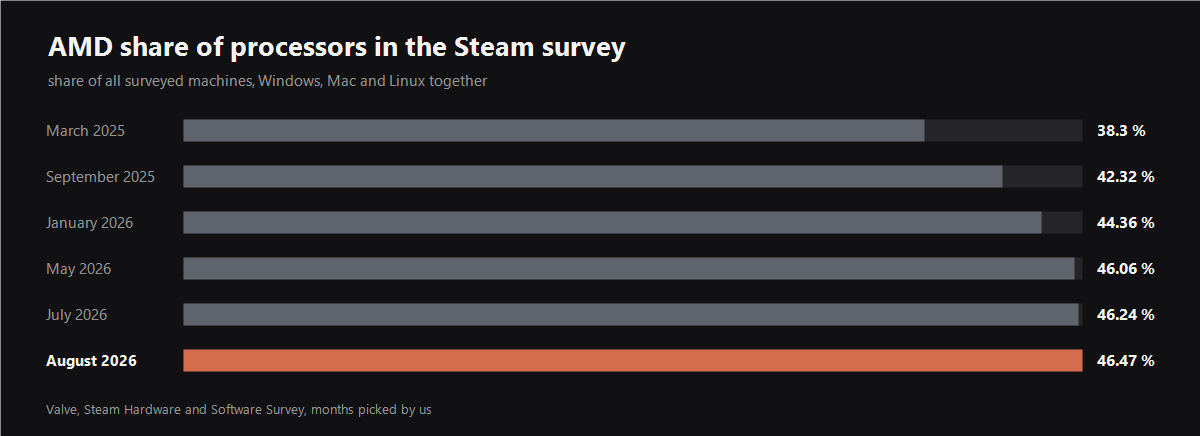
Eighteen months ago AMD had 38.3 percent. Now it has 46.47. That is a gain of just over eight points, and almost every month in between moved the same way.
The rest of the survey is less dramatic and worth knowing.
- Graphics cards have not moved. NVIDIA is on 72.88 percent, AMD on 18.68, Intel on 8.03. AMD gained less than a point across the whole eighteen months, which is a very different picture from the processor side.
- Windows 11 is on 70.97 percent of surveyed machines, up 0.71 in a month, with Windows 10 down at 22.90.
- The most common graphics card is still an RTX 3060. That has been true for a long time and it is the single most useful line in the whole survey for anyone deciding what to develop or buy for.
The number that shows why you should not overread it
Here is the part that gets left out of the headlines. In one month early in 2026 the graphics chart shows NVIDIA jumping to 84.68 percent and AMD collapsing to 10.61, then both snapping straight back the following month. Nothing happened in the market that month. The survey wobbled.
That is worth keeping in mind every time someone quotes this survey as a market share figure. It is a sample of the machines Valve happened to ask, it can be skewed by a single large group of users being polled, and it has visibly misfired before.
Two more caveats that matter as much.
- It counts machines, not sales. A gaming PC lives for years. This chart moves slowly because it is measuring what people already own, not what they bought last quarter.
- The Windows only view gives a different number. Valve publishes both, and the AMD figure is a little lower there. Any headline quoting this survey should say which of the two it is using, and most do not. The 46.47 above is the combined Windows, Mac and Linux view.

Does it change what you should buy
Not by itself, and anyone telling you otherwise is selling something. A popularity chart is not a benchmark. But the trend does have two practical consequences, and both are real.
- Games get tested on what people have. As AMD chips become half the installed base, they get more attention in patches and driver work. That is a slow effect but it is the one that eventually shows up as fewer strange bugs.
- The gap on graphics is the story nobody tells. AMD is nearly level on processors and still under a fifth on graphics cards. If you are wondering why FSR support in games lags DLSS, that ratio is most of the answer.
What actually decides a processor purchase is frames in the games you play at the resolution you use, and the price on the day. We keep our own hardware and price data for exactly that reason, and a survey like this one never enters into it as a number, only as context.
The survey runs monthly and Steam users are asked at random, so the September figures land in early October. If AMD crosses half then, it will be a milestone worth one sentence and no more.
Sources
All figures come from Valve's Steam Hardware and Software Survey for August 2026, read directly from the published charts on the Steam site: AMD at 46.47 percent and Intel at 53.53 percent of processors, NVIDIA at 72.88, AMD at 18.68 and Intel at 8.03 percent of graphics cards, Windows 11 at 70.97 percent and Windows 10 at 22.90, and the RTX 3060 as the most common card. The starting point of 38.3 percent for AMD is the March 2025 value in the same chart, which covers March 2025 to August 2026. The anomalous month with NVIDIA at 84.68 and AMD at 10.61 percent is a data point in that same published series. The months chosen for our chart, the arithmetic on the eight point gain, and the reading of what the survey can and cannot tell you are ours.