PhysX is NVIDIA's physics engine, and between 2008 and 2015 it ran on GeForce cards to add things the consoles of the day could not afford: newspapers that tumbled down Gotham's streets, flags you could shred with a shotgun, fog that parted around Batman's legs, water you could wade through in a frozen icebreaker. This is the story of those games, what each one did with it, and why the whole thing quietly disappeared.
- What PhysX was: a £218 add-in card, then a free GeForce feature
- Cryostasis: Sleep of Reason, 2008: water as 30,000 particles
- Mirror's Edge, January 2009: glass that stays on the floor
- Batman: Arkham Asylum, September 2009: fog that remembers your steps
- Mafia II, August 2010: Vito's coat and walls that crumble under fire
- Alice: Madness Returns, June 2011: 10,000 particles of black goo
- Batman: Arkham City, November 2011: bank notes, newspapers and fog
- Borderlands 2, September 2012: slag puddles and flags full of holes
- 2013, the busiest year: Metro: Last Light, Arkham Origins and Black Flag
- Batman: Arkham Knight, June 2015: the last big one
- Why PhysX disappeared: half the audience could not see it
- RTX 50 dropped 32-bit PhysX: what broke and what NVIDIA brought back
- How to turn PhysX on, and what to pick: GPU or CPU
- Mafia II "PhysX SDK not initialized": how to fix it
- Every GPU PhysX game worth knowing, and how it runs today
- The short version
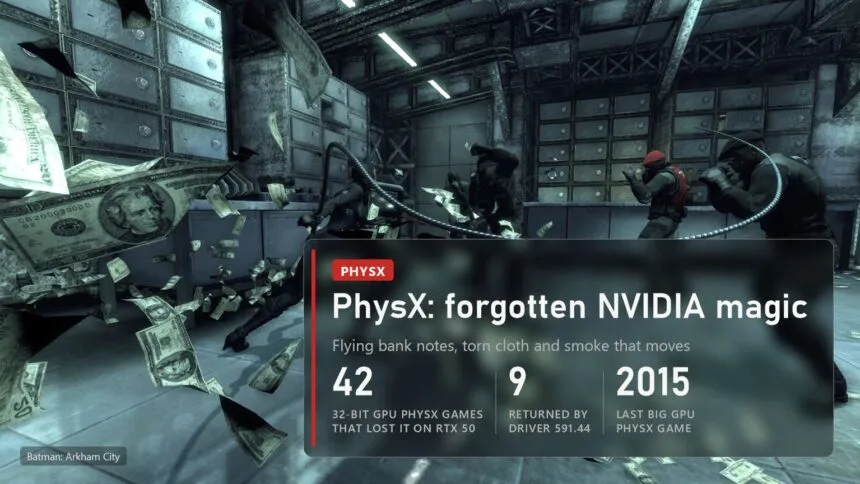
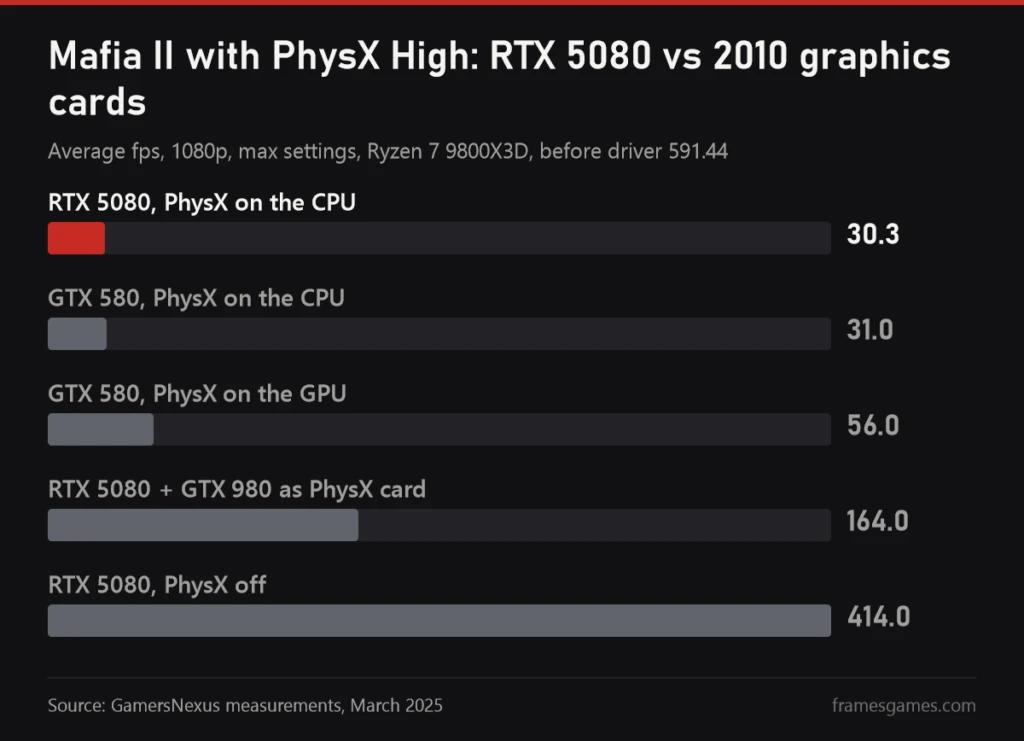
There is a practical side too. In January 2025 NVIDIA stopped supporting 32-bit CUDA on the RTX 50 series, and with it the GPU PhysX in older games. In GamersNexus testing an RTX 5080 ran Mafia II with PhysX at 30 fps, while a GTX 580 from 2010 managed 56. NVIDIA patched nine games back in December 2025. Below you will find which ones, how to switch PhysX on, and how to fix the Mafia II error that still has people searching for help.
What PhysX was: a £218 add-in card, then a free GeForce feature
In plain words, PhysX calculates how things move, fall, tear and pour. A game has some physics anyway (a crate knocked off a table falls on any computer). GPU PhysX was the extra layer on top: thousands of pieces of debris instead of five, cloth that tears where you shoot it, smoke made of particles that drift when someone walks through. Turn it off and those objects simply are not there, or they are painted into the textures.
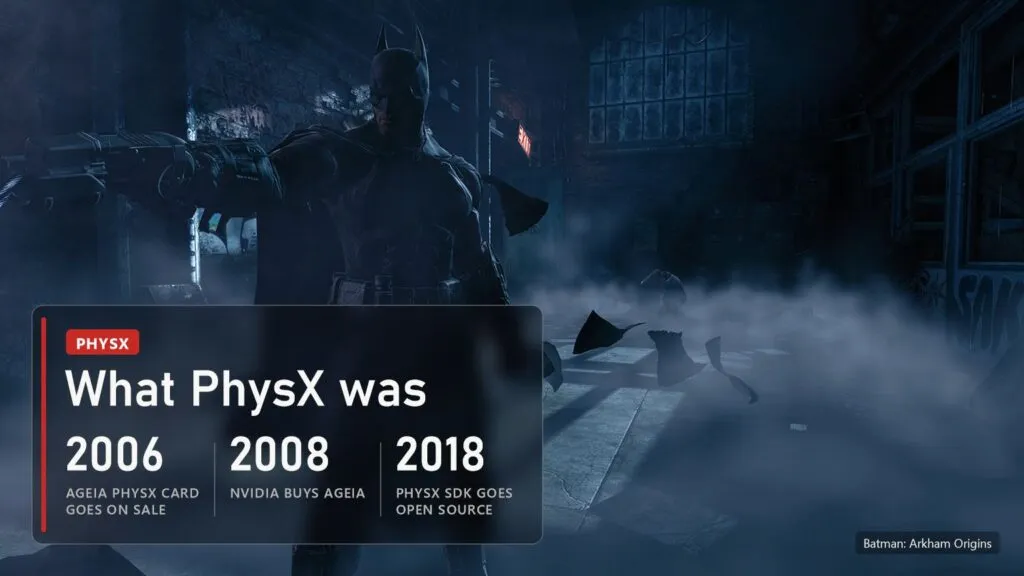
It started outside NVIDIA. The Swiss engine NovodeX was bought by Ageia, a company that wanted every gamer to own a separate physics chip. The Ageia PhysX card went on sale in May 2006; bit-tech paid £217.32 for a BFG model, and almost nobody else bought one, because a handful of games used it. In February 2008 NVIDIA bought Ageia, and by August the same physics ran through CUDA on any GeForce 8, 9 or GTX 200 with 256 MB of memory. A free driver update turned millions of cards into physics accelerators overnight.
- May 2006. The Ageia PhysX card goes on sale, a separate chip just for physics.
- February 2008. NVIDIA announces the purchase of Ageia and closes the deal nine days later.
- August 2008. GPU PhysX arrives on GeForce 8, 9 and GTX 200 through a free driver.
- September 2009. NVIDIA drivers switch GPU PhysX off if an AMD card is in the same PC. The block was never lifted.
- December 2018. The PhysX SDK goes open source under BSD-3. The GPU code followed on 25 March 2025.
One thing to clear up straight away: PhysX the engine is everywhere, from Unity to The Witcher 3, and most of the time it runs on the CPU and nobody notices. When people say "PhysX games", they mean the GPU-accelerated effects that only worked on GeForce. That is what this article is about.
Cryostasis: Sleep of Reason, 2008: water as 30,000 particles
 The video loads from YouTube (Google) when you press play. Privacy policy
The Ukrainian studio Action Forms made a horror shooter set on a frozen Soviet icebreaker, the North Wind, and released it in Russia and the CIS on 5 December 2008 as "Анабиоз: Сон разума" (Europe got it in February 2009, America in April). Most people remember the atmosphere: frost on the walls, heat as your health bar, flashbacks into the bodies of dead sailors. PhysX fans remember the water.
Water in Cryostasis was not a texture with ripples. It was a fluid made of particles (about 30,000 in the scene of the tech demo, according to PC Games Hardware), so it splashed, pooled on the deck and flowed down corridors. There was cloth too, and a heat simulation that melted ice. In 2008 that was the kind of thing you saw in a tech demo, not in a shooter you could buy.
It came at a price. PC Games Hardware tested the demo in December 2008 and called the performance unacceptable, especially when PhysX fell back to the processor. And today the game is hard to even get: it left Steam on 15 July 2013 and is gone from GOG as well. It is also one of the 32-bit games that NVIDIA did not fix for the RTX 50 series, so on a new GeForce the water runs on the CPU again, just like on a weak PC in 2009.
Mirror's Edge, January 2009: glass that stays on the floor
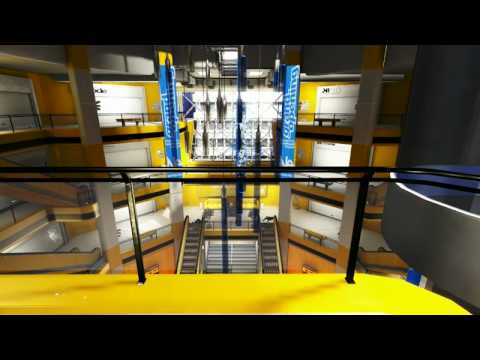
DICE built a white, clinical city, and PhysX was the thing that made it look lived in. With it switched on, windows burst into shards that stayed on the floor, plastic sheets and banners tore when bullets hit them, blinds moved, and smoke hung in the air during the chases. NVIDIA and DICE even gave a talk about it at GDC 2009, with glass and trash as the main examples.
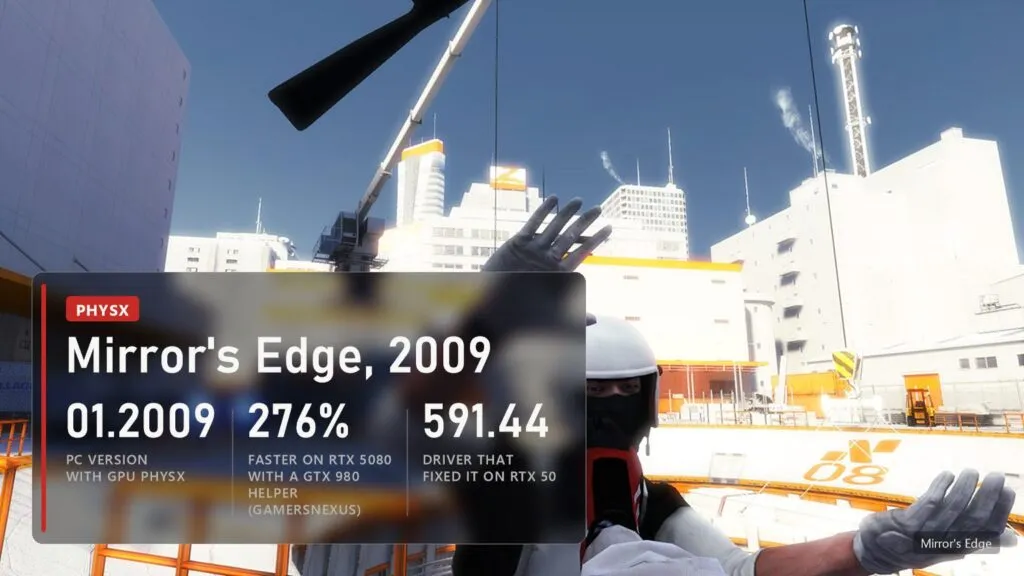
Without PhysX the cloth is simply missing, and Faith runs through a city that feels even emptier than intended. Mirror's Edge was also the game that showed the downside early: on a Radeon, or on a GeForce with PhysX forced to the CPU, the glass scenes became painfully slow. That has come back in 2025. GamersNexus found an RTX 5080 with a GTX 980 helping it ran Mirror's Edge 276% faster than the RTX 5080 alone. NVIDIA added the game to its December 2025 fix, so with driver 591.44 or newer it works properly again.
 The video loads from YouTube (Google) when you press play. Privacy policy
Batman: Arkham Asylum, September 2009: fog that remembers your steps
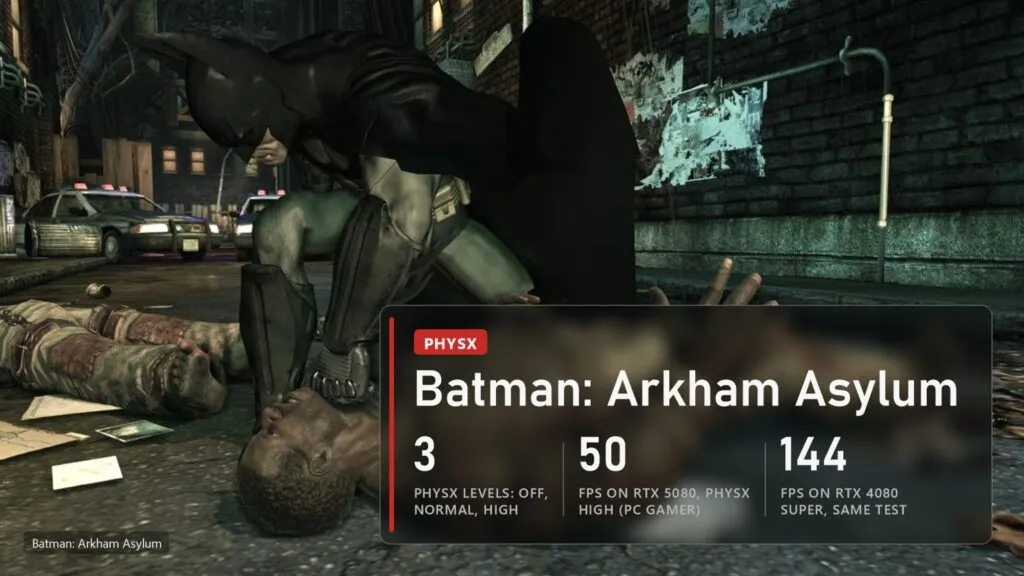
Rocksteady's first Batman had three PhysX levels: Off, Normal and High. On High the asylum filled up with things that reacted to you. Fog crept along the floor and left a wake behind Batman. Sheets of paper slid around, cobwebs and drapes tore, floor tiles cracked and walls crumbled in fights. Tom's Hardware summed it up in 2009: "the added detail is a real treat."
A small myth while we are here: Batman's cape is not PhysX. Tom's Hardware asked at the time, and it was custom code written by the developers. It flows the same with PhysX off.
Arkham Asylum is the sore point of the RTX 50 story. PC Gamer measured 50 fps with PhysX High on an RTX 5080 and 144 on an RTX 4080 Super. NVIDIA's December 2025 driver left Asylum out and promised support "in the first part of 2026". As of mid-November 2026 we have not found a driver note that delivered it, so if you own an RTX 50 card, set PhysX to Normal or Off in this game or add an older GeForce as a PhysX card (more on that below).
Mafia II, August 2010: Vito's coat and walls that crumble under fire
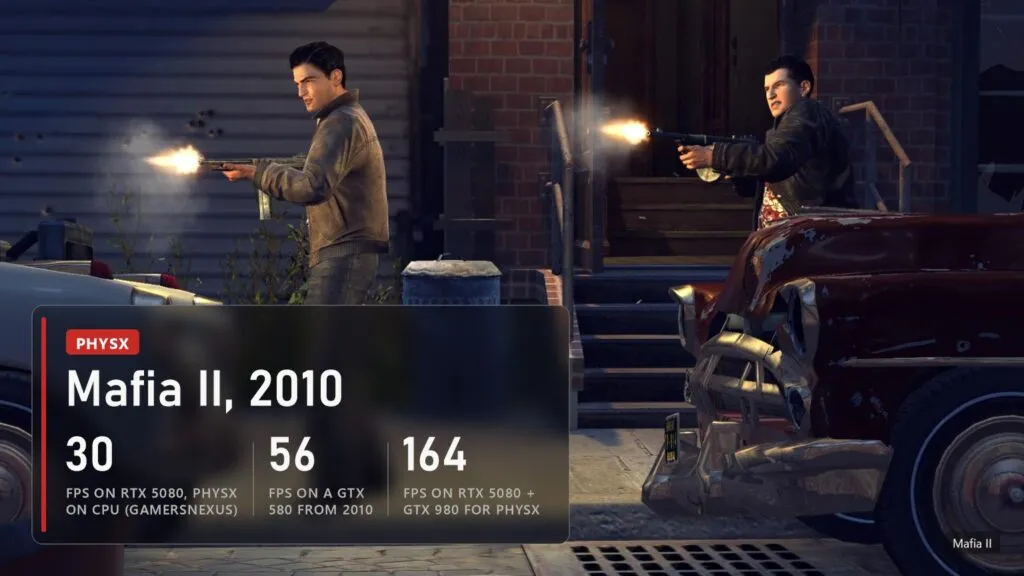
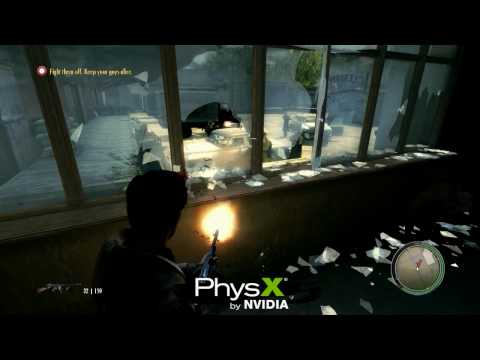
Mafia II used two APEX modules, Clothing and Particles. In practice that meant Vito's coat and the suits of every gangster moved like fabric instead of plastic, and a shootout chewed the walls into chunks that stayed on the ground, with dust and sparks in the air. The difference was most obvious in the warehouse shootouts: with PhysX on, the cover you hide behind slowly falls apart.
 The video loads from YouTube (Google) when you press play. Privacy policy
It was also expensive. bit-tech tested it in September 2010 on a GTX 460: 62 fps with PhysX off, 34 with PhysX High. Moving PhysX to a second card, an older GTX 275, brought it back up to 47. On a Radeon HD 5870 the CPU had to do all the work and the game dropped from 83 fps to 13. That chart is in the section about why PhysX died.
If you want this version of Mafia II today, buy the Classic edition: it is still on Steam next to the 2020 Definitive Edition. Players report that the remaster lost most of the PhysX effects, including the cloth (we found no official statement from 2K about it). Mafia II Classic is on NVIDIA's December 2025 list, so it runs GPU PhysX on RTX 50 cards again. If it refuses to start with a PhysX error, the fix is a few sections down. And if you came here after Mafia III, we have a guide to fixing its blur and pop-in on PC.
Alice: Madness Returns, June 2011: 10,000 particles of black goo
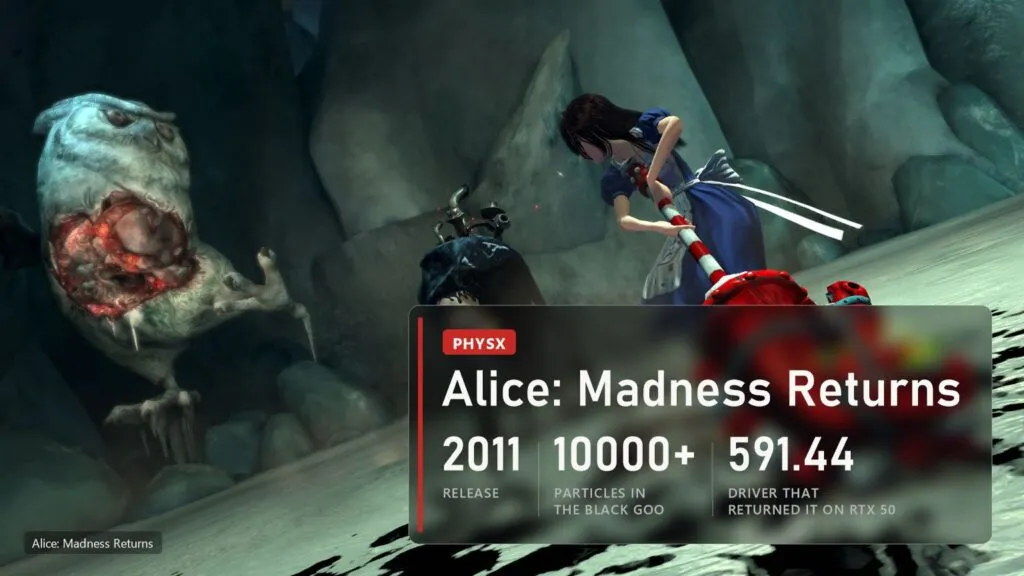
American McGee's Alice had one PhysX effect that fit its world perfectly: the black oily goo. Ruin enemies are made of it, it bursts out when you hit them and spreads across the floor as a real fluid. NVIDIA's developer article says the goo used more than 10,000 particles, calculated on the GeForce. Add volumetric smoke and debris and the darker levels look noticeably richer with PhysX High.
Alice is on the list NVIDIA restored in driver 591.44, and it is still sold on Steam. It is also a rare case where PhysX did not just decorate the game but became part of its art direction. The goo is the madness, and the game looks flatter without it.
Batman: Arkham City, November 2011: bank notes, newspapers and fog
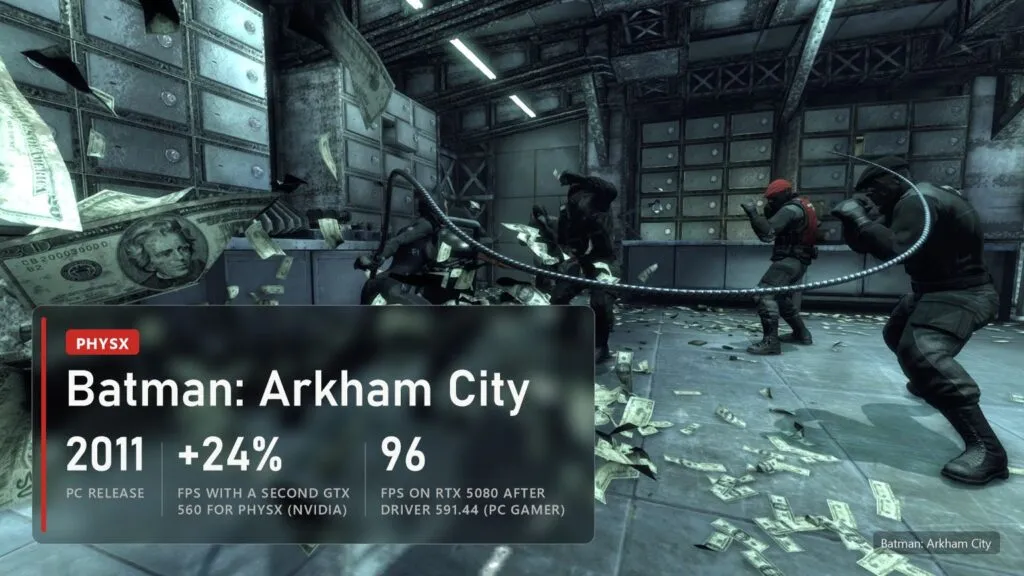
This is the one most people picture when they hear "PhysX". NVIDIA's own breakdown from December 2011 lists the effects, and it reads like a list of small pleasures. Newspapers tumble along the streets and get caught on lamp posts and in corners together with leaves. Bunting flutters, ropes and curtains react to you, fog particles pushed aside by guards keep drifting. Damaged machinery throws out smoke and sparks, glass breaks into shards that stay, and in the Smelting Chamber there is coal and office paper underfoot.
And yes, the money. In the bank vault, a fight sends every single bank note flying into the air. With PhysX off the debris is simply baked into the textures and the vault is just a room.
Catwoman is often mentioned next to the cloth, and she is part of it in the sense that her levels play in the same city with the same papers, curtains and fog that react to whoever moves through them. We did not find a source for the specific claim that she can wrap herself in a carpet, so we are not going to repeat it.
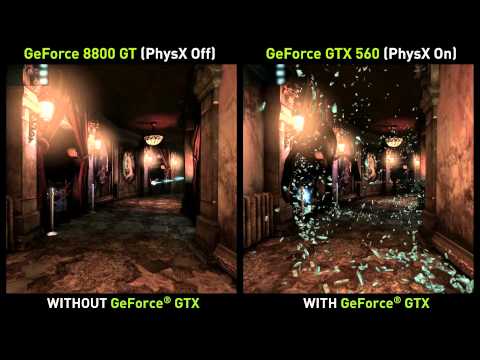 The video loads from YouTube (Google) when you press play. Privacy policy
NVIDIA's guide also showed the classic trick of that era: a second GeForce just for PhysX. Next to a GTX 560 Ti, an old 8800 GT added 11.56% to the frame rate, a GTX 260 added 17.55% and a second GTX 560 added 23.71%. Arkham City is on the December 2025 list, and PC Gamer measured the RTX 5080 going from 84 to 96 fps with driver 591.44. Still less than the 118 of an RTX 4080 Super, but playable.
Borderlands 2, September 2012: slag puddles and flags full of holes
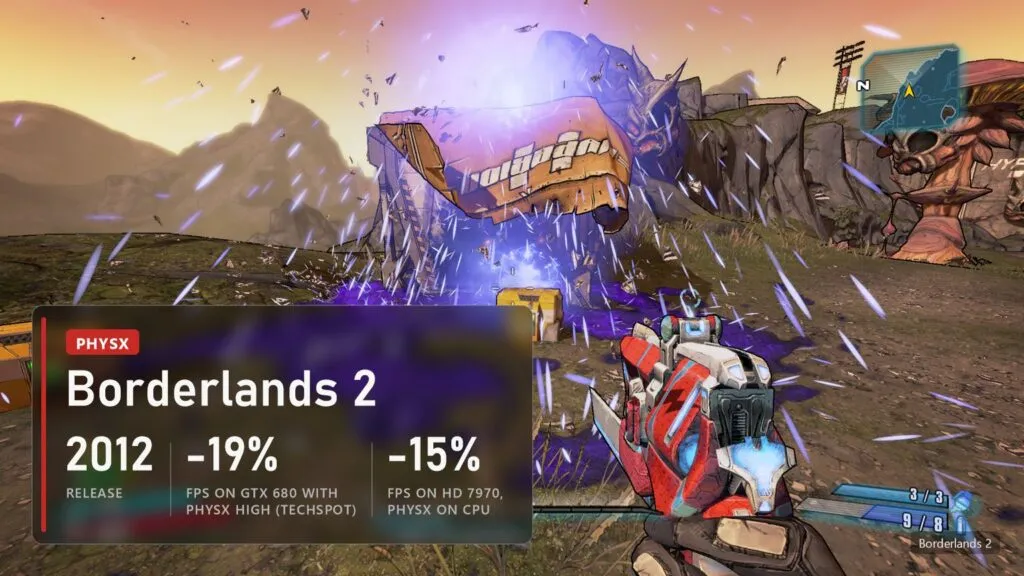
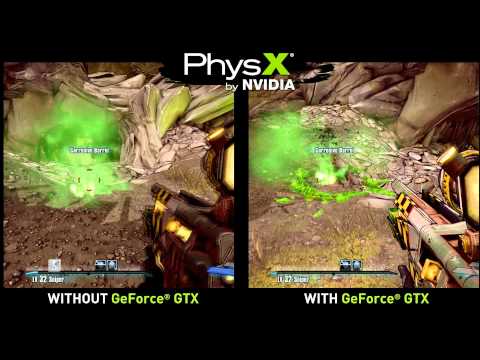
Gearbox went all in. Bullets knocked chunks out of rocks and robots, and the pieces piled up. Pipes leaked fluid that formed real puddles, Slag pooled in purple, flags, banners and tarps tore apart, and the Singularity grenades sucked everything nearby into a whirling cloud. NVIDIA's own trailer shows it better than any description:
 The video loads from YouTube (Google) when you press play. Privacy policy
Borderlands 2 was also a game where Radeon owners could cheat a little: an ini edit turned PhysX on with the CPU doing the work. TechSpot found that High PhysX cost the GTX 680 19% of its frame rate and the HD 7970 15%, and wrote that "PhysX adds some eye candy." But PC Perspective found the catch in heavy scenes: the GTX 680 went from about 90 to 70 fps, the HD 7970 from 71 to 33. The game is on NVIDIA's December 2025 list. Its sequel, The Pre-Sequel, added an Ultra level with up to 56,000 visible particles against 20,000 on High.
2013, the busiest year: Metro: Last Light, Arkham Origins and Black Flag
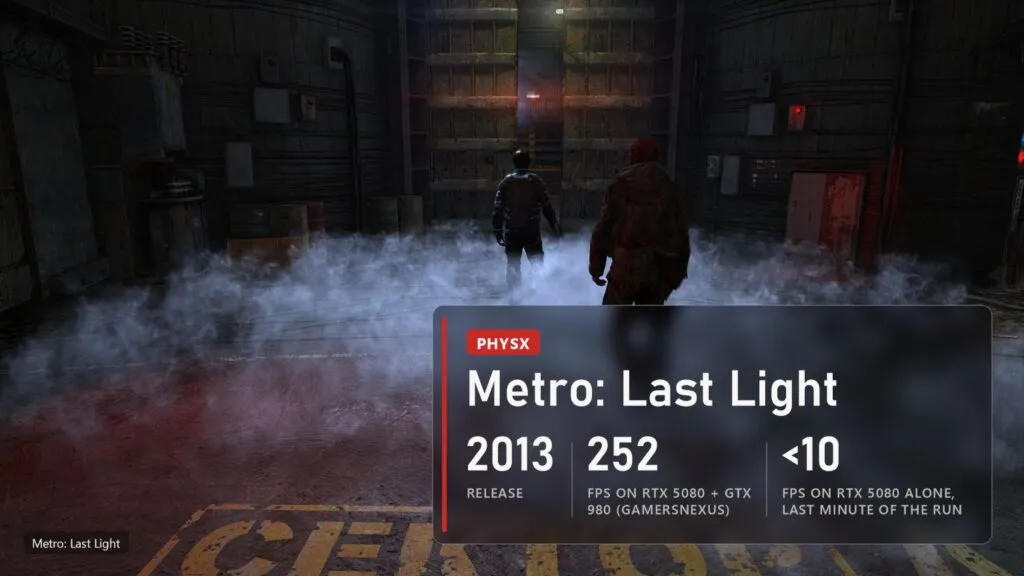
Metro: Last Light (May 2013) used PhysX for its heaviest moments. Debris and sparks bounced and cast shadows, windows, pillars and tiled walls broke, explosions threw pieces across the room, and fog and steam moved when a grenade went off. Banners and drapes were cloth. In GamersNexus testing an RTX 5080 on its own fell below 10 fps for the last minute of the run, while the same card with a GTX 980 for PhysX averaged 252. Both Metro 2033 and Last Light are on the December 2025 fix list, and the Redux versions are 64-bit. We covered the Redux next-gen update separately.
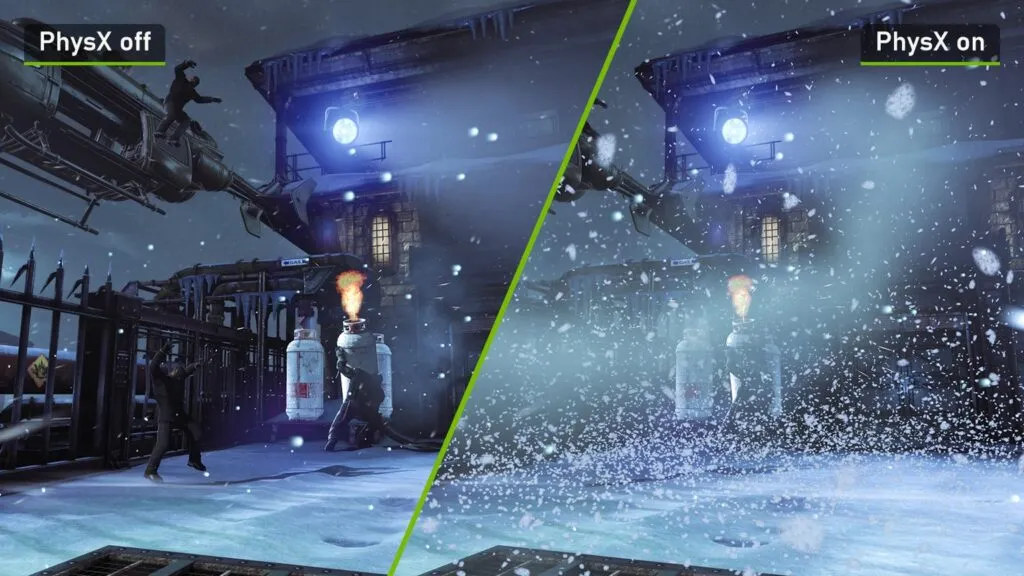
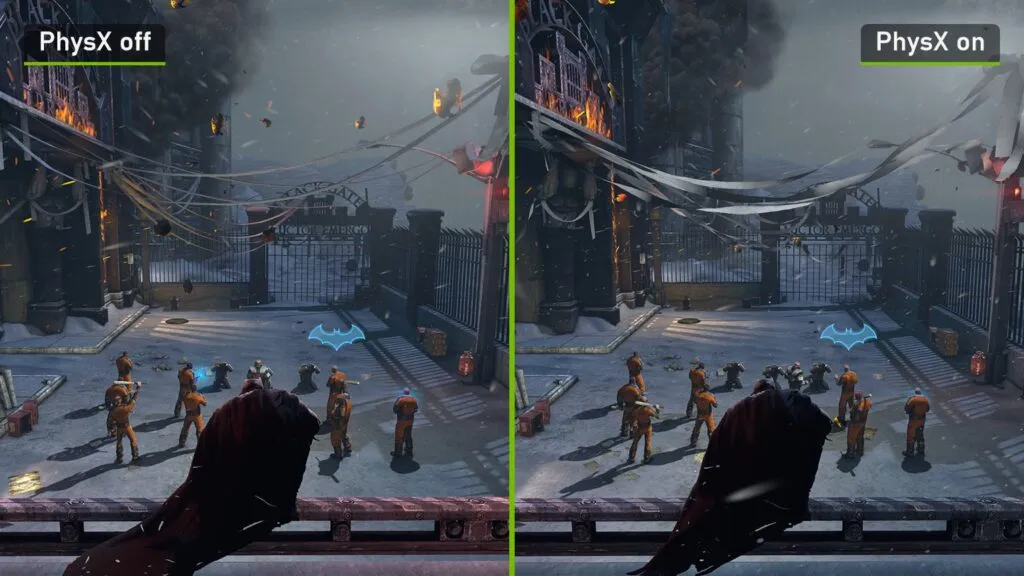
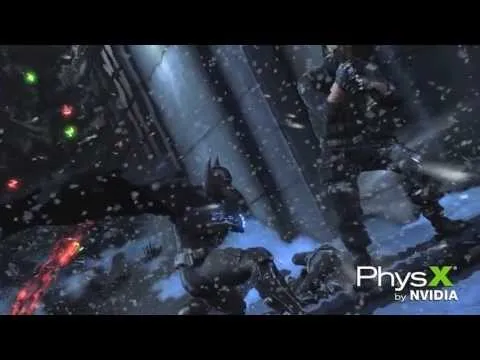
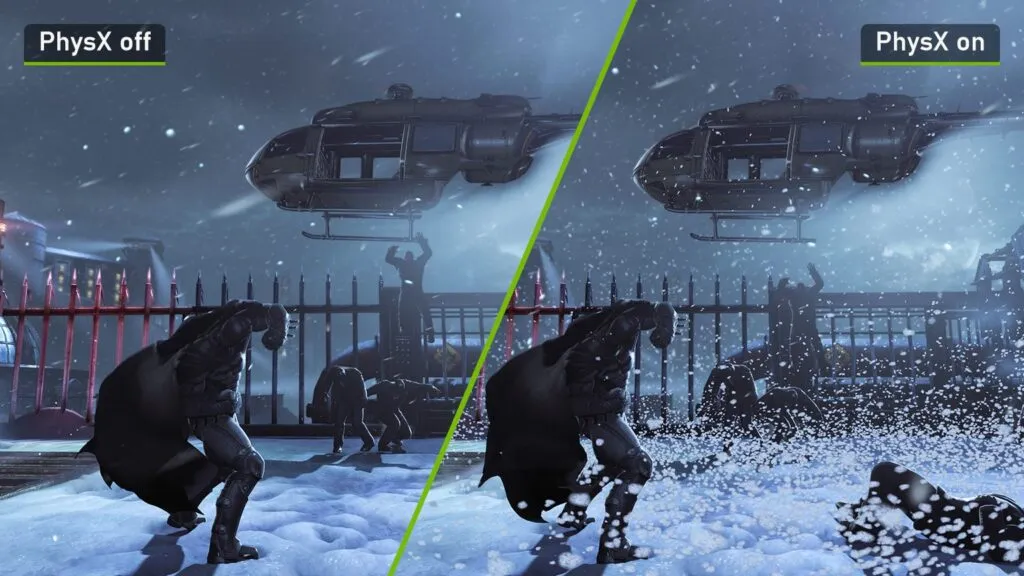
Batman: Arkham Origins (October 2013) moved the series into a snowy Gotham, and PhysX went with it. On Normal you get cloth flags, banners and papers that react to wind and movement. On High, NVIDIA's APEX Turbulence kicks up snow in every fight, a helicopter's downdraft blows snow, smoke and steam across the rooftop, and the smoke casts proper shadows. The comparison below is NVIDIA's own pair of screenshots of the same rooftop.
 The video loads from YouTube (Google) when you press play. Privacy policy
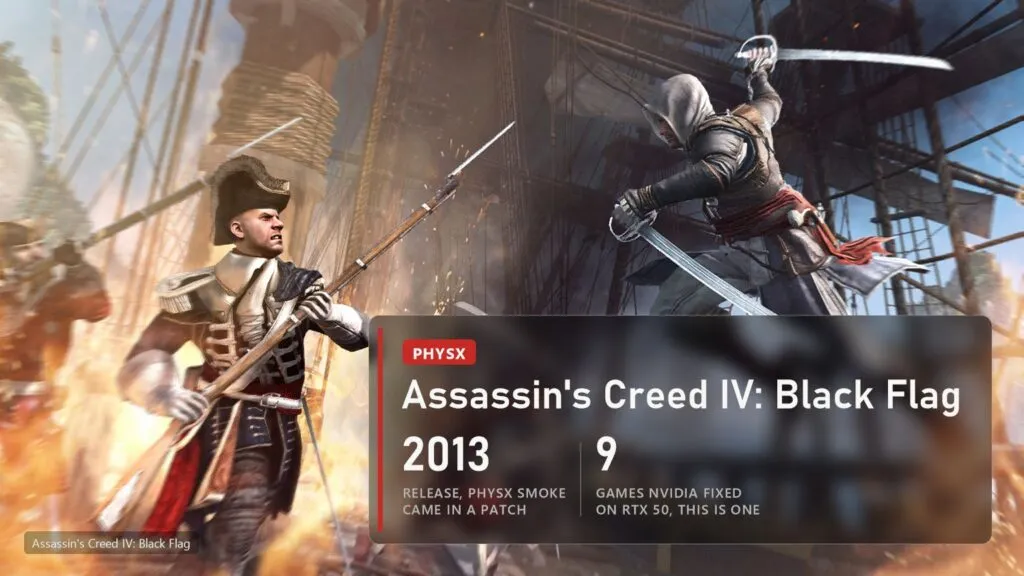
Assassin's Creed IV: Black Flag (November 2013 on PC) got its PhysX in a patch: thicker smoke from guns, smoke bombs, chimneys and torches, and particles that cast shadows. It is subtle compared with Batman, but sea battles with PhysX smoke look much heavier. Black Flag is also on the December 2025 list.
2013 also had the smaller ones: The Bureau: XCOM Declassified with Turbulence particles and cloth, Rise of the Triad with impact debris, PlanetSide 2 with battlefield particles, Hawken with mech wreckage and steam, and Call of Duty: Ghosts, where a patch added PhysX smoke grenades in multiplayer (the dog's fur, by the way, is HairWorks, a different NVIDIA feature).
Batman: Arkham Knight, June 2015: the last big one
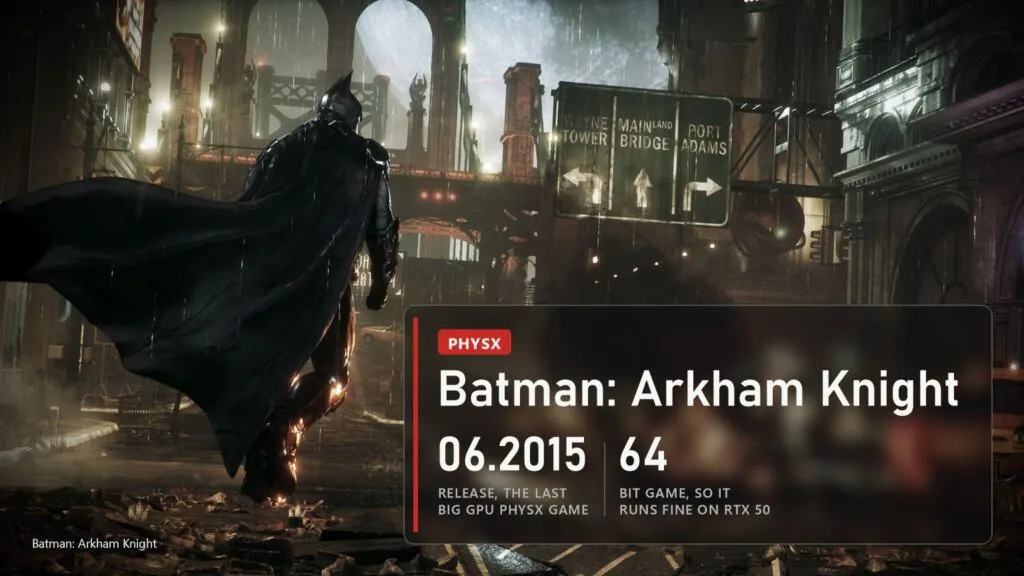
Arkham Knight closed the circle that Arkham Asylum opened. Interactive fog and smoke, paper debris and PhysX destruction were part of its GameWorks package, and rain beading on Batman's suit came with it (that part is GameWorks, not PhysX). It is a 64-bit game, so the RTX 50 change does not affect it at all.
After Knight, the big GPU PhysX releases stopped. A few games used FleX, NVIDIA's newer particle solver: Killing Floor 2 sprayed bile and blood with it in 2015, and Fallout 4 got Weapon Debris in a February 2016 patch. That one is now best switched off: PCGamesN reports it crashes on RTX cards. Warframe removed its NVIDIA particles in May 2018 and replaced them with a GPU effect that works on any card.

Why PhysX disappeared: half the audience could not see it
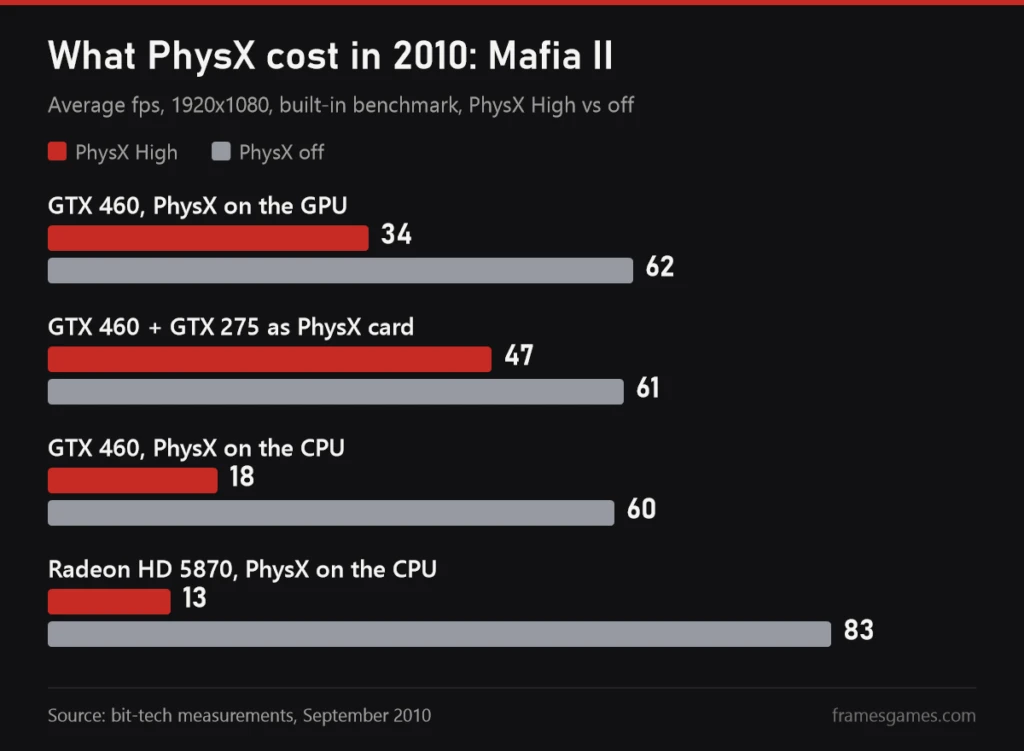
Looking back, the reasons are fairly mundane. The effects only worked on GeForce cards, so a studio was building extras for part of its PC audience, and for nobody on consoles. NVIDIA made it worse in 2009 by blocking GPU PhysX whenever an AMD card was in the system, which killed the idea of a Radeon for graphics plus a cheap GeForce for physics. A community hack to get around it appeared within two weeks.
Then there was the cost, as you can see above. PhysX High halved the frame rate of a mid-range GeForce in 2010, and on a Radeon it was a slideshow. Many players switched it off, and once consoles got strong CPUs, studios moved physics to the processor where it worked for everybody. The Witcher 3 is a good example: it uses PhysX cloth and destruction, but all on the CPU, for NVIDIA and AMD alike. Unreal Engine 5 has its own Chaos physics. In April 2025 Tom's Hardware put it bluntly: for games, PhysX is mostly a dead technology.
I find that a bit sad, to be honest. A modern game will happily render ray traced reflections in a puddle, but you rarely see a stack of newspapers flying apart the way they did in Arkham City in 2011.
RTX 50 dropped 32-bit PhysX: what broke and what NVIDIA brought back
In January 2025 NVIDIA updated a short support article: "CUDA Driver will not support 32-bit CUDA applications on GeForce RTX 50 series (Blackwell) and newer architectures." PhysX was not mentioned, but almost every classic PhysX game is a 32-bit program. In February 2025 owners of the new cards noticed that Mafia II, Borderlands 2 and Mirror's Edge suddenly ran PhysX on the processor. A list of 42 affected games, compiled by a ResetEra user, went around the press (NVIDIA itself never published one).
The numbers in the chart above come from GamersNexus, measured in March 2025 before any fix. The RTX 5080 with PhysX on gave 30.3 fps in Mafia II, while the same card with an old GTX 980 handling PhysX gave 164.
On 4 December 2025 driver 591.44 added custom support for nine games. This is a per-game list, not a return of 32-bit CUDA:
- Alice: Madness Returns
- Assassin's Creed IV: Black Flag
- Batman: Arkham City and Batman: Arkham Origins
- Borderlands 2
- Mafia II
- Metro 2033 and Metro: Last Light
- Mirror's Edge
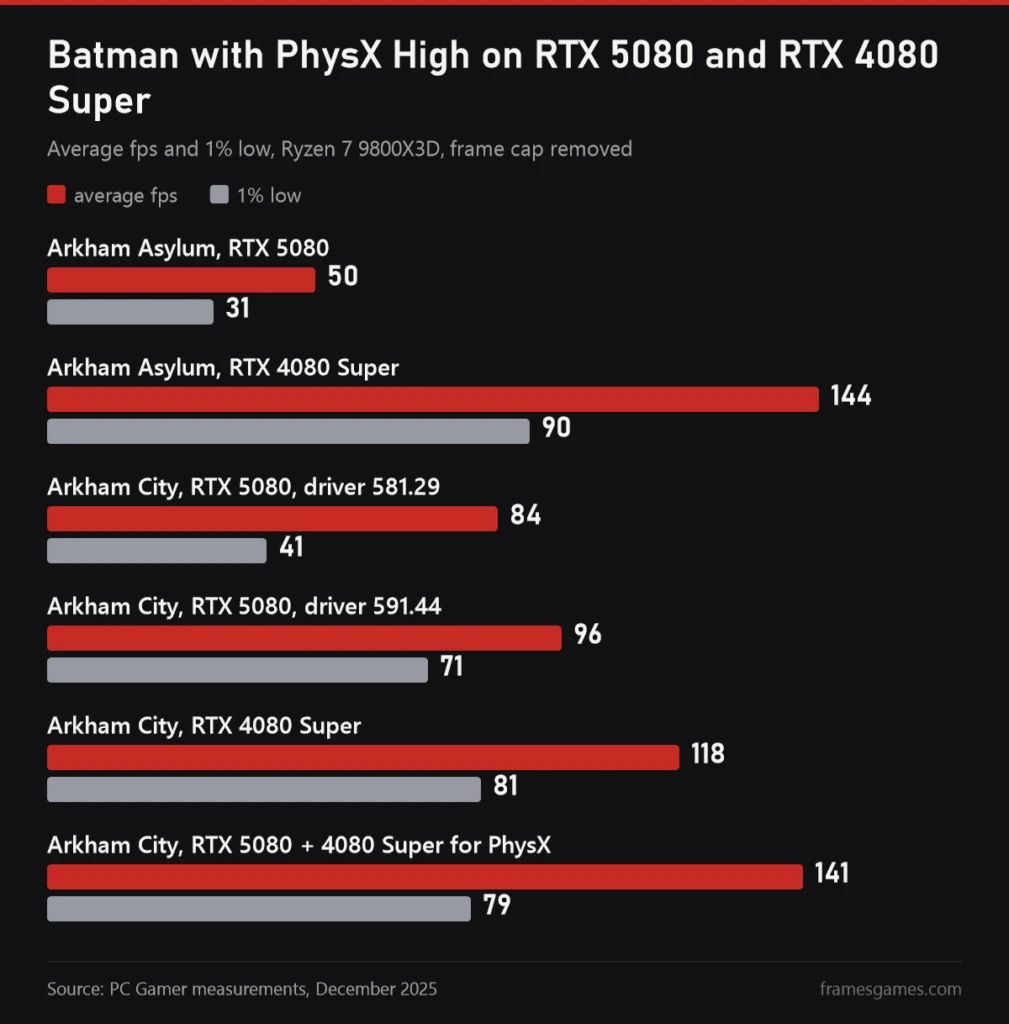
PC Gamer's December 2025 tests show the fix helps but does not make RTX 50 equal to the previous generation: Arkham City on the RTX 5080 went from 84 to 96 fps, while the RTX 4080 Super did 118. Arkham Asylum, Cryostasis, Unreal Tournament 3, Sacred 2, Dark Void, Blur, The Bureau and the rest of the 32-bit games still run PhysX on the CPU on RTX 50 cards.
One more option appeared in June 2026: ZLUDA v6, an open-source CUDA layer, added early 32-bit PhysX support, and it even works on AMD cards. In a test reported by PC Games Hardware, Mafia II on a Radeon RX 9070 XT went from 26.2 fps to 80.2. It is pre-alpha, fluids can glitch, and the project lost its funding the same week, so treat it as an experiment, not a fix.
How to turn PhysX on, and what to pick: GPU or CPU
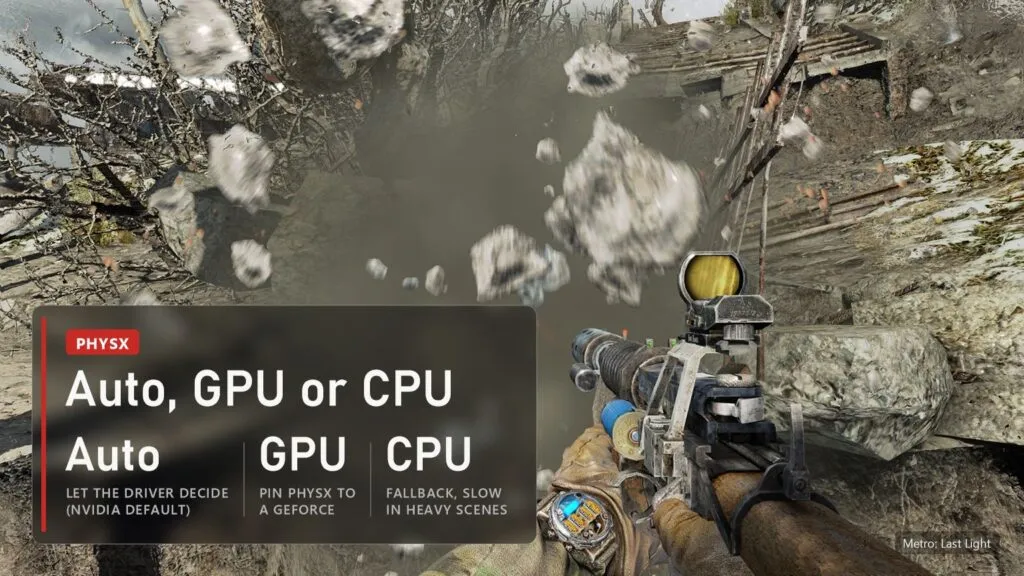
PhysX has two switches: one in the game, one in the driver. Both have to agree.
- In the driver. Open NVIDIA Control Panel, go to "Set PhysX configuration" and leave it on Auto-select, which NVIDIA marks as recommended. Pick your GeForce by name only if you have two cards and want one of them to do PhysX. CPU forces everything onto the processor.
- Check that it works. In the same panel's menu, under 3D Settings, enable "Show PhysX Visual Indicator". In the game, a corner label shows "PhysX > GPU" or "PhysX > CPU". No label means the game is not using PhysX acceleration at all.
- In the game. Set PhysX to High or Normal in the graphics menu. Some games call it APEX PhysX or Hardware PhysX.
- Keep the runtime installed. The latest PhysX System Software is 9.23.1019 from May 2024. It is harmless and old games need it, so there is no reason to uninstall it.
| Your card | What to do |
|---|---|
| GeForce GTX 900 to RTX 40 | Auto-select, PhysX High in the game. Everything runs on the GPU as it always did. |
| RTX 50, game on NVIDIA's list of nine | Driver 591.44 or newer, Auto-select, PhysX High. |
| RTX 50, any other 32-bit game (Arkham Asylum, Cryostasis) | PhysX Normal or Off, or a second older GeForce set as the PhysX processor. |
| AMD Radeon or Intel Arc | GPU PhysX never worked. Some games run the effects on the CPU, slowly. ZLUDA v6 is an experimental option. |
The second-card trick still works on RTX 50, as long as the helper is an RTX 40 or older GeForce. One Reddit user put an RTX 3050 next to an RTX 5090 and reported Mafia II going from 28.8 to 157.1 fps (that is a single owner's numbers, not a lab test). Note that NVIDIA ended Game Ready support for the GTX 900 and 10 series in the same December 2025 driver cycle, so a GTX 980 helper will not get new drivers.
Mafia II "PhysX SDK not initialized": how to fix it
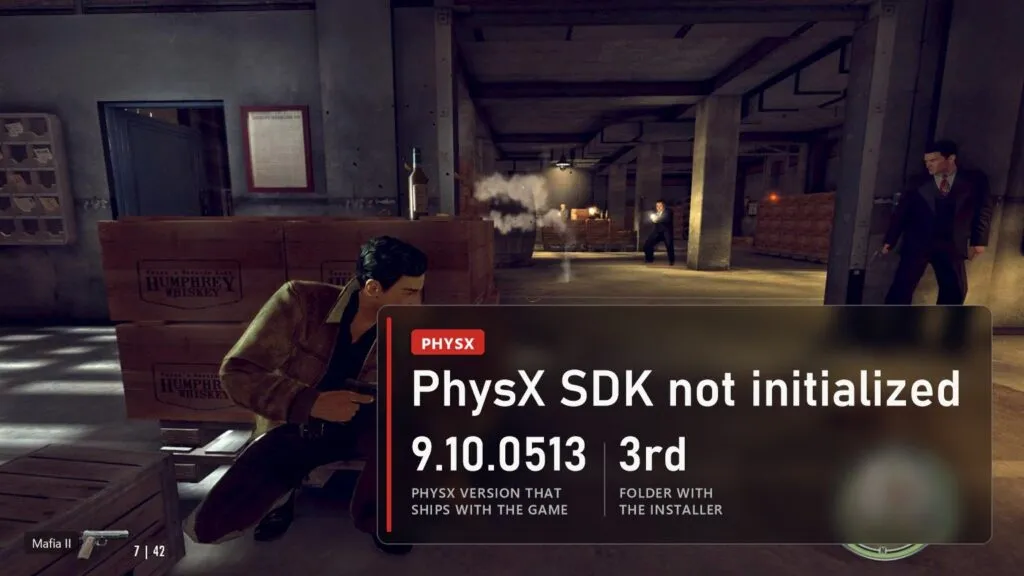
This error shows up in Mafia II Classic when the old PhysX runtime the game expects is missing. The most common fix among Steam players is to install the runtime that ships with the game:
- Open the game folder. In Steam, right-click Mafia II, choose Manage, then Browse local files.
- Go to the 3rd folder and run
PhysX_9.10.0513_SystemSoftware.msi. - Start the game again. If it still complains, install the current PhysX System Software 9.23.1019 from NVIDIA's site on top.
- If it crashes with APEX on, players report that lowering APEX PhysX to Medium or Off, or capping the frame rate below 100 fps, helps.
You may see advice to install the PhysX Legacy System Software 9.13.0604. NVIDIA describes it as a package for games built on PhysX SDK 2.7.0 and older, roughly 2007 and earlier, so it is not meant for Mafia II.
Every GPU PhysX game worth knowing, and how it runs today
| Game | Year | What GPU PhysX added | On RTX 50 today |
|---|---|---|---|
| Cryostasis: Sleep of Reason | 2008 | Water as a fluid, cloth, heat | CPU only, not on sale since 2013 |
| Mirror's Edge | 2009 | Glass shards, tearing cloth, smoke | Fixed by driver 591.44 |
| Batman: Arkham Asylum | 2009 | Fog with a wake, paper, cloth, breaking tiles | CPU only, support promised for 2026 |
| Darkest of Days | 2009 | Debris, smoke, leaves | CPU only |
| Sacred 2 | 2008 | Particles, leaves and rocks (patch) | CPU only |
| Mafia II (Classic) | 2010 | Cloth on clothes, debris, crumbling walls | Fixed by driver 591.44 |
| Metro 2033 | 2010 | Debris, smoke | Fixed by driver 591.44, Redux is 64-bit |
| Dark Void | 2010 | Smoke, jetpack trails | CPU only |
| Alice: Madness Returns | 2011 | Black goo fluid, smoke, debris | Fixed by driver 591.44 |
| Batman: Arkham City | 2011 | Newspapers, bank notes, fog, glass | Fixed by driver 591.44 |
| Borderlands 2 | 2012 | Fluids, tearing cloth, debris, vortexes | Fixed by driver 591.44 |
| Hawken | 2012 | Mech debris, steam, destruction | Servers shut in 2018 |
| Metro: Last Light | 2013 | Debris with shadows, fog, cloth, destruction | Fixed by driver 591.44, Redux is 64-bit |
| The Bureau: XCOM Declassified | 2013 | Turbulence particles, cloth | CPU only |
| Batman: Arkham Origins | 2013 | Snow, smoke, cloth flags | Fixed by driver 591.44 |
| Assassin's Creed IV: Black Flag | 2013 | Thick smoke, particles with shadows | Fixed by driver 591.44 |
| Borderlands: The Pre-Sequel | 2014 | Denser fluids, up to 56,000 particles | No reliable data |
| Lords of the Fallen | 2014 | Fog pushed by the player, cloth | Not on the 32-bit list |
| Batman: Arkham Knight | 2015 | Fog and smoke, paper, destruction | 64-bit, works |
| Killing Floor 2 | 2015 | FleX bile and blood | Not on the 32-bit list |
| Fallout 4 | 2016 patch | FleX weapon debris | Crashes on RTX cards, keep it off |
The short version
- GPU PhysX added the small things: paper, smoke, cloth, debris, water. From 2008 to 2015 it made a few games on GeForce look a generation ahead.
- It faded because it only worked on GeForce, cost a lot of frames, and consoles could not run it.
- On RTX 50 cards, nine popular games got GPU PhysX back with driver 591.44. Arkham Asylum and the rest still run it on the CPU.
- Want to see it at its best? Arkham City and Borderlands 2 on any GeForce with PhysX High. Bring a dedicated old GeForce if you are on RTX 50 and love Arkham Asylum.
What does PhysX actually do in a game?
It calculates extra physics: debris, tearing cloth, particle smoke and fog, fluids. With GPU PhysX on a GeForce those objects appear in the game. With it off they are missing or painted into textures.
Does PhysX work on AMD Radeon?
GPU PhysX never did. Some games, like Borderlands 2, can run the effects on the CPU, but heavy scenes slow down a lot. ZLUDA v6 (June 2026) runs 32-bit PhysX on Radeon experimentally.
Why does PhysX run badly on my RTX 5090 or RTX 5080?
RTX 50 cards do not support 32-bit CUDA, which most PhysX games use. Driver 591.44 restored GPU PhysX for nine games only. For the rest, lower PhysX or add an older GeForce as a PhysX card.
Should I pick GPU or CPU for PhysX in NVIDIA Control Panel?
Leave it on Auto-select. Pick a specific GeForce only if you have two cards. CPU is only worth it for testing.
What does "PhysX > CPU" in the corner of the screen mean?
That is NVIDIA's PhysX Visual Indicator. It shows that the game is calculating PhysX on the processor. You turn it off in NVIDIA Control Panel, in the 3D Settings menu.
Is HairWorks part of PhysX?
No. HairWorks, used for hair and fur in The Witcher 3 and Call of Duty: Ghosts, is a separate NVIDIA GameWorks feature.
Sources
History: Game Developer on Ageia and NovodeX, bit-tech review of the BFG PhysX card, TechPowerUp on the Ageia purchase, PC Perspective on GPU PhysX for GeForce, Tom's Hardware on the AMD block, CG Channel on the 2018 open-source release, NVIDIA on the GPU source release.
Games: PC Games Hardware on the Cryostasis tech demo, Delisted Games on Cryostasis, NVIDIA and DICE GDC 2009 talk, Tom's Hardware on Arkham Asylum, bit-tech Mafia II PhysX performance, NVIDIA on Alice fluids, NVIDIA Arkham City guide, NVIDIA Borderlands 2 guide, TechSpot Borderlands 2, PC Perspective Borderlands 2, NVIDIA Metro: Last Light guide, NVIDIA Arkham Origins guide, NVIDIA Black Flag guide, DSOGaming on Arkham Knight, PCGamesN on Fallout 4, Warframe patch notes 22.20.0.
RTX 50: NVIDIA support plan for 32-bit CUDA, TechPowerUp with the list of 42 games, GamersNexus tests, NVIDIA driver 591.44 notes, PC Gamer tests, Tom's Hardware on the second-card fix, Tom's Hardware on ZLUDA v6, PC Games Hardware on ZLUDA in Mafia II.
Setup and fixes: NVIDIA Control Panel help, PhysX System Software 9.23.1019, PhysX Legacy 9.13.0604, Steam discussion of the Mafia II error. Screenshots from NVIDIA GeForce guides and the games' Steam pages, charts by FramesGames from the numbers named on each chart.