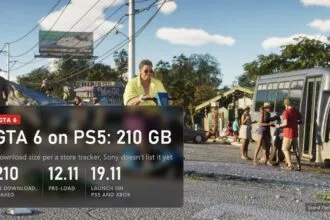
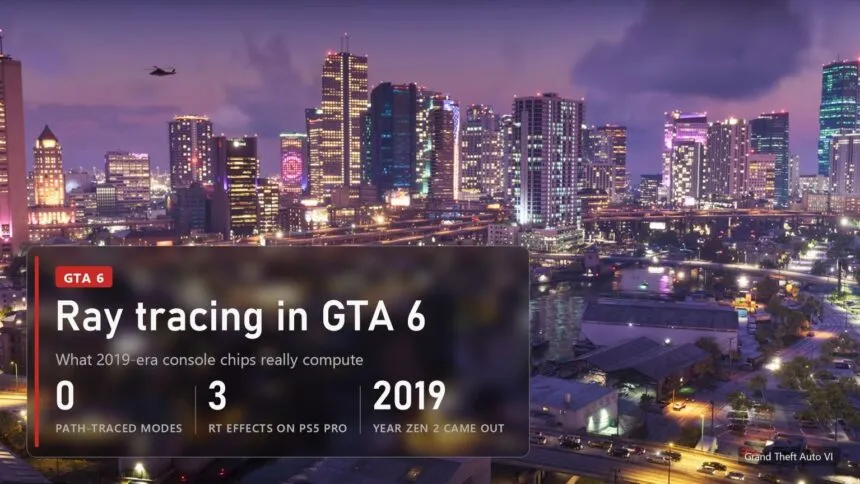
GTA 6 looks like a path-traced game, and that's how a lot of people describe it. It isn't one. On consoles Rockstar uses hybrid ray tracing: rays handle global illumination and reflections on every machine, and the PS5 Pro adds ray-traced shadows. Everything else is still drawn the classic way. That it works at all is the impressive part, because inside a PS5 or Xbox Series sits an 8-core Zen 2 processor, an architecture AMD launched in 2019, and AMD's first generation of hardware ray tracing. Below is what exactly the consoles compute with rays, how Rockstar fits it into 30 frames per second, and why real path tracing has to wait for the next generation.
- What GTA 6 actually ray traces, console by console
- The "2019 hardware": what's inside the consoles
- How Rockstar fits it into 30 frames per second
- PS5 Pro: the only console with ray-traced shadows
- Xbox Series S: ray tracing on 20 compute units
- What path tracing is, and why GTA 6 doesn't use it
- When consoles will get path tracing
- Quick answers
- In short
Read next:
What GTA 6 actually ray traces, console by console
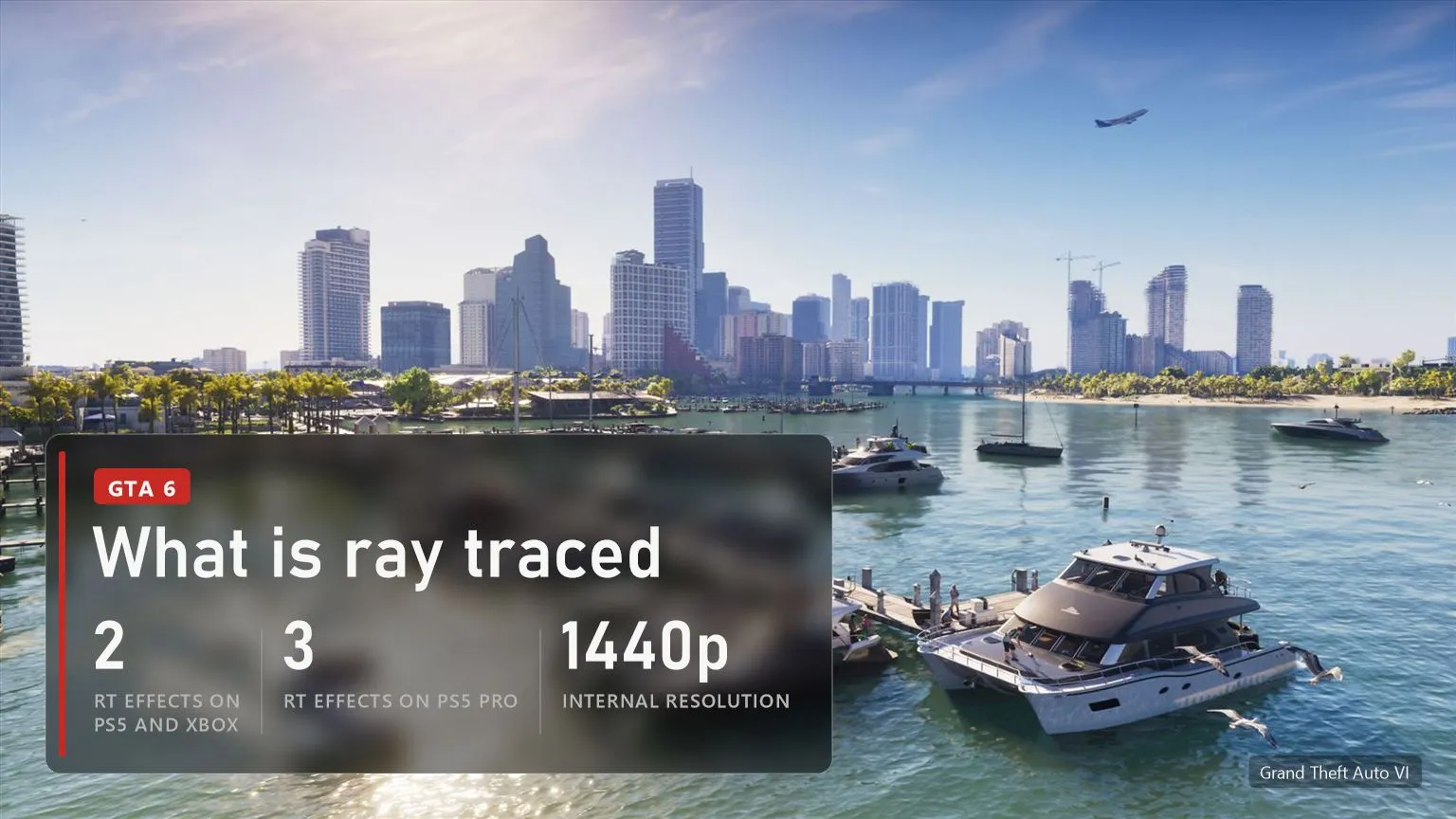
| Console | Ray-traced global illumination | Ray-traced reflections | Ray-traced shadows | Internal resolution |
|---|---|---|---|---|
| PS5 Pro | yes | yes | yes, Pro only | 1440p, near 4K through PSSR |
| PS5 | yes | yes | no, shadow maps | 1440p |
| Xbox Series X | yes | yes | no, shadow maps | about 1440p |
| Xbox Series S | yes | yes | no, shadow maps | 720p, about 1080p through FSR 4 |
Global illumination is the big one. It's the light that bounces: sunlight off a pink wall that tints a face, a neon sign that colors the wet street, the dim light under a pier. In older games artists baked this into textures ahead of time, and it couldn't react when the sun moved or a car parked in the wrong place. In GTA 6 it's computed with rays as you play, which is why time of day and weather change the whole look of a street. Reflections in windows, cars and puddles are traced as well. Digital Foundry called it "arguably the best implementation of ray tracing seen to date".
What isn't traced on the regular consoles: direct sunlight and the main shadows. According to Digital Foundry's analysis of the gameplay footage, they use classic shadow maps with variable soft edges. That's exactly what the PS5 Pro replaces with rays.
The "2019 hardware": what's inside the consoles
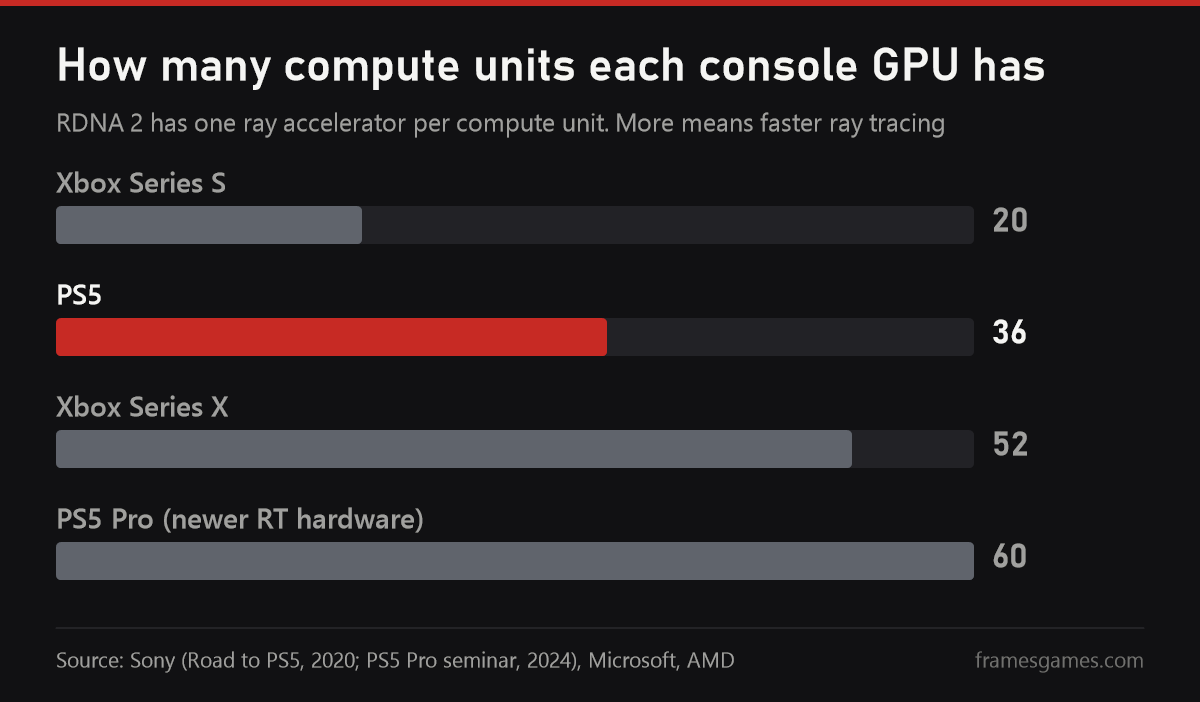
Both console families came out in November 2020, but their processor is older. All of them use eight Zen 2 cores, the architecture AMD first shipped in Ryzen 3000 desktop chips in July 2019. The PS5's runs at up to 3.5 GHz, the Series X's at up to 3.8 GHz. The graphics are RDNA 2, AMD's first architecture with hardware ray tracing, the same generation as the Radeon RX 6000 cards.
That first generation is the key limit. Each compute unit in RDNA 2 has one ray accelerator, which only checks whether a ray hits a box or a triangle. Walking the tree of boxes that describes the scene is left to the regular shader cores, which are busy drawing the frame at the same time. The PS5 has 36 compute units at up to 2.23 GHz, about 10.3 teraflops, the Series X has 52 and about 12 teraflops, and the Series S only 20 and 4 teraflops. In other words, the base PS5 sits roughly at the level of a mid-range Radeon RX 6000 card, and Rockstar built a 2026 game around it.
How Rockstar fits it into 30 frames per second
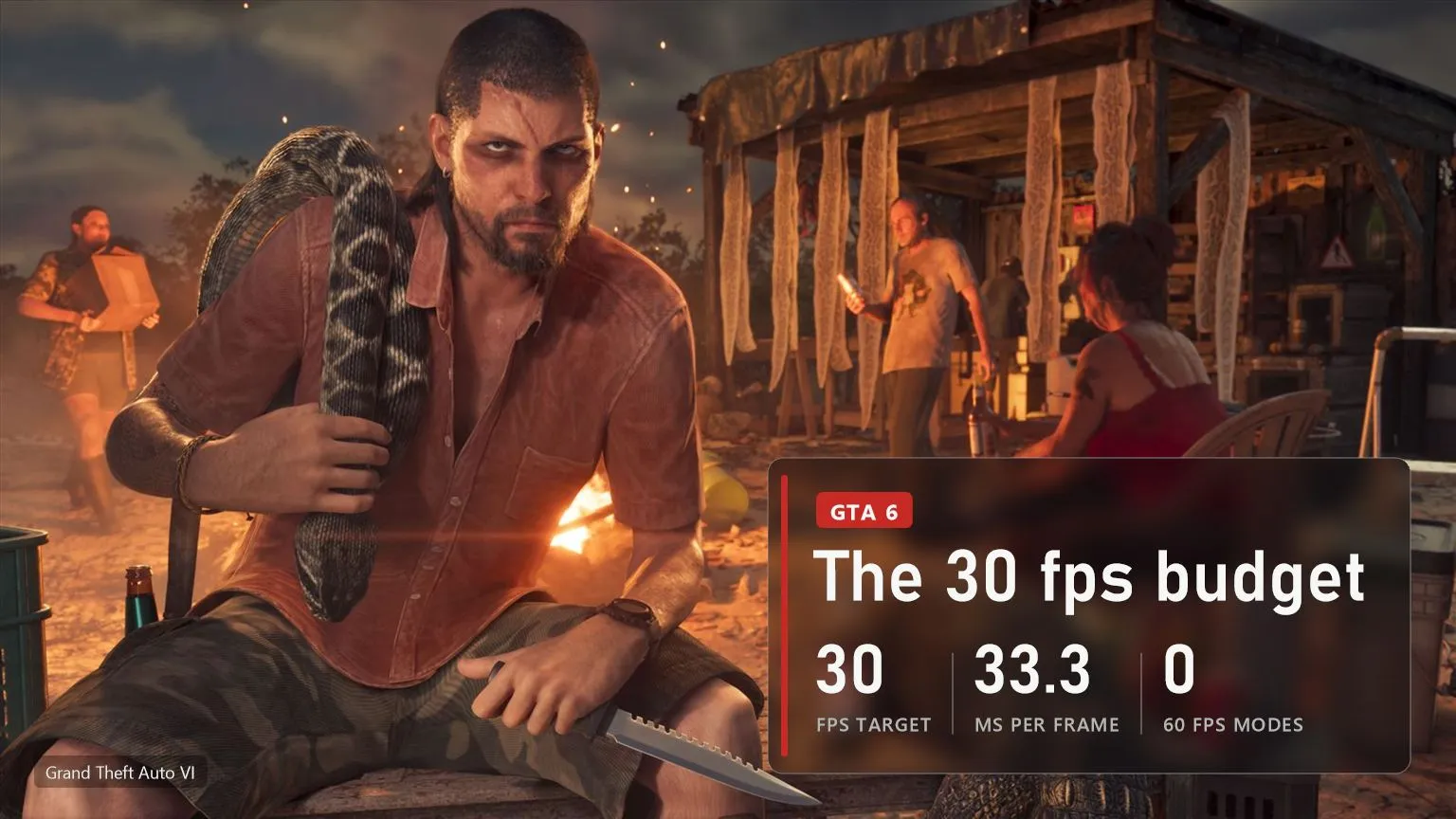
The short answer: by spending everything on the image and nothing on frame rate. At 30 fps each frame gets 33.3 milliseconds instead of 16.7 at 60, twice the time for rays and denoising. Rockstar confirmed before launch that the game targets 30 fps on every console, and there's no 60 fps mode on any of them, not even the Pro.
- Fewer pixels, then upscaling. The image is rendered at 1440p on PS5 and Series X instead of 4K, a bit less than half the pixels, and stretched afterwards.
- Rays only where they show the most. Bounced light and reflections get rays, while the sun's shadows stay on shadow maps, which are much cheaper.
- The processor is the other wall. Digital Foundry named the demanding hair system as one of the reasons a 60 fps mode wasn't possible, and its earlier analysis pointed to the heavy load on the Zen 2 cores: crowds, traffic, physics and the police AI all run on them.
The price shows in heavy scenes. In Digital Foundry's worst case, a grenade launcher rampage on a busy street, the base PS5 drops to 23 fps and the Series X to about 20.
PS5 Pro: the only console with ray-traced shadows
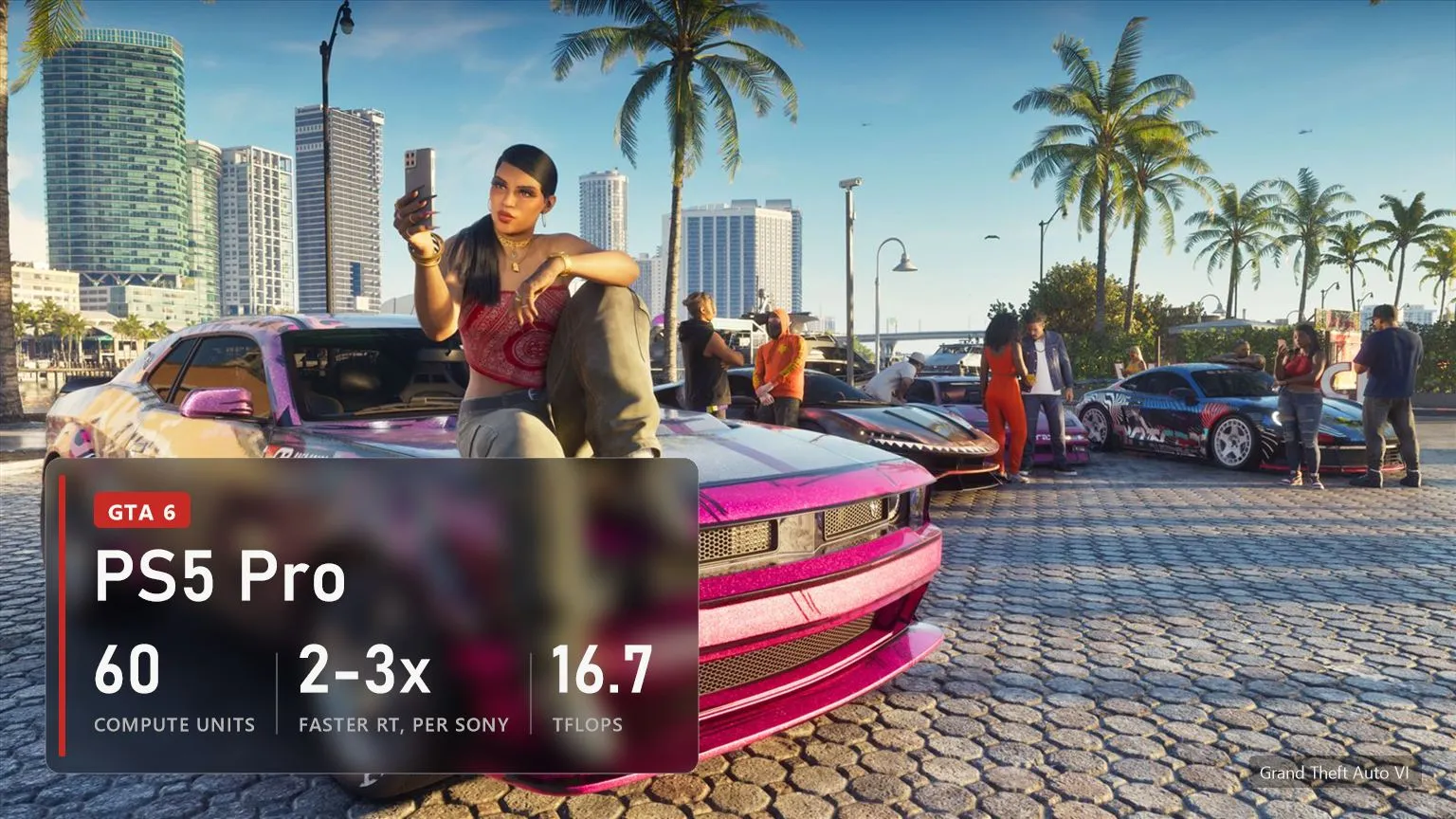
The Pro isn't simply a bigger PS5. Sony's lead architect Mark Cerny explained in December 2024 that its GPU sits between RDNA 2 and RDNA 3, while the ray tracing hardware comes from the next step of AMD's roadmap: the intersection engine is twice as fast and the scene boxes are packed in larger groups. Sony puts the Pro at 2 to 3 times faster in ray tracing than the PS5, with 60 compute units instead of 36 and 16.7 teraflops.
Rockstar spends that extra power on shadows: only the Pro version traces them, which, as Digital Foundry noted, removes the blocky shadow edges visible on the base PS5. Resolution stays the same 1440p, but the PSSR upscaler brings it close to 4K, and the 30 fps holds almost perfectly.
Xbox Series S: ray tracing on 20 compute units
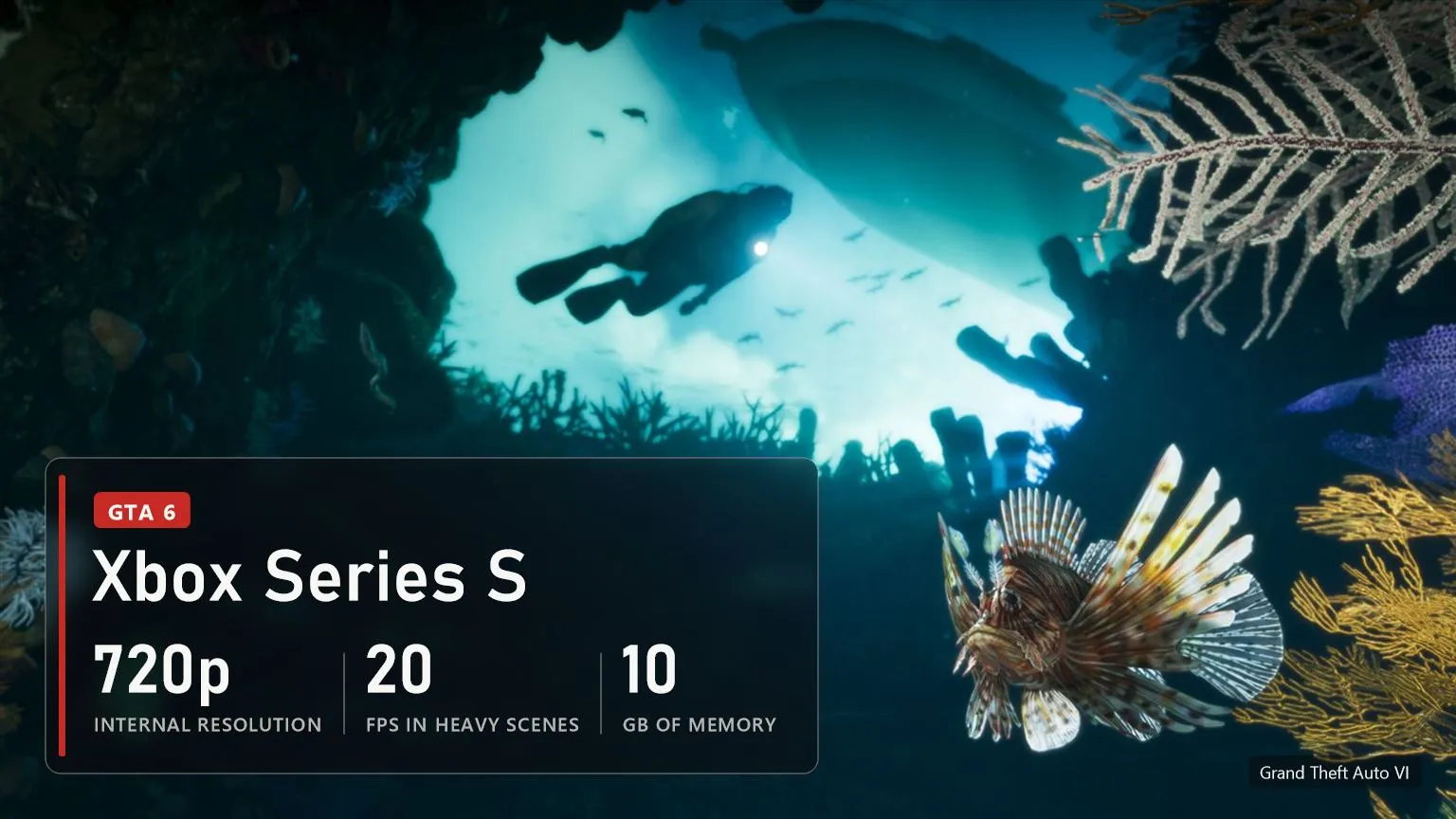
Before release some analysts expected the Series S to lose ray-traced lighting altogether and fall back to baked light. That didn't happen: according to Digital Foundry, all console versions keep ray-traced global illumination and reflections. The cost was paid in resolution instead. The Series S renders at 720p and uses FSR 4 to reach about 1080p, and even then it often misses 30 fps, dropping to about 20 in the heaviest scenes. Digital Foundry suspects its 10 GB of memory, but that's a hypothesis, not an established cause.
What path tracing is, and why GTA 6 doesn't use it
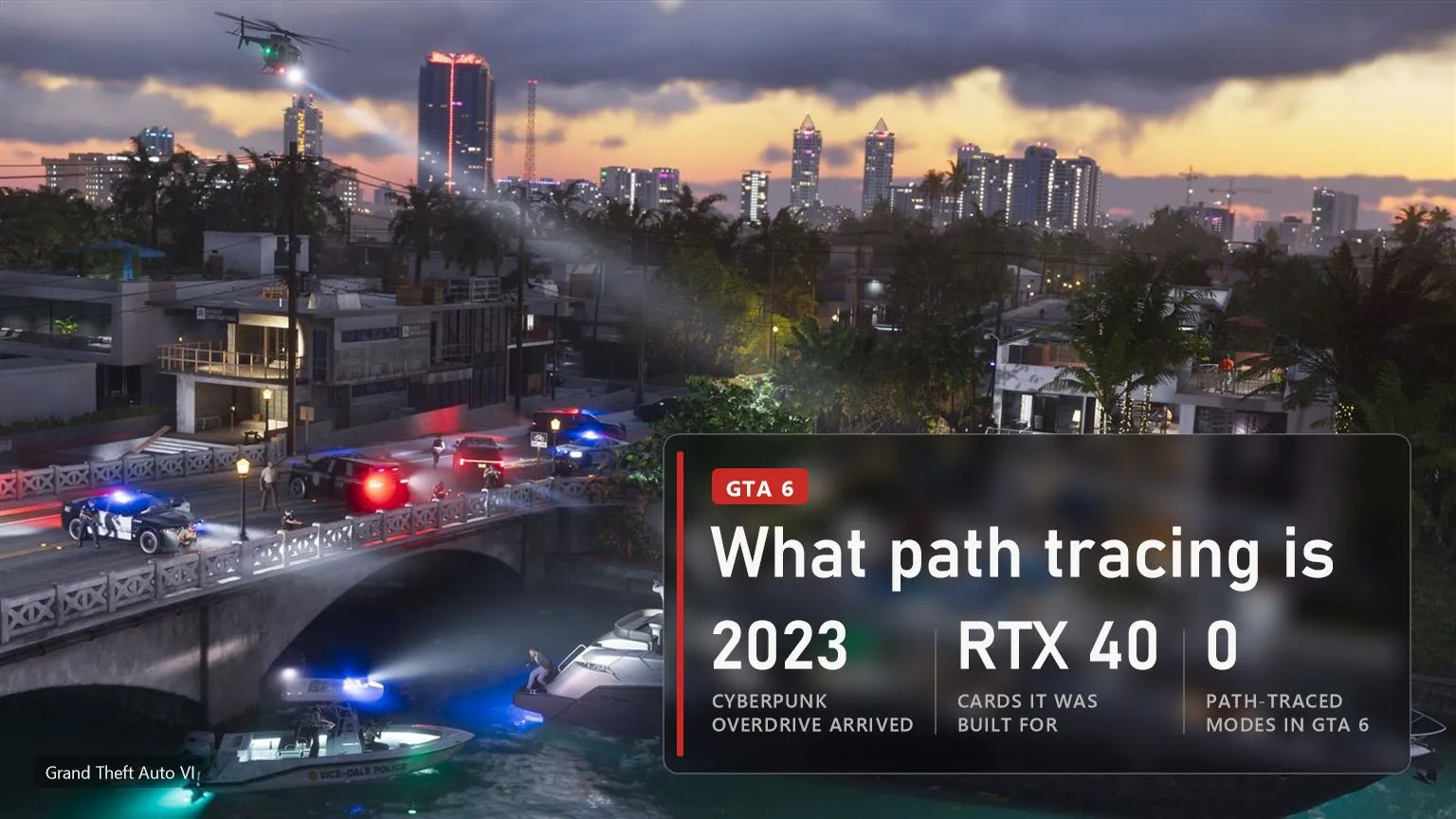
In hybrid ray tracing the game is drawn the classic way, and rays are added for separate effects: here the bounced light, there the reflections. Path tracing works differently: almost all the lighting in the frame, direct light, shadows, reflections and several bounces, comes from one simulation of light paths. The picture becomes more consistent, but it costs many times more rays per pixel.
On PC this mode arrived in 2023, when Cyberpunk 2077 got its RT Overdrive mode, and NVIDIA built it for RTX 40 cards with frame generation. A console with first-generation AMD ray tracing and a 2019 processor can't pull that off at a playable frame rate, even at 30 fps. So when you see "GTA 6 path tracing" in a video title, it's either a misnomer for the game's ray-traced lighting or a guess about a future PC version. Rockstar hasn't announced a PC version or any of its settings.
When consoles will get path tracing
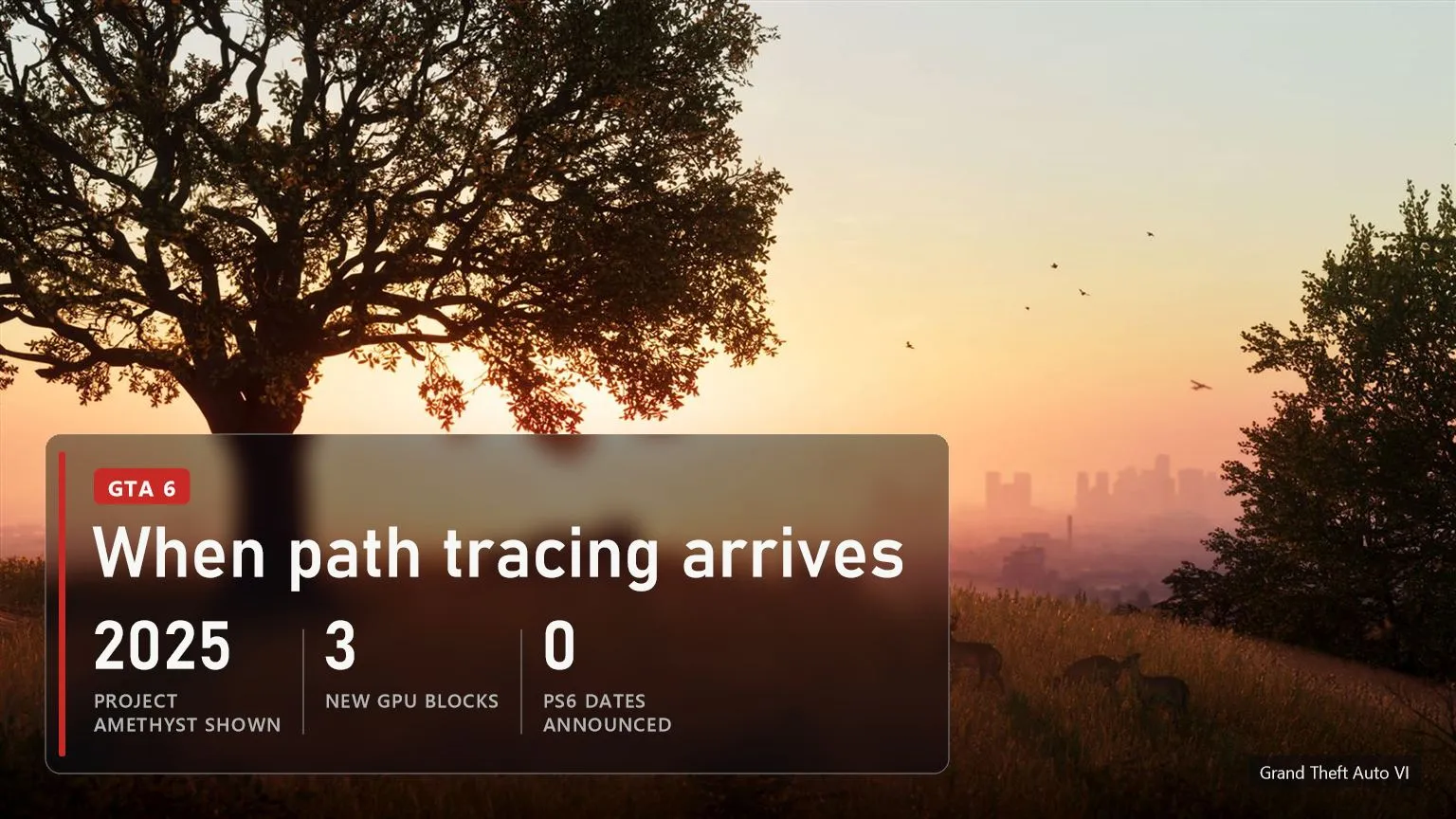
Not in this generation. In October 2025 Cerny and AMD's Jack Huynh presented Project Amethyst, a joint effort for future hardware. Its centerpiece is Radiance Cores, a separate block that takes over the walk through the scene from the shader cores. That's exactly the work RDNA 2 still dumps on the shaders today. Next to it are Neural Arrays for machine learning and Universal Compression for memory. Huynh described the radiance block as built for "unified light transport", which is path tracing. Cerny spoke of a "future console in a few years' time". Sony hasn't announced a date for any such console yet.
Quick answers
Does GTA 6 use path tracing?
No. On consoles it uses hybrid ray tracing: ray-traced global illumination and reflections everywhere, plus ray-traced shadows on PS5 Pro. The rest of the image is rasterized.
Does GTA 6 have ray tracing on the base PS5 and Xbox Series S?
Yes. Every console version has ray-traced global illumination and reflections, Series S included. Only the shadows are ray traced on PS5 Pro alone.
Can you turn ray tracing off for 60 fps?
No. There are no graphics modes: every console runs at 30 fps with ray tracing on. Digital Foundry names the processor load, including the hair simulation, among the reasons 60 fps wasn't possible.
Why is it called 2019 hardware?
The consoles came out in 2020, but their Zen 2 processor architecture debuted in July 2019, and their RDNA 2 graphics are AMD's first generation with hardware ray tracing.
Will the PC version have path tracing?
Unknown. Rockstar hasn't announced a PC version at all. Path tracing is technically possible on modern PC cards, but any claims about GTA 6 settings on PC are guesses for now.
In short
- GTA 6 doesn't use path tracing. It traces bounced light and reflections, and shadows on PS5 Pro.
- The consoles run on 2019's Zen 2 cores and AMD's first-generation ray tracing.
- Rockstar pays for the rays with 30 fps and 1440p, or 720p on Series S.
- The PS5 Pro has newer ray tracing hardware and the only ray-traced shadows.
- Real path tracing on consoles is a job for the next generation and AMD's Radiance Cores.
Sources
Ray-traced effects per console, resolutions, frame rates and the best-ray-tracing quote: Digital Foundry, Grand Theft Auto VI tech review, November 18, 2026, as reported by KitGuru, VGTimes and Consolyte. Shadow maps on base consoles and the Zen 2 load: Digital Foundry's analysis of the extended gameplay look, as reported by GameGPU on August 28, 2026. The hair system and 60 fps: VGTimes, November 18, 2026. PS5 Pro ray-traced shadows and the 30 fps target: Rockstar Games press release, as quoted by BGR on November 12, 2026. Series S expectations before release: GameGPU, May 17, 2026. PS5 specifications: Sony, Road to PS5, March 2020. Xbox Series X and S specifications: Microsoft. Zen 2 and RDNA 2 launch dates and the ray accelerator design: AMD. PS5 Pro architecture and the 2-3x figure: Sony PS5 Pro technical seminar with Mark Cerny, December 2024, PlayStation Blog, Tom's Hardware and PC Gamer. Project Amethyst: Sony and AMD video, October 2025, as reported by Tom's Hardware, PC Gamer and HotHardware. Cyberpunk 2077 RT Overdrive: CD Projekt RED and NVIDIA, April 2023. Screenshots: Rockstar Games, official GTA VI gallery.