The question "what PC do I need for 4K" has an unpleasant answer in 2026: almost nothing on the market delivers honest native 4K at sixty frames in new games, and what does costs as much as a used car. The good news is that this has not been the only route for a long time. Three builds, price per frame, and where the line of reason runs.
- The numbers first: what graphics cards actually deliver at 4K
- If you play online: the three most popular games on Steam
- Price per frame: where money turns into frames
- With ray tracing the picture is different
- Build one: 4K with compromises
- Build two: the sensible one
- Build three: the top of the reasonable
- What matters more than the graphics card
- The short answer
The numbers first: what graphics cards actually deliver at 4K
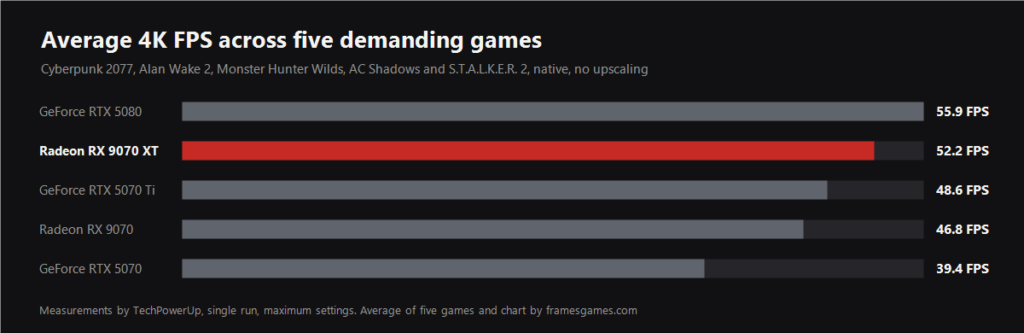
We took five demanding games from the TechPowerUp test suite, all from one run, 3840x2160, maximum settings, no upscaling.
| Game | RX 9070 | RX 9070 XT | RTX 5070 | RTX 5070 Ti | RTX 5080 |
|---|---|---|---|---|---|
| Cyberpunk 2077 | 57.1 | 63.4 | 49.1 | 57.8 | 69.6 |
| Alan Wake 2 | 52.2 | 58.6 | 41.6 | 52.9 | 60.5 |
| Monster Hunter Wilds | 41.3 | 45.8 | 34.3 | 43.2 | 48.4 |
| Assassin's Creed Shadows | 45.0 | 50.7 | 32.3 | 40.5 | 46.7 |
| S.T.A.L.K.E.R. 2 | 38.5 | 42.3 | 39.5 | 48.5 | 54.5 |
| Average | 46.8 | 52.2 | 39.4 | 48.6 | 55.9 |
The main conclusion is immediate: not one of these cards holds a steady 60 frames at 4K without upscaling. Even the RTX 5080 at fifteen hundred dollars averages 55.9. The conversation about native 4K in new games ends here, and from now on we are talking about 4K with an upscaler, where the game renders at roughly 1440p.
An important caveat: every number above is without ray tracing. We deliberately used the raster runs, because that is how most people actually play at 4K. With ray tracing on the picture changes, and there is a separate section on that below.
One curiosity: in Assassin's Creed Shadows the Radeon RX 9070 XT with its 50.7 frames beats the RTX 5080 at 46.7. That is not a rule, it is a quirk of that particular game, but it shows how much wider the spread between titles is than people assume.
If you play online: the three most popular games on Steam
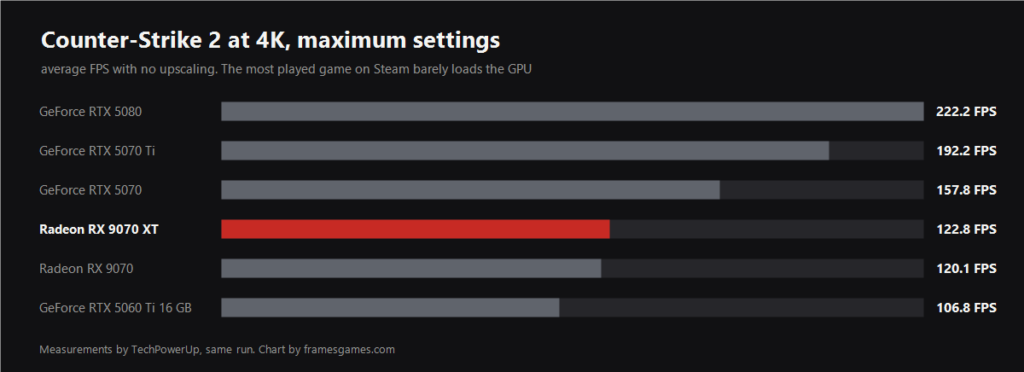
It is important not to confuse demanding games with popular ones. Here are the top three on Steam by peak concurrent players, taken from the official store API.
| Game | Peak players | What 4K needs |
|---|---|---|
| Counter-Strike 2 | 1,167,095 | any card in this article, the counts run into the hundreds |
| Dota 2 | 898,504 | the GPU is barely loaded, the CPU is the limit |
| PUBG: BATTLEGROUNDS | 735,209 | a card at the RX 9070 level handles 4K with plenty of room |
The only one of the three that TechPowerUp does test is Counter-Strike 2, and its numbers say everything: the RTX 5080 delivers 222 frames, the Radeon RX 9070 XT 123, and even the junior RTX 5060 Ti holds 107. That is at 4K on maximum settings.
The practical conclusion is honest and unprofitable for a hardware site to print: if you only play online games, none of the builds in this article are for you. Any current mid-range card and a good monitor will do. The builds below make sense only if your library contains single-player blockbusters.
Price per frame: where money turns into frames
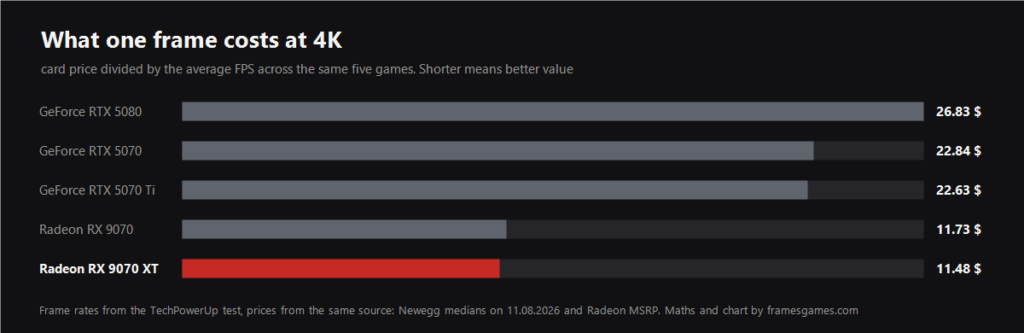
Now the part everything was counted for. Take the median retail price of the card and divide it by its average FPS at 4K.
| Graphics card | Average FPS at 4K | Price | Price per frame |
|---|---|---|---|
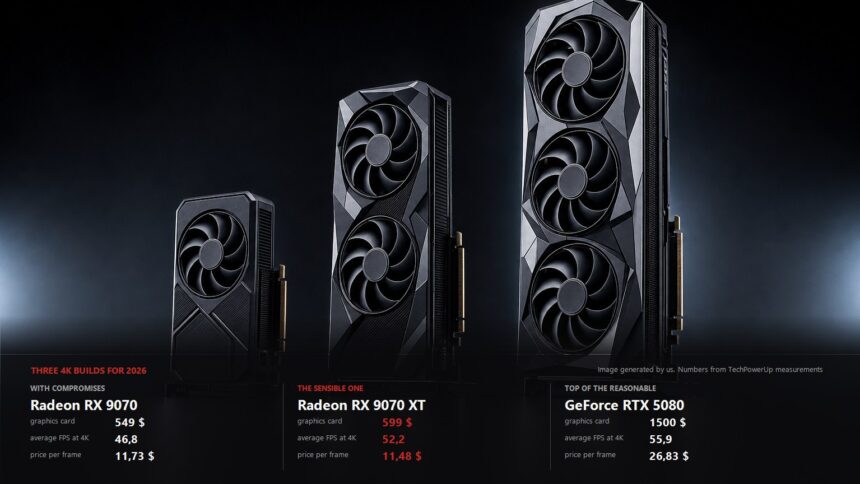
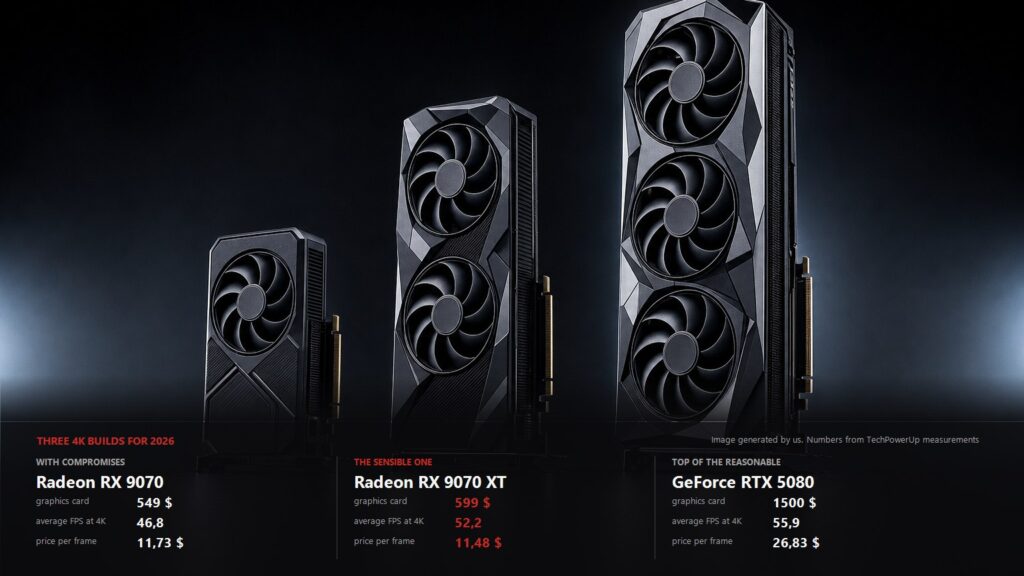
| Radeon RX 9070 XT | 52.2 | 599 $ | 11.48 $ |
| Radeon RX 9070 | 46.8 | 549 $ | 11.73 $ |
| GeForce RTX 5070 Ti | 48.6 | 1100 $ | 22.63 $ |
| GeForce RTX 5070 | 39.4 | 900 $ | 22.84 $ |
| GeForce RTX 5080 | 55.9 | 1500 $ | 26.83 $ |
The gap is exactly twofold. Both Radeons cost around 11.5 dollars per frame, every GeForce lands between 22.6 and 26.8. For the same money you get half the frames.
We leave the RTX 5090 out of the comparison deliberately. The card has long since passed every reasonable boundary: even the most optimistic pricing talks about three thousand dollars, and the retail median per TechPowerUp is 4700. For reference, in Cyberpunk 2077 at 4K it delivers 108.8 frames, which is 43.2 dollars per frame against 9.45 for the RX 9070 XT in the same game. That is not a gaming build, it is a separate category of purchase, and comparing it on price per frame is pointless.
With ray tracing the picture is different
Everything above is raster. If you turn ray tracing on, the order of the cards changes, and you should know that before buying. From the TechPowerUp summary at 4K with ray tracing, where the Radeon RX 9070 is taken as one hundred percent:
| Graphics card | Relative speed with ray tracing |
|---|---|
| GeForce RTX 5080 | 139 percent |
| GeForce RTX 5070 Ti | 122 percent |
| Radeon RX 9070 XT | 111 percent |
| Radeon RX 9070 | 98 percent |
| Radeon RX 7900 XTX | 97 percent |
| GeForce RTX 5070 | 72 percent |
What matters here. In raster the Radeon RX 9070 XT was ahead of the RTX 5070 Ti, with ray tracing it falls behind: 111 against 122. So if ray tracing is a must for you, the Radeon price per frame advantage narrows.
The reverse is also true, and this part usually goes unmentioned: the RTX 5070 collapses to 72 percent with ray tracing, noticeably below the Radeon RX 9070 at 549 dollars. A nine hundred dollar card ends up slower than a 549 dollar one exactly where NVIDIA is supposed to be strong.
Build one: 4K with compromises
The goal here is simple: play at 4K on a large TV or monitor, accepting an upscaler and the fact that in the heaviest games a couple of settings will drop from maximum to high.
| Component | What to take | Why |
|---|---|---|
| Graphics card | Radeon RX 9070, 549 $ | 16 GB of memory, second best price per frame here, FSR 4 with machine learning |
| Processor | Ryzen 5 7600 or Core i5-13400 | at 4K the load sits on the GPU, a mid range CPU does not get in the way |
| Memory | 32 GB DDR5, two modules required | 16 GB is already thin in 2026, many games ask for 32 officially |
| Storage | 2 TB NVMe SSD | current games run 100 to 160 GB each, a terabyte holds four |
| Power supply | 750 W | headroom for later and quiet operation under load |
What you get: 46.8 frames on average natively, which means a confident 60 plus with FSR 4 in quality mode almost everywhere. In Counter-Strike 2 and similar, 120 frames with no upscaler at all.
What you give up: native rendering, and a couple of settings in Alan Wake 2 and Monster Hunter Wilds, where even with an upscaler you will be closer to 50.
Build two: the sensible one
This build differs from the first by one line, and that line delivers the best price per frame in the set.
| Component | What to take | Why |
|---|---|---|
| Graphics card | Radeon RX 9070 XT, 599 $ | 11.48 dollars per frame, the best figure here. Fifty dollars more buys twelve percent more frames |
| Processor | Ryzen 7 7800X3D or 9800X3D | if you also play at 1440p, the CPU difference already shows there |
| Memory | 32 GB DDR5-6000 CL30 | fast memory matters specifically with AMD processors |
| Storage | 2 TB NVMe SSD, PCIe 4.0 | PCIe 5.0 currently adds nothing in games except cost |
| Power supply | 850 W | headroom for a future graphics card upgrade |
What you get: 52.2 frames on average natively and a steady 70 plus with an upscaler in heavy games. That is the level at which you can stop thinking about settings.
Why this one: the fifty dollar premium over the RX 9070 pays for itself immediately, while the next step up costs twice as much for a seven percent gain. A detailed look at this card in one specific game is in our piece on S.T.A.L.K.E.R. 2 at 2K and 4K.
Build three: the top of the reasonable
Different logic here: squeeze out everything you can without leaving the bounds of common sense. Which is why this build has an RTX 5080 rather than the flagship.
| Component | What to take | Why |
|---|---|---|
| Graphics card | GeForce RTX 5080, 1500 $ | the highest average FPS here, 55.9 at 4K, and the best ray tracing speed |
| Processor | Ryzen 7 9800X3D | so that a card like this is not held back by the CPU |
| Memory | 32 GB DDR5-6000 | 64 makes sense only if there is work beyond games |
| Storage | 4 TB NVMe SSD | a library of 4K textures fills up fast |
| Power supply | 1000 W | headroom for consumption spikes |
What you get: 55.9 frames on average natively, so closer to 80 with an upscaler, plus solid ray tracing where the Radeons start to sag.
What you do not get: value. A frame here costs 26.83 dollars against 11.48 on the RX 9070 XT, so you pay twice as much per frame for a seven percent gain in average rate. That is a deliberate premium for the top tier, not a calculation.
Why not the RTX 5090. We excluded it. The median price is 4700 dollars, and even the most optimistic offers around three thousand put the card outside any reasonable boundary for a gaming build. At 43.2 dollars per frame it loses to everything in this article by a factor of four. Unless spending money is the point, there is no reason to look at it.
What matters more than the graphics card
An upscaler is not a crutch, it is the baseline setting for 4K. In 2026 nearly everyone plays at 4K with DLSS, FSR 4 or XeSS, flagship owners included. Which games support FSR 4 and how to switch it on is in our piece on FSR 4 and the full list of games. Owners of older cards have OptiScaler.
32 GB of system memory is no longer headroom, it is the norm. Several major 2025 and 2026 releases put 32 GB straight into their recommended requirements.
Eight gigabytes of video memory are finished at 4K. Games take around 11 GB, so 16 GB is the working minimum, and both Radeons here have it. The RTX 5070 with its 12 GB is already on the edge at 4K.
An SSD is mandatory. Many major games list it in their requirements as required rather than desirable.
The short answer
If it has to fit in one sentence: for 4K in 2026 buy a Radeon RX 9070 XT at 599 dollars, 32 GB of memory and any current six core processor, and turn the upscaler on. That is 52 frames natively, 70 plus with FSR 4, and twice the value per frame of any GeForce.
Take the RX 9070 at 549 if fifty dollars matter. Take the RTX 5080 at 1500 if you want the top tier and ray tracing matters, understanding that each frame costs twice as much. Do not take the RTX 5090: at 4700 dollars and 43.2 dollars per frame it is no longer about games.