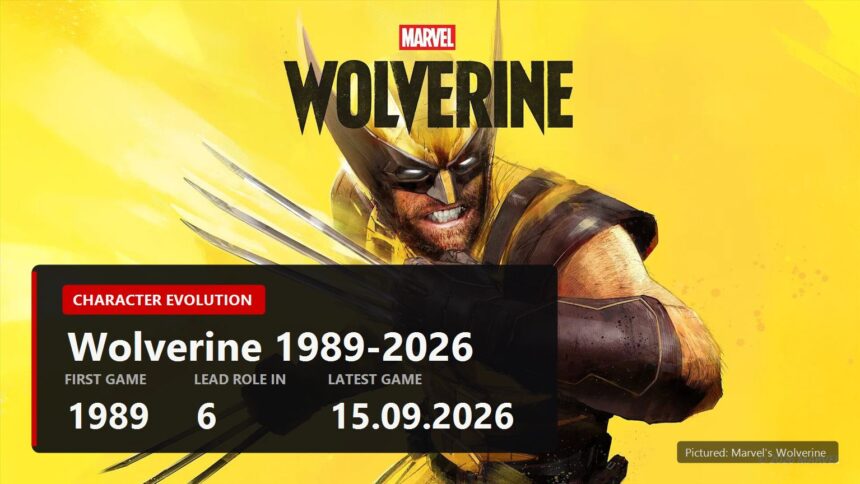
Wolverine reached games before he reached cinemas, and since then he has been drawn in pixels, sprites, polygons and neural-network fur. The 37-year road was a crooked one: from a cartridge where the claws drained your own health to a 70-dollar Insomniac game where that same idea about health finally became part of the story. Here is the whole route, era by era, with screenshots and trailers.
- 1989-1991: the NES, LJN and claws that hurt their owner
- 1992-1996: the arcade years
- 1997-2003: solo games return, and Mark Hamill comes with them
- 2004-2009: the best years, courtesy of Raven Software
- 2010-2019: ten years in supporting roles
- 2020-2026: back to the front
- 15 September 2026: Marvel's Wolverine
- How long the waits between solo games were
- The full list: where Wolverine showed up
- What changed in 37 years
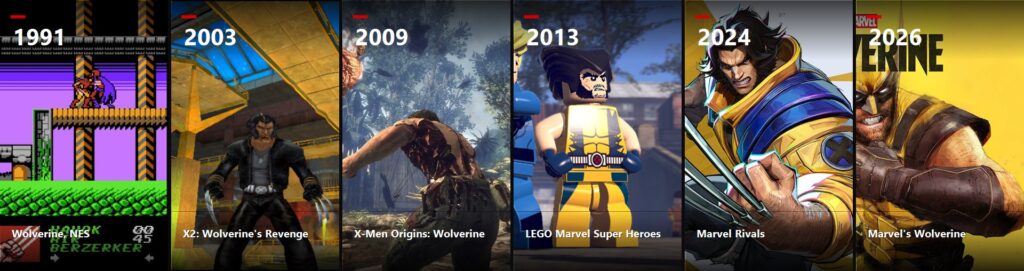
The whole road in one frame: Konami's cabinet on the left, Insomniac's game on the right, and between them LEGO, a hero shooter and a pixel beat 'em up. All frames are official, from re-releases and publisher pages.
Logan suits games by construction. He fights close up with weapons that never need reloading, he regenerates instead of picking up medkits, and he has a rage that turns into a meter with no effort at all. So everyone takes him: fighting game makers, role-playing studios, and anyone who needs a guest star for one season.
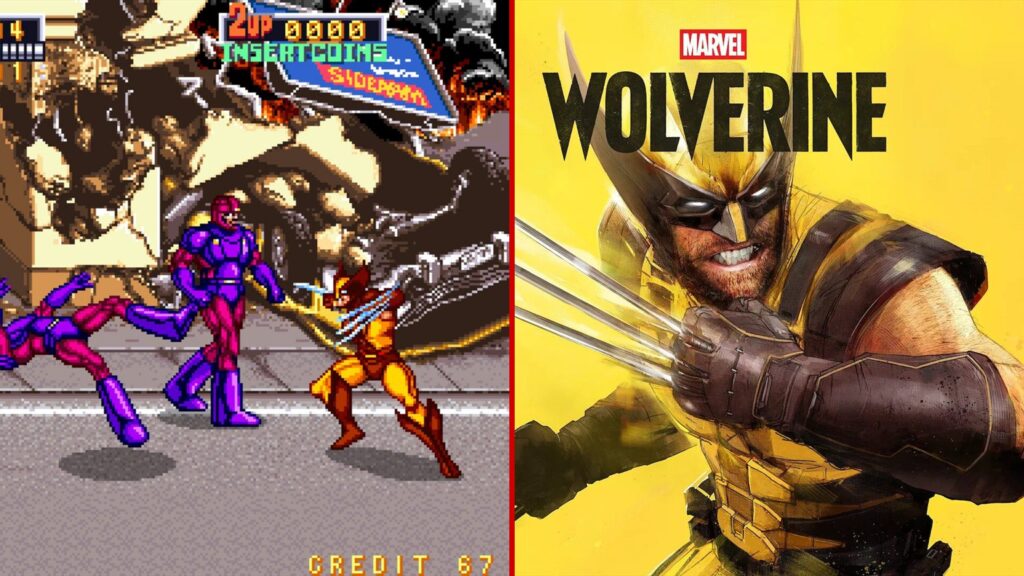
On the left a frame from Konami's 1992 cabinet, on the right the official art of Marvel's Wolverine from 2026. Thirty-four years apart and the same pose.
1989-1991: the NES, LJN and claws that hurt their owner
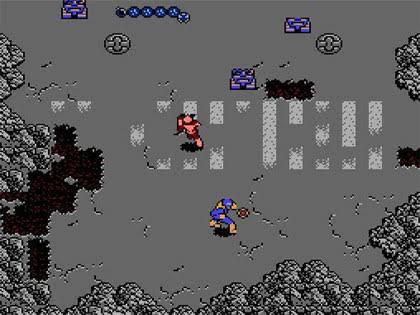
It started in December 1989, when LJN put The Uncanny X-Men on the NES. Six playable mutants, Wolverine among them, five missions and a secret sixth stage against Magneto. Two-player co-op worked. Nothing else did. The game is still remembered as one of the worst on the system: the Allgame reviewer gave it one star and called it a strange, laughably bad mess.
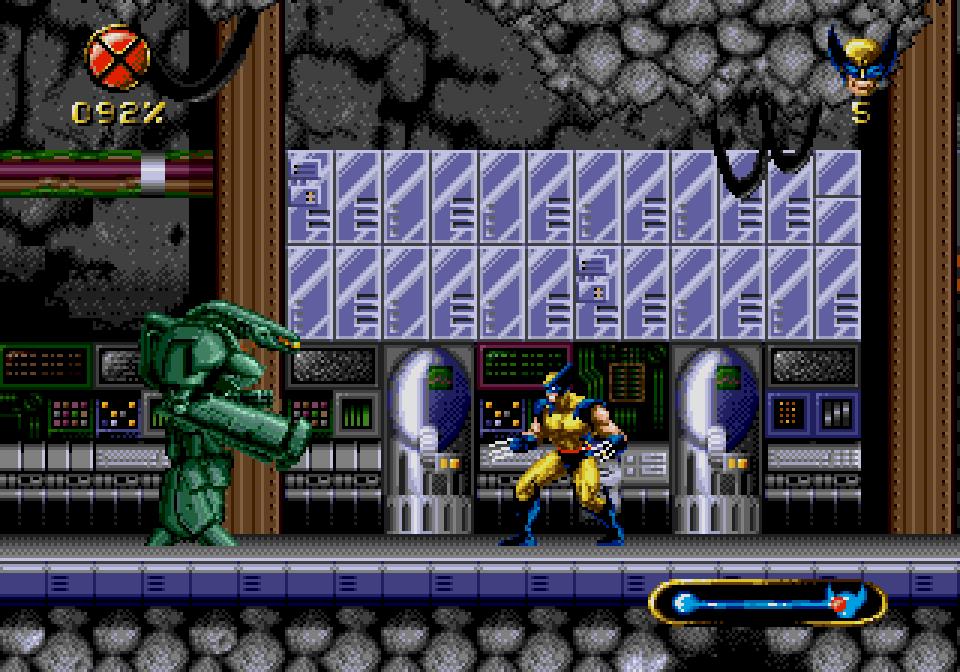
This is what it looked like: a top-down view, six mutants to pick from and enemies appearing out of nowhere.
Two years later, in October 1991, the same publisher released the first solo game: Wolverine for the NES, developed by Software Creations. It introduced the trick every retrospective still brings up. The claws came out with the Select button, they did proper damage, and they drained your own health while they were out. You topped it back up with hamburgers and soft drinks. The idea of paying a price for power was right, the execution was punishing: the game was exhausting, and IGN's retrospective named two problems, unfaithfulness to the comics and a brutal difficulty level.
The STRENGTH bar at the bottom left is the health bar. With the claws out it melted in front of you, and that was the whole game.
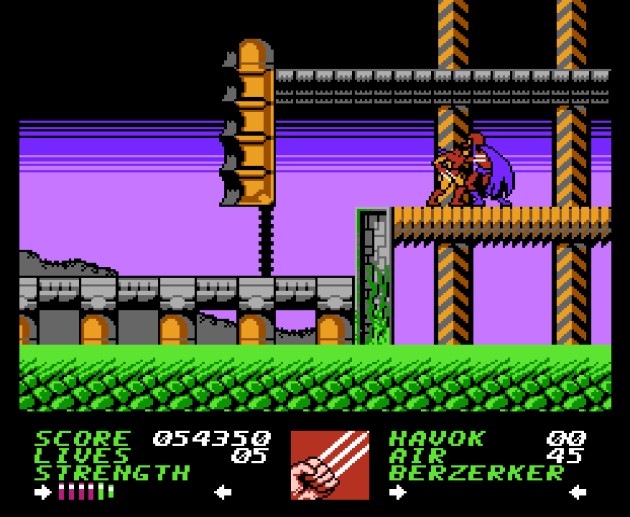
- The Uncanny X-Men. 1989, NES, published by LJN. Wolverine playable, one of six.
- Wolverine. 1991, NES, Software Creations and LJN. The first game with him in the lead.
1992-1996: the arcade years
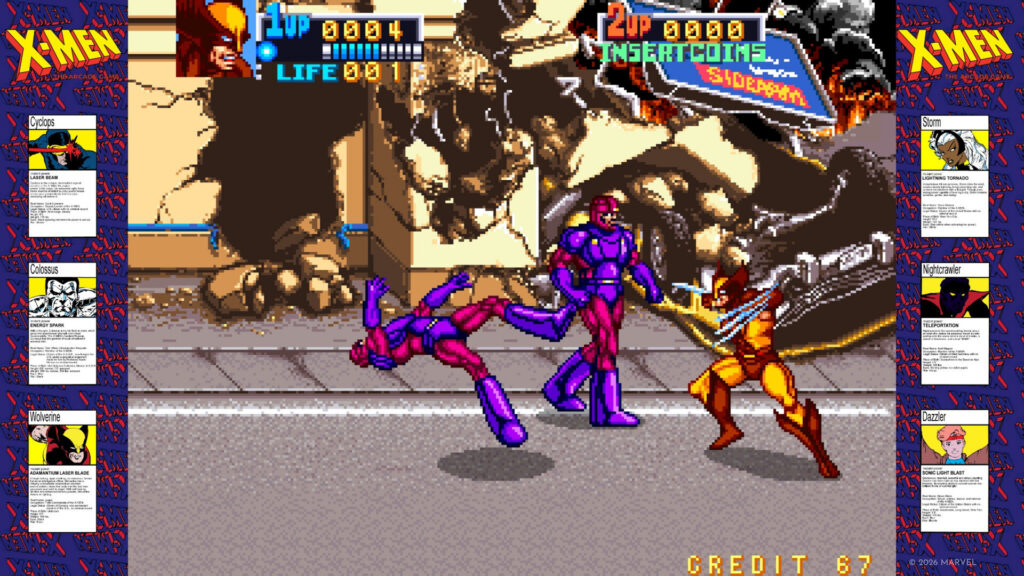
In March 1992 Konami's X-Men arcade machine arrived, and it is still the definitive team game. The six-player cabinet was built from two screens placed side by side for a double-wide picture, and there was always a queue in front of it. It finished the year among the five highest-grossing dedicated arcade machines in the United States, Play Meter magazine rated it 91 percent, and lines like "Welcome to die" outlived the cabinet itself: the 2010 digital re-release re-recorded the voices but kept the script word for word.
This is how Wolverine looked in the cabinet: six frames of animation, a blue trail behind the claws and Sentinels filling the screen.
Then Capcom stepped in and put Wolverine into the genre that suits his speed best. X-Men: Children of the Atom in 1994 was Capcom's first Marvel fighter, followed by X-Men vs. Street Fighter in 1996 and the whole Marvel vs. Capcom line. He remains one of the most recognisable fighters in all of them.
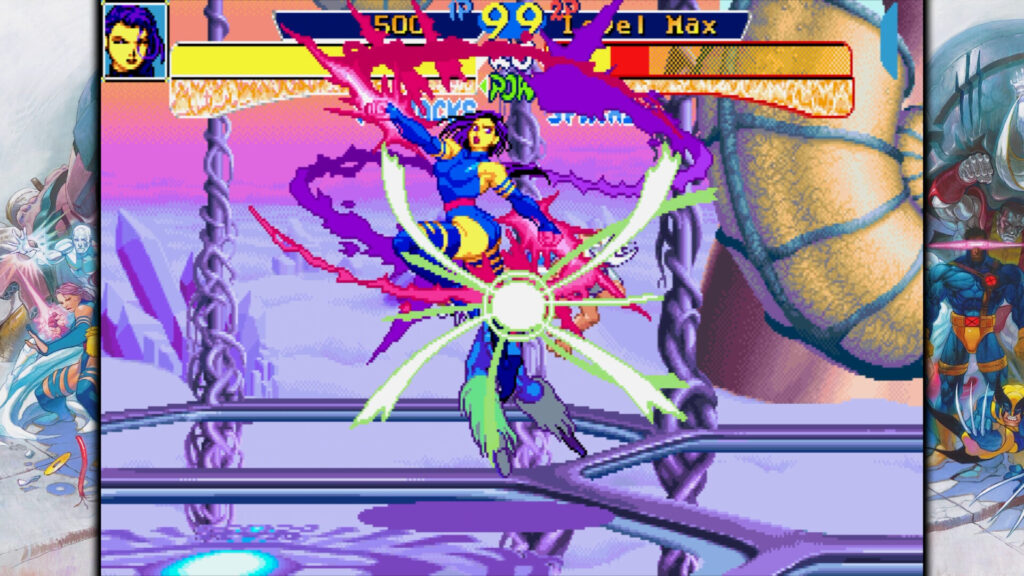
Those arcade fighters are sold officially again: on 11 September 2024 Capcom released MARVEL vs. CAPCOM Fighting Collection: Arcade Classics, with Children of the Atom first on the list. It is the easiest way to see the 1994 Wolverine with your own eyes without setting up an emulator.
- X-Men. 1992, arcade, Konami. One of six heroes, cabinets up to six players.
- Spider-Man and X-Men: Arcade's Revenge. 1992-1994, Genesis, SNES, Game Boy, Game Gear. A stage of his own.
- X-Men: Mutant Apocalypse. 1994, SNES, Capcom. Playable.
- X-Men: Children of the Atom. 1994, arcade, later PlayStation and Saturn, Capcom. Playable.
- Wolverine: Adamantium Rage. 1994, Genesis and SNES, published by Acclaim and LJN. The second solo game.
- X-Men 2: Clone Wars. 1995, Genesis, Sega. Playable.
- X-Men vs. Street Fighter. 1996, arcade, Saturn, PlayStation, Capcom. Playable.
1997-2003: solo games return, and Mark Hamill comes with them
Wolverine spent the late nineties as a guest: the Marvel vs. Capcom series, Activision's handheld X-Men games, rosters instead of roles. That turned in 2001 with X-Men: Wolverine's Rage on the Game Boy Color, and two years later a real budget arrived with X2: Wolverine's Revenge.
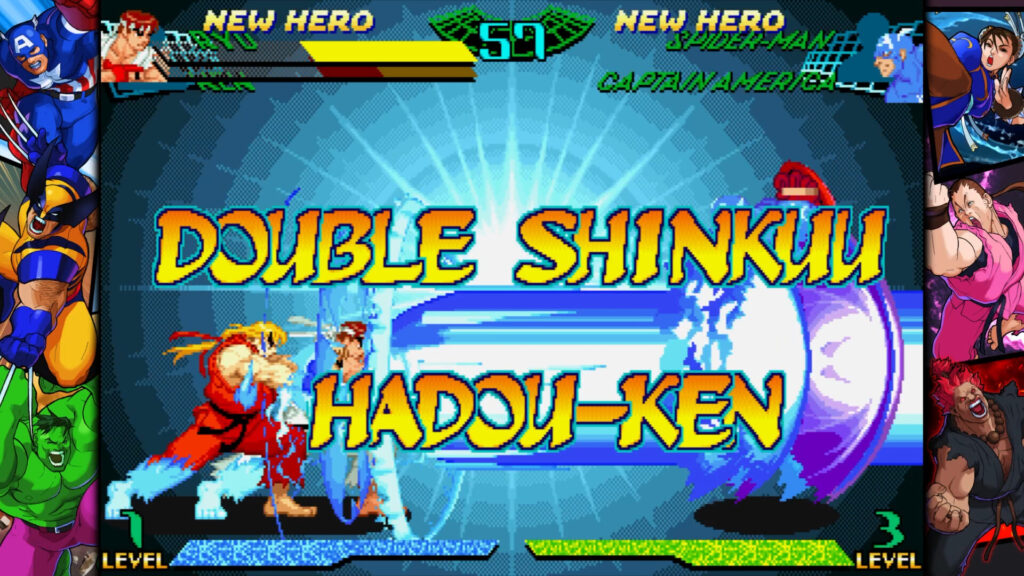
In Capcom's fighters he stayed in plain sight through the whole late nineties, even with no game of his own.
It launched on 15 April 2003 for PlayStation 2, Xbox, GameCube, Game Boy Advance and PC, developed by GenePool and published by Activision. The premise is simple and cruel: the Shiva Virus is found in Logan's blood, he has 48 hours before it kills him, and he has to get back into the Weapon X facility for the antidote. The voice cast was a coup, with Mark Hamill as Wolverine and Patrick Stewart reprising Professor X from the films.
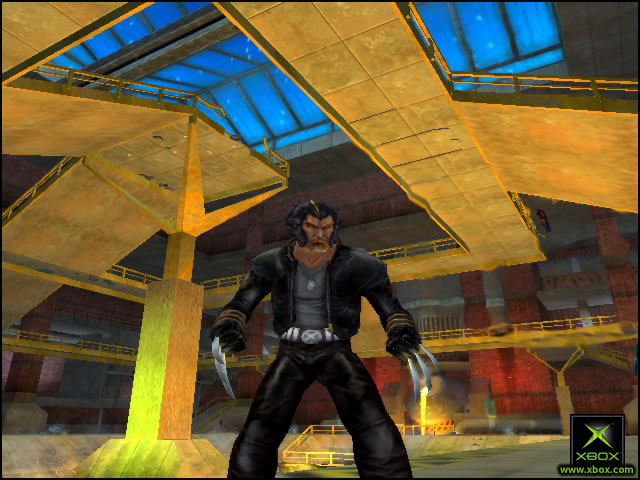
This is the game on Xbox: the cramped corridors of the Weapon X facility, Logan in his jacket, claws ready.
Here is how it was built. Six acts, each ending in a boss, and Sabretooth, Magneto and Lady Deathstrike each need a specific set of strike moves, flailing at them does nothing. The claws go in and out on a button, and that is not decoration: with the claws retracted Logan heals but cannot cut through barriers or break objects, with them extended he shreds everything and the healing switches off. The same deal the NES made in 1991, except now it is deliberate.
The second pillar is feral sense. Press the button and the world recolours: footprints appear, a green scent trail, the enemy's position as a red arrow, alarm lasers and hidden mines. In that mode you can walk up behind someone and kill them in one move, those kills hand you dog tags, and dog tags unlock new attacks. There is also a rage meter that fills from damage dealt and taken and briefly speeds Logan up.
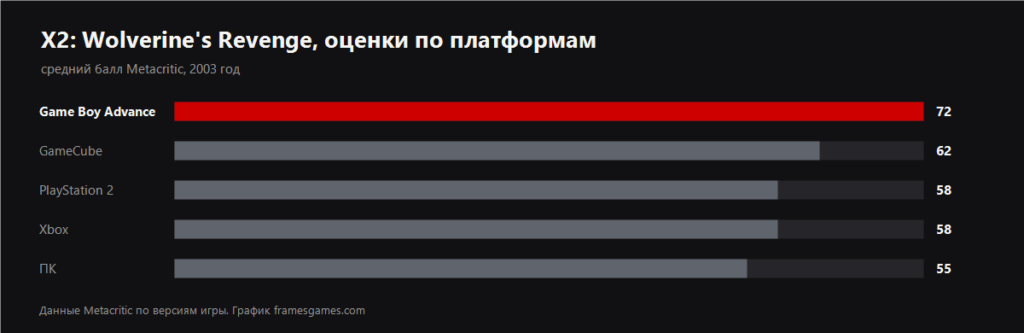
The reception was cool, and the spread of the scores says plenty on its own: the Game Boy Advance version came out on top and the PC version came out worst. Critics praised the voice acting, the plot and the unlockables, and attacked the sluggish combat, the missing mid-level checkpoints and the sheer difficulty. Entertainment Weekly summed it up bluntly: the pacing is sluggish, the gameplay irritating.
The publisher never left any official screenshots of this game, so here is how it actually looks in motion: a full playthrough recorded by the WishingTikal channel.
2004-2009: the best years, courtesy of Raven Software
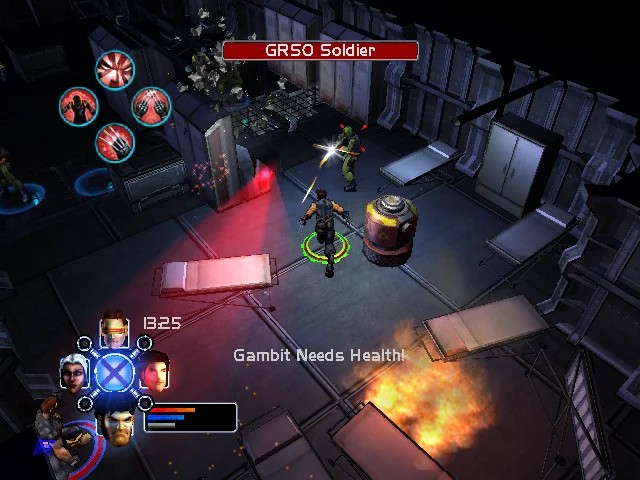
X-Men Legends arrived on 21 September 2004, and this is the case where a studio got the character right. A four-player action RPG, fifteen playable mutants, comic-book art with heavy outlines. The Xbox version scored 82 out of 100 on Metacritic, had sold 800,000 copies by July 2006 and earned 28 million dollars in the United States, while the series reached two million units domestically. The sequel, Rise of Apocalypse, followed in 2005, and the same team later built Marvel: Ultimate Alliance.
Four mutants, a top-down view and health bars at the bottom: the formula that later became Marvel: Ultimate Alliance.
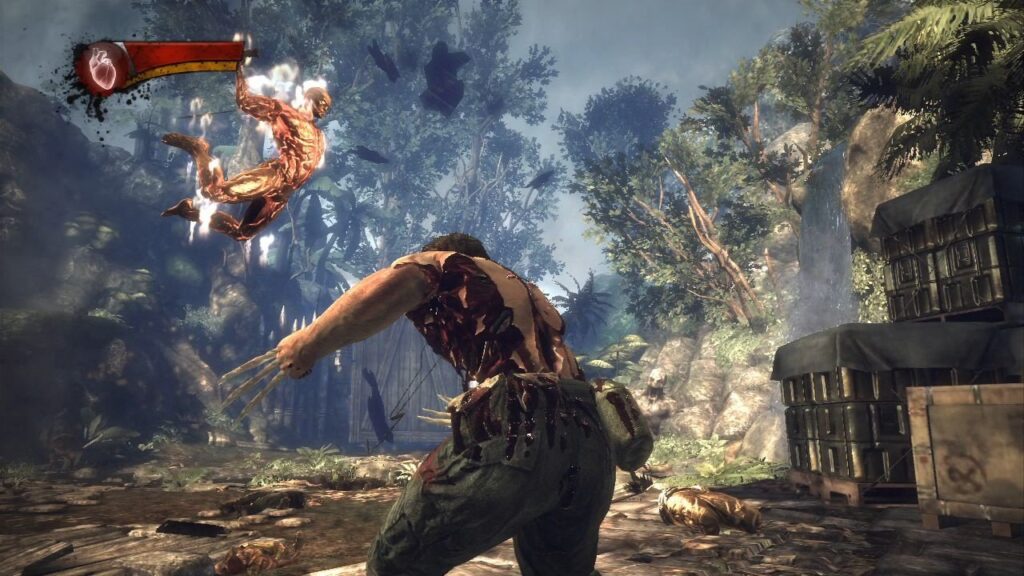
The peak of his solo career came on 1 May 2009 with X-Men Origins: Wolverine by Raven Software. A film tie-in that turned out markedly better than the film. A mature rating, armour tearing off enemies in pieces, visible wounds on Logan himself that close up while you watch, and regeneration as part of the fight rather than a line in the character description. IGN called it an awesome guilty pleasure, GameSpot gave it 7 out of 10 and called it one of the better movie tie-ins of recent years, and Eurogamer pinned it for being unapologetically repetitive.
Jacket torn off, back shredded, flesh on show: in this game the wounds stayed on the model and closed while you watched.
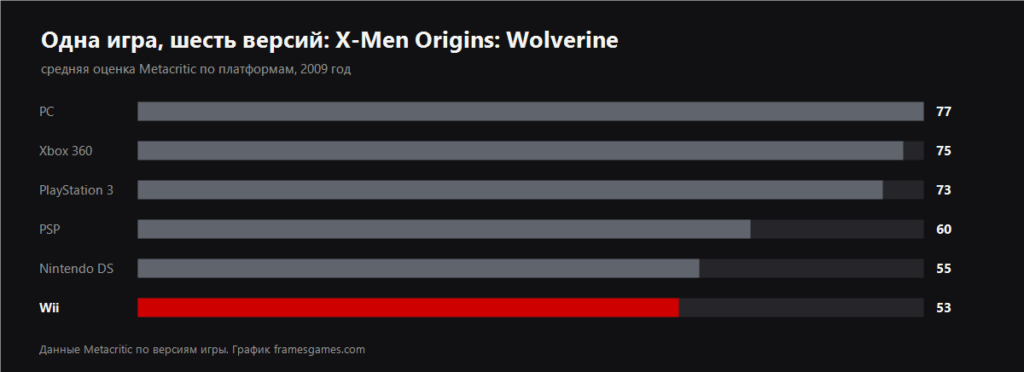
And then the classic failing of the era: the publisher shipped six versions of wildly different quality under one name. The adult Uncaged Edition was built for PS3, Xbox 360 and PC, everything else got a cut-down build.
- X-Men Legends. 2004, GameCube, PS2, Xbox. Raven Software and Activision.
- X-Men Legends II: Rise of Apocalypse. 2005, adding PC, PSP and more.
- Marvel: Ultimate Alliance. 2006, the same school of design across the whole Marvel universe.
- X-Men: The Official Game. 2006, tied to the second film, Wolverine playable.
- X-Men Origins: Wolverine. 2009, seven platforms, the best solo game until 2026.
2010-2019: ten years in supporting roles
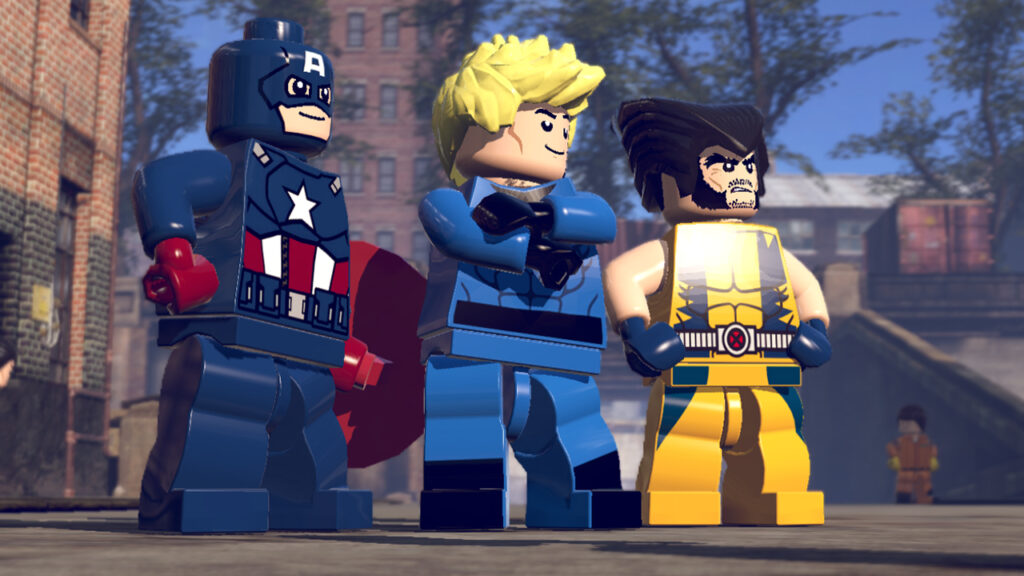
After 2009 no solo Wolverine game came out at all. He did not disappear, his role changed: a guest in fighters, a character in team-collecting mobile games, a tile in a puzzle. Marvel vs. Capcom 3, Marvel Heroes, LEGO Marvel Super Heroes, Marvel Puzzle Quest, Marvel Contest of Champions, Marvel Future Fight, Marvel Strike Force, Marvel Ultimate Alliance 3 on Switch in 2019. He is in all of them and leads none of them.
The decade of supporting roles looked roughly like this: Logan on screen, next to Captain America, one of a hundred characters.
The reason is dull and well known: the film rights to the X-Men sat with Fox at the time, and big publishers preferred heroes that Marvel Studios was putting on screen. Logan stayed on the character select screens and off the covers.
2020-2026: back to the front
The new cycle started in somebody else's game. On 27 August 2020 Fortnite launched the Marvel-themed Nexus War season, which ran until 1 December. Wolverine was both a battle pass reward and a live boss on the map: he prowled Weeping Woods, fought for real and handed his claws to whoever put him down. For a whole generation of players that was the introduction to the character.
Then he returned to team games as a headline pick. Marvel Rivals from NetEase launched on 6 December 2024 with Wolverine in the starting roster of 33 heroes. His job there is exactly what it is in the comics: dive into the crowd, latch onto the biggest thing in it and refuse to let go.
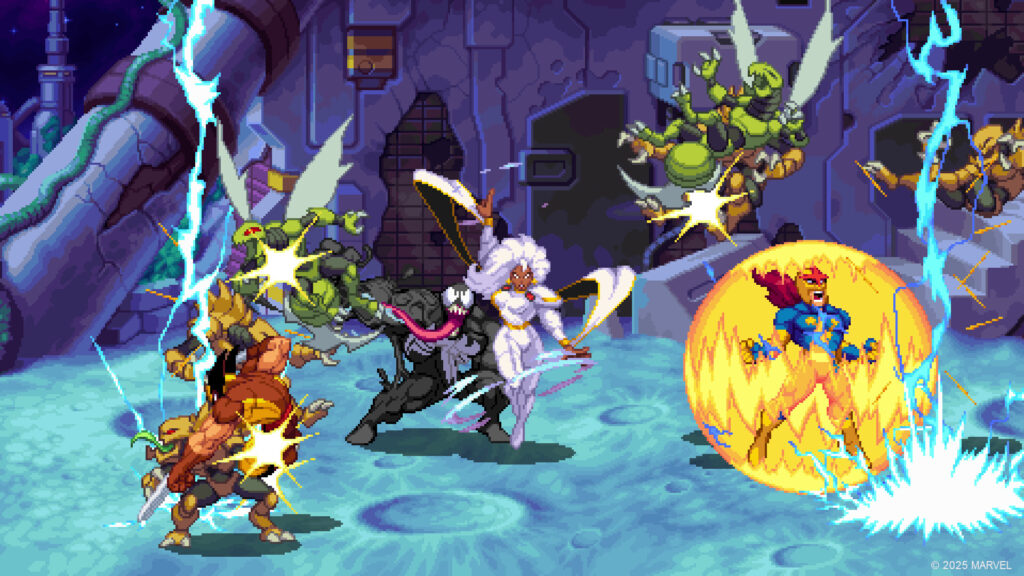
On 1 December 2025 came MARVEL Cosmic Invasion, a beat 'em up by Tribute Games and Dotemu, the people behind Teenage Mutant Ninja Turtles: Shredder's Revenge. It is a direct descendant of the early-nineties arcade machines, pixel art and two heroes in play at once, and Wolverine is one of the best characters in it.
15 September 2026: Marvel's Wolverine
The game people waited seventeen years for launched on 15 September 2026, exclusively on PlayStation 5. Developed by Insomniac Games, published by Sony. It begins three years after Logan leaves Team X, the route runs from Canada through Vancouver to Madripoor and Tokyo, and the story is built around mutant abductions orchestrated by the billionaire Bolivar Trask and his hired militia.
The scores came in cooler than expected: 77 on Metacritic and 69 percent recommended on OpenCritic. That is above X2: Wolverine's Revenge and exactly level with the best version of X-Men Origins, which means the bar for solo Wolverine games has barely moved in seventeen years. What has changed is the scale of the staging and the way the game handles healing: wounds no longer vanish, they stay on the model and get in the way while they close.
How long the waits between solo games were
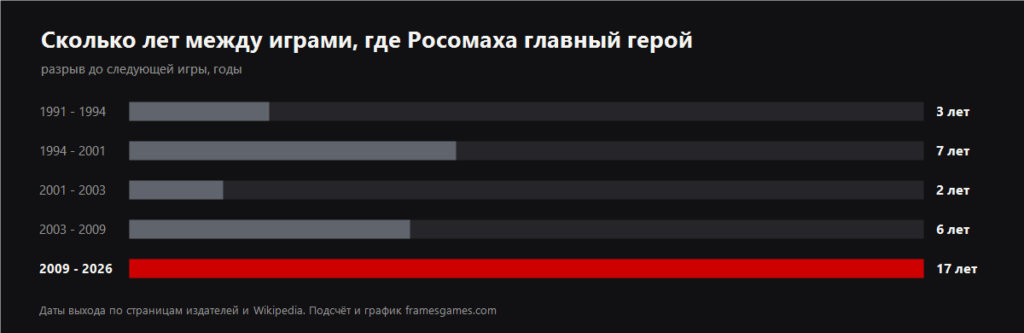
There are six games in total with Wolverine in the title: 1991, 1994, 2001, 2003, 2009 and 2026. Lay the gaps between them side by side and the last wait is longer than all the previous ones put together.
The full list: where Wolverine showed up
| Year | Game | Platforms | Role |
|---|---|---|---|
| 1989 | The Uncanny X-Men | NES | Playable |
| 1991 | Wolverine | NES | Lead |
| 1992 | X-Men | Arcade | Playable |
| 1992-1994 | Spider-Man and X-Men: Arcade's Revenge | Genesis, SNES, Game Boy, Game Gear | Playable |
| 1994 | X-Men: Mutant Apocalypse | SNES | Playable |
| 1994 | X-Men: Children of the Atom | Arcade, PlayStation, Saturn, PC | Playable |
| 1994 | Wolverine: Adamantium Rage | Genesis, SNES | Lead |
| 1995 | X-Men 2: Clone Wars | Genesis | Playable |
| 1995 | X-Men 2: Game Master's Legacy | Game Gear | Playable |
| 1996 | X-Men vs. Street Fighter | Arcade, Saturn, PlayStation | Playable |
| 1996 | X-Men 3: Mojo World | Game Gear, Master System | Playable |
| 1997 | X-Men: The Ravages of Apocalypse | PC | Playable |
| 2000 | X-Men: Mutant Academy | PlayStation, Game Boy Color | Playable |
| 2000 | X-Men: Mutant Wars | Game Boy Color | Playable |
| 2001 | X-Men: Mutant Academy 2 | PlayStation | Playable |
| 2001 | X-Men: Reign of Apocalypse | Game Boy Advance | Playable |
| 2001 | X-Men: Wolverine's Rage | Game Boy Color | Lead |
| 2002 | X-Men: Next Dimension | GameCube, PS2, Xbox | Playable |
| 2003 | X2: Wolverine's Revenge | PS2, Xbox, GameCube, GBA, PC | Lead |
| 2004 | X-Men Legends | GameCube, PS2, Xbox | Playable |
| 2005 | X-Men Legends II: Rise of Apocalypse | PC, PS2, Xbox, PSP, GameCube | Playable |
| 2006 | Marvel: Ultimate Alliance | Multiplatform | Playable |
| 2006 | X-Men: The Official Game | Multiplatform | Playable |
| 2009 | X-Men Origins: Wolverine | PS3, Xbox 360, PC, Wii, PS2, PSP, DS | Lead |
| 2009 | Marvel: Ultimate Alliance 2 | Multiplatform | Playable |
| 2010-2011 | X-Men (digital arcade re-release) | PS3, Xbox 360, mobile | Playable |
| 2011 | Marvel vs. Capcom 3 | PS3, Xbox 360 | Playable |
| 2013 | LEGO Marvel Super Heroes | Multiplatform | Playable |
| 2013 | Marvel Heroes | PC | Playable |
| 2014 | Uncanny X-Men: Days of Future Past | iOS, Android | Playable |
| 2014-2018 | Contest of Champions, Future Fight, Strike Force | Mobile | Playable |
| 2019 | Marvel Ultimate Alliance 3: The Black Order | Nintendo Switch | Playable |
| 2020 | Fortnite, Nexus War season | Multiplatform | Boss and skin |
| 2022 | Marvel's Midnight Suns | Multiplatform | Playable |
| 2024 | MARVEL vs. CAPCOM Fighting Collection | Multiplatform | Playable |
| 2024 | Marvel Rivals | PC, PS5, Xbox Series | Playable |
| 2025 | MARVEL Cosmic Invasion | Multiplatform | Playable |
| 2026 | Marvel's Wolverine | PlayStation 5 | Lead |
The list is not exhaustive: Wolverine has turned up in dozens of mobile and browser projects, in the card game Marvel Snap and in crossovers that closed after a season. What is collected here is what can be checked against publisher pages and release dates.
What changed in 37 years
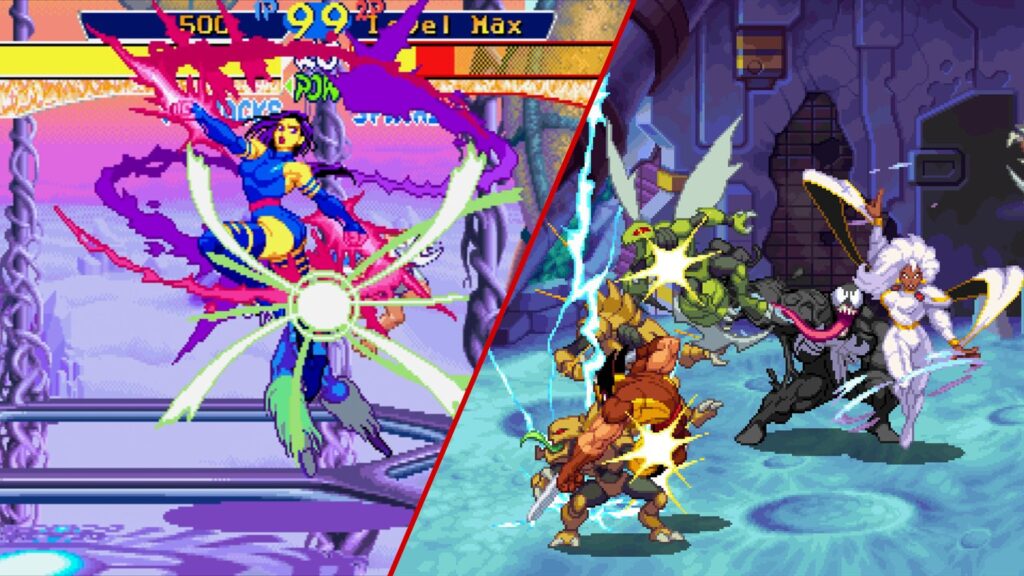
The pixel school never went away: Capcom in 1994 on the left, Tribute Games in 2025 on the right.
- The claws stopped being a button. In 1991 they simply drained health, in 2009 they became a dismemberment tool, and in 2026 they turned into the way you decide whether to kill.
- Healing went from a caption to a mechanic. For a dozen games it meant "health refills by itself", and only in the last two has it become visible: the wounds stay on the model and get in the way while they close.
- From the team to solo and back. From 1989 to 2006 he was one of six or one of fifteen, from 2009 he could carry a game alone, and in Marvel Rivals he is a team player again, because that is what the genre needs.
- The scores barely move. 77 for the best version of X-Men Origins in 2009 and 77 for Marvel's Wolverine in 2026. Budgets grew by orders of magnitude, the ceiling stayed put.
Look at those 37 years as one line and a simple thing shows up: Wolverine rarely got a game worthy of him, but he almost never dropped out of the rotation. He was called in whenever a studio needed a straightforward melee hero, and skipped whenever the film rights to the mutants sat elsewhere. Right now he is back on the cover, and per Notebookcheck, citing Insomniac, this is only the first part of a planned X-Men trilogy.
Sources
Release dates, developers and publishers were checked against the games' Steam pages and the Wikipedia articles on each game, scores against Metacritic and OpenCritic, and the X-Men Legends sales figures against the reporting quoted in that game's article. The arcade performance of the 1992 X-Men machine comes from Play Meter magazine and the US year-end rankings. Reviewer quotes belong to IGN, GameSpot, Eurogamer, Entertainment Weekly and Allgame and are attributed in the text. The Marvel Rivals launch roster and date follow NetEase and reporting from 6 December 2024. The Fortnite Nexus War dates come from Epic Games. Screenshots are taken from the games' Steam pages and the PlayStation Blog, and the videos are official trailers from PlayStation, Marvel Rivals, Dotemu and Marvel Entertainment. The charts are ours, built from the numbers listed above. The X2: Wolverine's Revenge gameplay recording belongs to the WishingTikal channel and is embedded from YouTube; the publisher never released official screenshots of this game.