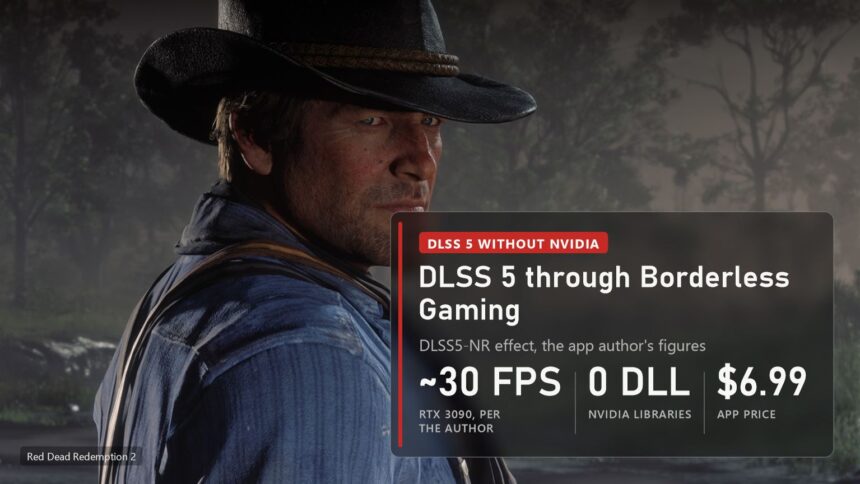
DLSS 5 has reached cards NVIDIA leaves off its list, and it came from an unexpected direction. Andrew Sampson, who makes Borderless Gaming, released a DLSS5-NR effect for the app on 29 September. It does not swap any game libraries or touch NVIDIA's files at all, and he says even an RTX 3090 holds around 30 fps with it. Nobody has tested that independently yet, so it is the developer's number, and by his own account it depends on the game and settings.
How it works
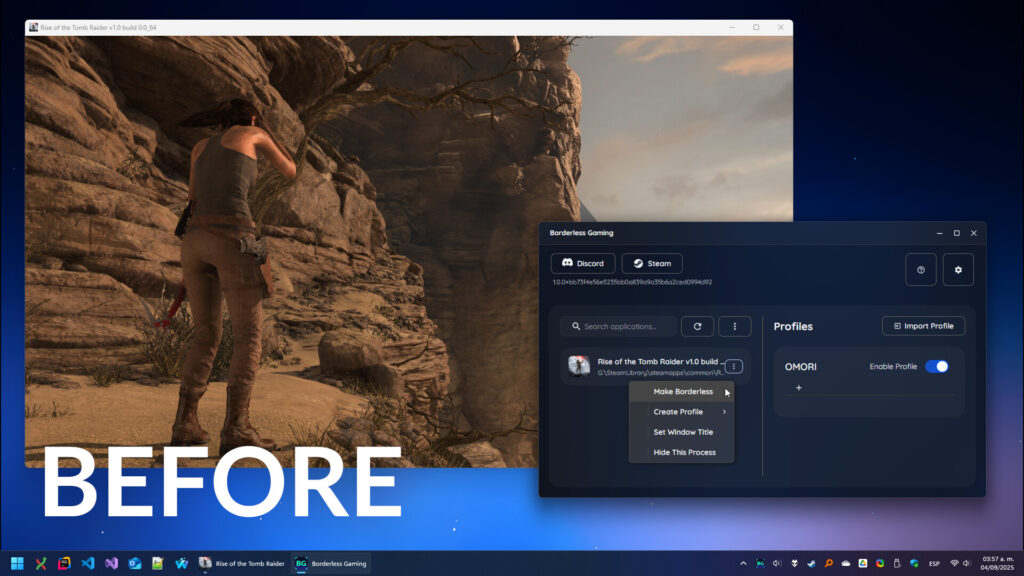
Borderless Gaming has sold on Steam since 2015 for $6.99, and it started out doing one simple thing: running games in a borderless full-screen window. In September it picked up its own frame generator, BGFG, and now DLSS 5. Everything goes through its BGFX scaling system. The app captures the game window, runs the finished image through a shader and puts the result on screen.
The effect is not part of the update itself. Sampson had to spell that out in bold in the announcement: DLSS5-NR is not on your drive and does nothing in the background until you install it. You get it from the effects editor with the install-from-GitHub button, pick the DLSS5-NR preset and, on Windows, switch to Scaling (GPU). There are five sliders (strength, lighting, structure, style, and the resolution the network runs at).
Most of the work went into quantizing the model, which shrinks it, plus changing how it runs and clearing bottlenecks inside the network. He calls the shader experimental and expects more frames once drivers fully support Shader Model 6.10.
Is 30 fps a lot? What the real DLSS 5 costs
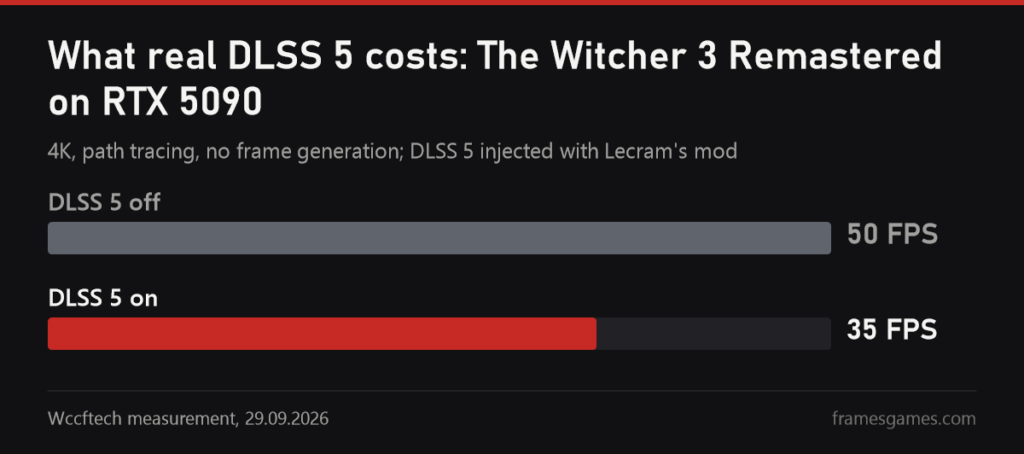
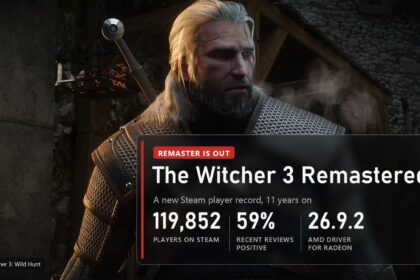
Thirty frames on a 2020 card sounds modest until you see what DLSS 5 costs NVIDIA's most expensive GPU. On 29 September Wccftech injected it into The Witcher 3 Remastered with Lecram's mod. An RTX 5090 at 4K with path tracing and no frame generation ran at 50 fps without DLSS 5 and 35 with it, 30 percent down. With 6x frame generation it was 180-183 against 245-247. Lecram's mod itself puts the network's work at 8.7 milliseconds per frame at 4K.
You cannot line those numbers up against 30 fps on an RTX 3090. The game is different, the resolution was not given, and the Borderless Gaming effect is built differently: it only sees the finished image on screen, HUD included, without the engine data the official version gets. So I would treat it as a filter modelled on DLSS 5 rather than DLSS 5 itself. Nobody has shown it side by side with the original yet.
What we still do not know
Sampson says nothing about Radeon or Arc. The changelog only mentions clearer errors when an effect needs hardware features your system lacks. AMD cards might work, or they might hit a shader support wall, and the first brave owners will find out. Radeon already has its own route, the DLSS-NR on AMD mod, which we follow in our living DLSS 5 guide.
The other open question is where the model came from. Sampson writes that he quantized "the model" without saying which one. Officially DLSS 5 ships in one game right now, NBA 2K27, and every mod so far has worked with the library that leaked alongside it. The effect download weighs about 150 MB. NVIDIA has not commented.
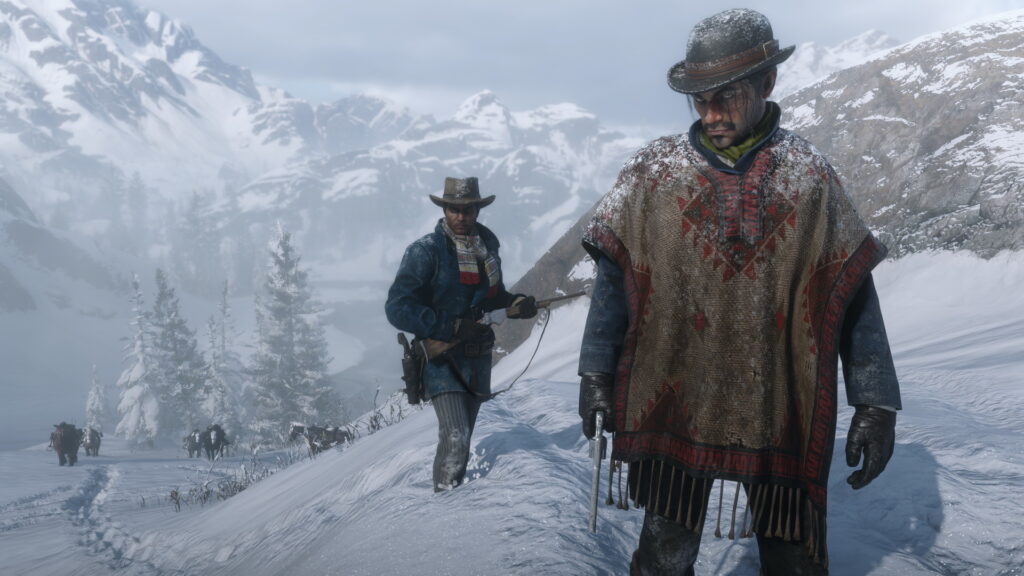
The author's samples on the effect page come from GTA IV and Red Dead Redemption 2, mostly faces. I am waiting for the first videos from players on RTX 30 cards and Radeon, which will show how much of DLSS 5 survives the compression and what those 30 frames really cost.
Sources
DLSS5 Neural Rendering for Everyone, Steam announcement, 29.09.2026
Wccftech on Borderless Gaming, 30.09.2026
Wccftech, DLSS 5 in The Witcher 3 Remastered, 29.09.2026
Borderless Gaming on Steam
Images: Steam, Red Dead Redemption 2 and Borderless Gaming