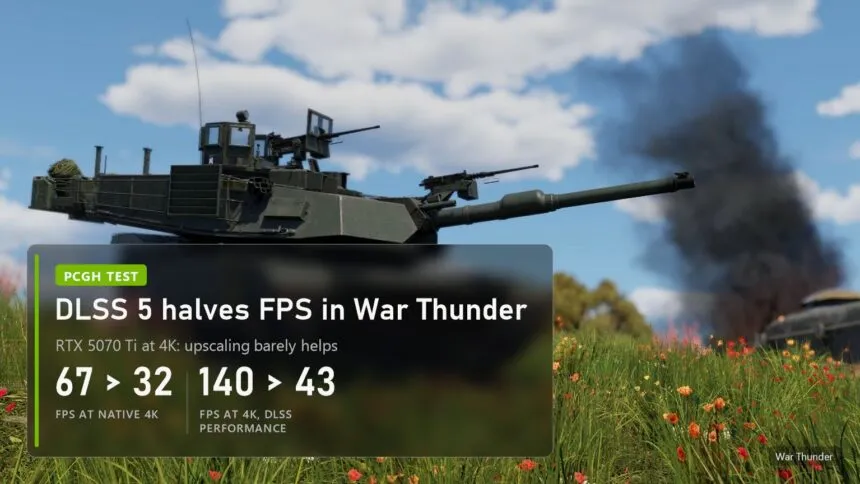
PC Games Hardware has tested DLSS 5 in War Thunder before the patch is even out, on Gaijin's developer server. The result is bad news for anyone planning to win the frames back with upscaling. On an RTX 5070 Ti at 4K, neural rendering takes more than half the frame rate, and DLSS Performance gives very little back: with ray tracing and DLSS 5 the card runs at about 32 FPS native and about 43 FPS upscaled.
DLSS 5 arrives in War Thunder with The Eagle's Shadow update in mid-November, and Gaijin has not given an exact date yet. It will be the third game with official support after NBA 2K27 and Hogwarts Legacy, which we covered in the announcement story and in our look at the ComputerBase test.
Why DLSS Performance doesn't fix it
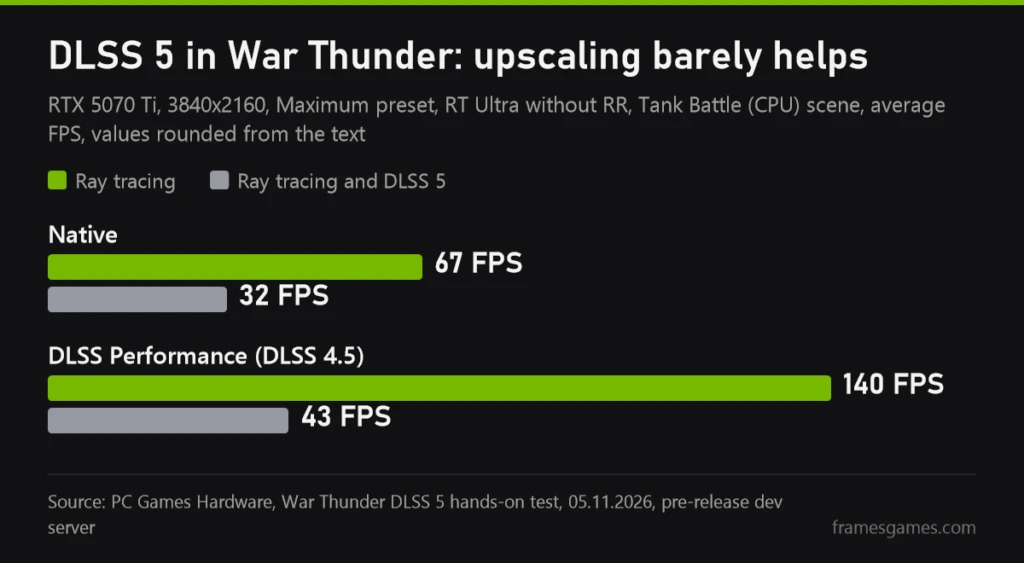
PCGH used the Maximum preset, Ultra ray tracing (including path traced global illumination, Ray Reconstruction left off) and the built-in Tank Battle (CPU) scene, which runs a real fight with game logic. The magazine says the GPU was the limit in every mode, not the processor. The client ships DLSS 310.9.16.
Without DLSS 5, upscaling behaves as usual: about 67 FPS at native 4K with ray tracing and about 140 with DLSS Performance, a 108 percent jump. With DLSS 5 the gain shrinks to 33 percent, from 32 to 43 FPS. The reason is the order NVIDIA sets in its documentation. Neural rendering runs after upscaling and before post-processing, so it always works at output resolution. Upscaling speeds up raster and ray tracing, while the most expensive pass stays the same size.
The only real lever is output resolution. At 2560x1440 with DLSS Performance and DLSS 5, the same RTX 5070 Ti ran just under 90 FPS without frame generation. PCGH then tried 2X, 4X and 6X frame generation: the counter climbs, but from 4X up there are visible artifacts at the edges of the screen, and 6X at 1440p shows more of them. One more detail from the menu: DLSS 4.5 is only used in Performance and Ultra Performance, every other step runs DLSS 4.
What it looks like
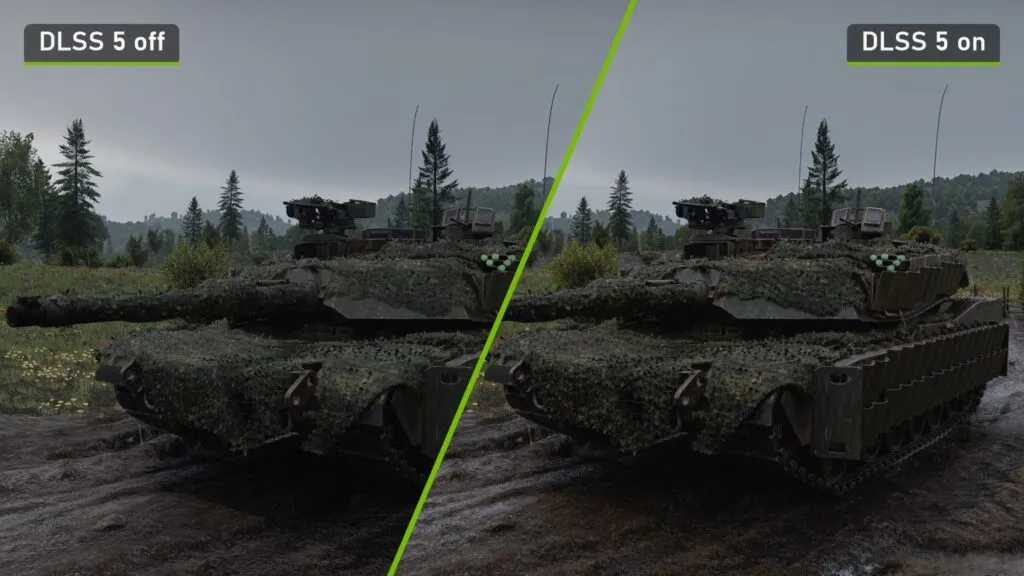
The image side goes better than in Hogwarts Legacy. Gaijin tuned the effect with a light hand and set Structure Intensity to maximum so shadows and highlights shimmer less. PCGH says fine shadows, wet surfaces, mud and metal gain a lot of depth in narrow streets and interiors. On open maps and on distant vehicles the difference is small while the cost stays the same. DLSS 5 has its own artifact here too: when an object comes out from behind a tree, its spot turns into grainy, pixelated mush for a moment.
PCGH's verdict: DLSS 5 suits War Thunder, but it costs too much, and the usual upscaling trick doesn't work here. The magazine also points out that modders have already moved neural rendering before the upscaler and got big gains. How people run it on Radeon and Intel Arc is in our DLSS 5 guide.
Sources
PC Games Hardware: War Thunder, DLSS 5 und neues Update im Hands-on-Test (November 5, 2026, benchmarks on page two). NVIDIA gave the magazine access to the developer server. Figures in our chart are rounded from the article text.
Cover image: War Thunder, Steam store page. DLSS 5 on and off comparison: NVIDIA.