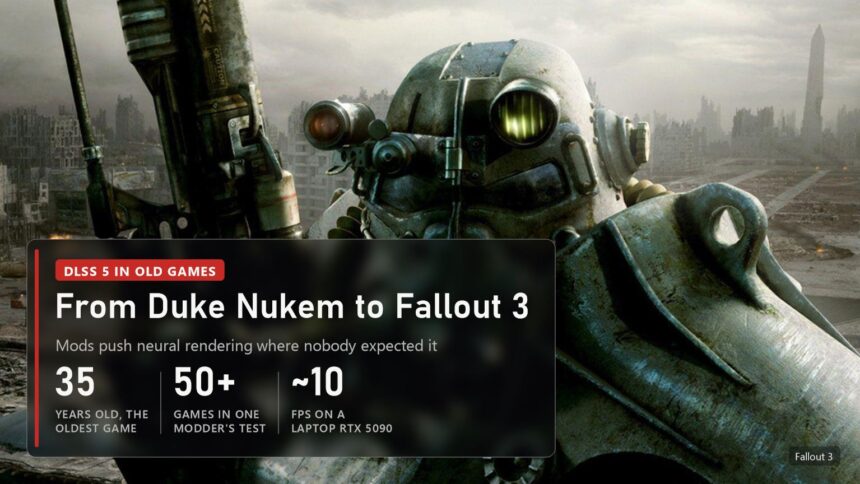
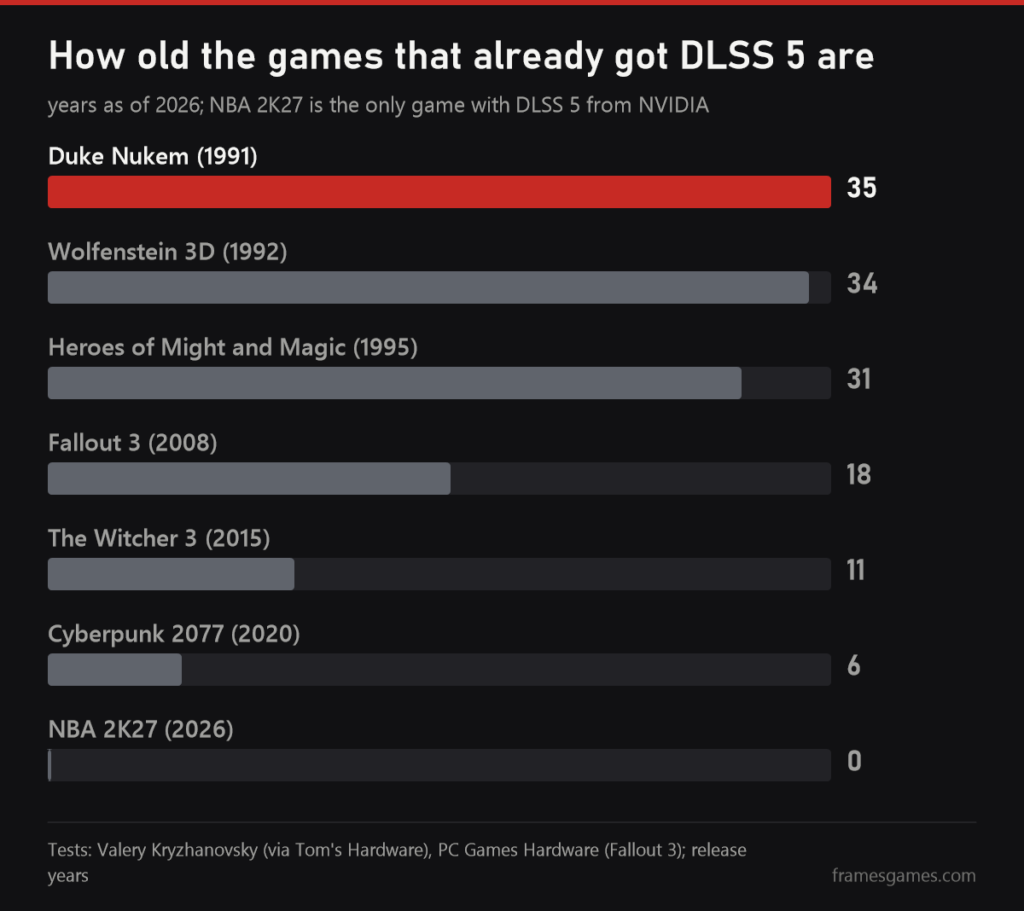
Officially, DLSS 5 runs in exactly one game, NBA 2K27. In a month, modders have pushed it into dozens of others, and this week they reached the bottom of the barrel: the 1991 Duke Nukem and the DOS port of Pong. The price comes first. Valery Kryzhanovsky, who has run more than 50 games this way, says his laptop RTX 5090 gave him about 10 fps, whether the game was Wolfenstein 3D or Cyberpunk 2077. At the same time a new mod, Aeon SR, adds DLSS, FSR and XeSS to old games, with the DLSS 5 network as an optional extra. PC Games Hardware tried it in Fallout 3 on 6 October.
Aeon SR: upscalers for games that never heard of them
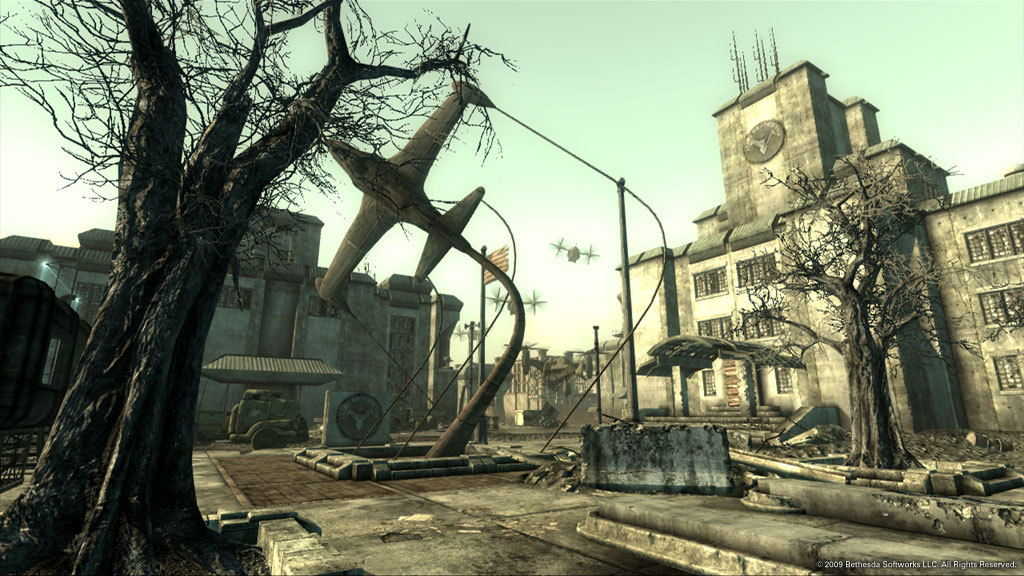
Aeon SR is a ReShade add-on by a modder who goes by Barbatos AWLS. Version 1.0.0 went up on GitHub on 5 October and 1.0.1 followed a day later. The clever part is motion vectors. Upscalers need them and old games don't provide any, so the mod estimates them itself with its own optical flow, working from the colour buffer and depth.
- APIs: DirectX 8 through 12, OpenGL and Vulkan, both 32-bit and 64-bit games.
- Upscalers: DLSS from SDK 310.9.1, FSR 4 on cards that support it and FSR 3.1 elsewhere, plus XeSS 3.0.2. The DLLs come from the official SDKs and ship in the package.
- DLSS 5: the neural rendering DLL is not included, you supply it yourself. Without it everything else works and the neural pass simply stays off.
- Anti-cheat: the author asks you plainly not to use it in protected games.
PC Games Hardware ran Fallout 3 at 4K on the highest preset. The image got much calmer in motion, with the fine pixel crawl gone. Frame rate went the other way. Even DLSS Performance cut it sharply, and the mode with visibly worse quality cost almost as much as native 4K. The DLSS 5 pass on top, according to the editors, costs hardly anything extra, though PCGH gives no numbers. Fed the original frame without upscaling, it only works on RTX 50 cards.
50 games, from Pong to Cyberpunk 2077
Kryzhanovsky took a different road: DOSBox for the old games, ReShade on top and RenoDX for the sliders. Tom's Hardware picked up the story, and the clips are on his YouTube channel. In Duke Nukem the network does a decent job of finding the player, enemies and bullets, and the blocky level tiles get some depth. Push the strength too far and it turns into an acid trip.
His conclusions are sober. At x2 and above, DLSS 5 looks at a single frame with no history and redraws fresh detail every time, which is where the invented faces come from. Injected at the render stage, it changes face geometry in RBDOOM-3-BFG. Every preset drags the image toward its own colour (green for Default, blue for Natural, purple for Cinematic), and it happily colourised L.A. Noire's black-and-white mode. Old DirectX 11, The Witcher 3 version 1.32 in his case, comes out noisy while DX12 games stay stable.
Still screens worked best, Heroes of Might and Magic being the standout. PS2 and PS3 emulators were a dead end: the frame rate drops so far that games start to stutter.
Worth a try, or worth the wait?
For screenshots, sure, it's fun. For playing, not yet, and 10 fps is only part of it. The network was trained on modern games that hand it a full set of engine data, and a DOS platformer gives it nothing to hold on to. Kryzhanovsky calls the model raw. I agree: it looks great in a still and falls apart in motion.
Aeon SR has a more practical use: proper anti-aliasing in games that never had any, on any graphics card. DLSS 5 is a nice extra there for RTX 50 owners. The Aeon SR author says nothing about Radeon. For old DirectX games on AMD there is a separate mod, dlss5-neural-amd, covered with the other mods for non-NVIDIA hardware in our DLSS 5 guide.

Sources
Aeon SR on GitHub, README and releases 1.0.0 (5 October) and 1.0.1 (6 October 2026).
PC Games Hardware, Aeon SR tested in Fallout 3, 6 October 2026.
Tom's Hardware on Valery Kryzhanovsky's tests, 6 October 2026.
Valery Kryzhanovsky's videos on YouTube: Duke Nukem 1991, Heroes of Might and Magic.
Fallout 3 screenshot: the game's Steam page.