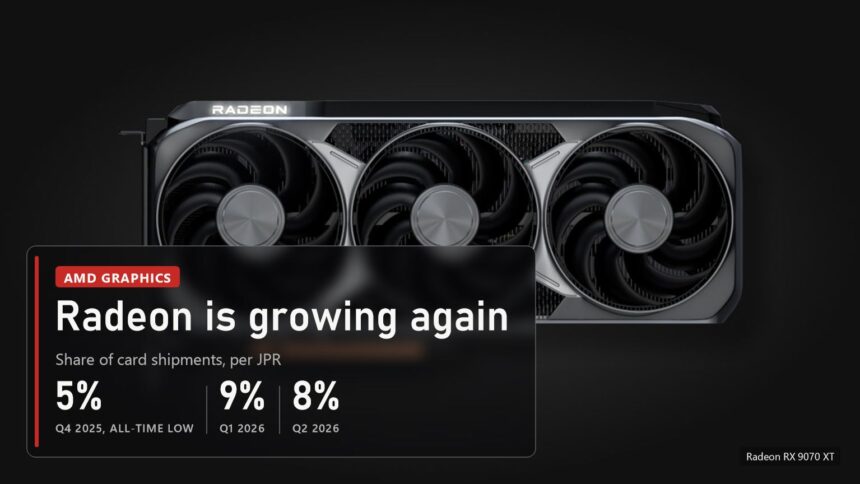
AMD graphics cards are winning back market share. According to Jon Peddie Research, Radeon took 5% of all discrete PC graphics cards shipped in the fourth quarter of 2025, the lowest share AMD, or ATI before it, has ever had. In the first quarter of 2026 that rose to 9%, and in the second quarter it held at 8%.
Units tell the story better than percentages. The market grew from 11.5 to 12.5 million cards over those six months, and if you multiply JPR's rounded shares out, AMD went from roughly 0.57 million cards at the end of 2025 to about a million in spring 2026. Close to double. NVIDIA still ships nine cards out of ten, though, so here's the whole thing in order: how Radeon fell, what's lifting it now, and what to expect before 2027.
What JPR shows: 5% at the end of 2025, then 9% and 8%
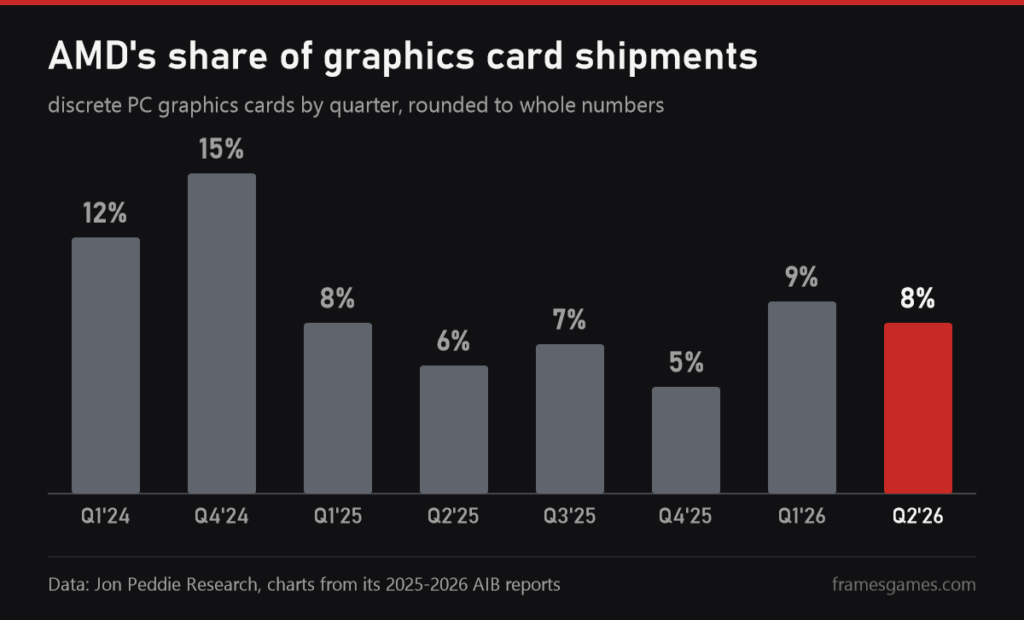
The series is a pothole. AMD had 15% of shipments at the end of 2024 and 8% in the first quarter of 2025, when NVIDIA was ramping RTX 50 and the RX 9070 cards only went on sale on 6 March, right at the end of the quarter. Then 6%, 7%, and the record low of 5% in Q4, with memory prices dragging everything else up.
- Q4 2025. 11.5 million cards: NVIDIA 94%, AMD 5%, Intel 1%.
- Q1 2026. 11.8 million cards: NVIDIA 90%, AMD 9%, Intel 1%.
- Q2 2026. 12.5 million cards, up 10% on the quarter and 6.6% on the year: NVIDIA 90%, AMD 8%, Intel 2%.
There's a wrinkle in JPR's numbers you should know about. The press release text gives share changes in hundredths: AMD minus 0.04 points in Q1, minus 0.16 in Q2. The charts in the same releases show a jump from 5% straight to 9%. My guess is that JPR revised earlier quarters and the text compares against the revised figures, but it doesn't say so. I'm going with the charts, since they at least line up from one report to the next. Shares to the decimal are in JPR's paid report.
The second quarter is usually a weak one. This year sales grew, and JPR says high-end cards actually sold better as prices climbed. Jon Peddie's own theory is that people rushed to buy before cards got any more expensive. Back in September we wrote that AMD gained seven points across the whole graphics market, but that was mostly integrated graphics in Ryzen chips. Now the report on actual graphics cards is out, and the gain is there too, just smaller.
Where it started: ATI once had half the market
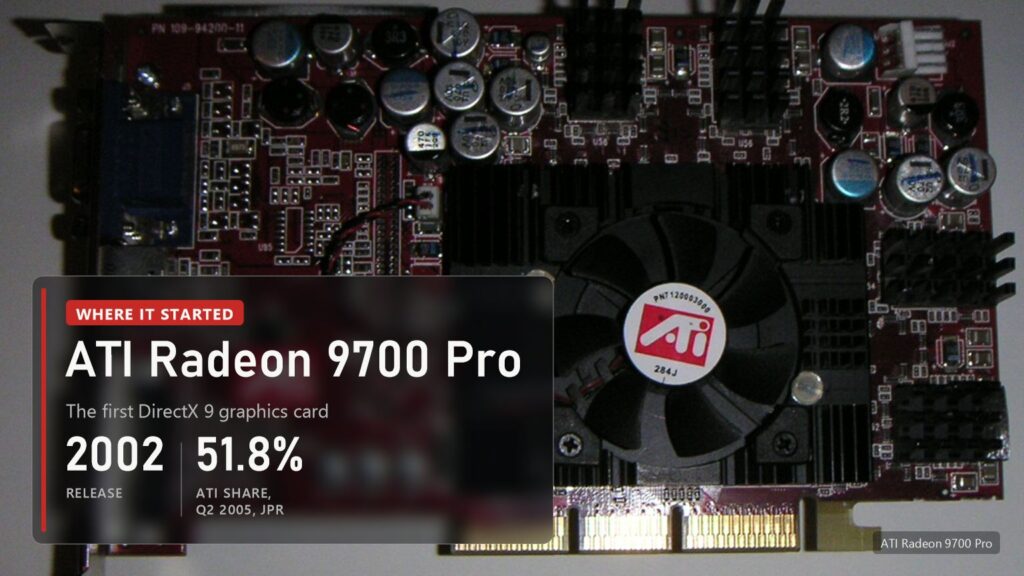
Radeon wasn't always the one catching up. In the summer of 2002 ATI released the Radeon 9700 Pro, the first DirectX 9 card, and NVIDIA's answer, the GeForce FX, showed up late and disappointing. Through 2004 and 2005 ATI held about half of the desktop discrete market: in Q2 2005, JPR had it at 51.8% to NVIDIA's 46.3%.
In 2006 AMD bought ATI for 5.4 billion dollars, and for a few years it looked like an expensive mistake. Then in September 2009 came the Radeon HD 5870, the first DirectX 11 card. NVIDIA took half a year to respond, and Mercury Research counted AMD at 51.1% of all discrete GPUs shipped in Q2 2010, desktop and mobile, against 48.8% for NVIDIA. Radeon hasn't been ahead since.
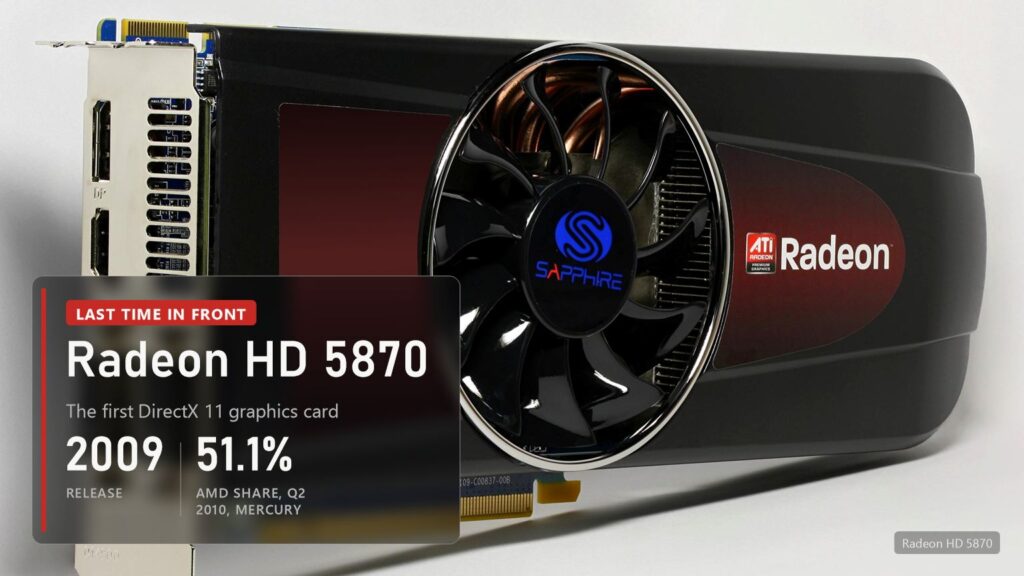
- 2015. 18% in Q2 per JPR, the lowest on record at the time. NVIDIA was selling Maxwell while AMD's R9 300 series was largely renamed older chips.
- 2016. The RX 480 at 199 dollars, a bet on the mid-range. People loved it; it didn't win the share back.
- 2022. 8% in Q3 per JPR, the year Intel entered the market with Arc.
- End of 2024. 15%, followed by a threefold drop within a year.
Compared with the past: in fifteen years AMD went from 51% to 5%. Today's 8% puts it back at its 2022 level, nowhere near 2010.
What's driving it: RX 9070 XT, RX 9060 XT and pricey memory
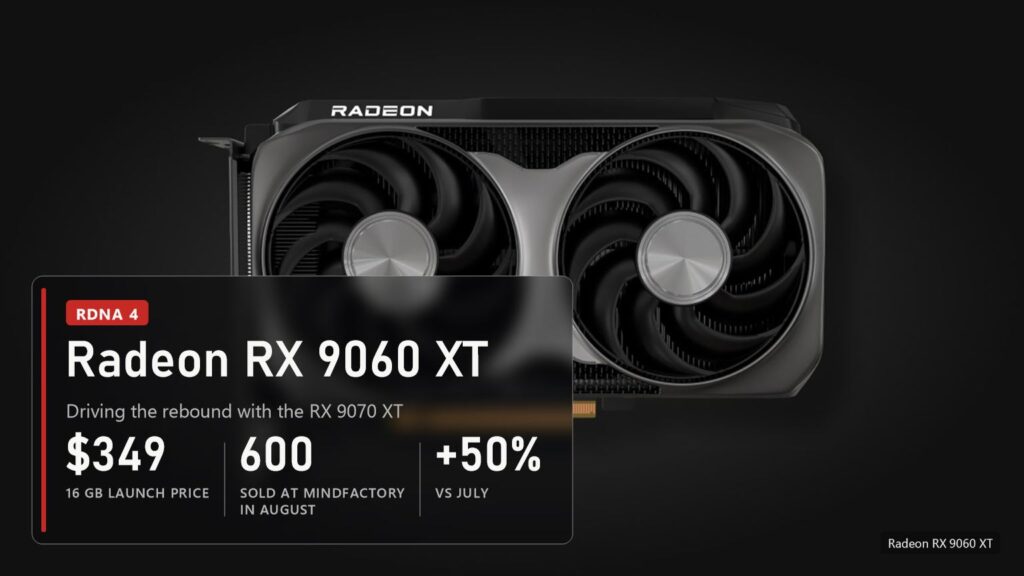
AMD unveiled RDNA 4 on 28 February 2025. The RX 9070 XT at 599 dollars and the RX 9070 at 549 went on sale on 6 March, and the RX 9060 XT followed on 5 June at 349 dollars for 16 GB and 299 for 8 GB. That's the whole lineup. AMD didn't build an RTX 5090 rival and is fighting where most cards get bought.
 The video loads from YouTube (Google) when you press play. Privacy policy
German retailer Mindfactory, which publishes sales by model, shows what people pick. In August 2026, per TechEpiphany's tally, it sold about 2,810 graphics cards, and 55.9% of them were Radeons against 39.5% GeForce. The RX 9070 XT moved around 870 units and the RX 9060 XT 600, up 50% on July.
Mindfactory has long been friendly to AMD (Radeon promotions are almost a permanent fixture there), and one German shop says nothing about the world. It does say who the buyer is, though: someone building their own PC and counting price per frame. Prices kept creeping up all through 2026 along with memory, and in September the RTX 5090 passed 5,000 euro in Germany. When a flagship costs as much as a used car, people look at the 350 to 650 euro bracket, and that's where I think AMD has the best value. Our picks there are in the best graphics cards under 500 euro.
Why Steam doesn't see the growth yet
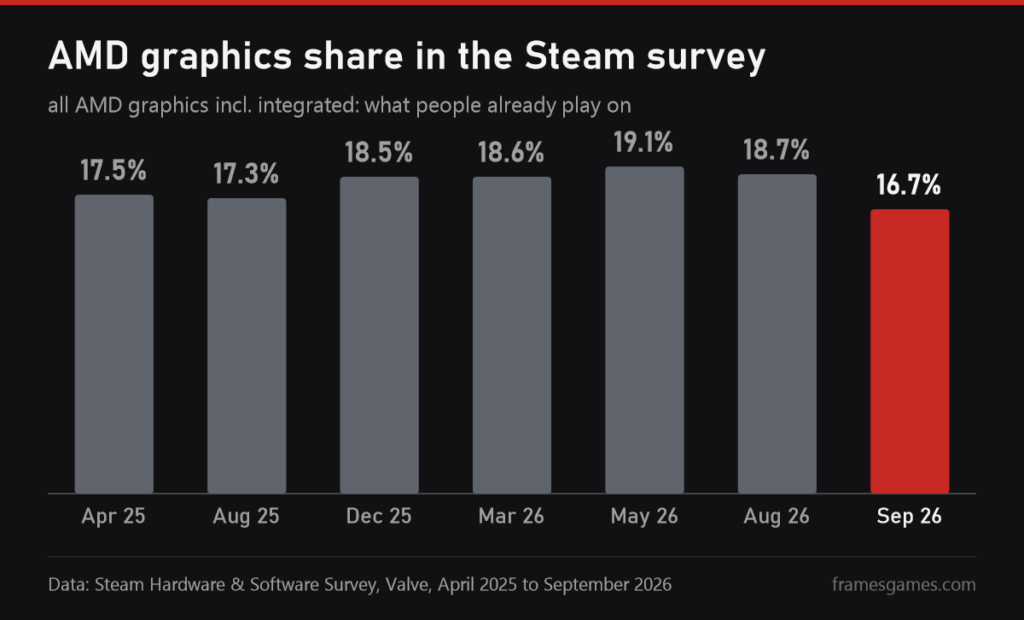
The Steam survey doesn't count sales. It counts what people already play on. All AMD graphics there, including integrated Ryzen chips and the Steam Deck, stood at 17.51% in April 2025, peaked at 19.13% in May 2026 and sat at 18.68% in August. In September it fell to 16.67%. That same month the survey saw a surge of users with Simplified Chinese set as their language, and The FPS Review ties September's GeForce jump directly to them.
The most common Radeon in the survey is the RX 9070 XT at 1.35%; the RTX 5070 is at 5.86%. People replace a graphics card every few years, and a million Radeons a quarter against eleven million GeForces won't turn the installed base around quickly. Processors are the opposite story, AMD is at a record there.
What's next: RDNA 5 no earlier than mid-2027
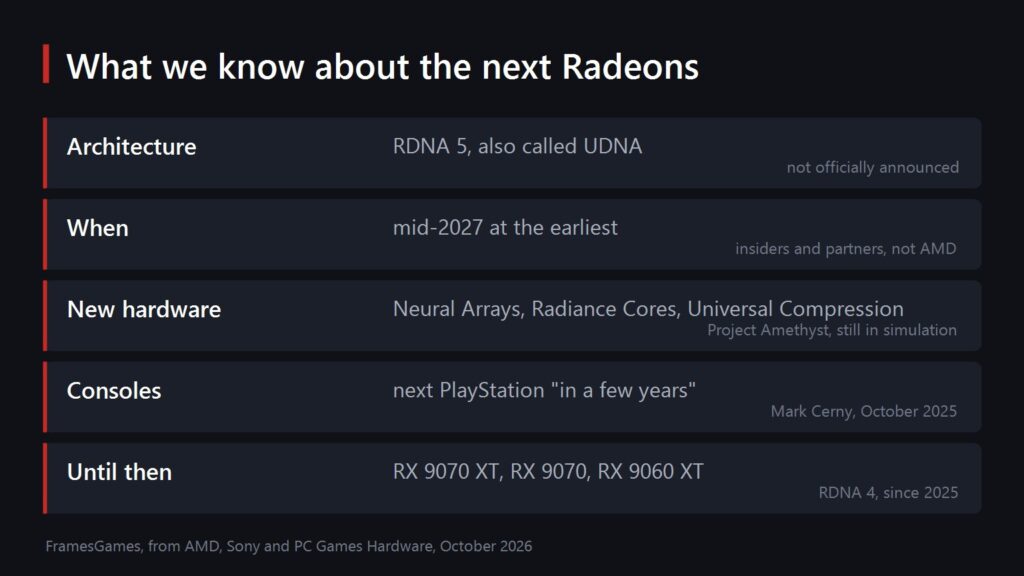
There won't be new cards this year. AMD hasn't officially named or dated its next generation. Leaker Kepler_L2, cited by PC Games Hardware in December 2025, expects RDNA 5 no sooner than mid-2027, and AMD's partners, according to press reports, talk about mid to late 2027. Until then the shelves hold the RX 9070 XT, RX 9070 and RX 9060 XT.
 The video loads from YouTube (Google) when you press play. Privacy policy
What goes into that generation, Sony and AMD sketched out in October 2025 in a video about Project Amethyst. Mark Cerny and AMD's Jack Huynh described Neural Arrays, where compute units work together like a single AI engine, Radiance Cores for ray and path tracing, and Universal Compression for all the data moving through the GPU. Cerny said it all exists only in simulation for now and will reach a future console "in a few years' time". That's also where a real answer to DLSS 5 seems likely to come from, as we covered in how AMD will answer NVIDIA.
The money side is cautious. AMD's gaming segment brought in 779 million dollars in Q2, down 31% on the year, mostly because of console chips. Lisa Su said separately that pricier components pushed graphics card prices up and weighed on demand, and CFO Jean Hu expects a strong double-digit decline in gaming in the second half.
To me, 8% looks like a bounce off the floor rather than a return to 15 or 20%. For it to stick, the RX 9060 XT and RX 9070 XT can't get pricier faster than GeForce cards do, and FSR Redstone needs to actually show up in games. The next numbers are close: AMD usually reports its quarter in early November, and JPR's Q3 report, going by past years, lands in December. We'll go through both.

Sources
Jon Peddie Research: Q2 2026 report, 09.09.2026, Q1 2026, 10.06.2026, Q4 2025, Q1 2025, 04.06.2025. Steam Hardware & Software Survey, September 2026. The FPS Review on the September Steam survey, 03.10.2026. Wccftech on Mindfactory's August sales via TechEpiphany, 08.09.2026. Guru3D on AMD's quarterly results, 05.08.2026. Tom's Hardware on Lisa Su's comments. PC Games Hardware on RDNA 5 timing, 26.12.2025. KitGuru on AMD's 2015 share per JPR. APH Networks on Mercury Research's Q2 2010 data. EE Times on JPR's 2005 data. Radeon 9700 Pro photo from Wikimedia Commons, public domain. Radeon HD 5870 photo from Wikimedia Commons by D-Kuru, CC BY-SA 3.0 AT.