In a year NVIDIA has shipped DLSS 4.5, pushed Multi Frame Generation past 250 games by January, and on 3 September launched DLSS 5 with neural rendering. AMD's answer was supposed to be FSR Redstone, a set of four machine-learning technologies that launched on 10 December 2025. Almost ten months later, we checked every part of it: one works and has spread widely, one works with caveats, one is in two games and one is in no games at all. AMD has still not responded to DLSS 5 officially.
What Redstone promised, and what shipped
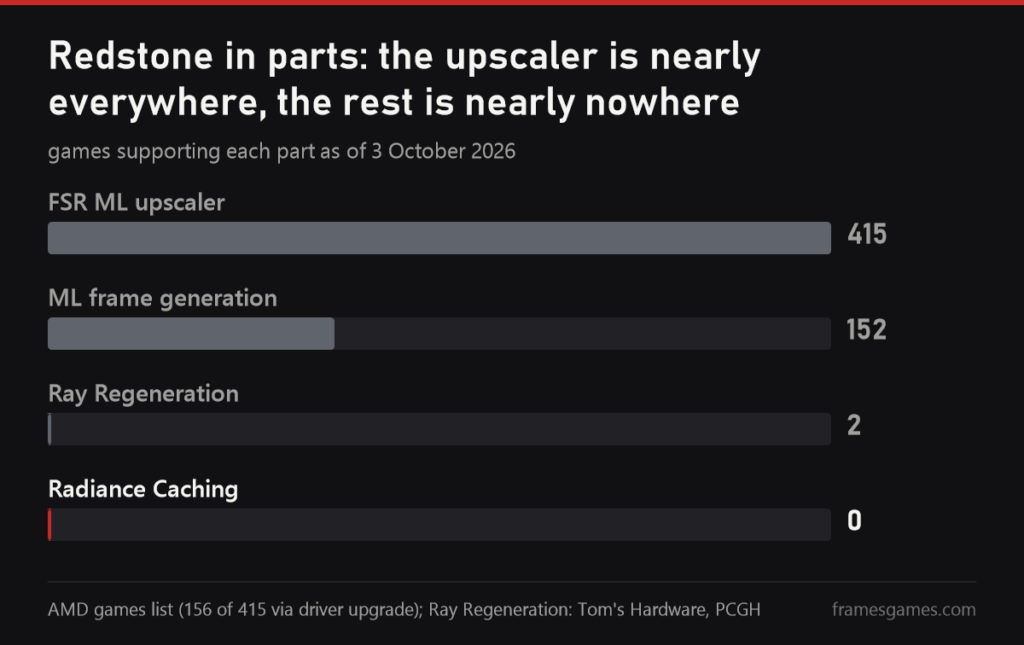
Redstone was shown at Computex in May 2025 and arrived in full with the Adrenalin 25.12.1 driver. Here is where each part stands today:
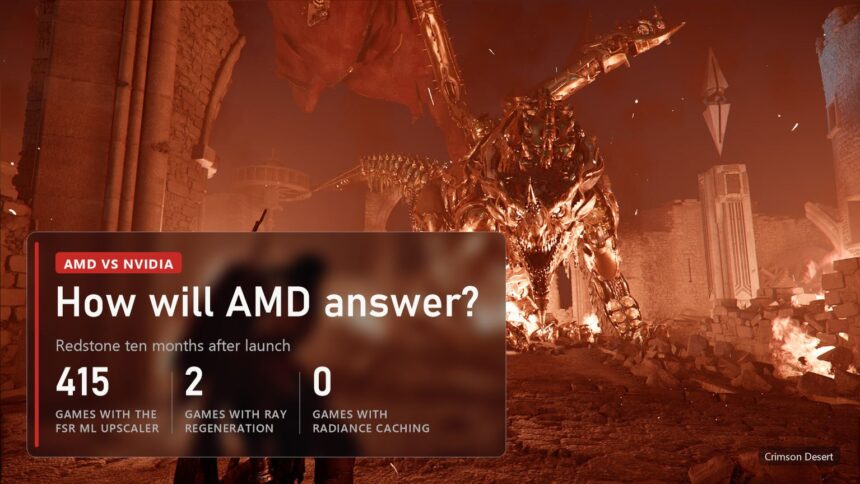
- The ML upscaler, a.k.a. FSR 4. It works and has spread the furthest: AMD's list has 415 games, though 156 of them get it through the driver upgrade on top of FSR 3.1. Since June 2026 it officially runs on RX 7000 too, and AMD promises it for RX 6000 in early 2027.
- ML frame generation. Shipped, 152 games on AMD's list, RX 9000 only.
- Ray Regeneration. A neural denoiser for ray tracing, AMD's take on NVIDIA's Ray Reconstruction. AMD keeps no separate list; we could confirm two games, Call of Duty: Black Ops 7 and Crimson Desert.
- Radiance Caching. A 0.9.0 technical preview for developers came out in December 2025, with a full release promised for 2026. As of 3 October the version on GPUOpen is still 0.9.0, and not a single game uses it.
Multi frame generation, which NVIDIA has offered since the RTX 50 series, does not exist at AMD at all. We looked at how Radiance Caching got stuck in preview in our piece on AMD's lighting research.
Where NVIDIA is ahead, and by how much
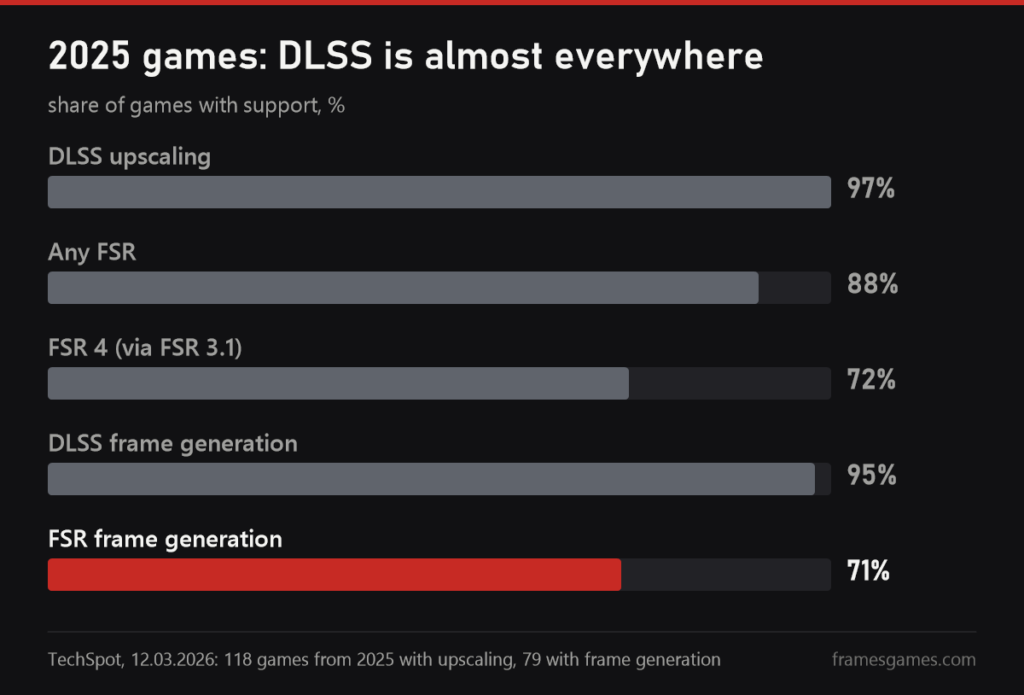
TechSpot counted 118 games from 2025 with upscaling. DLSS is in 114 of them, or 97 percent, while FSR 4 can be enabled through FSR 3.1 in 72 percent. Frame generation shows the same gap: 95 percent for NVIDIA, 71 for AMD. On quality, TechSpot found DLSS 4.5 sharper and more stable than FSR 4.1.
On frame generation, reviewers split. At Redstone's launch, Hardware Unboxed found frame pacing problems in most of the ten games it tested. ComputerBase instead praised the pacing, but spotted something else: Anti-Lag 2 does not work with FSR frame generation, so in Black Ops 7 latency rose by 31 percent, while DLSS frame generation with Reflex cut it by 17. PCGH rated Ray Regeneration above the game's own denoiser at almost no frame cost, but said NVIDIA is still ahead.
What AMD is planning next
AMD's main plan was named back in March 2026 at GDC: FSR Diamond. According to AMD's Jack Huynh, it will make ML upscaling, multi frame generation and neural rendering native to Project Helix, the next Xbox. The first developer kits are expected in 2027. AMD has not said whether Diamond will come to current Radeon cards, and the claim that it will be RDNA 5-only is still a rumor.
The second track is Project Amethyst with Sony: neural blocks in the GPU, dedicated ray tracing cores and data compression, which Mark Cerny and Jack Huynh described back in October 2025. According to Tom's Hardware, PlayStation's PSSR 2 upscaler is built on FSR 4.1 and is part of that project. Everything else AMD has shown in the past two months is research: in August a neural network for indirect light that needs 45.56 ms per 512 by 512 frame on a server-class Instinct MI250, and in September generative lighting based on a diffusion model. That is a long way from games.
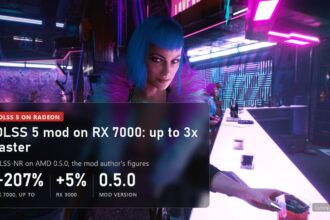
While AMD stays quiet, enthusiasts are running DLSS 5 on Radeon. In a month, the DLSS-NR on AMD mod went from RX 9000 to RX 6000.
Marketing or technology?
Calling all of Redstone marketing would be unfair. The upscaler is real and has made Radeon noticeably better: ComputerBase called the move to FSR 4.1 on RX 7000 a huge jump in image quality, at a cost of 10 to 15 percent of frames at 4K on an RX 7900 XTX compared with FSR 3.1. But after ten months, half of the package is still on slides: Radiance Caching is in no games, Ray Regeneration is in two, and there is no multi frame generation. A real answer to DLSS 5 is not in sight before 2027, and by all indications it is tied to the next consoles.
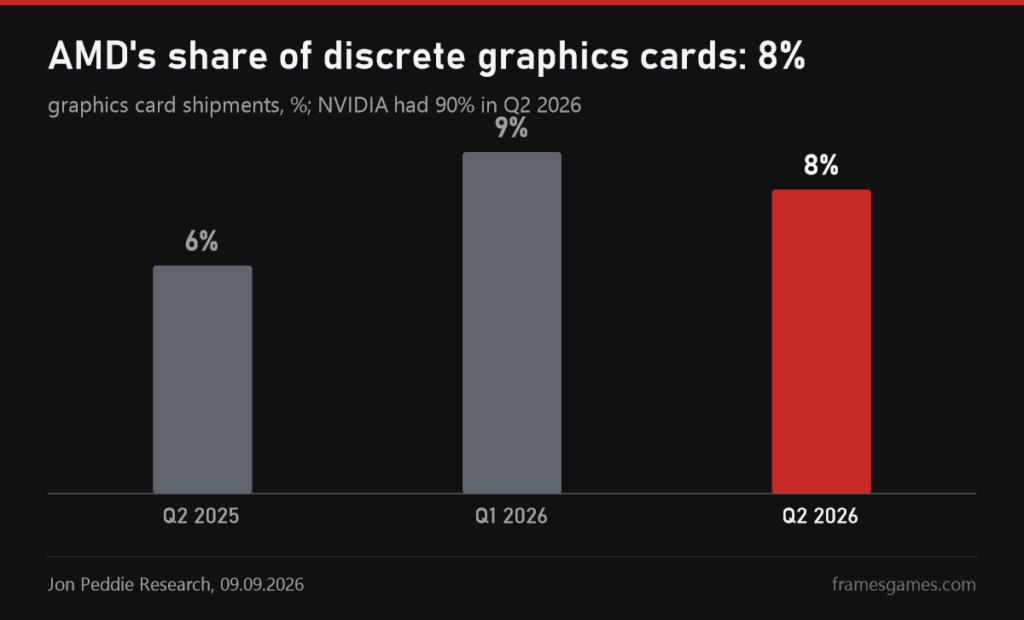
The market already reflects this. According to Jon Peddie Research, AMD took 8 percent of discrete graphics card shipments in Q2 2026, against 90 percent for NVIDIA. A year earlier it was 6, so Radeon has grown a little, but the gap is still enormous.

Sources
AMD GPUOpen on the Redstone launch, 10.12.2025. AMD FSR Radiance Caching, version 0.9.0. AMD's list of FSR games. Tom's Hardware on FSR 4 for RX 7000 and RX 6000. Tom's Hardware on FSR 4.1 and Ray Regeneration in Crimson Desert, 20.03.2026. TechSpot on game support in 2025, 12.03.2026. TechSpot, FSR 4.1 vs DLSS 4.5, 15.03.2026. TechSpot and Hardware Unboxed on Redstone, 10.12.2025. ComputerBase on FSR frame generation, 11.12.2025. ComputerBase on FSR 4.1 on RX 7000, 24.06.2026. PCGH on Ray Regeneration, 19.11.2025. TechSpot on FSR Diamond and Project Helix, 11.03.2026. GPUOpen, 20.08.2026 and 09.09.2026. Tom's Hardware on Project Amethyst, 09.10.2025. NVIDIA at CES 2026. Jon Peddie Research, 09.09.2026. Screenshots from the official Steam and AMD galleries.