FSR 4.1 really has got sharper. The softness that FSR 4 was criticised for has visibly receded: tests pick it up on fabric, hair and foliage. But the sharpness came at a price, and there is still a gap to DLSS 4.5.
What got better
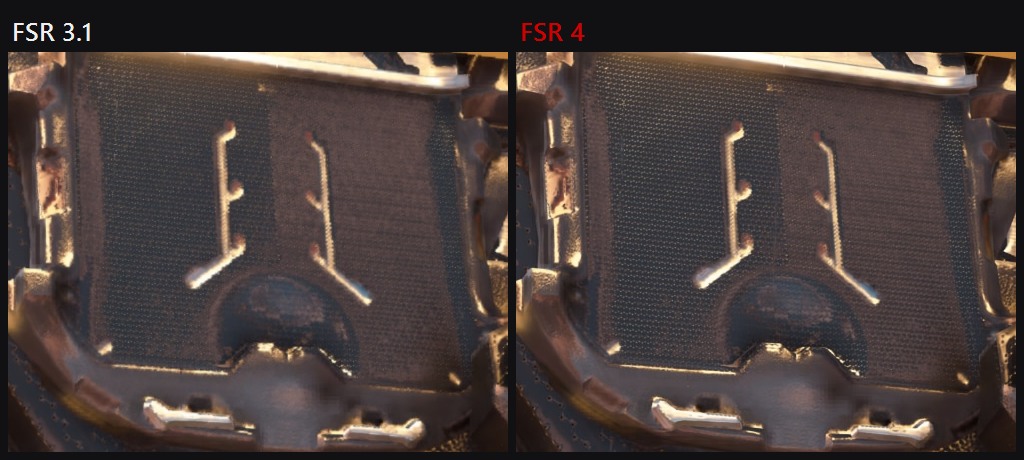
TechSpot ran both versions and put the same thing in its section headings that players see for themselves: detail reconstruction improved and smearing in motion went down. It shows most on foliage, which used to dissolve under FSR 4 while running.
- Fabric and hair. At 1440p in quality mode FSR 4.1 draws a cleaner pattern on shirts and hair strands, where 4.0.3 carried more noise along the edges.
- Shimmer in shadows. In performance mode the older version visibly sizzles on shadows and the background. There is less of it in 4.1.
- Thin objects. Railings, grates and distant geometry hold together better, with less boiling as the camera moves.
- Frames did not suffer. At 1440p quality the speed is identical, and in performance mode the difference sits within a couple of frames.
The sharpness was paid for with stability
And here comes the honest part. Sharpness in an upscaler is not a free bonus, it is a trade. TechSpot put it straight into a section heading: sharper detail comes with a stability trade-off.
In practice it looks like this: in performance mode hair under FSR 4.1 looks crisper, but visible pixel steps can appear along the character outline, which the softer 4.0.3 did not have. Softness was not only spoiling the picture, it was also masking artefacts.
So "sharper" and "better" are not the same sentence. In quality mode the update wins with almost no caveats. In performance mode it becomes a matter of taste: detail for some, a calm image without trembling edges for others.
The blind test: six out of seven
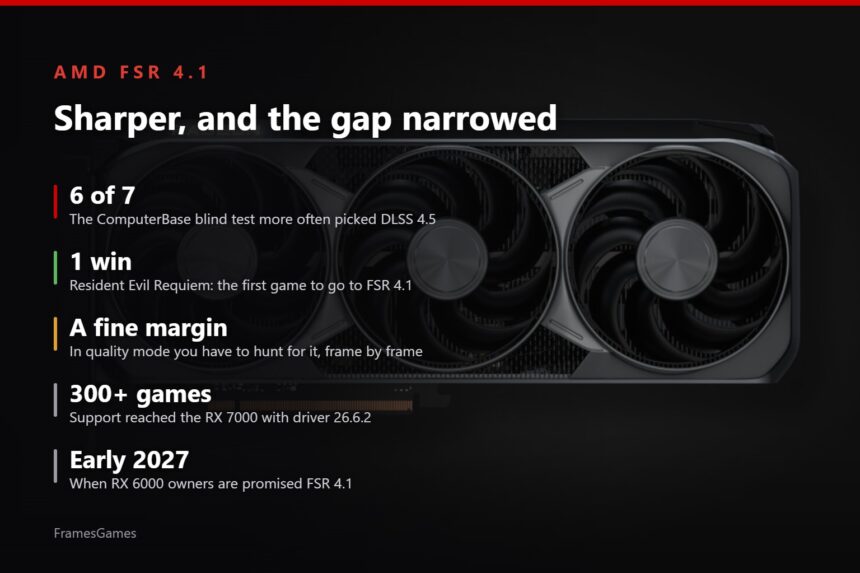
Talk of parity with DLSS is premature, and that is not an opinion but a vote count. ComputerBase updated its large blind test: the same unlabelled clips, but this time comparing FSR 4.0, FSR 4.1 and DLSS 4.5. Seven games:
- Year 117: Pax Romana, ARC Raiders, Assassin's Creed Shadows
- Call of Duty: Black Ops 7, Kingdom Come: Deliverance II
- Resident Evil Requiem, The Last of Us Part I
The result: in six of the seven games DLSS 4.5 was named the best. The single exception is Resident Evil Requiem, where viewers put FSR above DLSS for the first time in these tests, leaving DLSS 4.5 in second place.
The wording from ComputerBase themselves is careful: AMD has "nearly matched" Nvidia, and visual parity is possible in future versions of FSR. One win is a real milestone, but for now it is a milestone rather than equality.
How big the gap actually is
Six to one looks like a rout, and this is the point not to be misled on. It is a preference vote, not a measurement. Viewers were not playing a game, they were watching unlabelled clips they could pause, slow down and rewind.
- The margins inside each game were tiny. The discussion around the test keeps returning to it: between "DLSS looks better", "they all look the same" and "FSR looks better" the vote gap in many scenes sat within the noise.
- Some viewers see no difference at all. That is not a joke about eyesight: at a normal distance from the monitor, in motion, telling the versions apart is close to impossible.
- Sharpness buys votes. In still frame polls the sharper image wins almost every time, even when it is not more accurate, only more contrasty.
So there is no chasm between FSR 4.1 and DLSS 4.5. There is a deficit, and it becomes visible when you sit close to the monitor, freeze the frame and compare the edges of objects. In ordinary play most people will not name which upscaler is on.
Going to the opposite extreme would be dishonest too. The ComputerBase editors are stricter than their readers: they call the step from 4.0 to 4.1 real and advise switching to the new version everywhere, but in their view it does not reach the standard of DLSS 4.5. The move from DLSS 4 to 4.5 was a bigger jump than FSR 4 to 4.1.
The short version: the deficit is real, but it is measured with a magnifying glass, not with a canyon. A year ago the gap was discussed without one.
The big one for Radeon owners: FSR 4.1 has reached RX 7000
For most readers this part matters more than any screenshot comparison. FSR 4 was an RDNA 4 exclusive, meaning RX 9000 only. With FSR 4.1 AMD opened it up to RX 7000, and did so ahead of schedule: in the Adrenalin 26.6.2 driver at the end of June, against a promised July.
- How it is possible. The original FSR 4 model runs on second generation FP8 units. For RDNA 3 it was reworked for first generation INT8.
- How many games. More than three hundred supported titles at launch.
- What comes next. RDNA 3 integrated graphics follow, and RX 6000 on RDNA 2 is promised for early 2027.
What it means in practice
- You own an RX 9000. Update and stay in quality mode, where 4.1 is better at almost everything.
- You own an RX 7000. This is your biggest upgrade of the year and it is free. Until now these games meant choosing between FSR 3 and third party workarounds.
- You own a GeForce. Nothing changes: DLSS 4.5 still leads on image stability.
- You are waiting for parity. The gap has narrowed to one game in seven, but it is still there. The next FSR version is the interesting one.
We put together the full list of games where this version of the upscaler is available: FSR 4 and Redstone, the supported games and requirements.