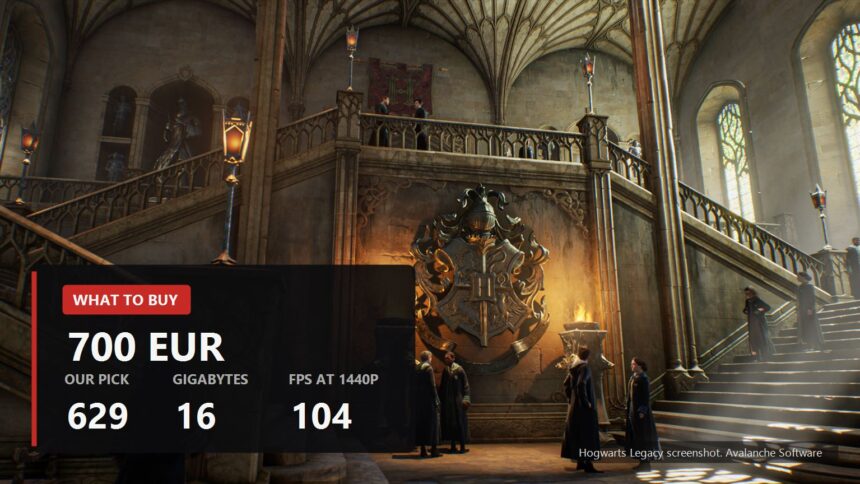
Under seven hundred euro I take the Radeon RX 9070 at 629. It does 104 frames at 1440p, carries 16 GB and has the best euro per frame in this price band. The RTX 5070 at 690 euro is eight percent slower and has twelve gigabytes. There is a catch though, and it is why this article does not end at the first paragraph: with ray tracing on, the whole thing flips.
Euro per frame
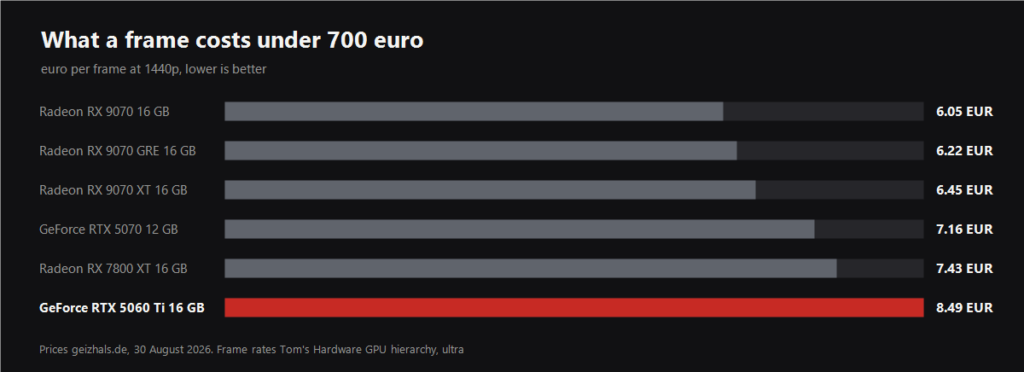
Counted on plain raster at 1440p, so no ray tracing and no upscalers. Lower is better.
| Card | Memory | Price, euro | FPS 1440p | FPS 4K | Euro per frame, 1440p |
|---|---|---|---|---|---|
| Radeon RX 9070 GRE | 16 GB | 539 | 86.6 | 46.3 | 6.22 |
| Radeon RX 9070 | 16 GB | 629 | 104.0 | 57.7 | 6.05 |
| Radeon RX 7800 XT | 16 GB | 629 | 84.7 | 45.1 | 7.43 |
| GeForce RTX 5070 | 12 GB | 690 | 96.4 | 54.3 | 7.16 |
| Radeon RX 9070 XT | 16 GB | 752 | 116.5 | 65.8 | 6.45 |
| GeForce RTX 5060 Ti | 16 GB | 623 | 73.4 | 40.2 | 8.49 |
The RX 9070 at 629 beats the RTX 5070 at 690 on frames, on euro per frame and on memory. If raster were the whole story, the article could stop here.
Raster against ray tracing
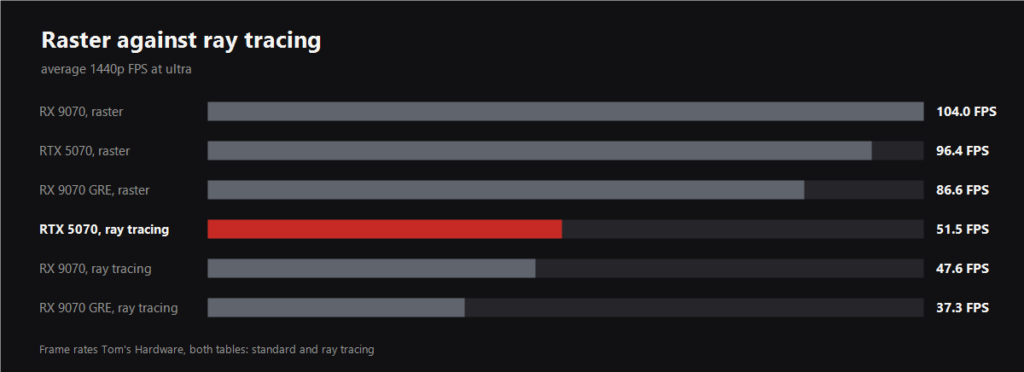
Tom's Hardware keeps two tables, one standard and one with ray tracing enabled. Buying guides almost never show the second one, which is a shame: the gap changes sign.
In standard mode the RX 9070 leads by eight percent. Turn ray tracing on and the RTX 5070 leads by eight instead: 51.5 frames against 47.6. That pleasure costs 690 euro against 629, so you pay sixty one euro extra for ray tracing and give up four gigabytes of memory.
- You mostly play without ray tracing. Take the RX 9070, there is nothing to think about here.
- Ray tracing matters to you. The RTX 5070 gives more frames exactly there, and DLSS is supported in more places than FSR. But 12 GB in 2026 is already tight.
- Willing to stretch. The RX 9070 XT at 752 euro does 116.5 frames and still beats the RTX 5070 on euro per frame.

RX 9070 GRE at 539 euro, when seven hundred is too much

Ninety euro of savings costs seventeen percent of the frames: 86.6 against 104. Same memory, sixteen gigabytes. For a 1440p monitor at 144 Hz that is enough in most games. For 4K it is not, 46 frames there.
With ray tracing the GRE sags the hardest of this group, down to 37.3 frames. If you plan to turn it on regularly, this is not your card and it is worth adding the money.
What not to buy in this budget
- RTX 5060 Ti 16 GB at 623 euro. The worst euro per frame in the table at 8.49. The RX 9070 costs six euro more and delivers forty two percent more frames.
- RX 7800 XT at 629 euro. A previous generation card at the price of the current RX 9070, and nineteen percent slower.
- Any RTX 5070 above 700. Shops list versions at 750 and 780. At that price the RX 9070 XT is right there, faster in both modes.
The verdict
The RX 9070 at 629 euro is the best buy under seven hundred, and that conversation is short. The RTX 5070 at 690 makes sense in exactly one case: you play with ray tracing and DLSS matters to you. Twelve gigabytes stays its weak spot, and in a couple of years we will probably be writing a separate article about that.
Prices are captured on the first of each month. These are from 30 August 2026.
Sources
Prices: Geizhals graphics card listing, lowest offer per model on 30 August 2026, VAT included, shipping excluded.
Frame rates: Tom's Hardware GPU Benchmarks Hierarchy, both tables, standard and ray tracing, ultra preset.