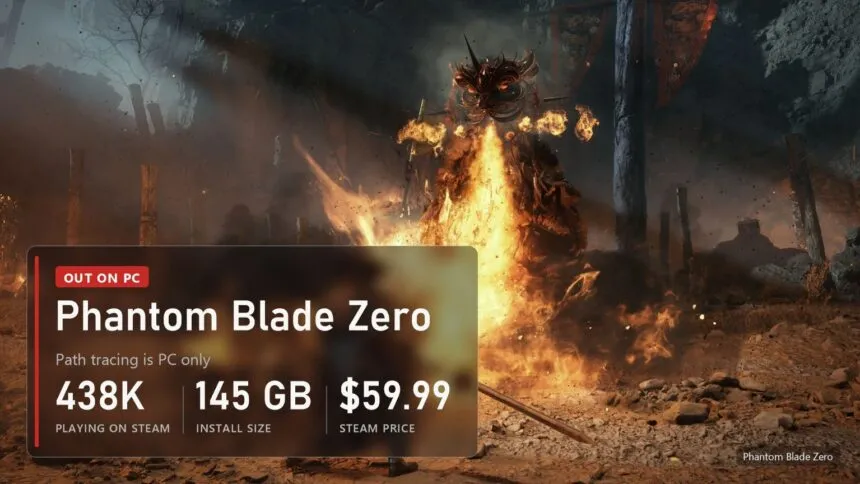
Phantom Blade Zero went live on October 28 at 7pm Pacific, and by the morning of October 29 (UTC) Steam's own player counter showed 438,423 people in the game at once. It costs $59.99, takes 145 GB, and the PC version has one thing the PS5 does not: path tracing. NVIDIA is already quoting up to 450 FPS at 1440p on an RTX 5090. That number leans on 6X frame generation, and I break it down below.
Read next:
Requirements: a GTX 1660 for 30 FPS, and 300 GB free during pre-load
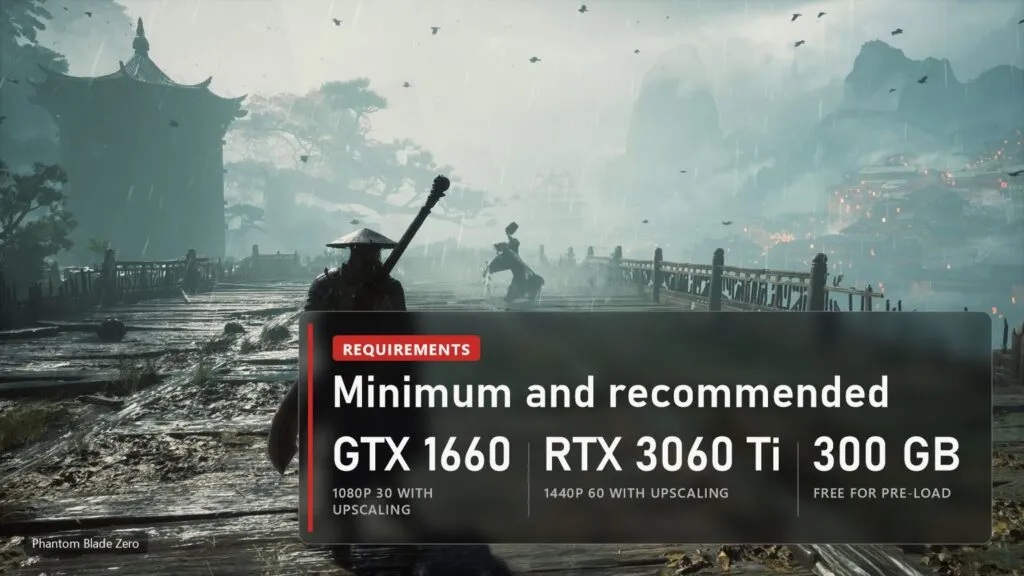
Here is the full table from the Steam page. S-GAME lists both tiers with upscaling switched on, so neither one is native resolution.
- Minimum, 1080p at 30 FPS. Core i7-8700K or Ryzen 5 3600, 16 GB RAM, GeForce GTX 1660 6 GB or Radeon RX 5500 XT 8 GB.
- Recommended, 1440p at 60 FPS. Core i5-10600K or Ryzen 5 5600X, 16 GB RAM, GeForce RTX 3060 Ti 8 GB or Radeon RX 6700 XT 12 GB.
- Both tiers. Windows 10 or 11, DirectX 12, 145 GB, SSD required.
The pre-load post from October 26 adds a line the store page leaves out: keep 300 GB free, not 145, because the installer needs room to unpack. If your drive is nearly full, the download will stall halfway and it will not be Steam's fault.
NVIDIA's 450 FPS: where the number comes from
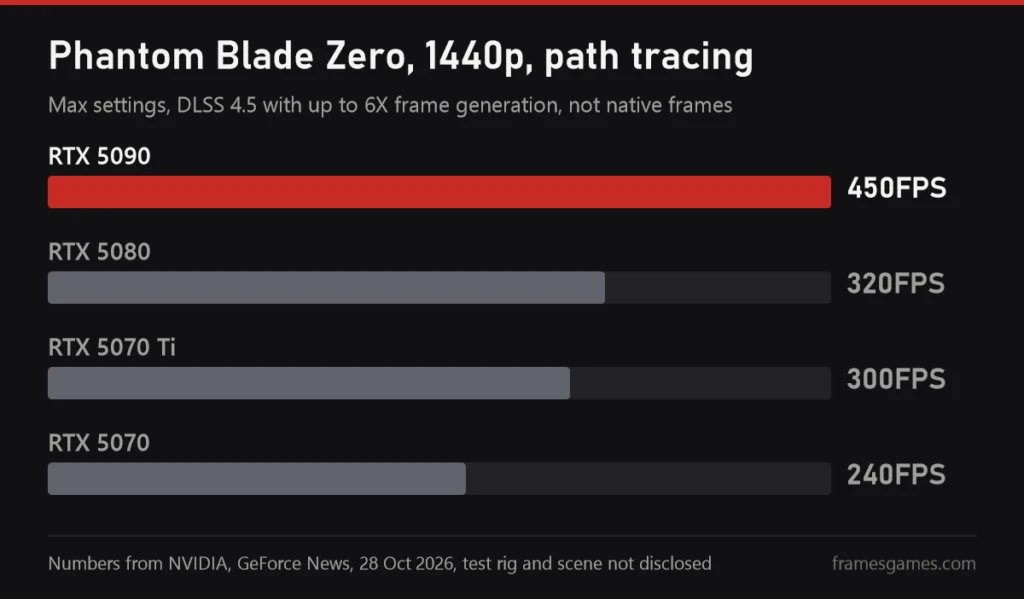
NVIDIA posted its own figures on launch day. Max settings, path tracing, 1440p: 450 FPS on the RTX 5090, 320 on the 5080, 300 on the 5070 Ti, 240 on the 5070. At 1080p it claims up to 600 FPS on the 5090 and 230 on an RTX 5060.
Every one of those runs uses Dynamic Multi Frame Generation, which inserts up to five generated frames per rendered one. NVIDIA itself says the DLSS 4.5 stack lifts 1440p frame rates by 7.8x on average. Divide 450 by 7.8 and you land near 58 rendered frames on a 5090 (my arithmetic, not a measurement). NVIDIA did not publish the test scene or the rest of the rig, so treat these as a ceiling, not a promise for your card.
What path tracing changes, and why it is PC only
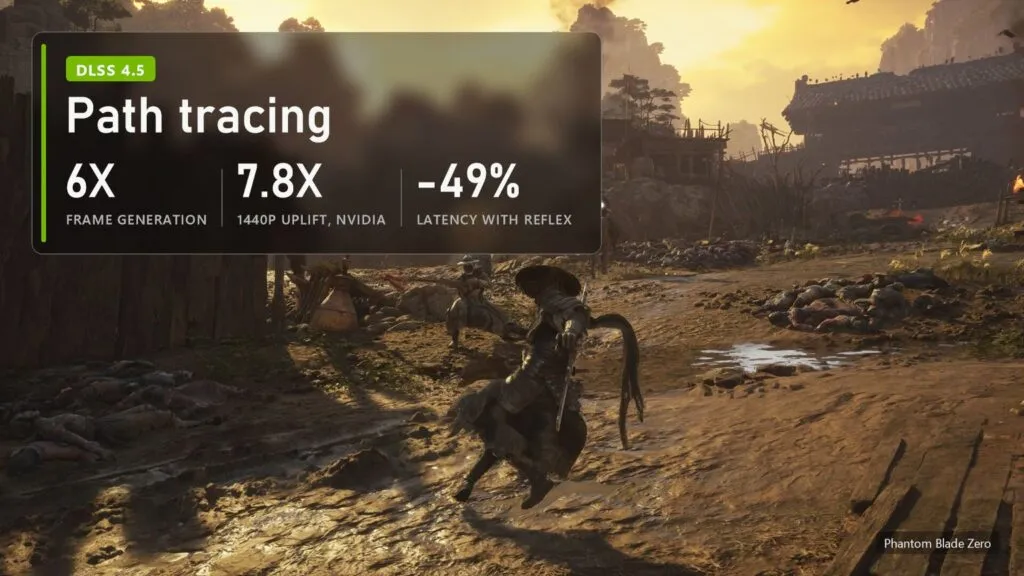
The game runs on Unreal Engine 5 and normally lights scenes with hardware ray-traced Lumen. Turn on path tracing and NVIDIA's ReSTIR GI takes over global illumination, with more accurate bounce light and deeper shadowing in grass and terrain. Water caustics, the rippling light patterns on a riverbed, only exist in this mode.
On GeForce cards the game switches Ray Reconstruction on by itself once path tracing is enabled. Reflex, according to NVIDIA, cuts latency by up to 49 percent, and in a game built around parries I would take that over prettier puddles any day.
One more thing from the Steam news feed. A few hours before launch, S-GAME's creative director Liang Qi wrote that it all started twenty years ago with Rainblood: Town of Death, a student project he made in RPG Maker. Not a bad trajectory for a hobby game.
Sources
Phantom Blade Zero on Steam: release date, price and system requirements. S-GAME news on Steam: pre-load post of 26 Oct 2026 and Liang Qi's letter "Reason and Madness" of 28 Oct 2026. Player count: Steam Web API GetNumberOfCurrentPlayers, 29 Oct 2026, around 09:50 UTC. NVIDIA GeForce News, 28 Oct 2026: path tracing, DLSS 4.5 and frame rate figures. The rendered-frame estimate is FramesGames arithmetic from NVIDIA's average multiplier. Images: official Phantom Blade Zero screenshots from Steam, chart by FramesGames from NVIDIA figures.