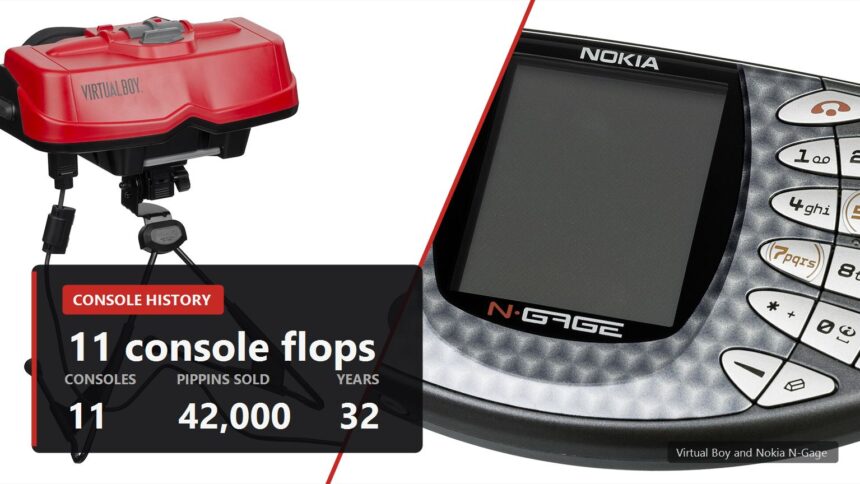
This is a walk through the eleven game consoles that failed the loudest, in order of release: from the Philips CD-i in 1991 to Google Stadia, which was shut down in 2023. For each one we cover who came up with it and why, what was inside, what the company expected, how the launch went, what broke, what its bosses said before and after, and how people treat the machine today.
- Philips CD-i, December 1991. Around a billion dollars lost
- 3DO, October 1993. 699 dollars for a standard that never took off
- Atari Jaguar, November 1993. 250,000 "64-bit" consoles sold
- Sega Saturn, November 1994. 9.26 million, but only 1.8 in the West
- Virtual Boy, July 1995. 770,000 against a plan of three million in Japan alone
- Apple Bandai Pippin, March 1996. 42,000 instead of half a million
- Sega Dreamcast, November 1998. A first day record and Sega's exit from hardware
- Nokia N-Gage, October 2003. Two million instead of six
- Wii U, November 2012. 13.56 million after a hundred million Wii
- Ouya, June 2013. 8.6 million dollars on Kickstarter and about 200,000 sold
- Google Stadia, November 2019. Shut down after three years and two months
- What all eleven have in common
The most telling number on the list belongs to the Apple Bandai Pippin: Bandai expected to sell half a million in the first year, and 42,000 were sold over the machine's entire life. Failure comes in different shapes, though. The Saturn and the Dreamcast each sold more than nine million and still cost Sega its place at the top, while the Virtual Boy came back on Switch in 2026 and turned out to matter more to fans than it did in 1995.
Philips CD-i, December 1991. Around a billion dollars lost
The CD-i was not conceived as a games console. Philips and Sony started work in 1984, just two years after the compact disc appeared, and announced the format in March 1986 at Microsoft's CD-ROM conference in Seattle. Funnily enough, Bill Gates only learned about the project there. The ambitions were huge: education, training, retail kiosks and multimedia for the living room. Gaston Bastiaens, the Philips vice president in charge of CD-i, put it plainly in 1990:
CD-I will be 'the medium' for entertainment, education and information in the 90's.
Gaston Bastiaens, Philips, 1990- Processor. Philips SCC68070 at 15.5 MHz.
- Memory. 1 MB.
- Graphics. From 384 by 280 up to 768 by 560 pixels, 16.7 million colours.
- Drive. Single speed CD, plus audio CDs, Photo CD and Video CD with an add-on module.
- Launch. The CDI 910/205 came out in the United States on 3 December 1991 for around 1,000 dollars.
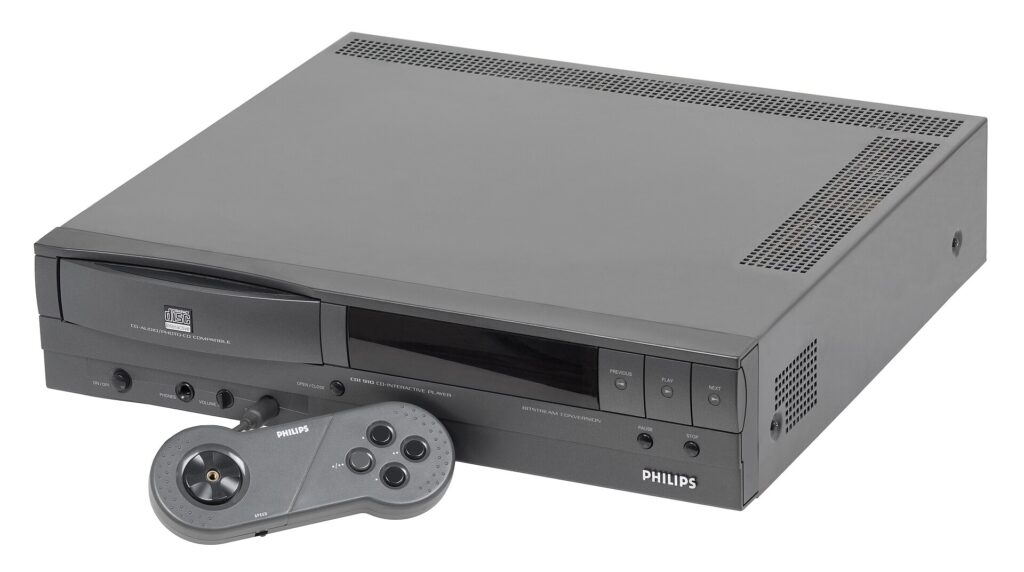
Plan versus reality. By October 1994 Philips claimed 570,000 players installed worldwide, and US sales reached about 400,000 by 1996. The project is estimated to have cost the company around a billion dollars.
What went wrong is visible in the price and the games. At a thousand dollars the CD-i lost to both computers and consoles, and most of its games were interactive video. Then there is the Nintendo story: the abandoned CD add-on for the SNES left Philips with rights to Nintendo characters, which is how Link: The Faces of Evil, Zelda: The Wand of Gamelon, Zelda's Adventure and Hotel Mario came to exist, some of the most savaged games in either series. About the only title reviewers praised was Burn:Cycle. Philips gave up on the platform in 1996 and officially ended it in June 1999.
It was a device that kind of basically got caught in the middle. It was a terrible game machine, and it was a terrible PC.
Bill Gates on the CD-iToday. The CD-i mostly lives on in memes, with those Zelda cutscenes circulating online for years. Surprisingly, a whole project grew out of that: in 2024 Seedy Eye Software released Arzette: The Jewel of Faramore, a successor to the CD-i Zelda games featuring Jeffrey Rath and Bonniejean Wilbur, the original voices of Link and Zelda. Running a real unit is harder, because a dead lithium battery often stops it from booting without some surgery. Retro creators keep coming back to it, with retrospectives from The MultiGen Gamer in 2023 and Lady Arcade in 2026.
3DO, October 1993. 699 dollars for a standard that never took off
Behind the 3DO was Trip Hawkins, the founder of Electronic Arts. In September 1991 The 3DO Company was spun off, and Hawkins stepped down as head of EA to run it himself. The idea was borrowed from VHS: 3DO would not make hardware itself, but license it to manufacturers such as Panasonic, GoldStar and Sanyo, and charge 3 dollars per game. The console was sketched out by RJ Mical and Dave Needle, the designers of the Atari Lynx, reportedly on a restaurant napkin in 1989. Hawkins framed it like this at the time:
The interactive media market cannot be built by a single company.
Trip Hawkins, 1991- Processor. 32-bit ARM60 at 12.5 MHz.
- Memory. 2 MB of RAM and 1 MB of video memory.
- Graphics. The Madam accelerator and the Clio audio processor.
- Drive. Double speed CD.
- Launch. Shown at CES in January 1993, the Panasonic FZ-1 went on sale in the United States on 4 October 1993 for 699 dollars.
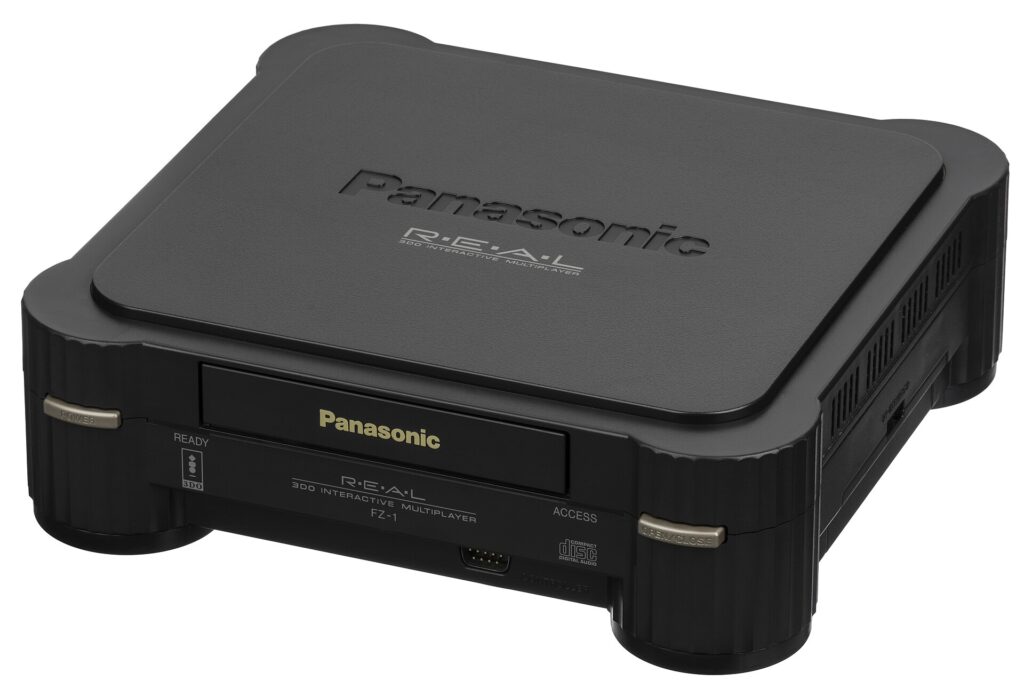
Plan versus reality. At launch there was a single game, Crash 'N Burn, and not many consoles either. By mid-November 1993 about 30,000 had sold, and around two million over the platform's life.
What went wrong was baked into the model. Sony and Sega sold consoles at a loss and made their money on games, while Panasonic and GoldStar had to profit from the hardware, hence the 699 dollar price. Once the PlayStation and the Saturn arrived, the graphics advantage was gone. In December 1995 GoldStar dropped its price to 199 dollars, lost more than a hundred on every unit and abandoned the platform. By 1996 The 3DO Company had left hardware and sold its M2 work to Panasonic, and in 2003 it went bankrupt. Hawkins later admitted that success needed one strong company leading marketing, hardware and software, exactly what he had ruled out in 1991.
I think we actually had our golden age when game development was using floppy disks, and it was an open, free platform when we could all make games like we wanted to make. Nintendo came along and software licensing came in, and we've been in a dark age since then.
Trip Hawkins, GamesBeat Summit, 2011Today. Since 2020 the 3DO trademark has belonged to Piko Interactive, which licenses new releases. Limited Run Games reissued The Eye of Typhoon in 2022. The console's story keeps getting told on YouTube, for example Pixel Playback's January 2025 video with the telling title The Story of 3DO: The PlayStation Before the PlayStation.
Atari Jaguar, November 1993. 250,000 "64-bit" consoles sold
The Jaguar was designed by Flare Technology, the company of Martin Brennan and John Mathieson, after the Panther project was cancelled. The team promised a machine stronger than the Genesis and the Super NES yet cheap to build. IBM took on manufacturing under a 500 million dollar contract. The Tramiel family's Atari sold it as the world's first 64-bit games system under the slogan Do the Math.
- Processors. A Motorola 68000 at 13.295 MHz and two custom 32-bit RISC chips, Tom for graphics and Jerry for sound, at 26.591 MHz each.
- Memory. 2 MB.
- Sound. 16-bit CD quality stereo.
- Media. Cartridges, later the Jaguar CD add-on.
- Launch. 23 November 1993, a test launch in New York and San Francisco, 249.95 dollars.
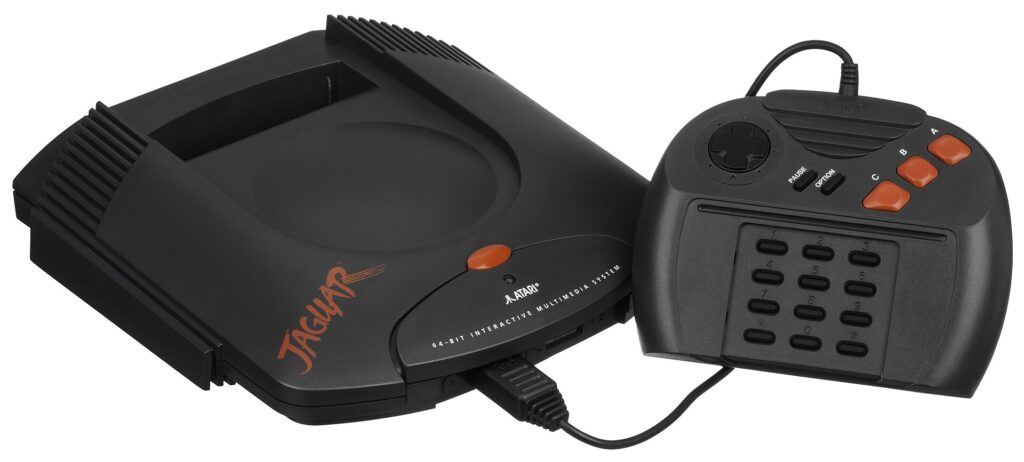
Plan versus reality. 17,000 units shipped in the 1993 test, around 100,000 sold by the end of 1994, around 125,000 by the end of 1995, with another 100,000 sitting in the warehouse. About 250,000 in total. In its 1995 annual report Atari wrote that Jaguar sales were substantially below its expectations, blaming software delays and the arrival of the Saturn and the PlayStation.
What went wrong was above all the games. Launch titles Cybermorph and Trevor McFur in the Crescent Galaxy reviewed poorly, and big third-party publishers such as Capcom never came on board. The "64 bits" were mocked: Electronic Gaming Monthly calculated that by the same maths the Saturn would be a 112-bit monster. Good games came later, Tempest 2000, Doom, Alien vs. Predator, but too late. Atari's chief Sam Tramiel stayed confident to the end:
Jaguar is as powerful, if not more powerful than Saturn. The PlayStation, I must say, is a little, little bit more powerful in certain areas, but not in others.
Sam Tramiel, Next Generation, 1995That same year Tramiel threatened to sue Sony for price dumping while admitting Atari itself was selling the Jaguar at a loss. In an April 1996 filing with the Securities and Exchange Commission the company noted drily that it had abandoned the Jaguar back in November 1995 and was mainly liquidating stock. In July 1996 Atari merged with JTS.
Today. The Jaguar has one of the strangest afterlives around. In May 1999 Hasbro Interactive released all of the console's patents into the public domain, so anyone can make homebrew without a license. The BigPEmu emulator ran the whole library for the first time in 2022, and in 2023 it learned to run Jaguar VR games on modern headsets. Nine Jaguar games are part of Atari 50, including Tempest 2000 and Cybermorph. In 2026 Songbird Productions is releasing a new game, Shape Shooter 2000. And the case moulds were bought by a dentist and adapted for a dental camera, later reused for the Retro VGS project, and now belong to the founder of AtariAge. Retro creators have not forgotten it either, with a long retrospective on Wrestling With Gaming titled Do The Math: The Story Of The Atari Jaguar.
Sega Saturn, November 1994. 9.26 million, but only 1.8 in the West
Development of the Saturn began in 1992 under Hideki Sato. It was built around two Hitachi SH-2 processors: as development section chief Kazuhiro Hamada explained, for cost and efficiency, and because a single CPU was not enough to calculate a 3D world. In early 1994, after learning about the PlayStation, Sega hurriedly added a second video processor. Sega of America president Tom Kalinske disliked the architecture and tried to strike a deal with Silicon Graphics, but Japan said no.
- Processors. Two Hitachi SH-2 at 28.6 MHz.
- Memory. 2 MB of RAM and 1.5 MB of video memory.
- Graphics. VDP1 for sprites and polygons and VDP2 for backgrounds.
- Sound. Yamaha YMF292 with 512 KB of sound memory.
- Launch. Japan on 22 November 1994 for 44,800 yen, with the first 200,000 sold out on day one. United States on 11 May 1995 for 399 dollars.
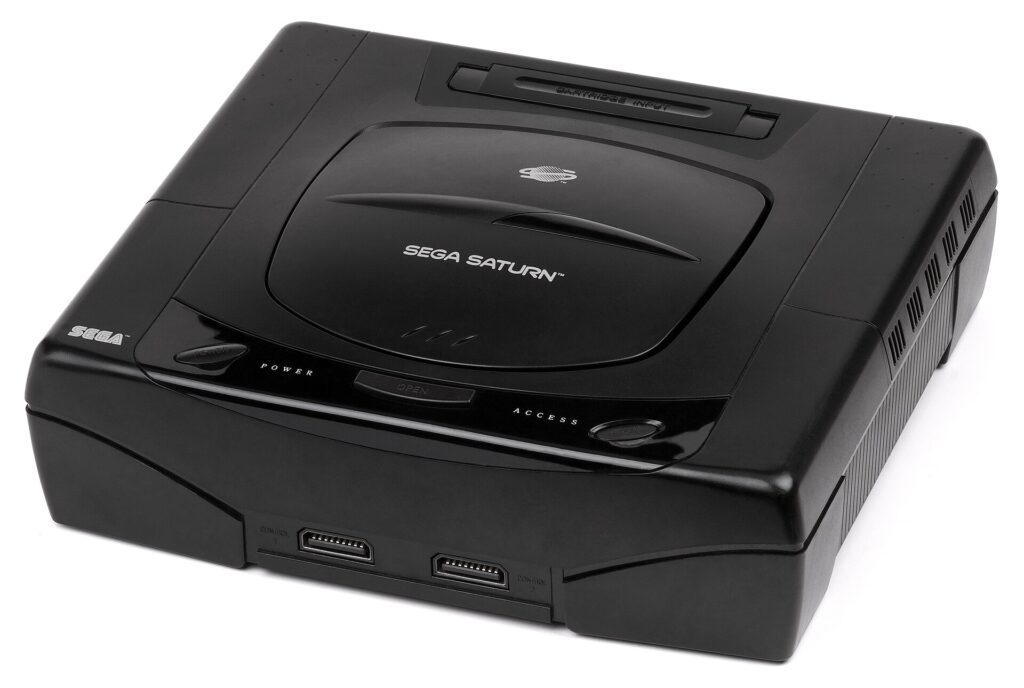
The American launch became legend. It was planned for September, but on 11 May 1995, at the very first E3, Kalinske announced that the console was already in shops:
We started our rollout of the Sega Saturn yesterday.
Tom Kalinske, E3, 11 May 199530,000 consoles went out to a handful of chains. A few hours later Sony's Steve Race walked on stage, said one thing, "Two ninety-nine", and walked off. The PlayStation was a hundred dollars cheaper.
Plan versus reality. In Japan the Saturn sold 5.75 million and held up well. In North America only 1.8 million, 9.26 million in total. By 1997 the PlayStation was outselling it three to one in the US, and Sony held 47 percent of the market against Sega's 12.
What went wrong was almost entirely management. The surprise launch angered chains that got no stock, Best Buy and Walmart among them. There were six games at the US launch. The first fully 3D Sonic, Sonic X-treme, never came out. The Japanese and American offices fought for years, and in 1996 the Nintendo 64 arrived. Kalinske later recalled:
That's not how you launch a system. We didn't know they were going to do it, and when they did, we were like: 'We are screwed here.'
Tom Kalinske, Time ExtensionKalinske left Sega in 1996. His successor in charge of development, former Sony executive Bernie Stolar, said the line at E3 1997 that settled everything: "The Saturn is not our future." The console was discontinued in North America in 1998 and in Japan in 2000.
Today. Opinion on the Saturn has warmed a lot. IGN ranks it 18th among the best consoles ever, and The Guardian wrote that it may have the strongest line-up of 2D shooters and fighting games in history. Japanese exclusives are prized by collectors, and Panzer Dragoon Saga sells for serious money. For the console's 30th anniversary Digital Foundry released 30 Years Of Sega Saturn in May 2025.
Virtual Boy, July 1995. 770,000 against a plan of three million in Japan alone
The Virtual Boy was made by Gunpei Yokoi, the father of the Game Boy, in Nintendo R&D1 together with the American firm Reflection Technology, which had been developing a red LED display since 1985. The project, codenamed VR32, took four years. Yokoi explained the colour simply: "Red uses less battery and red is easier to recognize. That is why red is used for traffic lights." A colour LCD was tried, he added, but people saw double rather than depth. The console was announced on 14 November 1994, and Nintendo president Hiroshi Yamauchi promised a lot:
It will transport game players into a 'virtual utopia' with sights and sounds unlike anything they've ever experienced.
Hiroshi Yamauchi, Nintendo press release, 14 November 1994- Processor. 32-bit NEC V810 at 20 MHz.
- Display. Two monochrome red displays at 384 by 224, around 50 Hz.
- Memory. 64 KB of work RAM, 128 KB of graphics and 128 KB of video memory.
- Sound. Stereo, one speaker per ear.
- Launch. Japan on 21 July 1995, United States on 14 August 1995 for 179.95 dollars.
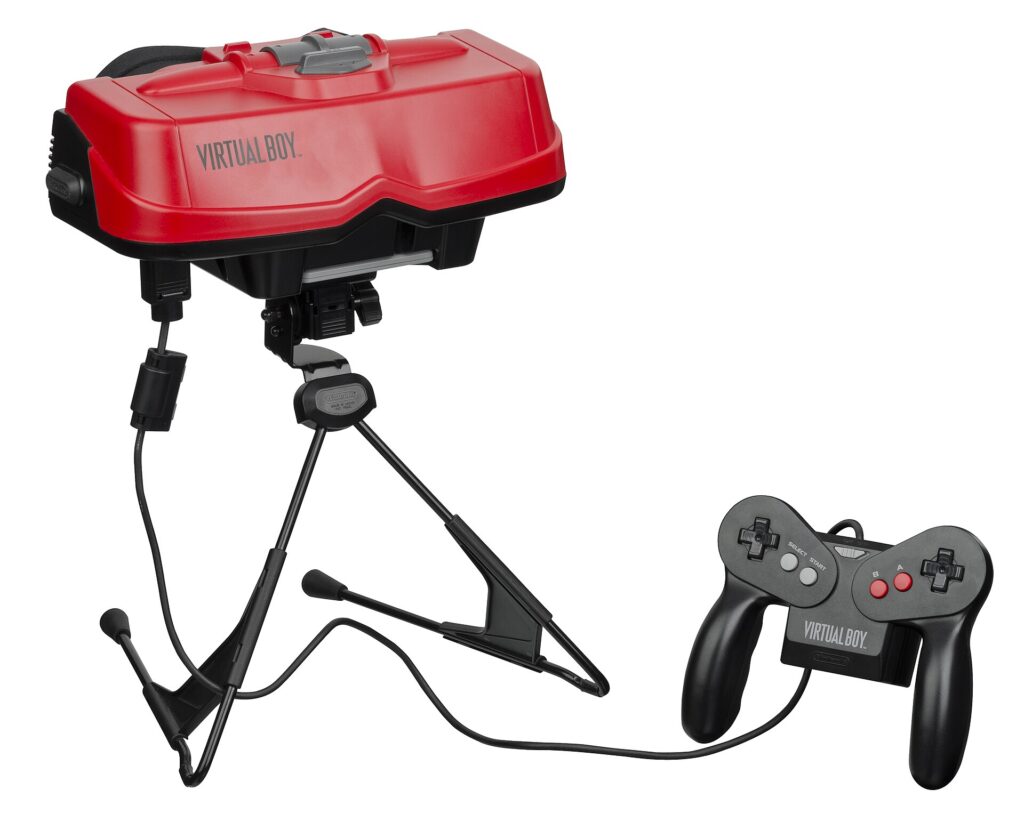
Plan versus reality. Nintendo expected to sell three million consoles and 14 million games in Japan alone by March 1996, plus 1.5 million consoles in North America by the end of the year. In the end 770,000 sold worldwide over its life, 140,000 of them in Japan. 22 games were released.
What went wrong could be felt physically. A Washington Post reviewer complained of dizziness, nausea and headaches. The picture was red only, the console was not really portable, you had to play at a table with your face in the eyepiece, and the planned head tracking was dropped. By many accounts it shipped unfinished so resources could go to the Nintendo 64, and Shigeru Miyamoto barely took part. The Virtual Boy was pulled in Japan on 22 December 1995 and in the US in August 1996, with no announcement.
We haven't been able to come up with that killer application.
Howard Lincoln, Nintendo of America, May 1996Yokoi left Nintendo on 15 August 1996, and newspapers wrote that he was taking responsibility for the failure. He denied it himself: "In reality, I did not resign to 'take responsibility for the Virtual Boy's failure.'" Yet after Yokoi's death in 1997 Howard Lincoln said he took it quite personally when it was not successful. Years later Miyamoto summed it up in an official Nintendo interview:
It's not so much that the machine itself was wrong as a product, but that we were wrong in how we portrayed it.
Shigeru Miyamoto, Iwata Asks, 2011Today. Nintendo has long joked about its flop: in Tomodachi Life characters worship a Virtual Boy, and Luigi's Mansion 3 has a gadget called the Virtual Boo. Then on 12 September 2025 the company announced the Virtual Boy for Nintendo Classics for real. Since 17 February 2026 its games have been available to Switch Online subscribers with the Expansion Pack on Switch and Switch 2, played through a cardboard or plastic stand shaped like the original. On 4 August 2026 two games that never came out at the time, Dragon Hopper and Zero Racers, were added along with colour palettes instead of just red. Retro creators have been interested for years, with big videos from Gaming Historian and from Did You Know Gaming together with LGR.
Apple Bandai Pippin, March 1996. 42,000 instead of half a million
The Pippin is Apple's only games console, and Apple never meant to sell it itself. The company designed a Macintosh-based platform and wanted it to become an open standard like VHS: manufacturers would pay Apple 20 dollars per console and a couple of dollars per title. The main licensee was Bandai, whose chief Makoto Yamashina picked the Pippin for the ease of use of the Mac and aimed for at least 500,000 sales a year. The machine was meant for multimedia, the internet and games all at once.
- Processor. PowerPC 603 at 66 MHz.
- Memory. 6 MB in the Japanese Atmark and 8 MB in the American @WORLD.
- Graphics. 640 by 480 pixels, 8 and 16-bit colour.
- Drive and network. Quad speed CD and a 14.4 or 33.6 kbit/s modem.
- Launch. Japan in March 1996 for 64,800 yen, United States in November 1996 for 599 dollars.
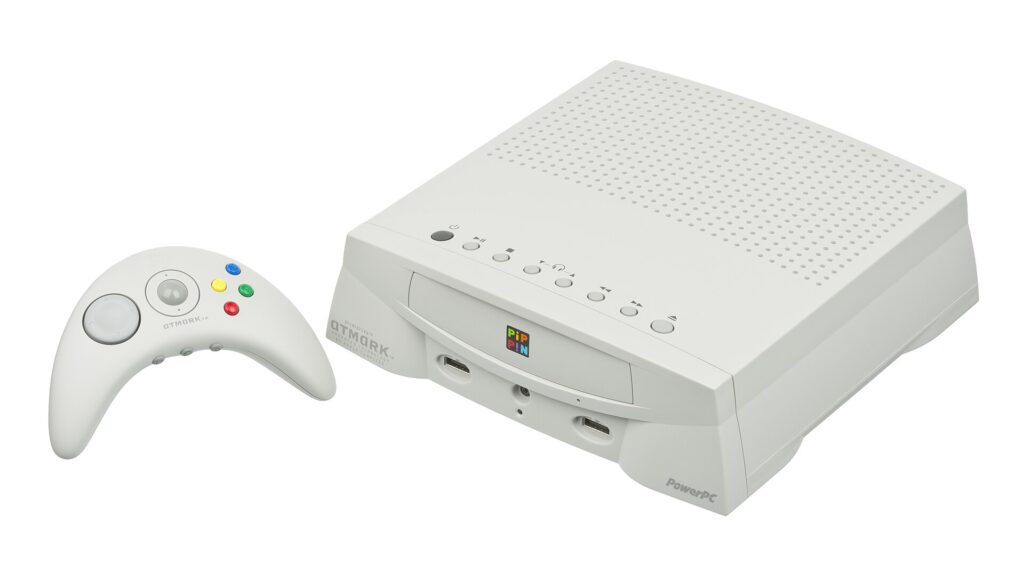
Plan versus reality. Bandai forecast 200,000 in Japan and 300,000 in the US in the first year. Over its whole life the console sold 42,000: 30,000 in Japan and 12,000 in the US.
What went wrong started with the price. At 599 dollars the Pippin cost more than a Saturn plus its NetLink modem. There was almost no ready software, and the only major publisher was essentially Bandai itself. It did not have enough memory to run the Netscape 2.0 browser. It was marketed as a computer, and American buyers did not understand what the @ sign in @WORLD was. Steve Jobs finished it off: when he returned to Apple in 1997 he shut down the whole Mac clone programme, and the Pippin with it. Production stopped in mid-1997, and Bandai kept up support until the end of 2002. There were no big statements from Apple's leadership after the failure: the project was simply closed quietly.
Today. In 2006 PC World placed the Pippin 22nd on its list of the 25 worst tech products of all time. On the other hand it is now one of the rarest consoles for collectors, and the Katz Media Player 2000 from the second licensee is almost impossible to find. Its story is told regularly on YouTube, recently in When Apple Made A Game Console from Lady Decade in April 2025.
Sega Dreamcast, November 1998. A first day record and Sega's exit from hardware
The Dreamcast was developed by two rival teams: in the US a group led by IBM's Tatsuo Yamamoto under the codename Blackbelt, and in Japan Hideki Sato's in-house team. The Japanese design won, with a Hitachi SH-4 processor and NEC PowerVR2 graphics. Bernie Stolar later put it bluntly: "Japan wanted the Japanese version, and Japan won." The mood at the top was combative:
I'm personally not used to losing fights. We're not really going to compete with Sony or Nintendo. We're going to blow them out of the water.
Shoichiro Irimajiri, Sega president, Bloomberg, December 1998- Processor. Hitachi SH-4 at 200 MHz.
- Graphics. NEC PowerVR2 at 100 MHz.
- Memory. 16 MB of RAM, 8 MB of video and 2 MB of sound memory.
- Media and network. GD-ROM discs, cheaper than DVD, and a built-in modem.
- Launch. Japan on 27 November 1998 for 29,000 yen, United States on 9 September 1999 for 199 dollars.
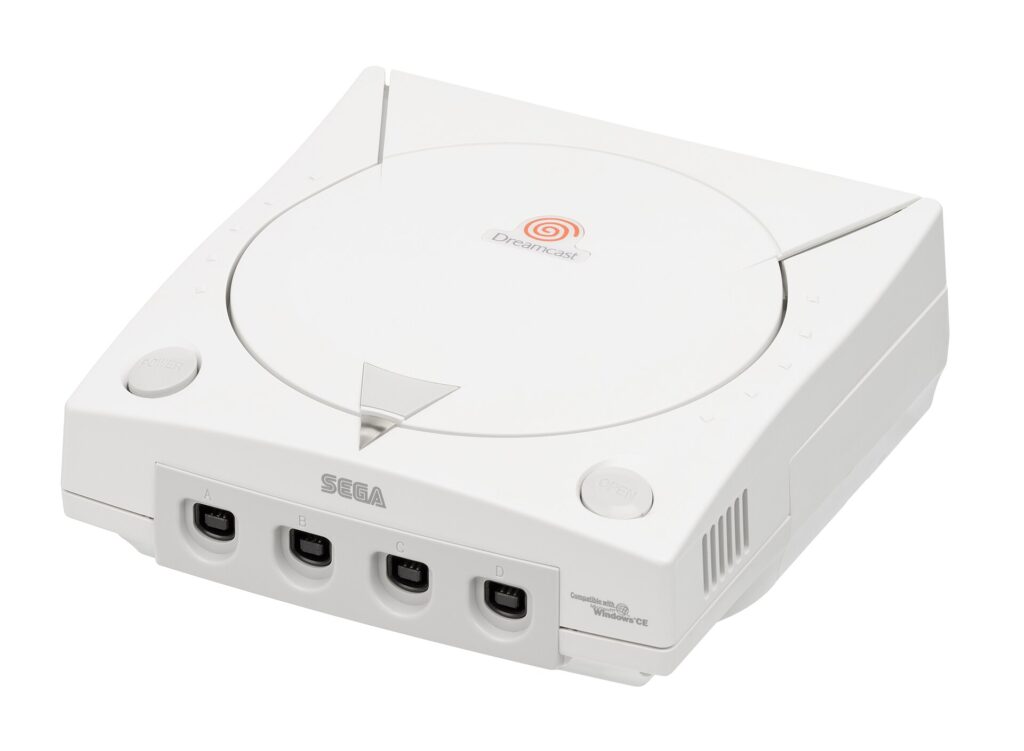
The American launch under the slogan 9/9/99 for 199 dollars was the best in history at the time. Peter Moore, who ran marketing, asked reporters beforehand what had ever sold 60 to 80 million dollars in its first 24 hours. Reality was even better: more than 225,000 consoles and 98.4 million dollars in a day.
Plan versus reality. Over its life the Dreamcast sold 9.13 million. But in the six months to September 2000 Sega lost 17.98 billion yen, and the US market split 50 percent Sony, 35 Nintendo and 15 Sega.
What went wrong was mostly the competition. As early as 2 March 1999, six months before the Dreamcast's US launch, Sony revealed the PS2's specs with DVD, and buyers started waiting. Electronic Arts refused to make Dreamcast games, and others followed. Price cuts only deepened the losses. On 31 January 2001 Sega announced it would stop making the console on 31 March. The decision fell to Peter Moore, by then president of Sega of America:
We had a tremendous 18 months. Dreamcast was on fire - we really thought that we could do it. But then we had a target from Japan that said we had to make x hundreds of millions of dollars by the holiday season and shift x millions of units of hardware, otherwise, we just couldn't sustain the business.
Peter Moore, Sega of AmericaAccording to Moore they were selling 50,000 consoles a day, then 60,000, then 100,000, and it still was not enough to reach critical mass against the PS2. Sega chairman Isao Okawa, who had personally paid for a year of free internet for every Dreamcast owner in Japan, forgave the company's debts to him and returned 695 million dollars' worth of stock before his death in March 2001. After that Sega became a games publisher only.
Today. Of everything on this list the Dreamcast is the most loved, regularly named among the greatest consoles ever for bringing online play and downloadable content long before its rivals. The homebrew scene is alive in 2025 and 2026: the DreamSDK development environment got a major update, a Sonic Mania port appeared, Senile Team announced a new game, and enthusiasts run private servers for online modes. Gaming Historian has a long documentary on the console.
Nokia N-Gage, October 2003. Two million instead of six
Nokia wanted to combine a phone with a games console and take the market from the Game Boy Advance. Development cost more than 100 million dollars, and a single game cost between 600,000 and 1.5 million. Electronic Arts, Sega and Activision all signed up. The device was announced on 4 November 2002 at the Mobile Internet Conference in Munich, and at E3 it was presented by Anssi Vanjoki and Ilkka Raiskinen.
- Processor. ARM920T at 104 MHz.
- Screen. 2.1 inches, 176 by 208 pixels, portrait.
- System. Symbian OS 6.1, Series 60.
- Connectivity and media. GSM, GPRS, Bluetooth, games on MultiMediaCard.
- Launch. 7 October 2003 for 299 dollars.
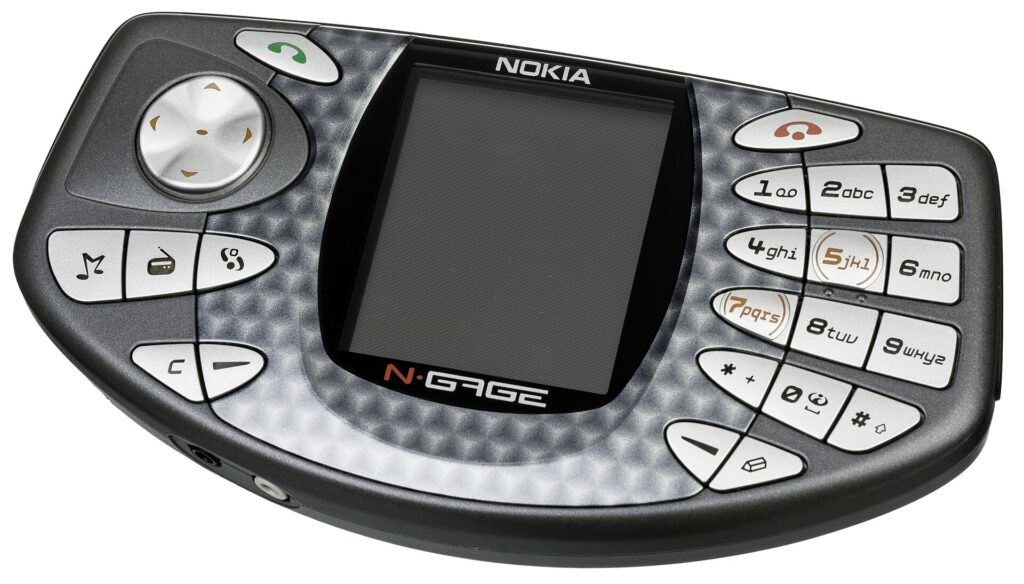
Plan versus reality. In the first weeks the Game Boy Advance outsold it a hundred to one, and within 17 days GameStop and Electronics Boutique were offering 100 dollar rebates. Nokia announced its millionth unit, but later admitted it had counted shipments to shops rather than purchases. The target was six million in three years.
What went wrong is visible in the photo. The phone was nicknamed the taco, and you had to hold its edge to your ear to talk, which gave the internet the word sidetalking. To swap games you had to take off the cover and remove the battery. In April 2004 the fixed N-Gage QD arrived with a slot on the bottom and a normal earpiece, but MP3, radio and USB were cut. At the QD launch Ilkka Raiskinen admitted:
Nokia are entering a new market, and we have made some mistakes. One of them is in communication. We'd like to give the N-Gage three Christmas sales periods.
Ilkka Raiskinen, Nokia, April 2004I am not happy. I said we needed to sell six million in three years, and we sold one-third of that. We need to make some changes.
Anssi Vanjoki, Nokia, November 2005Today. Nokia does not hide the flop, quite the opposite. The New York Times noted that the company wants people to remember the N-Gage. In 2023 the Finnish Museum of Games opened an exhibition called A Fantastic Failure. The games run on PC and Android through the EKA2L1 emulator, and the platform had worthy exclusives such as Pathway to Glory and Ashen. Retro creators like it too, for example Stuff We Play showed off a rare N-Gage prototype.
Wii U, November 2012. 13.56 million after a hundred million Wii
The Wii U was conceived in 2008 to win back the core gamers the Wii had pushed away. Its central idea was the GamePad with its own screen and asymmetric play, where each player has a different role. Satoru Iwata presented the console at E3 2011:
A system we will all enjoy together, but also one that's tailor-made for you.
Satoru Iwata, E3 2011- Processor. Three-core IBM PowerPC Espresso at 1.24 GHz.
- Graphics. AMD Latte at 550 MHz.
- Memory. 2 GB of DDR3, 8 or 32 GB of storage.
- GamePad. 6.2 inch resistive screen, camera and NFC.
- Launch. United States on 18 November 2012 for 299.99 and 349.99 dollars, 29 launch games.
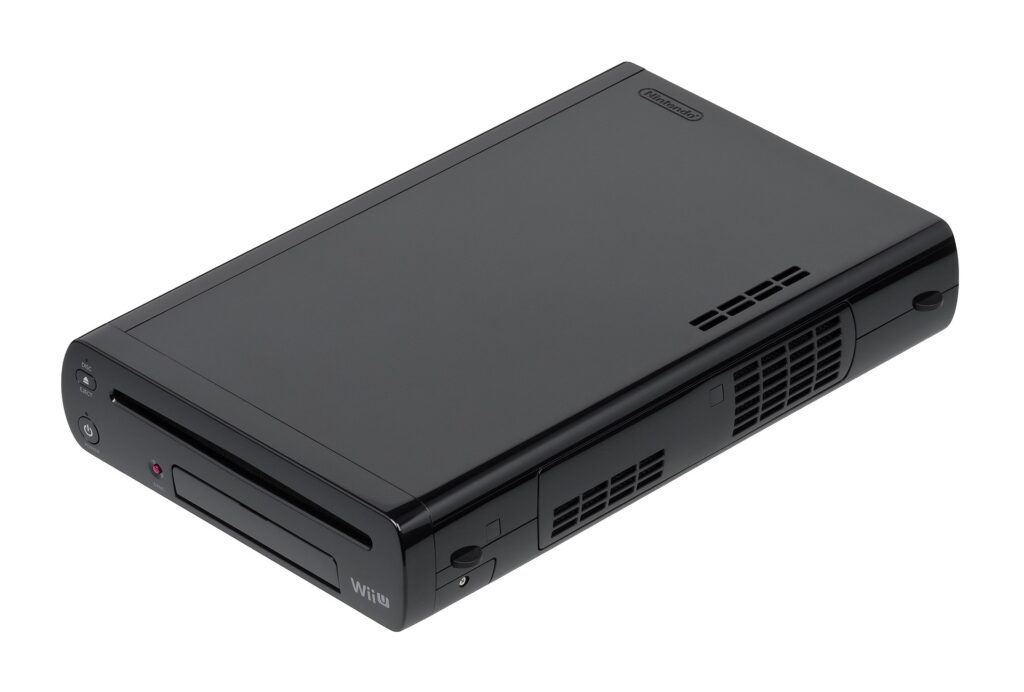
Plan versus reality. In January 2014 Nintendo cut its Wii U forecast for the financial year from 9 million to 2.8 million. Over its life the console sold 13.56 million, while the Wii before it sold more than 101 million.
What went wrong was admitted inside Nintendo itself. Nintendo of America marketer Bill Trinen said the promotion focused too much on the GamePad, and some buyers assumed it was an accessory for the old Wii. In 2013 Electronic Arts said it had no Wii U games in development, and others pulled back too. The GamePad battery lasted about three and a half hours, and strong games were thin at launch. Iwata cut his own salary in half for five months and told investors in an official answer:
Our biggest downfall last year was that we failed to communicate the true value of Wii U.
Satoru Iwata, Nintendo investor briefing, 30 January 2014Reggie Fils-Aimé later called the Wii U a necessary step on the way to the Nintendo Switch. Production ended on 31 January 2017, and almost all its exclusives, Breath of the Wild included, moved to Switch.
Today. Wii U eShop purchases ended on 27 March 2023, and online services were switched off on 9 April 2024. But online play lives on: the community project Pretendo Network, which opened its beta on 26 November 2023, restores Wii U and 3DS network features including multiplayer and Miiverse, and in 2026 players are still getting online through it.
Ouya, June 2013. 8.6 million dollars on Kickstarter and about 200,000 sold
Ouya was founded by Julie Uhrman in 2012, and its little cube was designed by Yves Béhar. The idea was a cheap open Android console where every owner is also a developer with no licensing fees, and every game can be tried for free. Uhrman spoke about it with passion:
The idea of Ouya is to be open. Ouya is our love letter to gamers.
Julie Uhrman, 2012- Processor. Nvidia Tegra 3.
- Memory. 1 GB.
- System. Android 4.1 Jelly Bean with its own interface.
- Kickstarter. Launched on 10 July 2012, the 950,000 dollar goal was met in eight hours, final total 8,596,475 dollars.
- Launch. To backers from 28 March 2013, in shops from 25 June 2013 for 99 dollars.
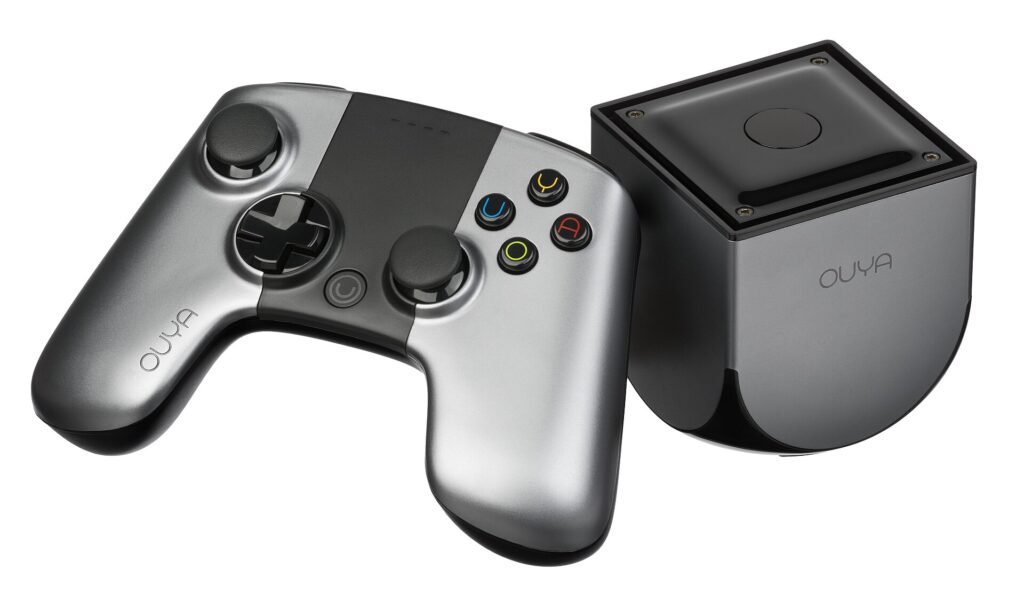
Plan versus reality. The campaign was the fifth biggest in Kickstarter history at the time. Around 200,000 consoles sold over its life, and NPD called first month sales relatively light. The platform's best-known game, TowerFall, sold about 7,000 copies on Ouya.
What went wrong was felt right out of the box: the controller lagged and felt cheap, and good games were scarce. The Free the Games Fund, which promised to match Kickstarter money for Ouya games, ended in a scandal over suspicious backers. Debt restructuring failed, and on 27 July 2015 Razer bought the software and the team and stopped making hardware. The same day Uhrman left and tweeted: "Ouya was a once in a lifetime experience." On 25 June 2019 Razer closed the Ouya store.
Today. Fans saved the Ouya. Before the shutdown a volunteer group called Ouya Saviors on Discord archived the games, and in November 2019 enthusiasts, helped by findings from the Internet Archive's Jason Scott, launched a replacement for the official server, so consoles could once again see a store with more than a thousand games.
Google Stadia, November 2019. Shut down after three years and two months
Google tested cloud gaming in October 2018 as Project Stream with Assassin's Creed Odyssey, and on 19 March 2019 it unveiled Stadia at GDC. It promised 4K, 60 frames and HDR with no console at all, its own studios led by Jade Raymond, and games for everyone. The stage talk was loud:
When we say for everyone, we really mean it.
Sundar Pichai, GDC 2019The new generation of gaming is not a box. The data centre is your platform.
Phil Harrison, GDC 2019- Server processor. Intel x86 at 2.7 GHz.
- Graphics. A custom AMD GPU at 10.7 teraflops.
- Memory. 16 GB.
- Controller. Connected over Wi-Fi straight to Google's data centre.
- Launch. 19 November 2019, Founder's Edition for 129 dollars with a Chromecast Ultra, controller and three months of subscription, 22 games.
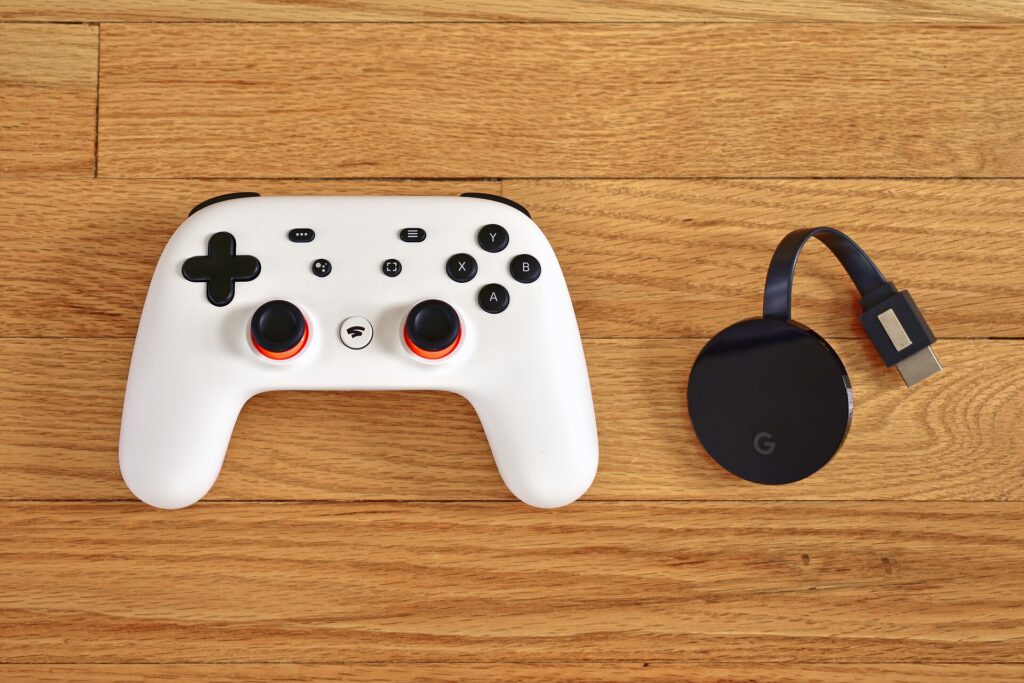
Plan versus reality. Google never published sales figures. At launch Digital Foundry found Red Dead Redemption 2 running at 1440p rather than the promised 4K, and Ars Technica wrote that early adopters felt like they were getting a beta. On 1 February 2021 Google closed its game studios, affecting about 150 people including Jade Raymond. On 29 September 2022 the shutdown was announced, and on 18 January 2023 Stadia went offline.
I am proud of the team we built at Stadia Games and Entertainment.
Jade Raymond, 2021What went wrong, Phil Harrison summed up very briefly in the shutdown announcement: Stadia hasn't gained the traction with users that we expected. A model of buying games at full price on top of a subscription never convinced players, and many features were simply missing at launch. Harrison himself left Google in April 2023.
Today. Stadia closed more honestly than anything else on this list: Google refunded all hardware and every game purchase. As a parting gift it released a tool that switches the Stadia controller to Bluetooth so it does not end up as rubbish, and extended the deadline to 31 December 2025.
What all eleven have in common
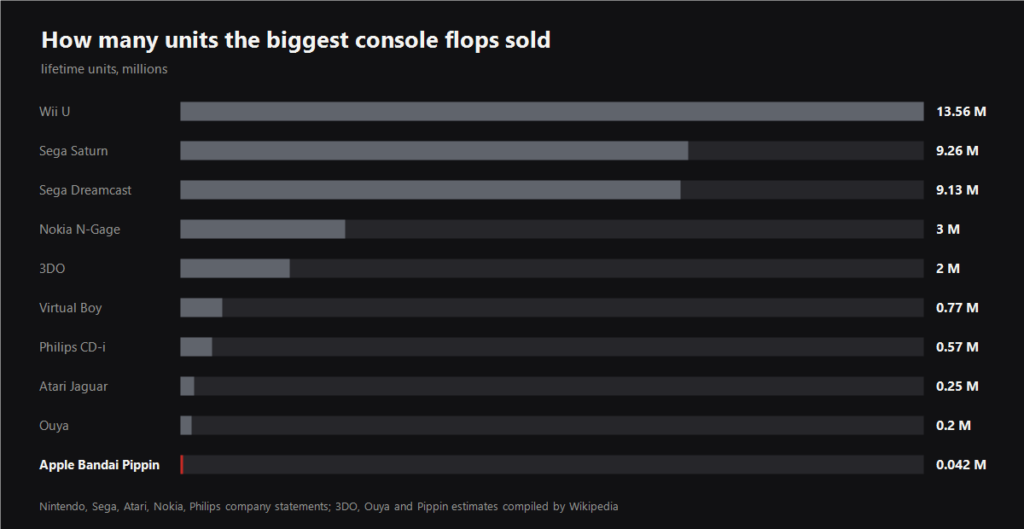
Put the stories together and the causes are few, and they repeat. Price: the CD-i at a thousand dollars, the 3DO at 699, the Pippin at 599. An empty shelf at launch: one game for the 3DO, six for the Saturn in the US, weak launch games and no big publishers for the Jaguar. A confusing idea: the CD-i never decided whether it was a games machine or a multimedia box, the Wii U was mistaken for an accessory, the N-Gage for a phone. And a strong rival at the wrong moment, as the PS2 was for the Dreamcast.
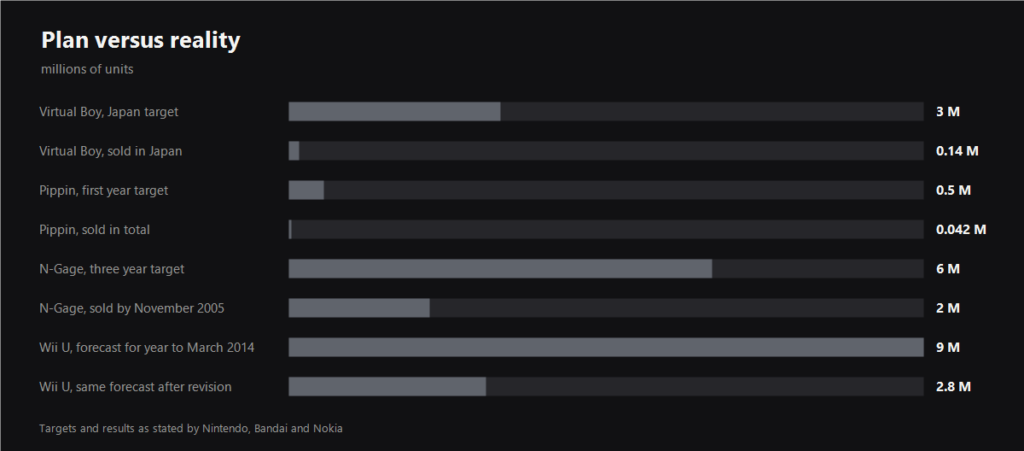
Another shared trait shows in the chart of plans: failure almost always starts with a forecast. Nintendo expected three million Virtual Boys in Japan alone, Bandai half a million Pippins in a year, Nokia six million N-Gages in three years. The gap between promise and sales was several times over for all of them, and more than ten times for the Pippin.
One last thing. Almost every console on this list has its own small army today: homebrew for the Jaguar and the Dreamcast, Pretendo servers for the Wii U and Ouya Saviors for the Ouya, a museum exhibition for the N-Gage and the Virtual Boy's return on Switch. A sales flop does not mean a console was unwanted. Sometimes it means it came out too early, too expensive, or from the wrong company.
Sources
Specifications, dates, prices and sales for each console come from the Wikipedia articles on them, which compile company reports and industry analysts: Philips CD-i, 3DO Interactive Multiplayer, Atari Jaguar, Sega Saturn, Virtual Boy, Apple Bandai Pippin, Dreamcast, N-Gage, Wii U, Ouya and Google Stadia. Gaston Bastiaens's 1990 remark and Bill Gates's words on the CD-i, the estimate of about a billion dollars lost by Philips and the CD-i's standing with retro fans come from Wikipedia and Time Extension. Trip Hawkins's 1991 and 2011 quotes and the 3 dollar per game licensing fee come from Tedium's 2024 feature. Sam Tramiel's words from his 1995 Next Generation interview are quoted as reproduced on the AtariAge forums and by Time Extension, and extracts from Atari's annual report and SEC filing come from Wikipedia. Tom Kalinske's words at E3 1995, Steve Race's line and Kalinske's later admissions come from Wikipedia and Time Extension's feature on E3 1995, and Bernie Stolar's E3 1997 line from Wikipedia. Hiroshi Yamauchi's press release of 14 November 1994, Howard Lincoln's words from 1996 and 1997 and the Virtual Boy sales targets come from Game Developer's "Loose Lips: The Quotable History Of Nintendo's Virtual Boy", Gunpei Yokoi's words on colour and on leaving from Wikipedia and Kotaku, and Shigeru Miyamoto's words from Nintendo's official Iwata Asks interview. The Virtual Boy on Nintendo Classics and the dates of 17 February and 4 August 2026 come from Wikipedia, Nintendo Life and GameSpot. Bandai's Pippin targets come from Wikipedia and the Pippin Wiki. Shoichiro Irimajiri's words come from Bloomberg on 6 December 1998, Peter Moore's and Bernie Stolar's words on the Dreamcast from Wikipedia, and the state of the Dreamcast homebrew scene from Time Extension and the Dreamcast-Talk forum. Ilkka Raiskinen's words come from All About Symbian's interview of 19 April 2004, Anssi Vanjoki's from NBC News on 2 November 2005, the A Fantastic Failure exhibition and The New York Times remark from Wikipedia, and the EKA2L1 emulator from its official site. Satoru Iwata's E3 2011 words come from Wikipedia, his answer to investors from Nintendo's official transcript of the 30 January 2014 briefing, the pay cut and forecasts from GameSpot, Reggie Fils-Aimé's and Bill Trinen's words from Wikipedia, and Pretendo Network details from Wikipedia and the project's official site. Julie Uhrman's 2012 words come from interviews with The Next Web and Forbes, her tweet from Game Informer, and the Ouya Saviors and replacement server story from VICE and GameRevolution. Sundar Pichai's and Phil Harrison's GDC 2019 words come from Game Informer and The Star, the Stadia shutdown announcement from NBC News and TechRadar, Jade Raymond's words from Kotaku, and technical details and dates from Wikipedia. The retro creator videos mentioned were checked on YouTube: Gaming Historian, Did You Know Gaming, Digital Foundry, Wrestling With Gaming, Pixel Playback, Lady Decade, Lady Arcade, The MultiGen Gamer and Stuff We Play. Official videos in the article: the Wii U overview and the Virtual Boy Nintendo Classics video from the Nintendo of America channel, and the campaign video on the OUYA channel. For companies and products without official channels, archival recordings of period commercials and shows are used, and the Stadia reveal is CNET's recording. The sales and plans charts were built by us from these figures. Console photos come from Wikimedia Commons: the CD-i, 3DO, Jaguar, Saturn, Virtual Boy, Pippin, Dreamcast, N-Gage, Wii U and Ouya shots were taken by Evan-Amos and released into the public domain, and the Stadia shot was taken by Y2kcrazyjoker4 under CC BY-SA 4.0.