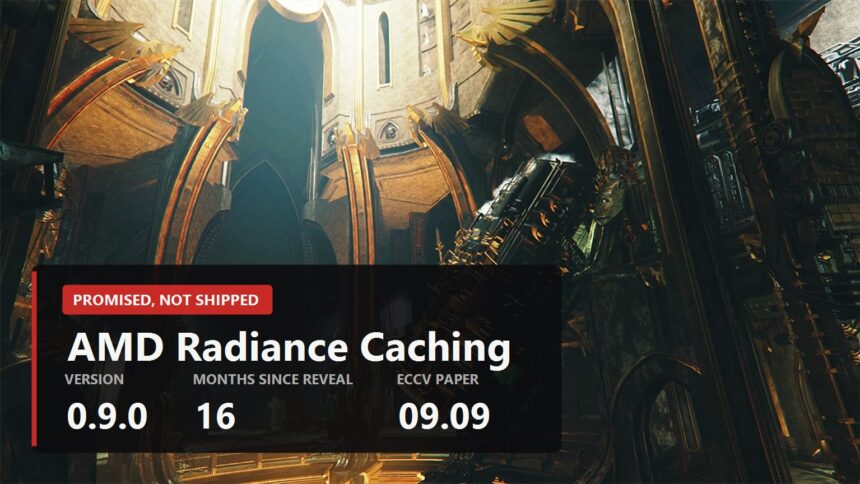
On 9 September AMD posted a research paper on GPUOpen, its developer site, that its engineers are presenting at ECCV 2026, the 19th European Conference on Computer Vision. In it, a neural network fills in the bounced light that path tracing currently has to calculate, while the GPU works out only the direct lighting. Some coverage has already called this AMD's new path tracing. It isn't. It is a research project with no performance figures, and it says nothing about FSR, Redstone or Radeon cards.
The more awkward question is elsewhere. FSR Radiance Caching, the neural lighting cache AMD promised back in May 2025, still has not shipped in a single game. Since December it has sat in the developer SDK as technical preview 0.9.0, and that number has not moved once in 2026.
The idea behind the paper
In path tracing a ray bounces off walls, floors and furniture many times, and every bounce costs GPU time. The expensive part is indirect light: light that reaches an object from a nearby surface rather than from the lamp. It is what makes a room look real, and it is why path tracing brings even flagship cards to their knees.
AMD's proposal is to draw that light instead of calculating it. The GPU renders direct lighting with no bounces and hands the network the frame's utility layers: normals, material colour, roughness, metalness and a rough, noisy estimate of the bounced light. A diffusion model then takes over, the same family as image generators, except it needs one step instead of dozens. Material colour is stripped out beforehand so the model deals only with light, and the textures are put back on the way out.
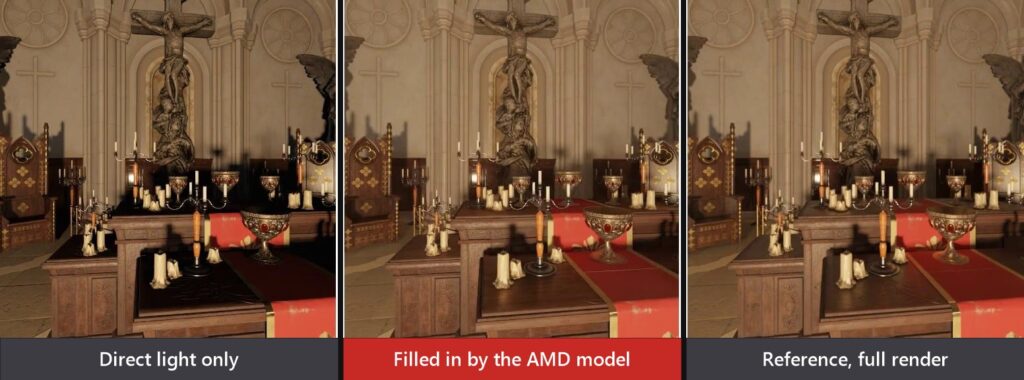
The usual problem with generative models in games is flicker, because every frame is drawn from scratch and comes out slightly different. So AMD built its own decoder that takes the previous frame, shifts it along the motion vectors and reuses pixels wherever the image has barely changed. According to the authors, that keeps the lighting stable over long sequences without smearing detail.
What the paper leaves out
- Speed. AMD's page gives no milliseconds, no resolution and no GPU model. The three-to-five-times speedup and the FP8 maths on RDNA 4 that are going round in retellings do not appear in the original.
- Games. The model was trained on synthetic interiors rendered in Blender Cycles and tested on rooms it had not seen. Open worlds, foliage and crowds are not part of the work.
- Plans. There is no word about the method reaching FSR, the driver or the SDK. The authors compare quality against other academic methods using PSNR, SSIM, LPIPS and FovVideoVDP, not against anything that ships in games.
The full conference talk is online, and AMD links to it from the paper's page. It shows the main claim holding up: the lighting stays put from frame to frame instead of flickering.
What AMD promised with Redstone
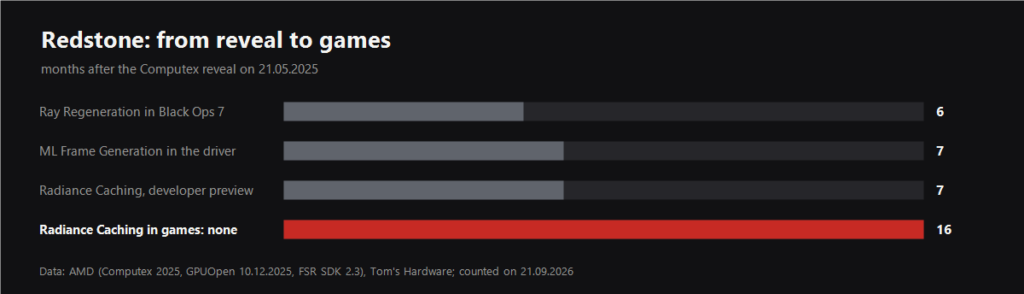
On 21 May 2025 at Computex, alongside the Radeon RX 9060 XT, AMD announced Redstone as its answer to NVIDIA's neural rendering features. The package had three parts: Ray Regeneration, a neural denoiser for ray traced effects, machine learning frame generation, and Neural Radiance Caching. The timing was stated plainly: the second half of 2025.
AMD delivered two thirds of that roughly on time. Ray Regeneration went live in Call of Duty: Black Ops 7 on 14 November 2025. On 10 December the Adrenalin 25.12.1 driver brought the full Redstone set to RX 9000 cards. Radiance Caching went out the same day to developers only, as a preview, with a note that the production release would follow in 2026.
Radiance Caching is standing still
Radiance Caching goes after the same problem as the new paper, from a different angle. Path tracing stays, but each ray makes fewer bounces and takes the rest from a cache. The cache is a small neural network that learns during play how light behaves in that particular scene. NVIDIA's equivalent is called Neural Radiance Cache.
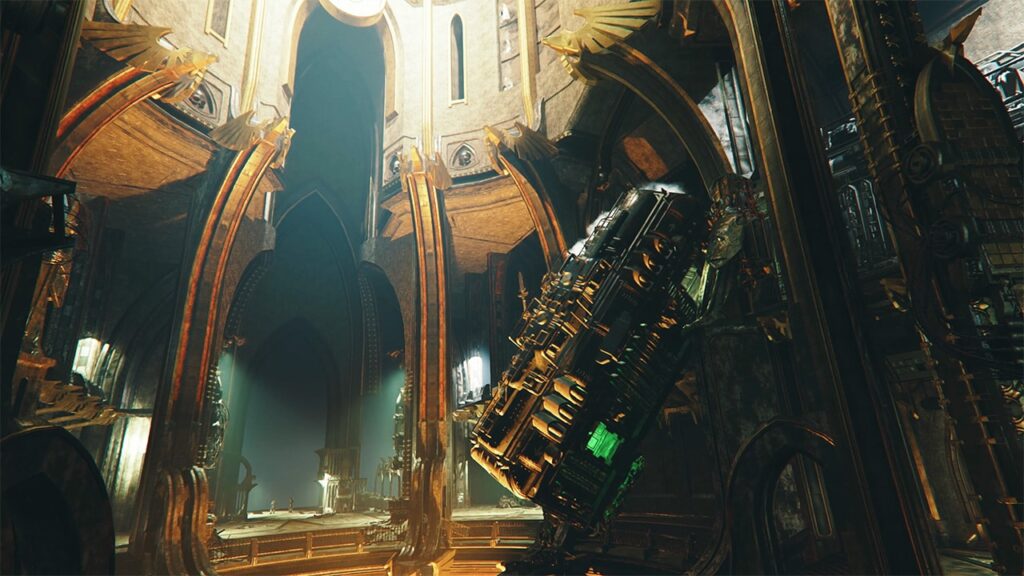
It has been shown in exactly one demo: a build of Warhammer 40,000: Darktide that Fatshark put together on its Stingray engine. On Redstone launch day the studio clarified that it has no plans to ship the feature in the game, saying it needs further development, optimisation and quality checks. No other game with Radiance Caching has turned up since.
The version history says the most. The FSR SDK was updated three times in 2026, in February, March and June. The upscaler reached 4.1.1 and came to RX 7000 cards in June, frame generation moved to 4.0.1, Ray Regeneration climbed to 1.2.0. Radiance Caching stayed at the same 0.9.0 from 10 December 2025 in all three releases, and its documentation still says the section is in active development. There are three months left of the year AMD set for the production release.
What it means if you own a Radeon
| Technology | Version in FSR SDK 2.3 | Status | Cards |
|---|---|---|---|
| FSR Upscaling | 4.1.1 | in games and via the driver | RX 9000, RX 7000 from driver 26.6.2 |
| FSR Frame Generation | 4.0.1 | in games | RX 9000 |
| FSR Ray Regeneration | 1.2.0 | in games, first was Black Ops 7 | RX 9000 |
| FSR Radiance Caching | 0.9.0 | technical preview, no games | RX 9000 |
| Generative lighting from ECCV | not in the SDK | research paper | not stated |
Today a Radeon RX 9000 gets everything from Redstone except the part that matters most for path tracing. The ray denoiser works. The technology meant to make the light calculation itself cheaper is still a demo. The ECCV paper shows AMD is working the same problem from another direction, and working it seriously. But the road from a paper about Blender interiors to a game on a home PC is usually measured in years, not months. If path tracing is what decides your next graphics card, judge by what runs today, not by what was shown at a conference.

Sources
AMD GPUOpen: Temporally stable generative illumination with a one-step diffusion model, 09.09.2026. AMD GPUOpen: FSR Redstone for developers, 10.12.2025. AMD GPUOpen: FSR Radiance Caching. AMD GPUOpen: FSR SDK version history. AMD: Computex 2025 announcement. Tom's Hardware: Ray Regeneration in Black Ops 7. Wccftech: Fatshark statement on Darktide. Images from AMD materials.