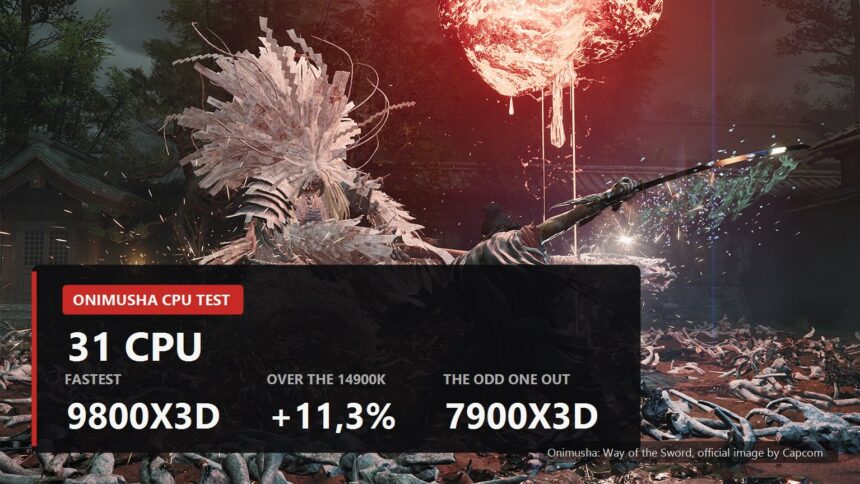
Somebody put 31 processors through Onimusha: Way of the Sword, and the result is the usual one with one genuinely strange exception. X3D chips take the top of the chart. A Ryzen 9 with 3D V-Cache does not.
If you are picking a processor right now, the interesting part is not who won. It is why one of AMD's own expensive chips ended up level with a mid range one.
The best CPU for Onimusha, by the numbers

The Ryzen 7 9800X3D is fastest, 11.3 percent ahead of the Core i9-14900K, which is Intel's strongest chip in this game. Every other X3D part sits right behind it, and the gaps between them are small enough not to matter.
Worth saying that the margins here are narrower than X3D usually manages. RE Engine leans on the graphics card more than the processor, so the cache advantage has less to work with. It still wins, just not by the distance you might expect if you have seen these chips in a strategy game.
On the Intel side, Arrow Lake and its refresh do not climb as high as the 14th generation, but they hold up fine against their price rivals. A Core Ultra 5 245K lands level with a Ryzen 5 9600X, which is exactly where it should be, and even the modest Core Ultra 5 225 stays close to a Ryzen 5 7600X.
The Ryzen 9 7900X3D problem
Here is the finding worth remembering long after you have forgotten this game. The Ryzen 9 7900X3D, a twelve core chip with 3D V-Cache, finished level with a Ryzen 7 7700X. That is a much cheaper processor with no cache stack at all.
The reason is the layout. On these twelve core parts the cache sits on only one of the two core clusters, so the game has to land on the right half to benefit. When it does not, you are paying for cache you never touch. The tester says outright that the extra cache could not overcome the twelve core penalty here, and that this may be something Capcom fixes in a patch or AMD fixes in firmware.
Until one of them does, the practical advice is old and still true: for gaming, the eight core X3D parts are the safe buy. The twelve and sixteen core ones are for people who also do work that wants the cores, and they are occasionally worse at games than a cheaper chip.
How many cores this game actually uses
Lightly threaded, like almost everything else. There is a clear step up past four cores and then it flattens out.
One detail worth carrying into your next build. Because the flagships with many cores boost lower, all core clock speed matters more here than single core boost, though the tester notes clock speed is not a major factor either way. Which is a polite way of saying the cache is doing the work, not the megahertz.
How to read this test
The conditions matter, because they are not your conditions.
- 1080p with an RTX 5090. That is deliberate. The point is to remove the graphics card from the equation so the processors can separate. It is not a prediction of your frame rate.
- Ultra preset, no ray tracing, no upscaling. No DLSS, no FSR. A clean baseline rather than a realistic playthrough.
- Three runs, median taken, outliers rerun. That is the right way to do it and it is worth checking whether the next benchmark you read says the same.
- Optional modes enabled. Intel's Core Ultra 200S Boost was on where supported, and the Ryzen 5 9600X and Ryzen 7 9700X ran in their optional 105 W mode rather than the stock 65 W. Both are covered by warranty, and both flatter those chips slightly against a stock configuration.
At 1440p or 4K with a card most people own, these gaps shrink and often disappear. Which is the point of any CPU test at 1080p: it tells you the order, not the distance.
Sources
The test of 31 processors in Onimusha: Way of the Sword, the figure of 11.3 percent for the Ryzen 7 9800X3D over the Core i9-14900K, the observation that every other X3D chip sits near the top with almost no margin between them and with smaller leads than in other titles, the Ryzen 9 7900X3D finishing level with a Ryzen 7 7700X and the explanation that 3D V-Cache could not overcome the twelve core penalty, the suggestion that Capcom or AMD may address it, the Core Ultra 5 245K matching the Ryzen 5 9600X and the Core Ultra 5 225 being close to the Ryzen 5 7600X, the note that Arrow Lake does not scale as high as the 14th generation, the description of the game as lightly threaded with a clear bump past four cores, the point that all core clocks matter more than single core boost while clock speed is not a major factor, and the test conditions of 1080p with an RTX 5090 Founders Edition on the Ultra preset without ray tracing or upscaling, three runs with the median taken, Core Ultra 200S Boost enabled where supported and the 105 W mode used on the Ryzen 5 9600X and Ryzen 7 9700X, all come from Tom's Hardware testing published on 3 September 2026. The reading of what this means for choosing a processor is ours.