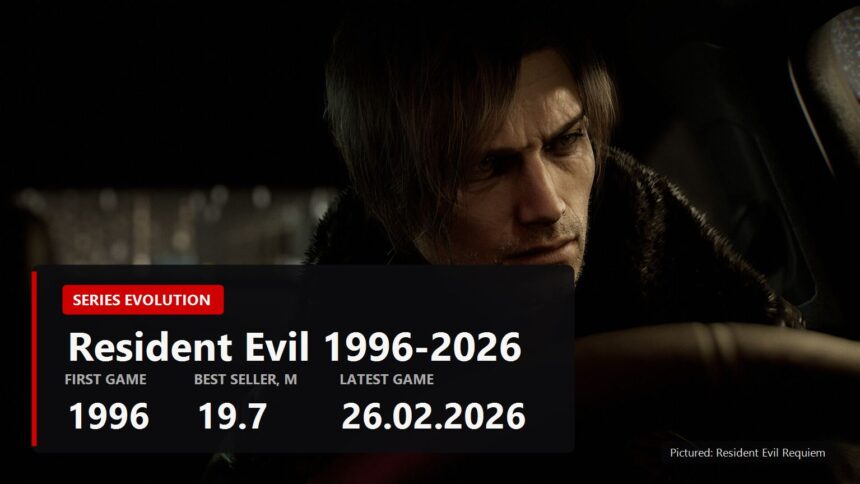
The new Resident Evil film opened on 18 September and the series is back in every conversation. Zach Cregger's film is a standalone story with no connection to the games, while the series itself has now lived thirty years and changed genre three times. Here is the whole road: how it started in 1996, what broke the formula in 2005, why the remakes outsell the originals, and where the series stands today.
- 1996: a mansion, fixed cameras and a typewriter
- 1998 and 1999: Raccoon City and a monster that follows you
- 2000-2004: the formula runs out of road
- 2005: Resident Evil 4 rewrites more than the series
- 2009 and 2012: record sales, worst reputation
- 2017: first person, and the fear comes back
- 2019-2021: the age of remakes
- 2023 and 2026: where the series stands now
- Every key game and what it sold
- What changed in thirty years
Briefly about the film, to get it out of the way: directed by Zach Cregger, written by Cregger with Shay Hatten, with Austin Abrams as a medical courier whose night turns into a slaughter. It is a separate story with no ties to the earlier adaptations or to the games. The games, on the other hand, are tied to the entire genre, which is what this piece is about.
1996: a mansion, fixed cameras and a typewriter
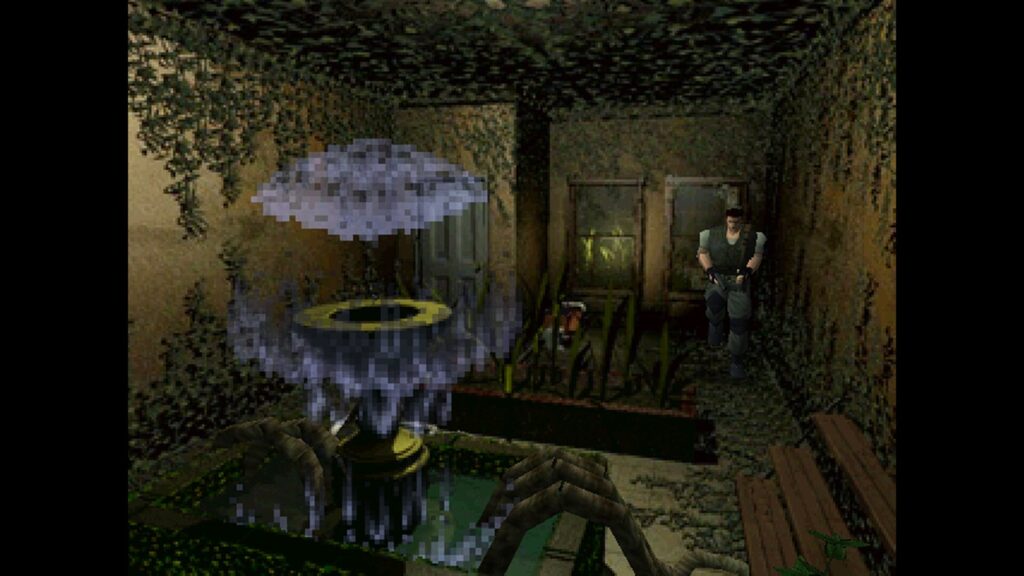
The first Resident Evil came out in March 1996 on PlayStation and sold 2.75 million copies, by Capcom's own figures. Modest by today's standards, enormous by 1996 ones, and enough to create survival horror in the shape everyone else would copy.
The way it was built reads today like a list of restrictions, but back then it worked as a tension system. Cameras sat in fixed positions, so you could not see what waited around the corner. The controls were tank controls: the character turned on the spot, and you could not spin and sprint away from a zombie. Ammunition ran out. Inventory space ran out faster, so you chose between a herb and a key. Saving cost an ink ribbon for the typewriter, and ribbons were finite, so saving meant spending a resource.
Those rules are the answer to why the series took off at all. The fear rested on scarcity rather than on monsters: every shot and every save was a decision. And you can play the original legally today without touching an emulator: on 1 April 2026 Capcom, together with GOG, put the first three games back on sale, each with its own Steam page.
1998 and 1999: Raccoon City and a monster that follows you
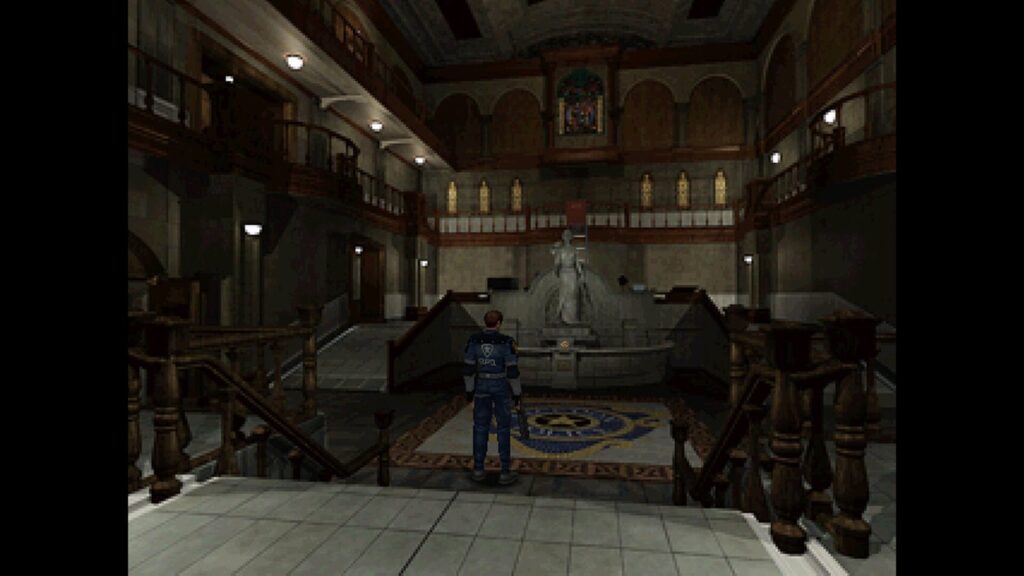
Resident Evil 2 arrived in January 1998 and sold 4.96 million, almost double the first game. Capcom did the right thing: it kept the rules and moved the action out of the mansion and into a city. The Raccoon City police station is as much a character as Leon and Claire, and the two-campaign structure made you play the game twice and see the same events from two sides.
Resident Evil 3: Nemesis followed in September 1999 with 3.5 million copies. Its main invention is still in use across the industry: an enemy that hunts you through the whole level and shows up where you do not expect him. Nemesis broke the genre's main comfort, the safety of a room you had already cleared.
2000-2004: the formula runs out of road
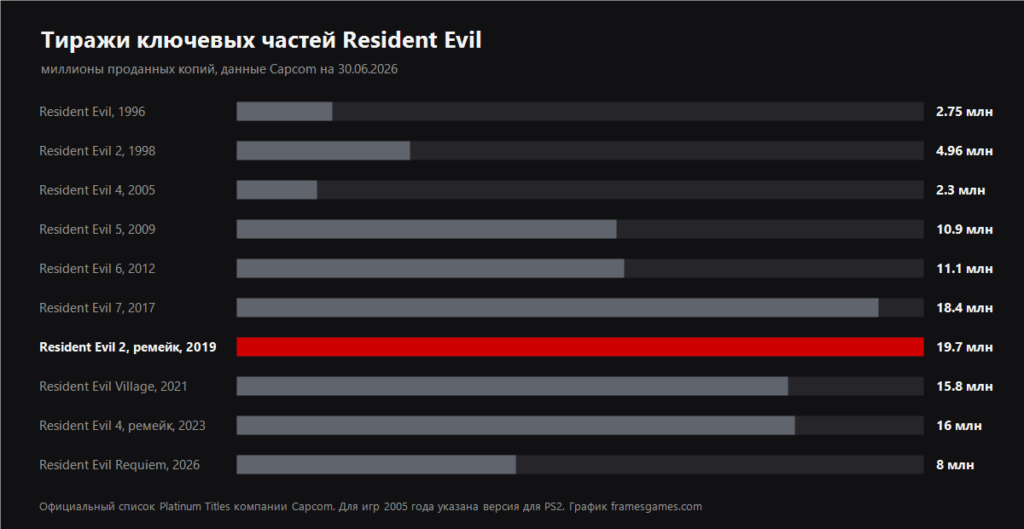
Then the series stalled. Code: Veronica, treated as the true fourth game, sold 1.4 million in its Veronica X version for PS2 and Dreamcast. The online Outbreak in 2003 managed 1.45 million. The GameCube remake of the first game in 2002, the best remake of its era, stopped at 1.35 million.
Look at the sales chart and the whole early period sits between one and five million, even as the games themselves got better. The formula of fixed cameras and tank controls had hit a ceiling: new players found it awkward, and long-time players knew it so well that it had stopped frightening them.
2005: Resident Evil 4 rewrites more than the series
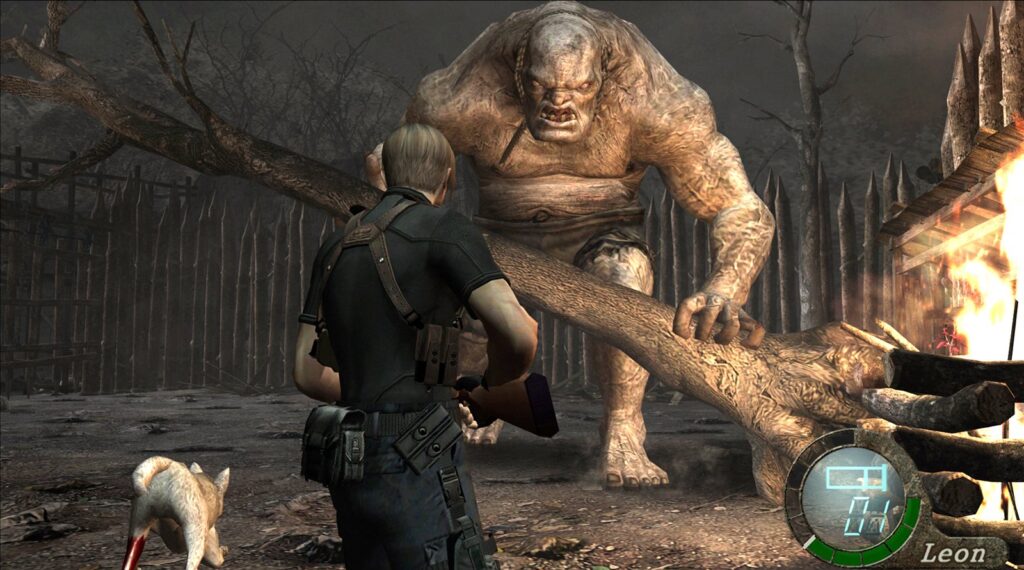
Resident Evil 4 launched in January 2005 on GameCube, in December on PS2 and later on Wii. Taken one by one the numbers are modest, 1.6 million on GameCube, 2.3 on PS2 and 2 on Wii, but that is not how this game is measured.
The camera moved behind the hero's shoulder, real-time aiming arrived, and the enemies stopped being slow sacks and started surrounding you, throwing dynamite and climbing through windows. Instead of a claustrophobic mansion there was a Spanish village and constant forward motion. Everyone copied that layout for the next decade, from Gears of War to Dead Space, which is exactly why RE4 keeps turning up on lists of the most influential games ever made.
The cost of the change is just as clear. The horror stayed, but the tension changed shape: not "I am afraid to open this door" but "there are too many of them". Hence the old fans' complaint that the series had gone action, and the next two games proved them right.
2009 and 2012: record sales, worst reputation
Resident Evil 5 came out in March 2009 and became the first game in the series past ten million, at 10.9 million copies. Resident Evil 6 in October 2012 took 11.1 million, with another 4.8 million for the 2016 re-release. In money terms this was a success.
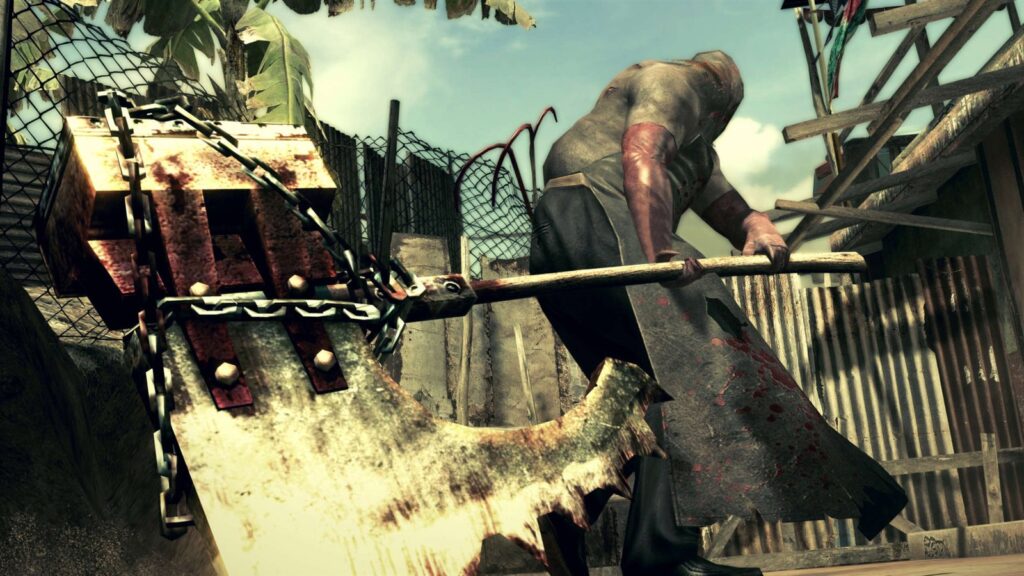
In substance they were co-op action games. The fifth gave you a permanent partner and built itself around him. The sixth tried to please everyone at once: four campaigns, four tones, from slow horror to helicopter shootouts. It came out loud and incoherent, and it is what made Capcom turn the series back around.
- What the series gained by 2012. A mass audience, co-op, real staging craft and sales above ten million.
- What it lost. Scarce ammunition, the fear of the next room and its reputation as horror. That is exactly what Capcom then had to win back.
2017: first person, and the fear comes back

Resident Evil 7 launched on 23 January 2017 and did what nobody expected from the series: it switched to a first-person camera, removed the partners, shrank the action down to one house in the Louisiana swamps and brought the survival rules back. You count ammunition again, you craft healing items again, and the Baker family chases you through the house as stubbornly as Nemesis did in 1999.
The result: 18.4 million copies, the second biggest number in the series. The game arrived on the wave of interest in first-person horror and it was well made: the same restrictions as in 1996, translated into a modern language.
2019-2021: the age of remakes
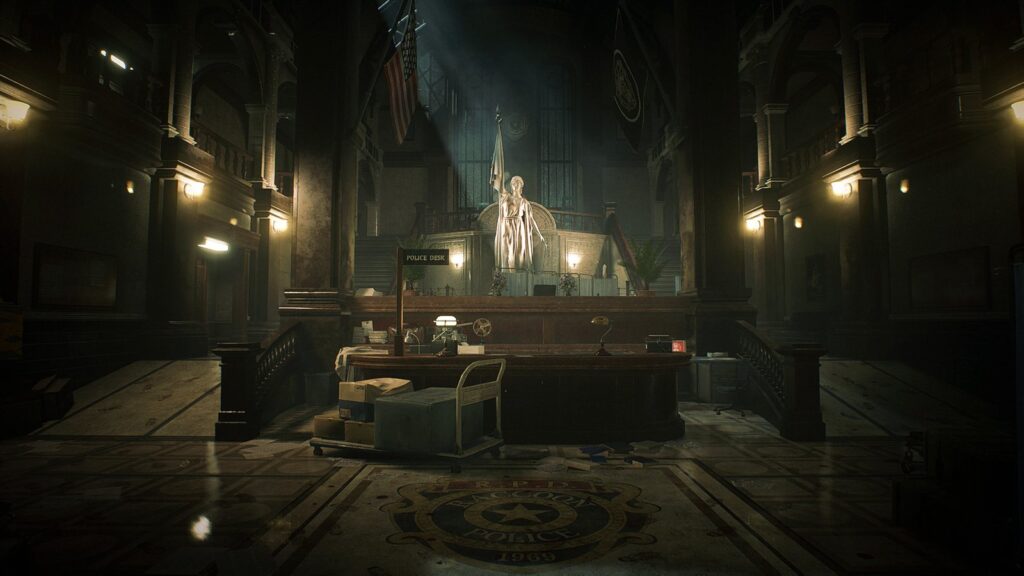
The Resident Evil 2 remake arrived on 24 January 2019 and is the best selling game in the series' history at 19.7 million copies. The over-the-shoulder camera from the fourth game, modern graphics on the RE Engine, but the structure and the pace of 1998. The rare case where a new game satisfies both the people who remember the original and the people who never saw it.
The same recipe followed: the Resident Evil 3 remake in April 2020 with 14.5 million, and Resident Evil Village in May 2021 with 15.8 million. Village is formally the eighth game and a sequel to the seventh, first person again, but with a village, a castle and open nods to the fourth game.

Put the originals and the remakes side by side and the comparison is brutal. The 1998 second game sold 4.96 million, its remake 19.7. The 1999 third game sold 3.5 million, its remake 14.5. It is not only that the market grew: the remakes ship on every platform at once, PC included, while the originals lived on a single console.
2023 and 2026: where the series stands now
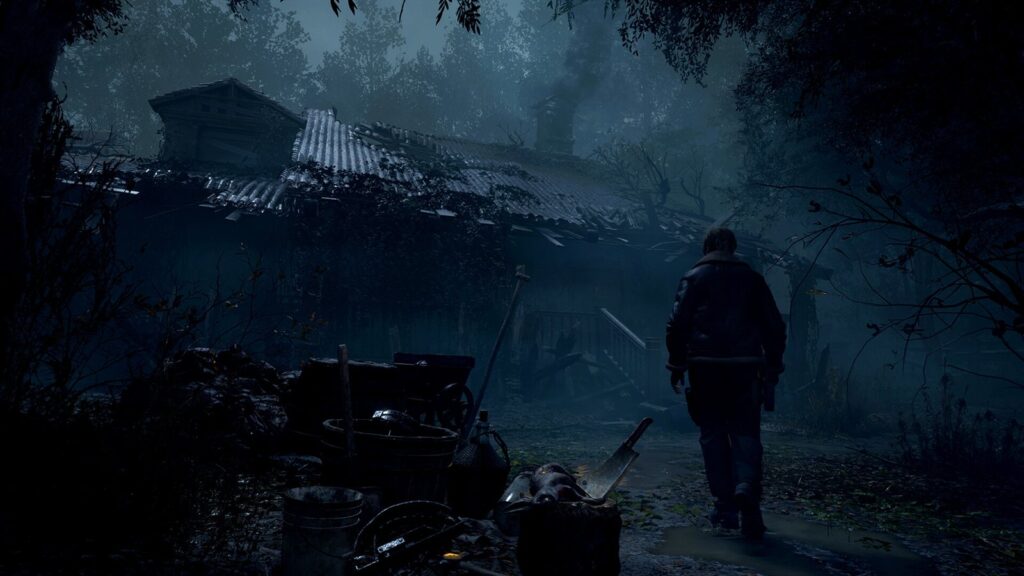
The Resident Evil 4 remake came out on 23 March 2023 and has sold 16 million copies. Capcom rewrote a game that was already considered a benchmark: it kept the structure and the rhythm, cut the dated solutions, added a knife parry and reworked the original's weakest stretches.
Resident Evil Requiem launched on 26 February 2026 for PS5, Xbox Series, Switch 2 and PC. By Capcom's figures at the end of June it had sold 8 million copies, which means it took roughly four months to match what the entire classic trilogy sold in total.
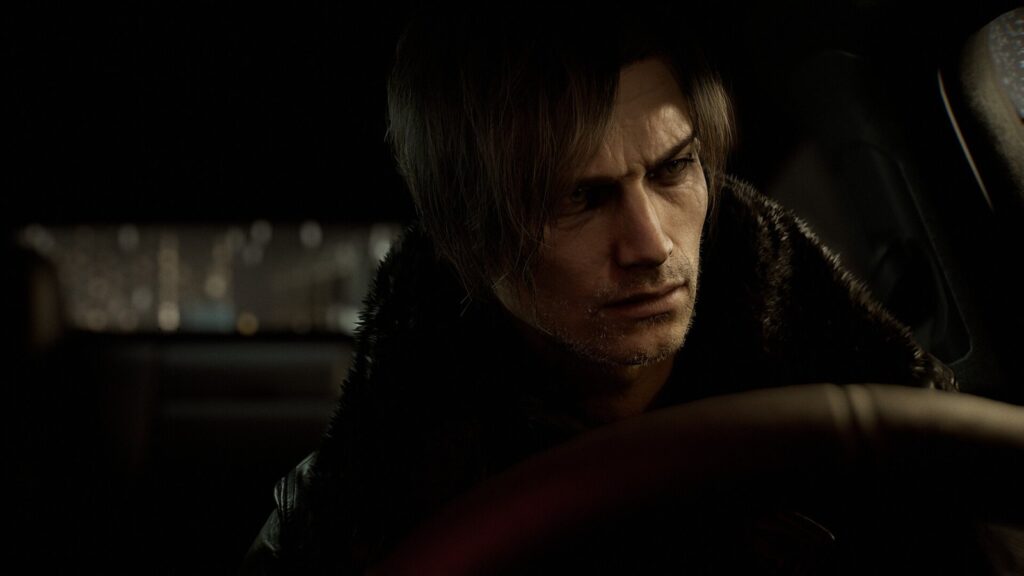
And the series is not stopping there: a Steam page for Resident Evil Veronica is already open, marked 2027. The next in line is a remake of Code: Veronica, the game that sold worst of all the mainline entries back in 2000 and that fans have been asking about the longest.
Every key game and what it sold
| Year | Game | Launch platform | Sales, millions |
|---|---|---|---|
| 1996 | Resident Evil | PlayStation | 2.75 |
| 1998 | Resident Evil 2 | PlayStation | 4.96 |
| 1999 | Resident Evil 3: Nemesis | PlayStation | 3.50 |
| 2001 | Resident Evil Code: Veronica X | PS2, Dreamcast | 1.40 |
| 2002 | Resident Evil remake | GameCube | 1.35 |
| 2002 | Resident Evil 0 | GameCube | 1.25 |
| 2003 | Resident Evil Outbreak | PS2 | 1.45 |
| 2005 | Resident Evil 4 | GameCube, then PS2 | 1.60 and 2.30 |
| 2009 | Resident Evil 5 | PS3, Xbox 360 | 10.90 |
| 2012 | Resident Evil 6 | PS3, Xbox 360 | 11.10 |
| 2015 | Resident Evil Revelations 2 | Multiplatform | 4.30 |
| 2017 | Resident Evil 7 biohazard | Multiplatform | 18.40 |
| 2019 | Resident Evil 2 remake | Multiplatform | 19.70 |
| 2020 | Resident Evil 3 remake | Multiplatform | 14.50 |
| 2021 | Resident Evil Village | Multiplatform | 15.80 |
| 2023 | Resident Evil 4 remake | Multiplatform | 16.00 |
| 2026 | Resident Evil Requiem | PS5, Xbox Series, Switch 2, PC | 8.00 |
| 2027 | Resident Evil Veronica | Announced, Steam page open | - |
What changed in thirty years
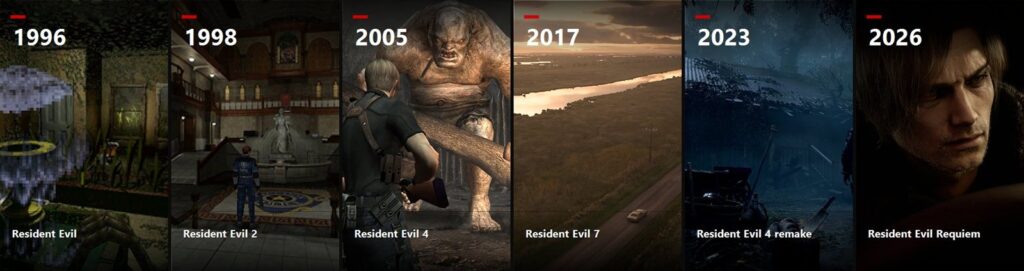
On the left 1996, on the right 2026: thirty years between two frames of the same series.
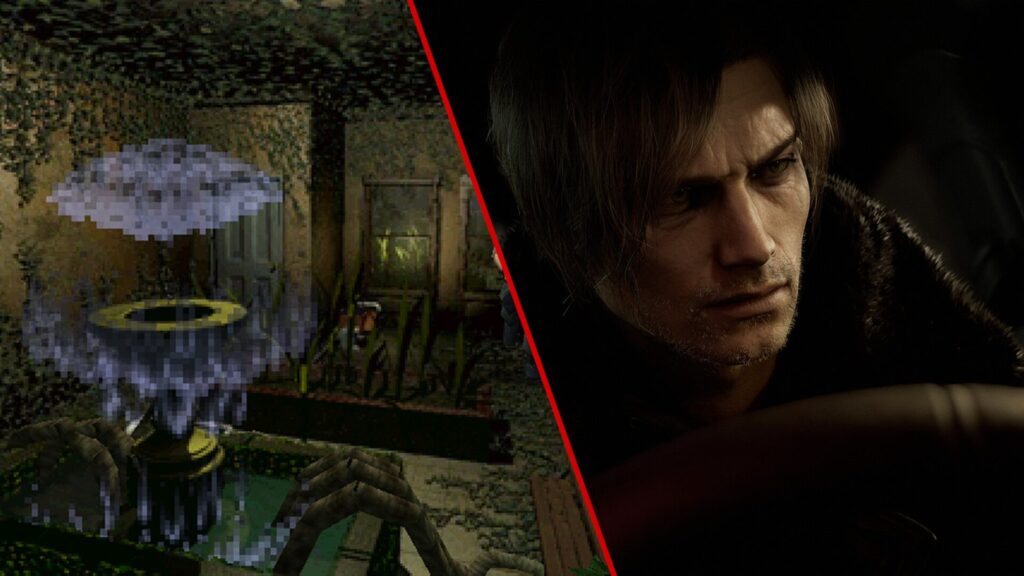
- The camera changed three times. Fixed positions until 2004, over the shoulder from 2005, first person from 2017. Both modern schemes now live in the series at once, chosen per game on purpose.
- Scarcity came back. After the action games of 2009 and 2012 Capcom brought back counted ammunition and limited inventory, and that is once again the main source of tension.
- Remakes turned out to be worth more than originals. 19.7 million for the second game against 4.96 for the original, 14.5 for the third against 3.5. For Capcom this is not nostalgia, it is a business model.
- The series stopped fearing pauses. More than four years passed between the sixth game and the seventh, and that pause is what saved its reputation.
One line to sum it up: Resident Evil began as a game about running out of ammunition in a locked house, went action twice and came back to running out of ammunition both times, only with a new camera. Thirty years on the formula works better than ever: Requiem sold eight million in four months, and the next remake is already dated for 2027.
Sources
Sales figures come from Capcom's official Platinum Titles list, which gives the release date, the platforms and the number of copies sold for each game. Release dates and platforms were checked against the games' Steam pages, including the re-releases of the first three games on 1 April 2026 and the Resident Evil Veronica page marked 2027. Film details: in cinemas from 18 September 2026, released by Sony, directed by Zach Cregger, written by Cregger and Shay Hatten, starring Austin Abrams. Screenshots come from the games' Steam pages. The chart and the year strip are ours, built from the numbers listed above.