This is S.T.A.L.K.E.R. from the inside, from the first prototypes in 2000 to the Cost of Hope expansion that came out in August 2026. What GSC Game World developers, THQ producers and the people who left to make Metro have said over the years. What was cut from Shadow of Chernobyl and where you can still see it. Which builds leaked and why people search for them by number. And how the sequel was finished through a war and an evacuation.
- Oblivion Lost, 2000-2003: Aztec pyramids, robots and portals instead of the Zone
- March 29, 2002: into the Zone on the second try, and 1,000 microroentgen by the sarcophagus
- The Bar is the Rostok factory: how Kyiv ended up in the Zone
- Dean Sharpe, 2005: the THQ producer who cut the cars, sleep and half the Zone
- Builds 749, 1096, 1935, 2205 and 2571: what they are and why people search for them
- March 2007: the game shipped, and its engine's authors were already making Metro
- Clear Sky, 2008: swamps from the cutting room floor and an honest "we ran out of time"
- Call of Pripyat, 2009: sleep came back, and Loki has a GSC designer's face
- December 9, 2011: "I have decided to stop Stalker 2 development. Goodbye."
- Heart of Chornobyl: evacuating 700 people, hacks and a fire in Prague
- After launch: 6 million players, Unreal 5.5 and "Can I cry?"
- Legends of the Zone and the Enhanced Edition: how the remastered trilogy differs from the original
- Every S.T.A.L.K.E.R. game: year, platforms and scores
- Where to start with S.T.A.L.K.E.R. today
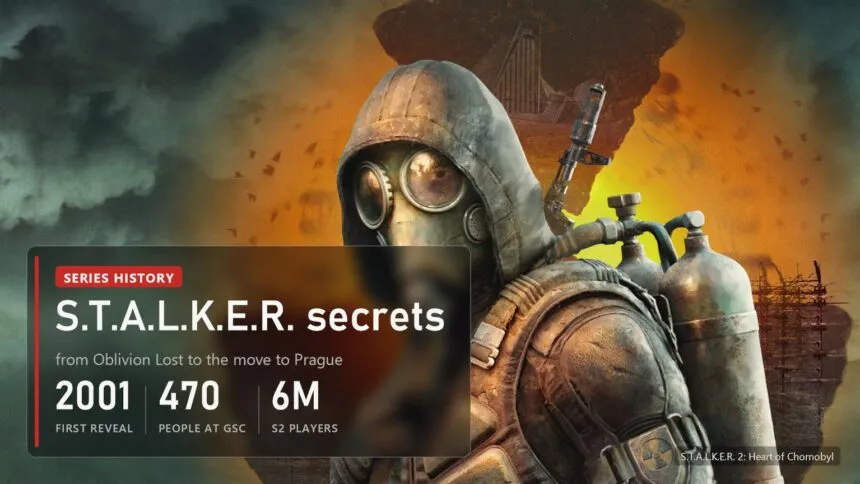
It didn't start with Chernobyl at all. The first level of the future game was an Aztec pyramid with robots walking around it, and in 2005 an American producer from the publisher flew to Kyiv and told the studio owner there would be no more money until the game shipped. Let's take it in order.
Oblivion Lost, 2000-2003: Aztec pyramids, robots and portals instead of the Zone
 The video loads from YouTube (Google) when you press play. Privacy policy
The most detailed account of the early years comes from the Russian magazine Luchshie Kompyuternye Igry (LKI), in a long April 2010 feature by Yuri Mikhailov based on the developers' own words. In 2000 programmers Oles Shyshkovtsov and Oleksandr Maksymchuk joined GSC with a puzzle game called AlienLogic. Sergiy Grygorovych said an action game would be better, and a couple of months later there was a demo built mostly from Quake assets. That was the start of the X-Ray engine.
Artist Serhiy Karmalsky built a level with Aztec pyramids on it and dropped robots in. Anton Bolshakov suggested going "closer to space", which brought portals, colonization of other worlds, a special forces unit called the Pathfinders and about ten planet levels. Karmalsky also came up with the name Oblivion Lost. Players immediately compared the project to Stargate, and when the concept switched to the Zone, the old name stayed in the subtitle anyway, because money had already gone into promoting it.
- The hype was deliberate. PR manager Oleg Yavorsky told Eurogamer in 2018: "From day one we started promoting the concept. We were trying to over-hype it." One of the promises was that an NPC could finish the game before the player.
- The dots came from the lawyers. They warned about possible claims from the heirs of Roadside Picnic, so Stalker became a pseudo-acronym. Every "expansion" of S.T.A.L.K.E.R. you see on forums was made up by fans.
- GSC kept the brand. THQ made the best offer: a good royalty, and the trademark stayed with the studio. That mattered in 2012, when German publisher bitComposer claimed it had bought the game rights to Roadside Picnic.
March 29, 2002: into the Zone on the second try, and 1,000 microroentgen by the sarcophagus
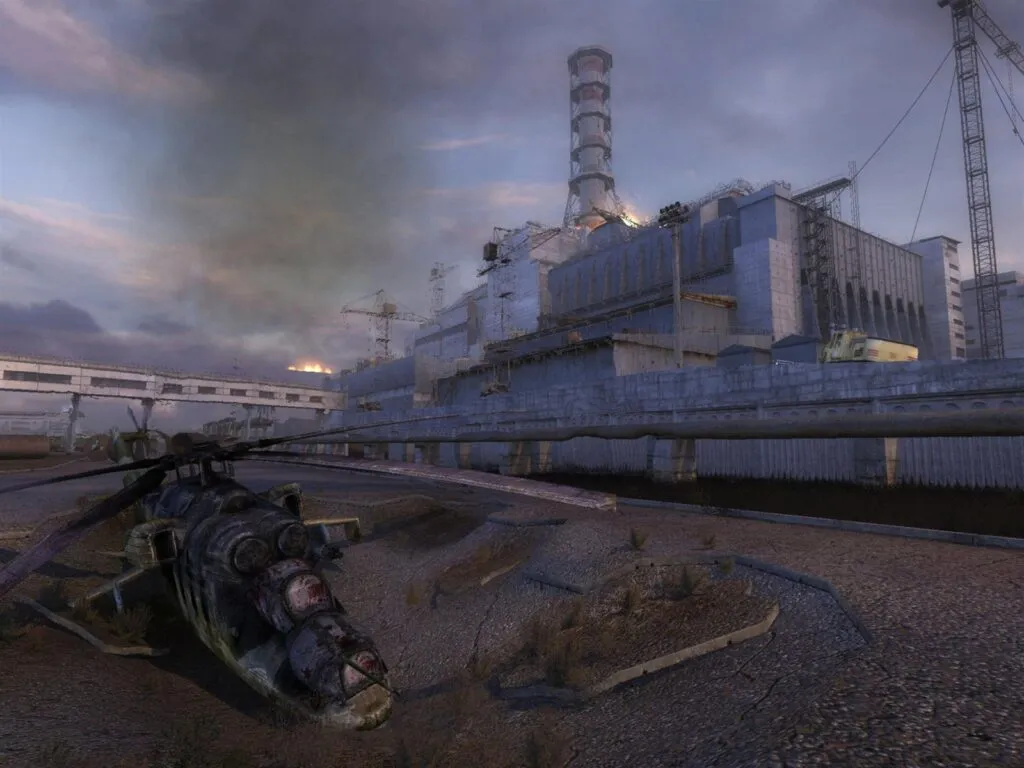
To make the Zone look real, the team went there themselves. The first group was turned back at the Dytiatky checkpoint; the second attempt, on March 29, 2002, got in. Karmalsky, Grygorovych, project lead Andriy Prokhorov and staffer Sytianov went, with Rimma Kyselytsia as their guide. GSC published Sytianov's diary on its site on April 5, 2002, and a copy survives in the Web Archive. On a balcony by the sarcophagus the dosimeter read 1,000 microroentgen per hour. In Pripyat they photographed the Azure swimming pool, the stadium and the Palace of Culture.
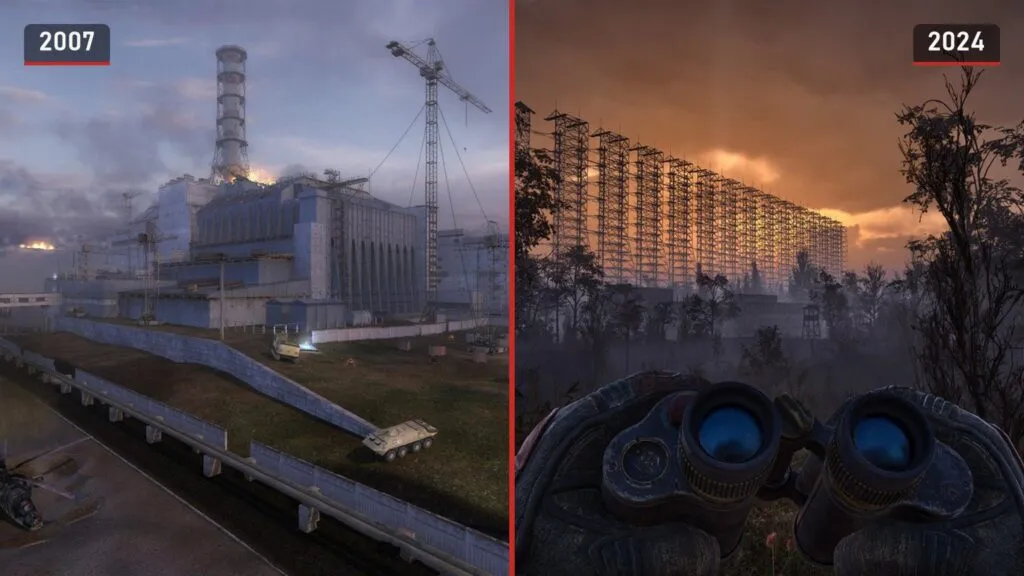
The studio also had a consultant from the plant itself: Oleksandr Novikov, head of nuclear safety at the Chernobyl NPP, whom LKI calls a close friend of GSC. He gave the team photos of the station's interiors. The truss you walk along to the Wish Granter at the end is the real remains of the reactor's refueling machine. In the 2004 version the power plant was even closer to the real thing than in the released game.
The Bar is the Rostok factory: how Kyiv ended up in the Zone
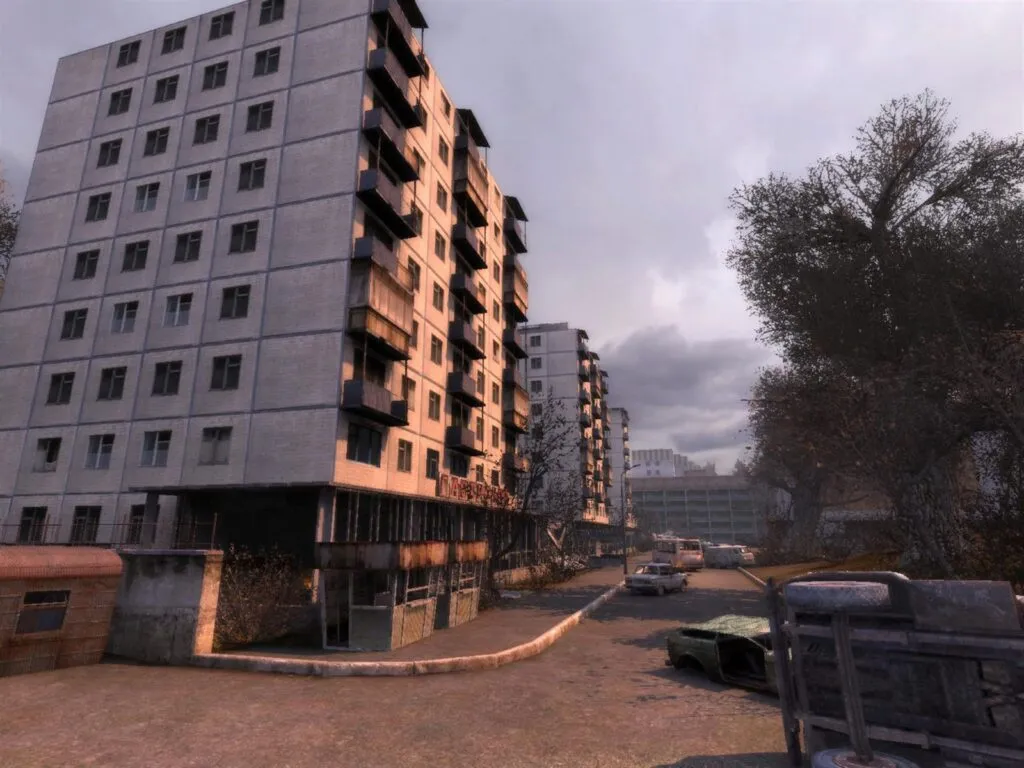
One of the game's best-known locations is copied from the studio's office. GSC worked in the administrative building of the Rostok factory in Kyiv, which is where the Bar and the Rostok area come from. According to the developers in LKI, early versions let you go up to the floor where the team actually sat. Pripyat's tower blocks are local too: they were modeled on buildings on Lepse Boulevard, across the road from the office.
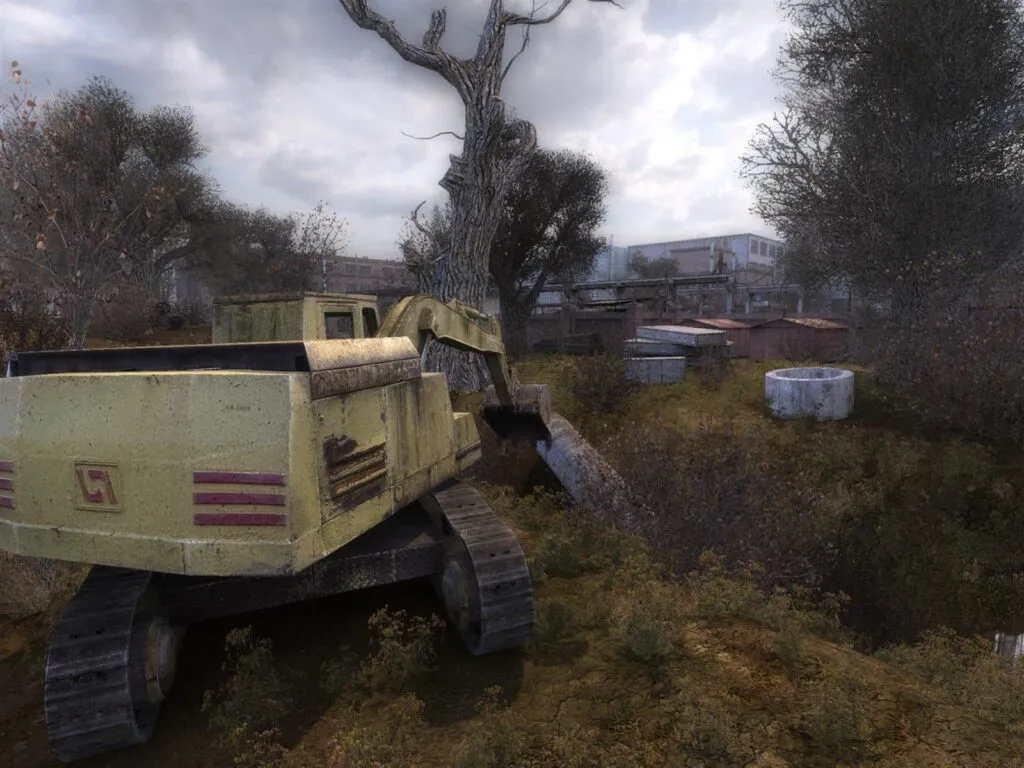
One more detail from the same article, about the Red Forest. In Shadow of Chernobyl it looks like rows of rubbish mounds, and that wasn't lazy art: that's how the real place looked after liquidators cut down and buried the dead forest. Clear Sky shows it as it was before the clearing.
Dean Sharpe, 2005: the THQ producer who cut the cars, sleep and half the Zone
By 2005 the game was years late. According to LKI, tests back in 2004 had shown that unscripted A-Life was "a very interesting thing to experiment with, but a completely uninteresting game" (we've covered how A-Life itself evolved in a separate article). THQ sent Dean Sharpe, a LucasArts veteran, to Kyiv. He told Eurogamer he agreed "by the end of our third bottle of wine" at a dinner with THQ's Jack Sorensen. GSC's office, he said, felt like a hospital.
Sharpe took control of the milestone schedule and told Grygorovych flatly that there would be no more money until the game was finished. Then came the cuts: parts of the Zone, monsters, vehicles, and an AI rework. Sleep went for a simple reason: "We could get rid of half-a-bug-report by cutting one feature. It was a no-brainer." Fans didn't forgive him; he says death threats arrived daily, and THQ passed one to the authorities. His own description of the job: "I was there to be the bad guy." Sharpe later became CEO of 4A Games.
The cuts are still visible if you know where to look:
- The Dark Valley gate. In the original script you rammed it with a KamAZ truck. The truck is gone, but you can still break the right-hand gate leaf.
- A helicopter chase. South of Dark Valley there was an almost finished driving level with two checkpoints and an attack helicopter on your tail.
- Dead City and the Generators. In the first, the Marked One met the Doctor; the second was meant to host the final battle. Both were cut.
- The swamps moved. The far swamps became Clear Sky's swamps and grew about fourfold. The early Cordon was three times bigger than the one we got.
- The Rat Catcher became the Deserter, but the code still calls him rats_catcher.
One correction to a popular myth: hunger wasn't cut, it's in the release. Sleep was.
Builds 749, 1096, 1935, 2205 and 2571: what they are and why people search for them
 The video loads from YouTube (Google) when you press play. Privacy policy
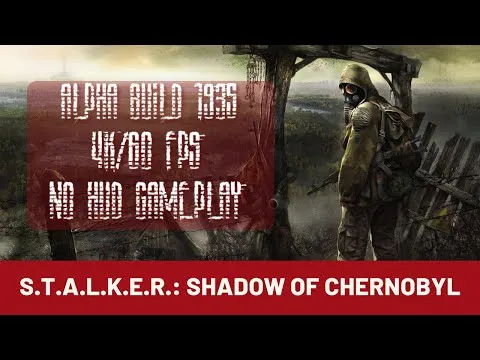
A build number is the engine's build number, and fans use it to tell versions from different years apart. Here's what's known about the famous ones:
| Build | Build date | How it got out | What's inside |
|---|---|---|---|
| 749 | April 19, 2001 | leak | the earliest Oblivion Lost era, DirectX 7, Quake III assets |
| 1096 | 2003 | leaked in late December 2003 from an unprotected FTP | an early version of the Zone; Yavorsky denies it was a PR stunt |
| 1935 | October 18, 2004 | released by GSC itself in 2009 | full A-Life, cars with a gearbox, Dead City, Swamps, Generators |
| 2205 | April 15, 2005 | leaked in 2009 | a transitional build between the old and final game |
| 2571 | March 16, 2006 | leaked on September 23, 2010 | nearly the whole story, two cut locations, sleep, a car chase from a helicopter |
For a regular player the most interesting one is 1935: GSC released it officially, and it shows the game as originally planned, with cars and a bigger Zone. 2571 is closest to the final release and shows what was cut in the last year. Install them out of curiosity, not for a playthrough: these are work-in-progress builds with all the crashes that implies.
March 2007: the game shipped, and its engine's authors were already making Metro
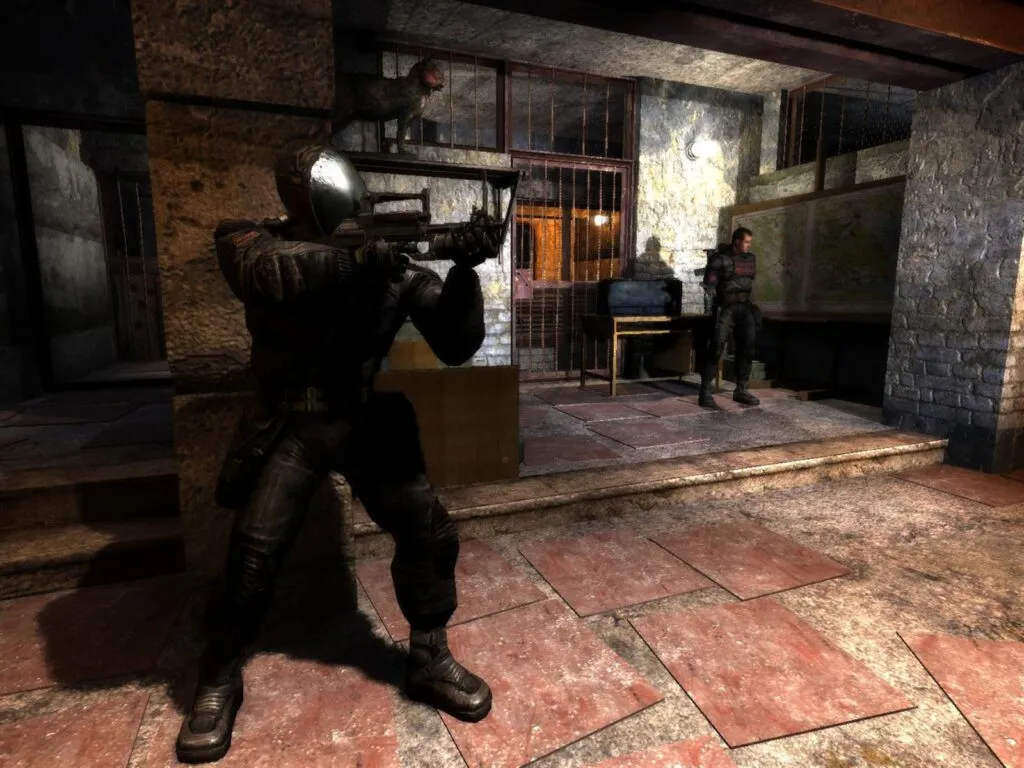
Shadow of Chernobyl came out on March 20, 2007. Before launch GSC took journalists to Pripyat and handed out backpacks with canned stew and "Stalker" vodka, and Anton Bolshakov promised to give players his Subaru if the game missed March. He kept the car. By February 2008, according to GSC figures in Igromania, it had sold 950,000 copies in the CIS and 700,000 in the West. It sits at 82 on Metacritic.
By release, though, the team had already split. Andriy Prokhorov told the Ukrainian outlet Mezha in August 2026 that he, Shyshkovtsov, Maksymchuk and Andriy Tkachenko had decided to leave back in 2004 and promised to finish the game first. In January 2006 Grygorovych fired most of the artists and animators, and in February 4A Games opened its office. Grygorovych threatened to sue them for "stealing X-Ray", even though two of 4A's co-founders were the ones who wrote it. They built the 4A Engine for Metro from scratch in about six months and finished S.T.A.L.K.E.R. on evenings and weekends.
A detail from Polygon in 2013 that explains a lot. In 2005 GSC had 140 employees and four cars in the parking lot. Three belonged to Grygorovych: a BMW X5, a Porsche Cayenne and a Ferrari. Prokhorov, by the way, was interviewed for his job in 1996 by a 16-year-old Grygorovych.
Clear Sky, 2008: swamps from the cutting room floor and an honest "we ran out of time"
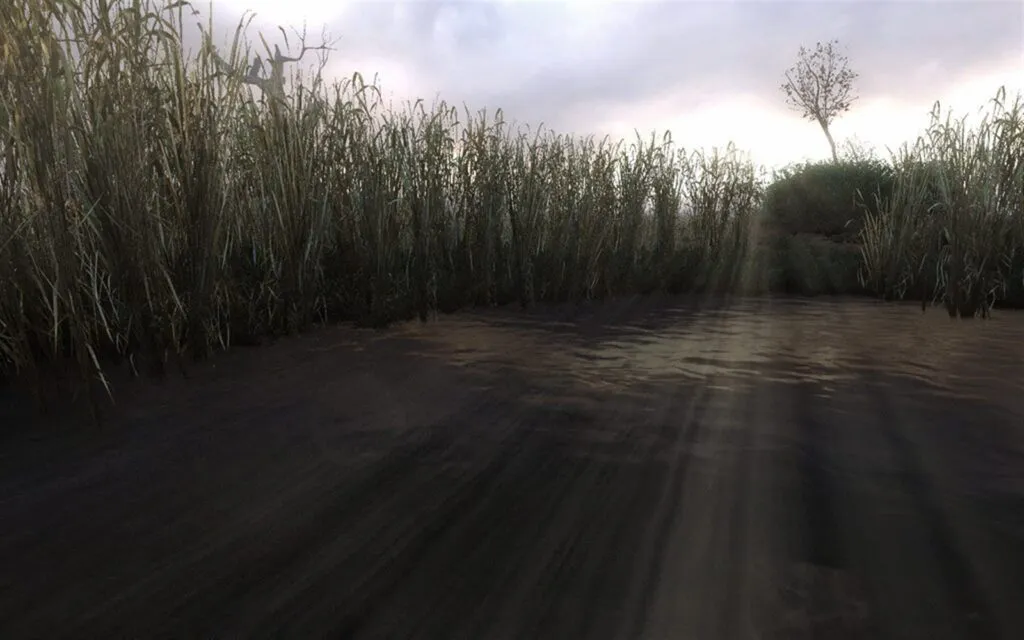
The prequel came out in August 2008 in Russia and Ukraine and in September in the West, now published by Deep Silver. Its signature location, the swamps, grew out of the far swamps cut from the first game. It's remembered for the faction war, DirectX 10 and bugs, and GSC didn't argue. Yavorsky told Rock Paper Shotgun in 2009: "We had no time to polish and fix everything as proper before the release." Metacritic 75, the lowest of the trilogy.
Call of Pripyat, 2009: sleep came back, and Loki has a GSC designer's face
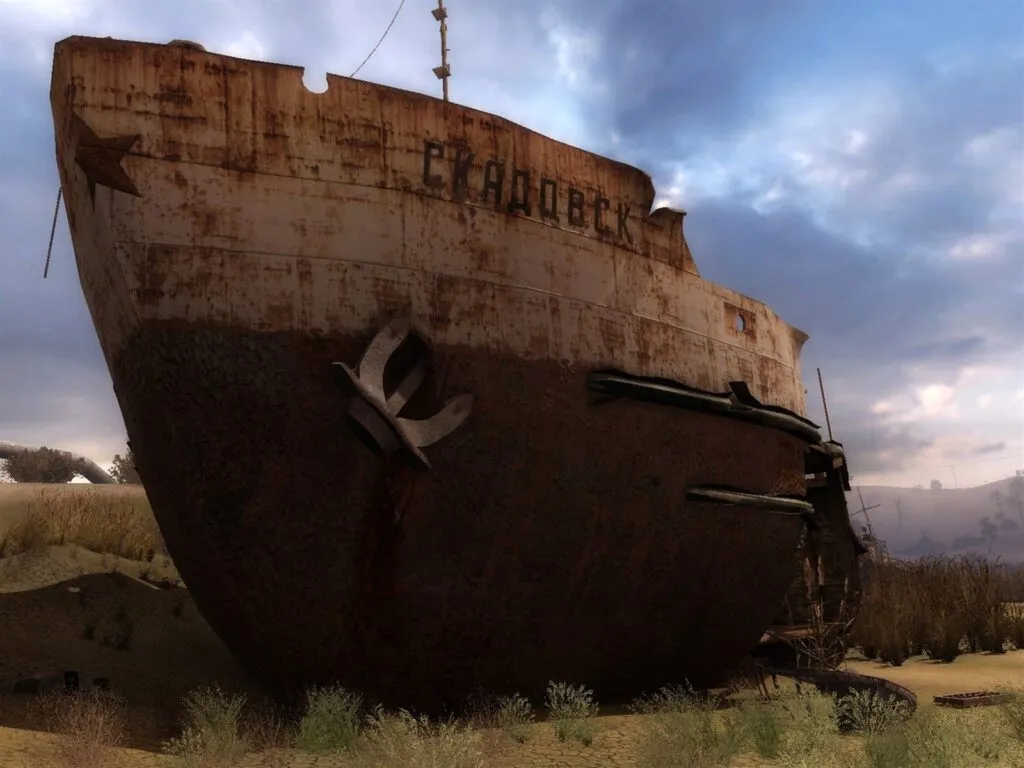
The third game came out in Ukraine on October 2, 2009, and in the West in February 2010. Lessons from Clear Sky were learned: the global faction war was dropped and testing ran longer. Sleep, cut by Sharpe in 2005, came back, now only at bases. Yavorsky promised RPS a real area of Pripyat "in real scale" and joked about more Russian speech "flavoured with vodka, bears and balalaikas". Metacritic 80.
The face of Loki, one of the game's characters, was modeled on GSC game designer Volodymyr Yezhov. After February 24, 2022 he volunteered for the Ukrainian army and was killed near Bakhmut that December. Ukrainska Pravda and The Guardian both reported it.
December 9, 2011: "I have decided to stop Stalker 2 development. Goodbye."
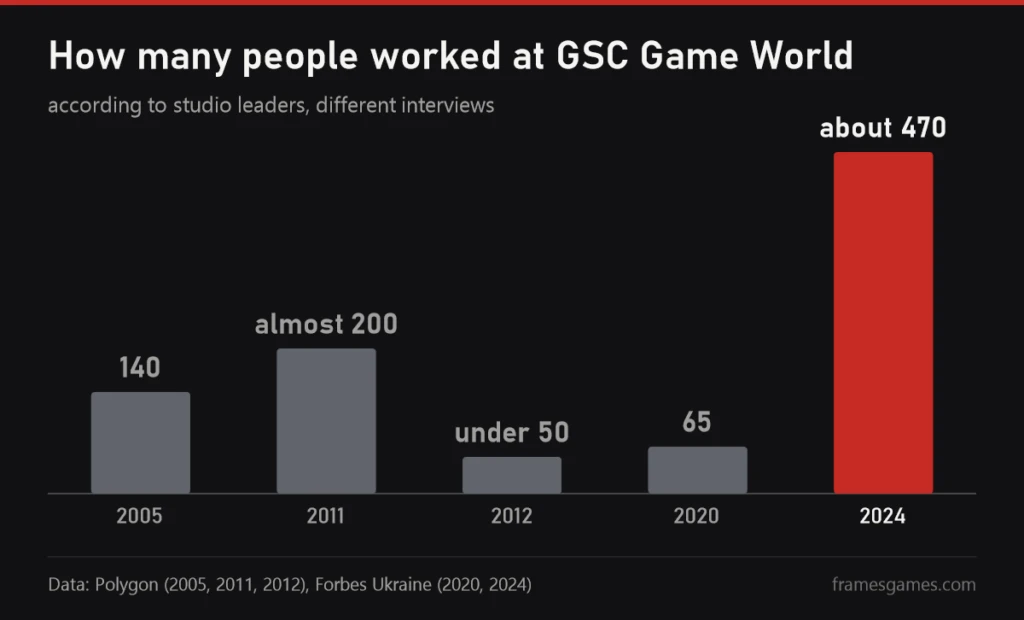
The first S.T.A.L.K.E.R. 2 was announced in August 2010, on new multiplatform tech, for 2012. By then, Grygorovych said, the series had sold over 4 million copies. In February 2011 Ernst & Young named him Ukraine's entrepreneur of the year. Then on December 9 he gathered the staff and, as Yavorsky told Polygon, said: "I have decided to stop Stalker 2 development. Goodbye." It was a very short speech.
The bitter part is that Yavorsky had planned the first presentation of the new game's story for that same day, with pizza and drinks to lift morale. Staff went from almost 200 to fewer than 50. Clear Sky and Call of Pripyat art director Ilya Tolmachev had already left in 2010 after seeing the design documents: "It was more like a war, less like an exploration game." Former staff tried to buy the license, Grygorovych wouldn't sell, and in March 2012 they founded Vostok Games and made Survarium. GSC returned at the end of 2014.
Heart of Chornobyl: evacuating 700 people, hacks and a fire in Prague
 The video loads from YouTube (Google) when you press play. Privacy policy
The new S.T.A.L.K.E.R. 2 was announced on May 15, 2018. Ievgen Grygorovych told PC Gamer the team started on Unreal Engine 4 and moved to an early Unreal Engine 5 that didn't support an open world of this size, so the studio wrote a lot of its own code. The team grew sevenfold in that time: 65 people in 2020 and about 470 at launch, nearly 270 of them in Ukraine, GSC owner Maksym Kryppa told Forbes Ukraine.
According to The Guardian, preparations for the worst began about six weeks before the invasion. Buses waited near the office with drivers on call around the clock, and a week before February 24, 2022, more than 200 employees and their families were moved to Uzhhorod. In total around 700 people relocated with families, one bag per family, with three hours to grab equipment from the office. Via Budapest the studio made it to Prague; about 170 people stayed in Ukraine, and GSC keeps paying those who joined the army. Ievgen Grygorovych: "We just had to save as many people as we could." Development resumed by May 2022.
- The subtitle changed in spring 2022: Chernobyl became Chornobyl, the Ukrainian spelling.
- The 2023 hacks. In March, hackers from a Russian online community broke into one of the studio's work accounts and demanded a different attitude toward players from Russia and Belarus and a Russian localization. In June a test build leaked; GSC blamed attacks that had gone on for almost a year and a half.
- The fire. In September 2023 one of the three floors of the Prague office burned. The studio's response: "We've dealt with worse than that before. This is fine."
- The documentary. Xbox released War Game: The Making of S.T.A.L.K.E.R. 2 on October 3, 2024; it's above, in full and free.
After launch: 6 million players, Unreal 5.5 and "Can I cry?"
 The video loads from YouTube (Google) when you press play. Privacy policy
The game launched on November 20, 2024 on PC and Xbox Series, day one on Game Pass, and on PS5 exactly a year later. It sold a million copies in about two days not counting Game Pass, and by March 2025 6 million people had played it; that figure counts players, not copies. In December 2024 Kryppa told Forbes Ukraine the project had already paid off. The PC version sits at 73 on Metacritic, the later PS5 version at 80. Our take on the game itself is in our review.
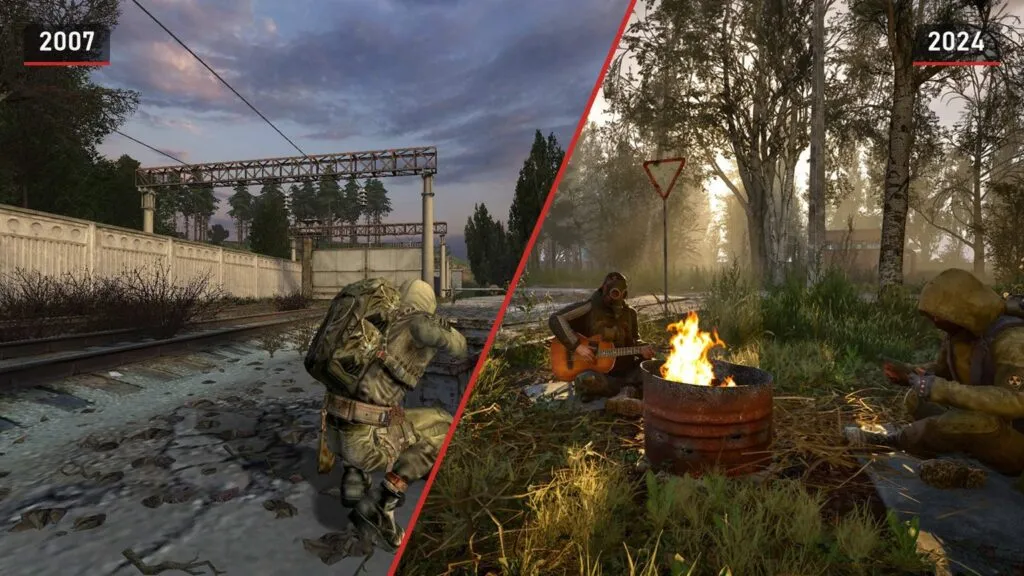
Almost two years of patches followed, and the heaviest of them, update 2.0 in August 2026, moved the game from Unreal Engine 5.1 to 5.5.4. Asked by PC Gamer what that was like, Maria Grygorovych answered: "Can I cry?" Asked whether they miss X-Ray, both Grygorovyches answered with one word: "No." We showed how the game changed after 2.0 in a before-and-after comparison. The same day brought the Cost of Hope expansion with the power plant and the Duty-Freedom war, rated 84, the best score in the whole series (more on it here).
There was a scandal too. In July 2026 studio founder Sergiy Grygorovych told a YouTuber that Xbox paid more for exclusivity than the game cost to make. GSC replied that Sergiy took no part in the negotiations or development and that most of the budget came from Kryppa. So treat that number as one man's claim that the studio denies.
Legends of the Zone and the Enhanced Edition: how the remastered trilogy differs from the original
 The video loads from YouTube (Google) when you press play. Privacy policy
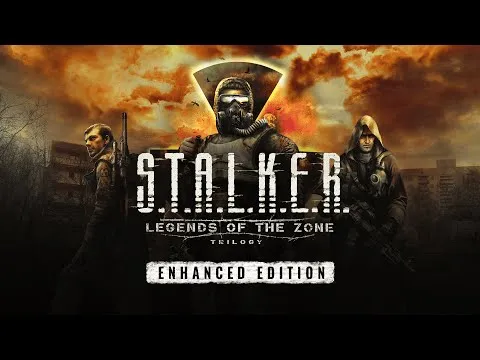
On March 6, 2024 the trilogy came to PS4 and Xbox One as Legends of the Zone, with ports made together with the studio MATABOO, and Switch followed in October 2024. At the same time the games were renamed Shadow of Chornobyl and Call of Prypiat. On May 20, 2025 the Enhanced Edition arrived for PC, PS5 and Xbox Series. According to GSC's official FAQ:
- Free if you already own the games, and buying the Enhanced Edition also gets you the classic versions.
- Graphics: global illumination, SSR reflections, god rays, upscaled textures, new NPC and weapon models. On PC the only upscaler is FSR.
- Same content, with balance and economy untouched. Multiplayer was removed and old mods don't work, but there's Steam Workshop and mod.io support.
- Voice acting: a full Ukrainian voice track was added. Russian remains in text only.
If you play mod packs like Anomaly or GAMMA, you still need the classic version: the Enhanced Edition won't run them. If the original won't start on a modern PC, we have a Windows 11 guide.
Every S.T.A.L.K.E.R. game: year, platforms and scores
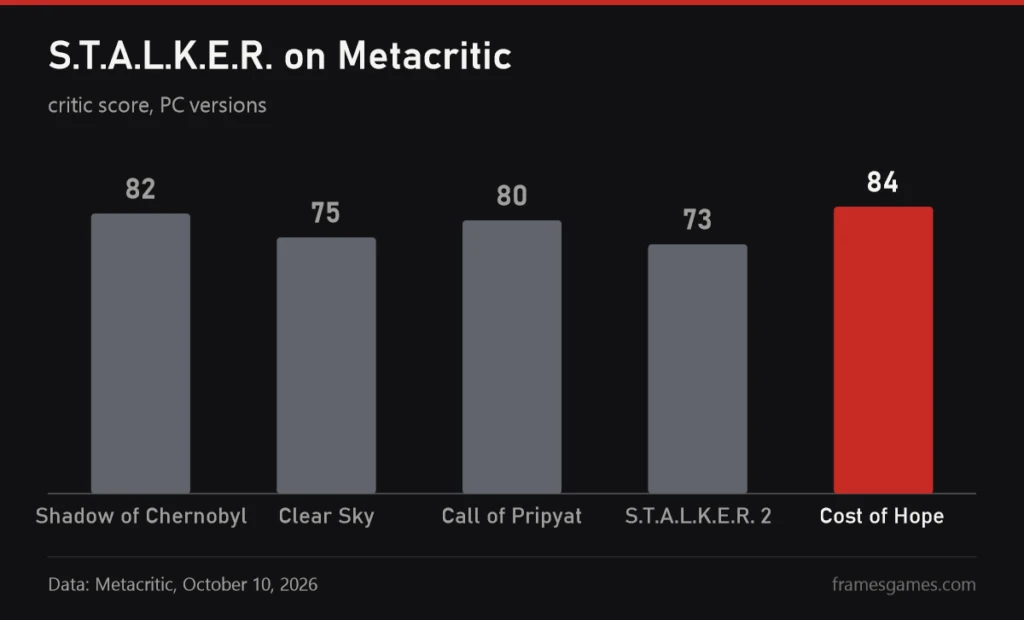
| Year | Game | Platforms | Metacritic |
|---|---|---|---|
| 2007 | S.T.A.L.K.E.R.: Shadow of Chernobyl | PC, since 2024 PS4, Xbox One, Switch | 82 |
| 2008 | S.T.A.L.K.E.R.: Clear Sky | PC, since 2024 PS4, Xbox One, Switch | 75 |
| 2009 | S.T.A.L.K.E.R.: Call of Pripyat | PC, since 2024 PS4, Xbox One, Switch | 80 |
| 2010-2011 | S.T.A.L.K.E.R. 2 (first version) | cancelled | none |
| 2024 | S.T.A.L.K.E.R. 2: Heart of Chornobyl | PC, Xbox Series, since 2025 PS5 | 73 |
| 2025 | Legends of the Zone Enhanced Edition | PC, PS5, Xbox Series | re-release |
| 2026 | Cost of Hope (expansion) | PC, Xbox Series, PS5 | 84 |
Where to start with S.T.A.L.K.E.R. today
On Steam each game in the trilogy costs $19.99, S.T.A.L.K.E.R. 2 is $59.99 and the Cost of Hope expansion $29.99. I'd start with Shadow of Chernobyl in the Enhanced Edition: it's where it all began, and it explains better than anything why people love the Zone. Play Call of Pripyat second, it's the most polished of the three. Clear Sky is for when you want more, and S.T.A.L.K.E.R. 2 works fine without the old games, the story explains itself.
What does S.T.A.L.K.E.R. stand for?
Nothing. The dots were added on lawyers' advice to avoid claims over the Strugatsky brothers' Roadside Picnic, where the word stalker comes from. Every expansion of the acronym you'll find online was made up by fans.
What are S.T.A.L.K.E.R. builds 1935 and 2571?
Early builds of Shadow of Chernobyl. Build 1935 dates from October 18, 2004; GSC released it officially in 2009, and it has cars, Dead City and the Generators. Build 2571 dates from March 16, 2006, leaked in 2010 and is the closest to the final game.
What's the difference between the Enhanced Edition and the original?
Better graphics, gamepad support and mods through Steam Workshop. Story, balance and economy are the same; multiplayer is gone, old mods don't work, and Ukrainian voice acting was added. Owners of the original get the upgrade for free.
Are there real stalkers in Chernobyl?
Yes, that's the name for people who enter the Chernobyl Exclusion Zone illegally. In November 2024 Ukraine's border service said a significant share of trespassers were video game enthusiasts and asked them to stay out. GSC told National Geographic back in 2017 that it never encouraged players to visit illegally.
Is there a S.T.A.L.K.E.R. movie or TV series?
Not officially. In December 2024 GSC owner Maksym Kryppa said he'd like a Netflix series and that talks were under way, but nothing has been announced.
Sources
Early history: Yuri Mikhailov, "S.T.A.L.K.E.R.: the history of the game's creation", Luchshie Kompyuternye Igry issue 4 (101), April 2010; Robert Purchese, Eurogamer, July 2018 (Oleg Yavorsky and Dean Sharpe); the Zone trip diary on gsc-game.com, April 5, 2002, via the Web Archive; Charlie Hall, Polygon, September 8, 2013; Andriy Prokhorov interviewed by Oleg Danylov, Mezha, August 13, 2026; Igromania, February 2008 (sales); Shacknews, March 2, 2009 (builds 1096 and 1935) and August 16, 2010 (S.T.A.L.K.E.R. 2 announcement and 4 million copies); GSC's official modding wiki (build 1935). Dates for builds 749, 2205 and 2571 come from fan archives.
Clear Sky and Call of Pripyat: Oleg Yavorsky, Rock Paper Shotgun, May 25, 2009; Ukrainska Pravda, December 25, 2022 (Volodymyr Yezhov); PC Gamer, December 13, 2012 (bitComposer). The 2011 shutdown and Vostok Games: Polygon, 2013; PC Gamer, December 9, 2011.
S.T.A.L.K.E.R. 2: Polygon, May 15, 2018; Tom Regan, The Guardian, January 31, 2024; Microsoft on the War Game film (October 2024); Rock Paper Shotgun, May 23, 2022; VGC, March 13, 2023, and Insider Gaming (hacks); TechRadar, September 10, 2023 (fire); PC Gamer, November 22, 2024 and March 5, 2025 (sales), September 2, 2026 (update 2.0); Maksym Kryppa, Forbes Ukraine, December 18, 2024; Insider Gaming, July 21, 2026, and Mezha (budget dispute); Rock Paper Shotgun, March and August 2026 (Cost of Hope). Legends of the Zone: Mezha, March 6, 2024; GSC's official Enhanced Edition FAQ. Stalkers in the Zone: National Geographic, December 22, 2017; AFP via SCMP, November 22, 2024.
Scores: Metacritic as of October 10, 2026. Prices: Steam, US, October 10, 2026. Images: official screenshots and art from Steam. Videos: official GSC Game World and XBOX channels, the early Oblivion Lost trailer from the StalkerVideoArchive channel, build 1935 gameplay from the PCGI channel.