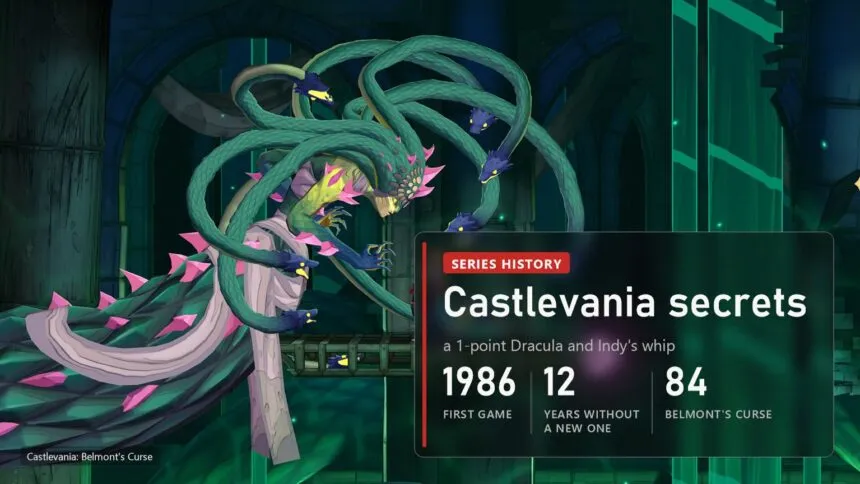
This is the Castlevania series told by the people who made it, from the 1986 original to Belmont's Curse, which came out on October 15, 2026. Why Dracula is worth exactly one point in the first game, where the Belmont whip really comes from, who wrote "What is a man?" (not the Japanese script) and how Lords of Shadow nearly shipped under a name its own director compared to a deodorant brand.
- Belmont's Curse, 2026: the first new Castlevania in 12 years came from the Dead Cells team
- Castlevania, 1986: an Indiana Jones whip and a one-point Dracula
- Simon's Quest, 1987: the model was Maze of Galious, not Metroid
- Dracula's Curse, 1989: built to outdo the Ninja Turtles
- Super Castlevania IV, 1991: the director worked under a fake name
- Rondo of Blood, 1993: humanoid monsters were kept away from American eyes
- Bloodlines, 1994: Vampire Killer, the "tabasco" version and a cursed tapestry
- Symphony of the Night, 1997: a 200.6% map and a line that is not in the Japanese script
- Castlevania 64, 1999: Dracula 3D and the heroes who disappeared
- Aria of Sorrow, 2003: Soma Cruz is named after Penélope Cruz
- Lords of Shadow, 2010: "Light and Shadow" and the one sentence from Kojima
- 2014: Lords of Shadow 2, Igarashi walks out and Bloodstained raises $5.5 million
- Every Castlevania game in this article: year, platform and score
- Where to start with Castlevania today
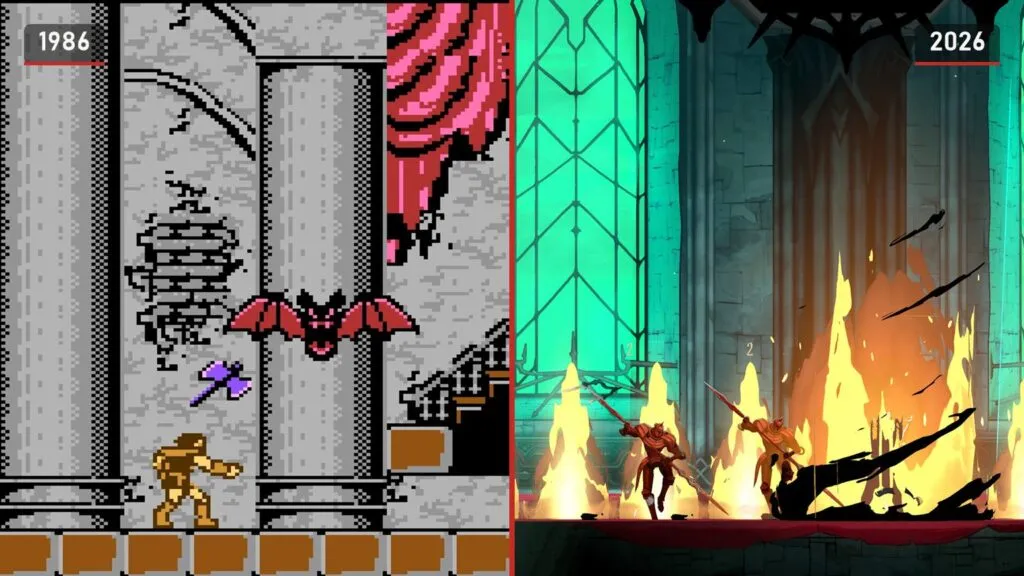
The timing is not random. Belmont's Curse is the first new full-size Castlevania since 2014, and Konami handed it to Evil Empire, the French studio that had been looking after Dead Cells. Its all-time peak on Steam is 21,745 players at once. Lords of Shadow 2, the previous record holder, topped out at 3,784.
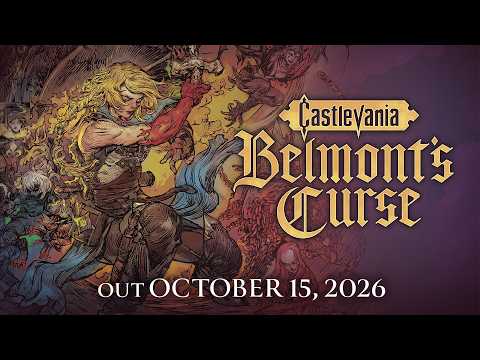
Belmont's Curse, 2026: the first new Castlevania in 12 years came from the Dead Cells team
 The video loads from YouTube (Google) when you press play. Privacy policy
Konami revealed it at the February 12, 2026 State of Play, dated it at the Xbox Games Showcase on June 8, put out a demo on October 1 and released the game on October 15 for PS5, Xbox Series X|S, PC and Switch, at $29.99 on Steam. You play Rose Belmont, 23 years after Castlevania III: Dracula's Curse. Evil Empire developed it with Konami, and Motion Twin advised.
Konami producer Tsutomu Taniguchi told Game Informer in July how a French studio ended up with the keys to Dracula's castle: "They actually approach us with a DLC for Dead Cells." That was Return to Castlevania in 2023. Asked whether they hesitated, Evil Empire creative director Emmanuel Nouaille went for sarcasm: "It was very difficult to refuse a proposition."
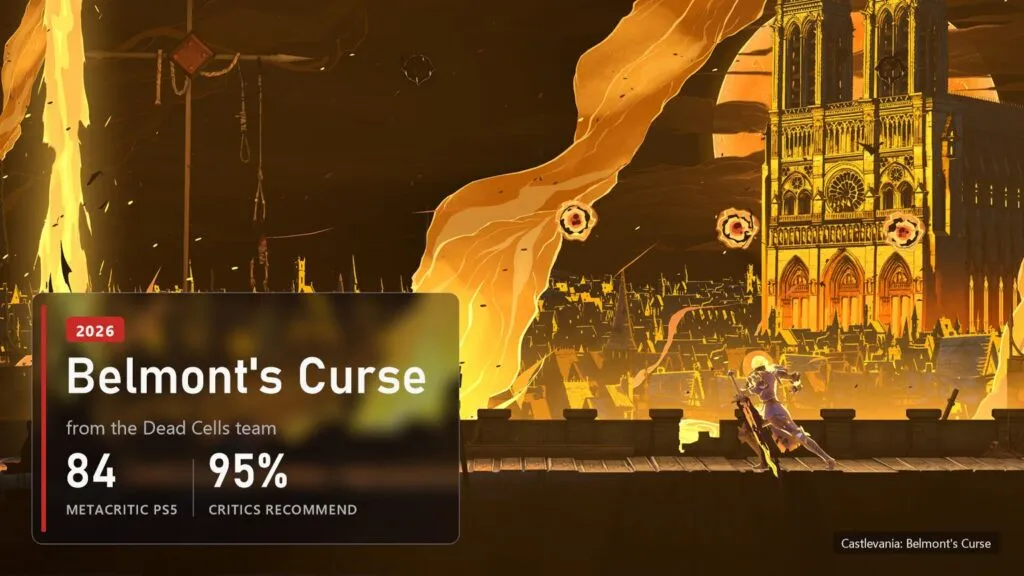
- Reviews. Metacritic has the PS5 version at 84 from 62 critics, Xbox Series X at 87, PC at 82 and Switch at 79. OpenCritic shows 84 with 95% of critics recommending it. Steam users: 7,670 reviews, Mostly Positive.
- No sales number. Konami has published neither copies nor players. The only public figure is the Steam concurrent peak on SteamCharts.
- More coming? Konami president Hideki Hayakawa told Nikkei xTrend on July 23 that the company is "actively developing Castlevania". He did not say which game, and Belmont's Curse is not named in that interview.
- Rumors that missed. VGC reported in October 2021 that a "reimagining" was being made inside Konami in Japan. A new game did arrive, just from France. In February 2025 Geekinout promised a big-budget Castlevania, possibly by MercurySteam, to be announced that year. It was not.
Castlevania, 1986: an Indiana Jones whip and a one-point Dracula
The first game came out on September 26, 1986 in Japan as Akumajo Dracula for the Famicom Disk System, and in North America in May 1987. Its creator, Hitoshi Akamatsu, almost never gave interviews. Most of what we know about his thinking comes from Sonna Yuumi, a developer he mentored in the 1990s, whose recollections were translated by shmuplations.
- The whip is a movie reference. Whips are good at keeping enemies back, Akamatsu said, and also "because I love Raiders of the Lost Ark!"
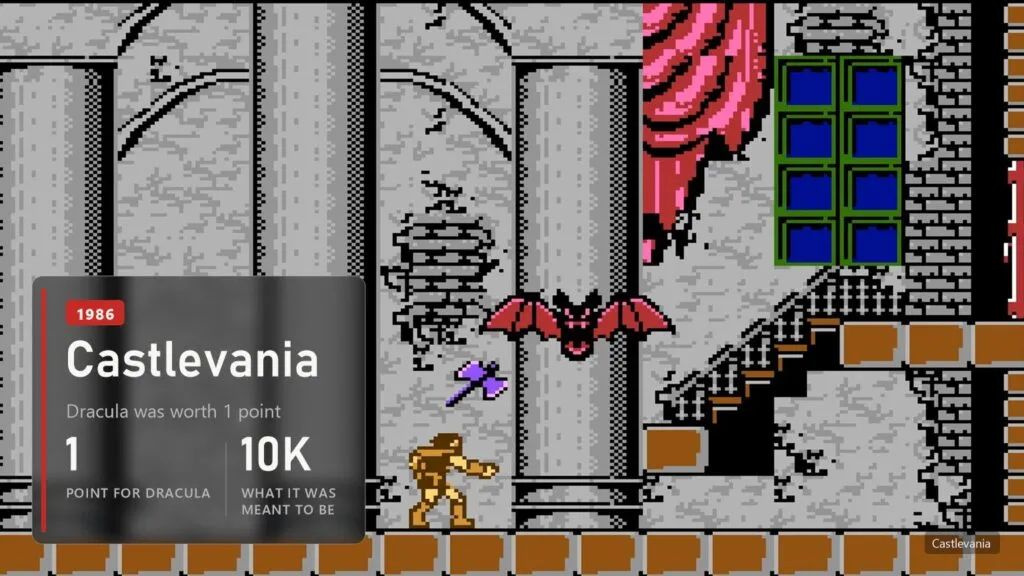
- Dracula is worth 1 point by accident. He was supposed to give 10,000. On a tight schedule Akamatsu "set the wrong bit".
- The final monster is not Dracula. Akamatsu described it as "a monster borne from the curse of man". In a truly peaceful age, he said, Dracula would not exist.
- The clock tower gears are his heart. They keep turning while Dracula lives, and in the ending only the tower falls, which was meant as a sequel hook.
- No sympathy for "too hard". His answer to complaints: "Simon doesn't die from one hit, Mario does!"
The end credits are a horror film joke: "Trans Fishers" for Terence Fisher, who directed Hammer's Dracula in 1958, "Vram Stoker", "Christopher Bee", "Belo Lugosi", "Boris Karloffice" and a "James Banana" standing in for Hammer composer James Bernard. And composer Kinuyo Yamashita said in September 2026 that Hidenori Maezawa, often listed as her co-composer, "was not involved".
Simon's Quest, 1987: the model was Maze of Galious, not Metroid
 The video loads from YouTube (Google) when you press play. Privacy policy
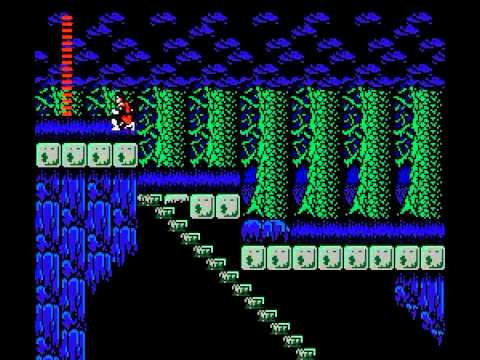
The sequel launched in Japan on August 28, 1987 as Dracula II: Noroi no Fuuin and reached the NES in December 1988. According to Yuumi, the English title Simon's Quest was Akamatsu's own idea. Asked if Metroid inspired it, he pointed instead to Konami's MSX game Maze of Galious. The night zombies originally hopped like Chinese jiangshi, but they turned out "too strong", so he "reluctantly" made them walk.
The game's reputation for being confusing is usually blamed on the translation. That is only part of it. The villagers who lie to you were lying in Japanese too, and the localization garbled just a few clues. Igarashi has said the game left a weak impression in Japan for the same reasons, plus long disk loading.
Dracula's Curse, 1989: built to outdo the Ninja Turtles
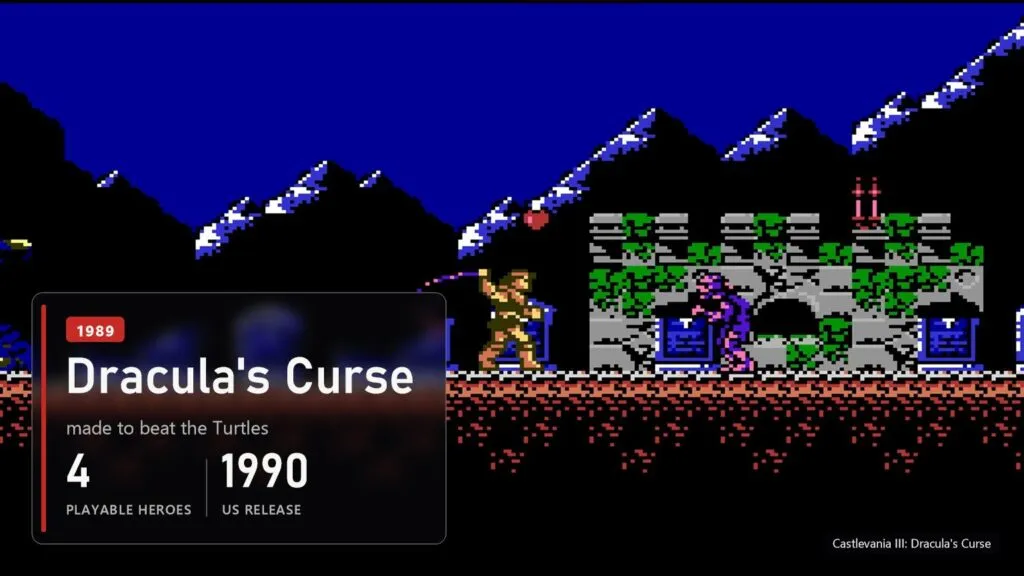
Castlevania III came out in Japan on December 22, 1989 and in North America in September 1990. Yuumi says Akamatsu made it as good as it is "in an attempt to outdo the Ninja Turtles games". TMNT was Konami's best seller abroad and its team got everything first, while the Castlevania staff lived on scraps.
- The four heroes were a group decision. An anonymous staff member posted on 2ch in 2012 that characters were picked in team meetings. He also revealed that the "C" in Ralph C. Belmondo, Trevor's Japanese name, stands for Christopher.
- The Famicom cart sounds better. The Japanese version used Konami's own chip with extra sound channels. That was not allowed on the NES, so the music was rearranged for the West. This is a well-documented regional difference, though we could not open the primary write-up ourselves.
- The "exile to an arcade" story is unproven. Yuumi says Akamatsu was demoted to a Konami game center after poor sales and then quit. Former staff who spoke to journalist Jack Yarwood tell it differently: he moved to arcade games in 1990, and whether it was a punishment nobody knows.
Super Castlevania IV, 1991: the director worked under a fake name
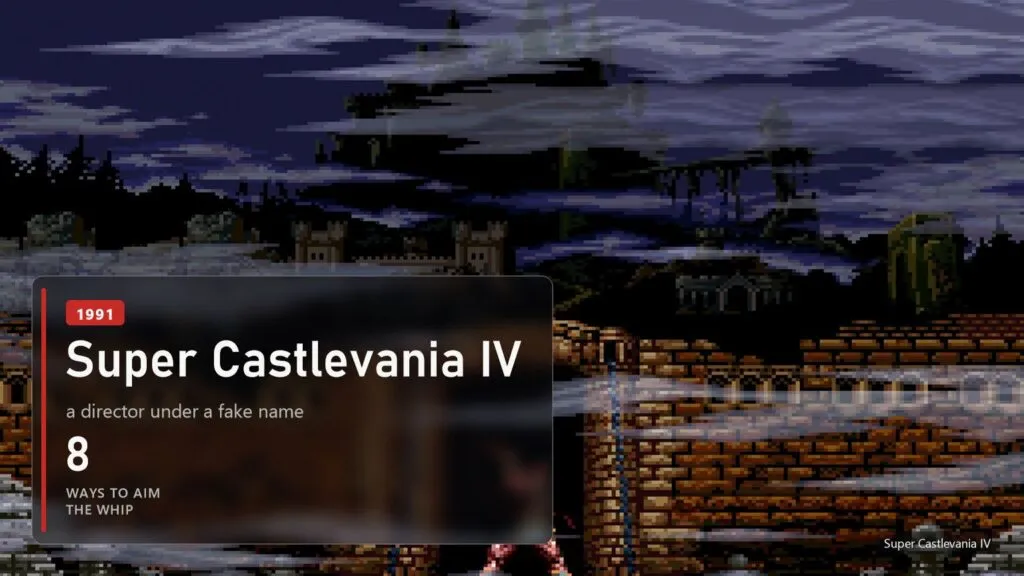
Super Castlevania IV hit the Super Famicom on October 31, 1991. Its director, Masahiro Ueno, is credited as "Jun Furano" because Konami did not allow real names in credits at the time, and he also programmed the enemies and bosses. Work started in late 1989, before Castlevania III was even out.
Ueno loved the original and dropped the RPG ideas of II and III. What he added instead were the things he felt 1986 was missing: an eight-direction whip, whip swinging and the ability to jump on and off stairs. Mitsuru Yaida, who later co-founded Treasure and worked on Gunstar Heroes, was on the team.
Rondo of Blood, 1993: humanoid monsters were kept away from American eyes
 The video loads from YouTube (Google) when you press play. Privacy policy
Rondo of Blood launched on October 29, 1993 on the PC Engine Super CD-ROM, in Japan only. The West did not get it officially until The Dracula X Chronicles for PSP in 2007. The CD liner notes and an interview with the lead programmer show a team that knew the game was not going abroad and relaxed accordingly.
- Medusa and Carmilla, thanks to Japan. Designer Toshiharu Furukawa said monsters with a human form had been avoided because they "violated American morals". With a Japan-only release, he drew plenty of them.
- Five times harder. Programmer Shingo Takatsuka said the first build was "easily five times more difficult" than what shipped.
- Four playable characters were planned. Two made it: Richter and Maria, who is effectively easy mode. Director Toru Hagihara's verdict on Maria: she "gave us nothing but bugs!"
- Voices from the meeting room. New Konami hires recorded the voices in conference rooms. One described the monster voice as a salaryman screaming in a conference room.
Konami was making two more Dracula games at the same time, one for the X68000 computer and one for the Mega Drive. Akamatsu, asked about Rondo years later, said simply that he had not played it.
Bloodlines, 1994: Vampire Killer, the "tabasco" version and a cursed tapestry
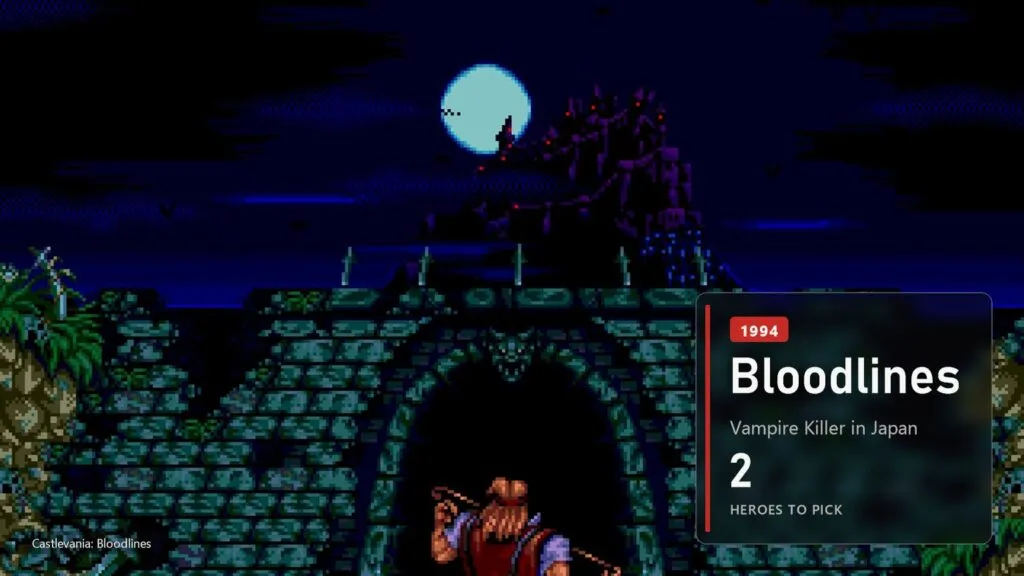
In Japan the only Mega Drive Castlevania was called Vampire Killer. Director Toshiki Yamamura told BEEP! MegaDrive in 1994 that they dropped the usual Akumajo Dracula title on purpose, to signal a faster new style. Japanese players who found it too easy were told to try the Western release, which he called the "tabasco" version.
For mood, the team hung an "evil tapestry" in the office. After enough strange mishaps Yamamura put up ofuda charms next to it. He called the story his personal conception, the second act of a Dracula trilogy, and Michiru Yamane, who would go on to score Symphony of the Night, wrote the music.
Symphony of the Night, 1997: a 200.6% map and a line that is not in the Japanese script
 The video loads from YouTube (Google) when you press play. Privacy policy
Symphony of the Night came out on PlayStation on March 20, 1997 in Japan and in October in North America. Its Metacritic score of 93 is still the series best. Koji Igarashi gets the credit in most retellings, but Toru Hagihara directed the first half of development. Igarashi describes his own role as director for the latter half, scenario writer and programmer.
- The brief was "Ultimate Dracula". A section chief ordered it, and according to Furukawa nobody knew what "ultimate" was supposed to mean.
- Zelda came first. At GDC 2014 Igarashi said The Legend of Zelda was the first game that came to mind, and moving that kind of exploration to 2D "ended up like Metroid". Retro Gamer's making-of names Super Metroid. Both versions circulate.
- A morality system was cut. Sub-weapons would push Alucard toward holy, magic toward dark, and the ending would change. Familiars "almost didn't get added", so Hagihara asked players not to overlevel them: enemies were never balanced around them.
- 200.6%. A hundred for the castle, a hundred for the inverted castle and 0.6 for the underground waterway.
- The Alucart set is a shrug. The room first opened for one hour at a set time. When it became a stopwatch puzzle, Hagihara says they "lazily made up those crappy three Alucart items".
- The artist came from a bookstore. The team bought books with covers they liked and looked up who painted them. That is how they found Ayami Kojima.
About "What is a man? A miserable little pile of secrets": it is not in the Japanese script. Translator Jeremy Blaustein took it from André Malraux's Antimémoires (1967). He blames the dub's odd delivery on the fact that a Japanese colleague directed the English voice sessions. Dracula was voiced by Michael Guinn, who told Time Extension in June 2026: "So it's fun to have an iconic phrase."
Konami never published a sales figure. Retro Gamer put the PAL print run at around 15,000 copies with no reprint, which explains the European collector prices. And at Tokyo Game Show 2026 Konami showed early design documents, including a mock-up with a "cute" Alucard, a fairy familiar and RPG-style damage numbers.
Castlevania 64, 1999: Dracula 3D and the heroes who disappeared
 The video loads from YouTube (Google) when you press play. Privacy policy
The first 3D Castlevania was built at KCE Kobe under the working title Dracula 3D. Unseen64 pieced the timeline together from magazines of the period: 10% done in September 1997, 20% in February 1998, and in October 1998 two of the four planned characters were dropped. Cornell the werewolf came back in Legacy of Darkness at the end of 1999. Castlevania 64 sits at 78 on Metacritic.
The next 3D attempt, Castlevania Resurrection for Dreamcast with Sonia Belmont, never shipped. The usual account says it was cancelled in 2000, over friction between the Japanese and American teams and the Dreamcast's decline, but there is no document behind that, only recollections.
Aria of Sorrow, 2003: Soma Cruz is named after Penélope Cruz
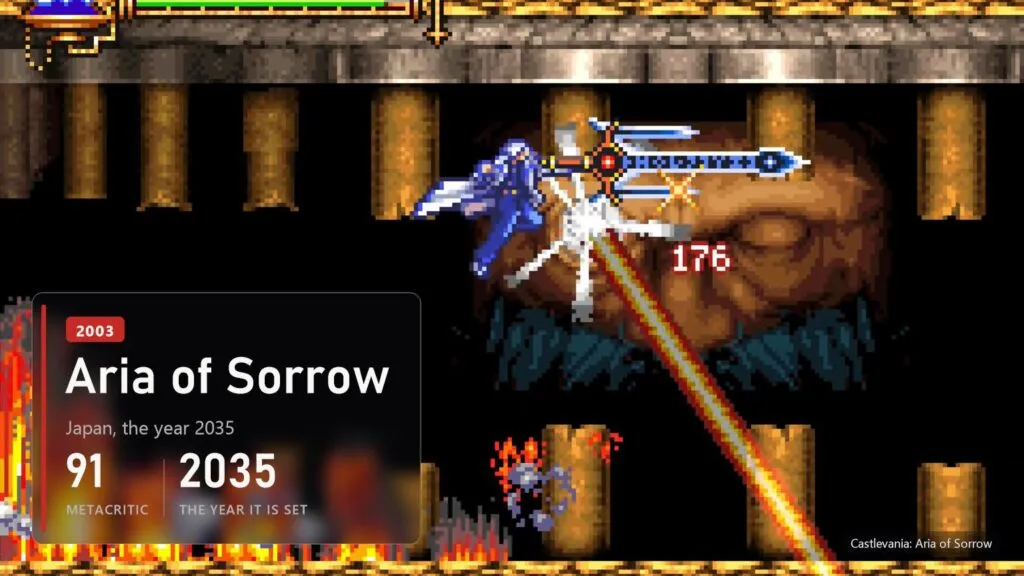
After Symphony the series moved to handhelds, and Igarashi told Nintendo Dream why: Circle of the Moon "sold very well" on the GBA, while 2D games on PS2 were getting lower review scores. Aria of Sorrow came out in 2003 and moved the story to Japan in 2035.
- Why Japan. Eclipses. The 1999 total eclipse over Europe came with Dracula rumors, and in Japan an eclipse ties into the Amaterasu myth. Igarashi also felt there was no room left in the past for new stories.
- The name. Cruz because Penélope Cruz had just visited Japan and the word suggests a cross. Soma for the Indian ritual drink, and because director Junichi Murakami's son is called Soma.
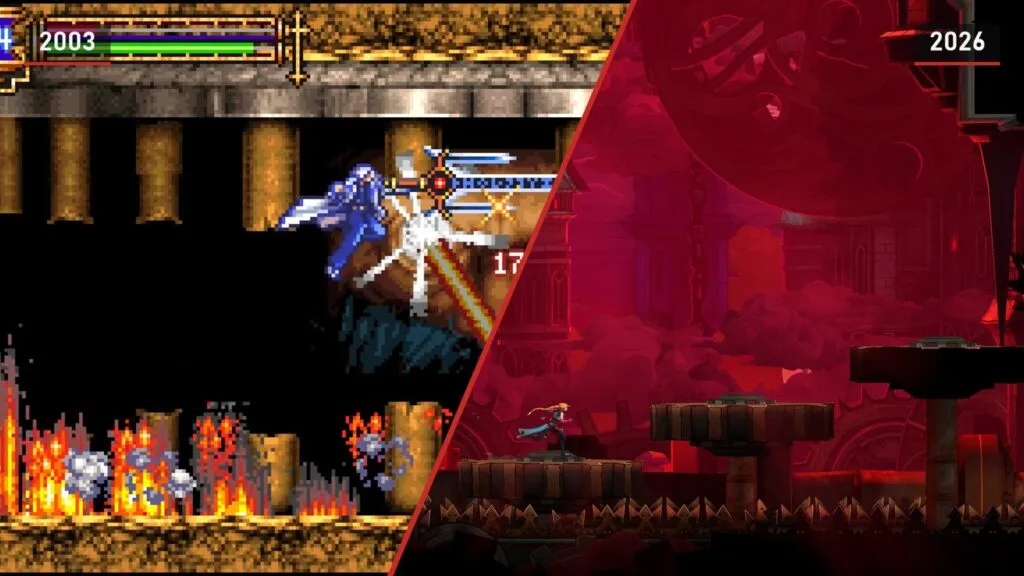
- "No more damn lasers." The soul of Balore, the boss in the shot above, originally fired a laser. That was the note that changed it.
- Japan got the word Castlevania late. Harmony of Dissonance in 2002 was the first game sold there under that name. Igarashi later felt it split Japanese and Western fans, and the Akumajo Dracula title came back.
Budgets stayed small. Christian Nutt wrote in 2015 that Igarashi's games were never treated as triple-A "because Castlevania wasn't big in its home territory", and that the DS games sold poorly in Japan. Igarashi himself joked in 2007 that he was waiting for his lottery winnings so he could leave Konami.
Lords of Shadow, 2010: "Light and Shadow" and the one sentence from Kojima
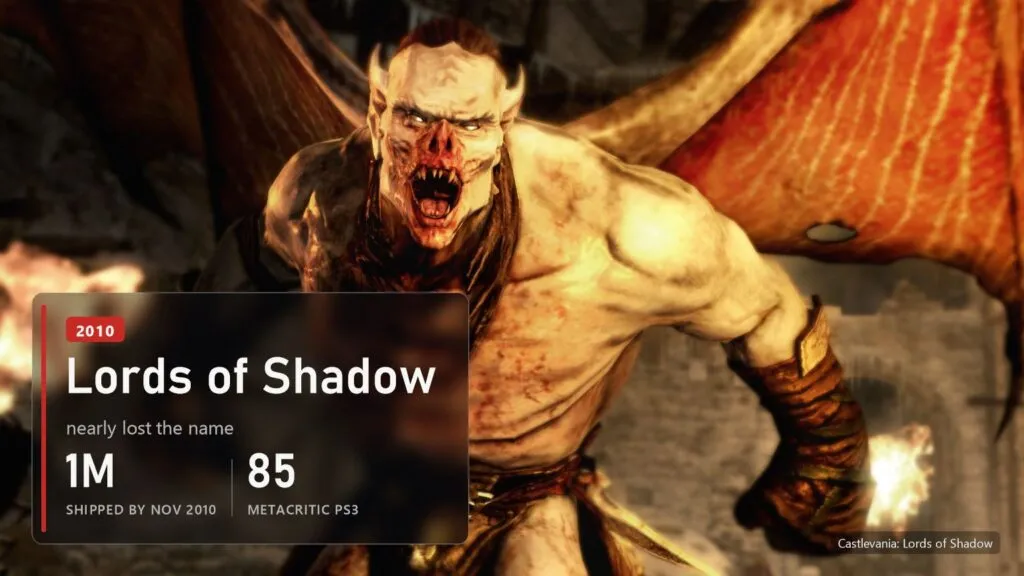
Madrid's MercurySteam pitched Konami a 30-second video starring Simon Belmont. Studio head Enric Álvarez told the Madrid in Game audience in 2023 (reported by 3DJuegos) that after the contract was signed, Konami said the game could not be called Castlevania because a new entry was in the works in Japan. The working title became Light and Shadow, which Álvarez joked sounded like a tobacco or deodorant brand. Leaflets with that name still exist.
- Hideo Kojima gave the name back. Then on Konami's board, he saw the game and said: "Por supuesto que debe ser Castlevania", of course it has to be Castlevania.
- And that was all. Álvarez: "En realidad no nos dieron nada", no style guide, no canon. So much for the idea that Kojima shaped the game.
- The producer remembers it differently. Dave Cox told Edge that upper management found the direction "too radical", and the game was going to be called just Lords of Shadow.
- A million, shipped. In November 2010 Konami said the game "has shipped a million units". That is stock sent to stores, not copies sold to players. Álvarez claims the best-selling Castlevania before it did around half a million.
Igarashi paid for that success. Nutt wrote that the franchise was taken away from him, and his own PS3 and Xbox 360 Castlevania, teased at TGS 2008, was cancelled.
2014: Lords of Shadow 2, Igarashi walks out and Bloodstained raises $5.5 million
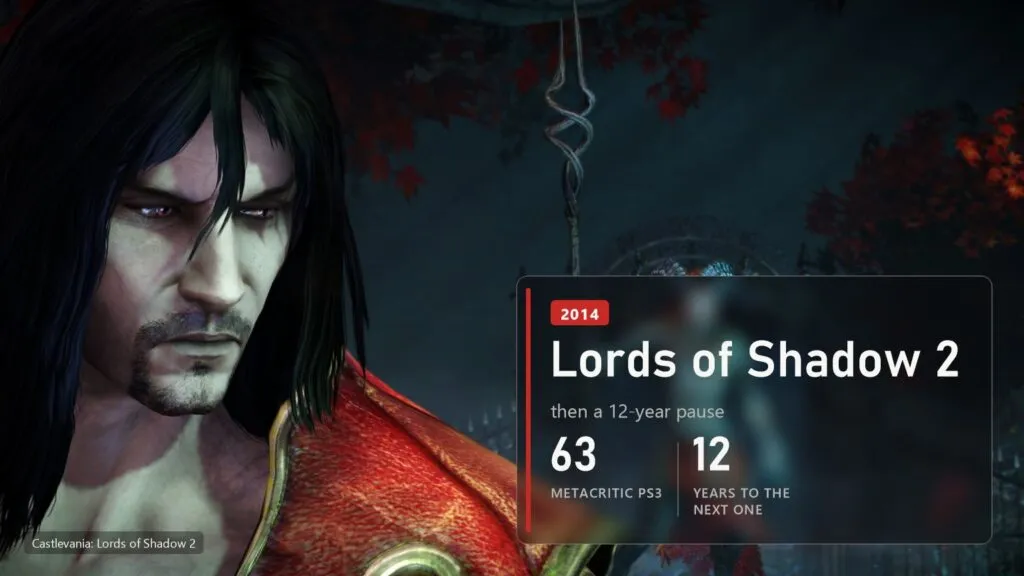
Lords of Shadow 2 launched on February 25, 2014 and scored 63 on PS3. In March, Igarashi left Konami. He explained it to Polygon: "it was two years of making a game that leaned too 'hardcore' for the social market. So it was canceled." Then he would try again, and it would be canceled again. Nine years later at MAGIC in Monaco he put it more poetically: he heard "the voice of a devil inside me telling me to quit".
In May 2015 he launched Bloodstained: Ritual of the Night on Kickstarter, asking for $500,000. He got $5,545,991 from 64,867 backers. Meanwhile Netflix kept the name alive: the 2017 animated series was written entirely by Warren Ellis, with no writers' room, and Ellis had earlier been hired for an unmade Castlevania III movie.
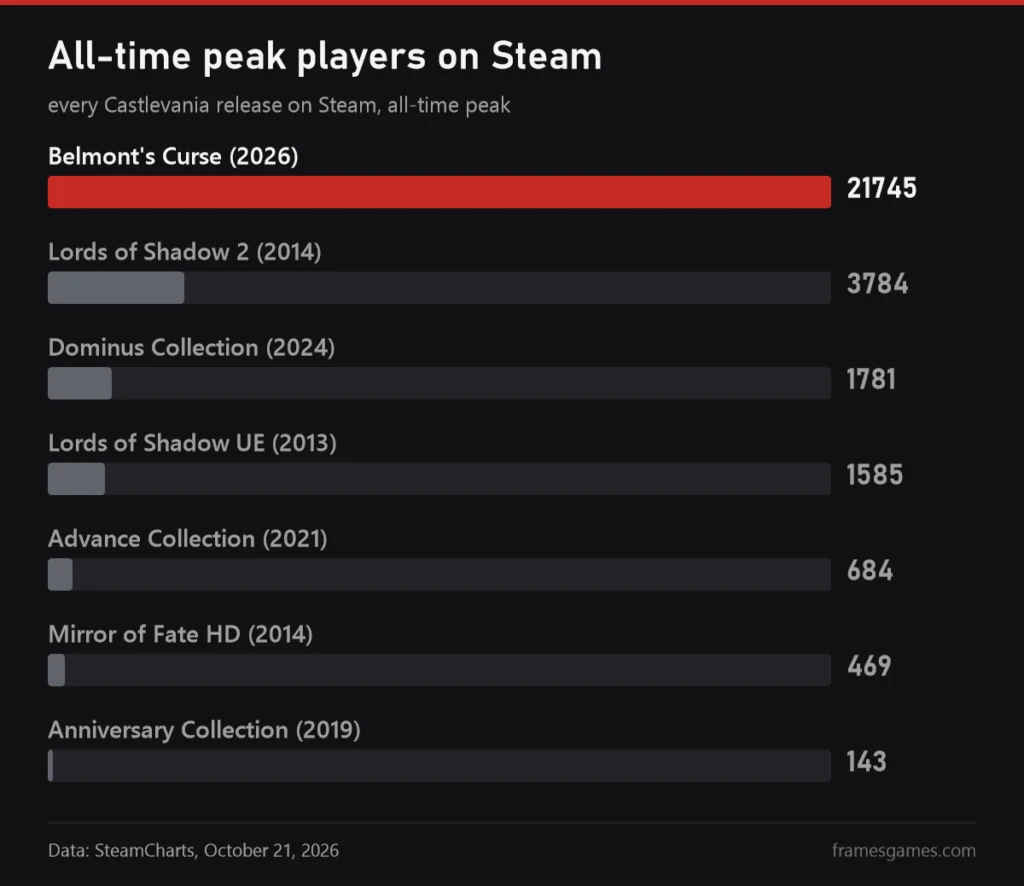
For twelve years there was no new full-size game, unless you count the mobile Grimoire of Souls. There were collections instead: Anniversary in 2019, Advance in 2021 and Dominus in 2024. Dominus scored 92 on Switch, higher than any new entry since Symphony of the Night.
Every Castlevania game in this article: year, platform and score
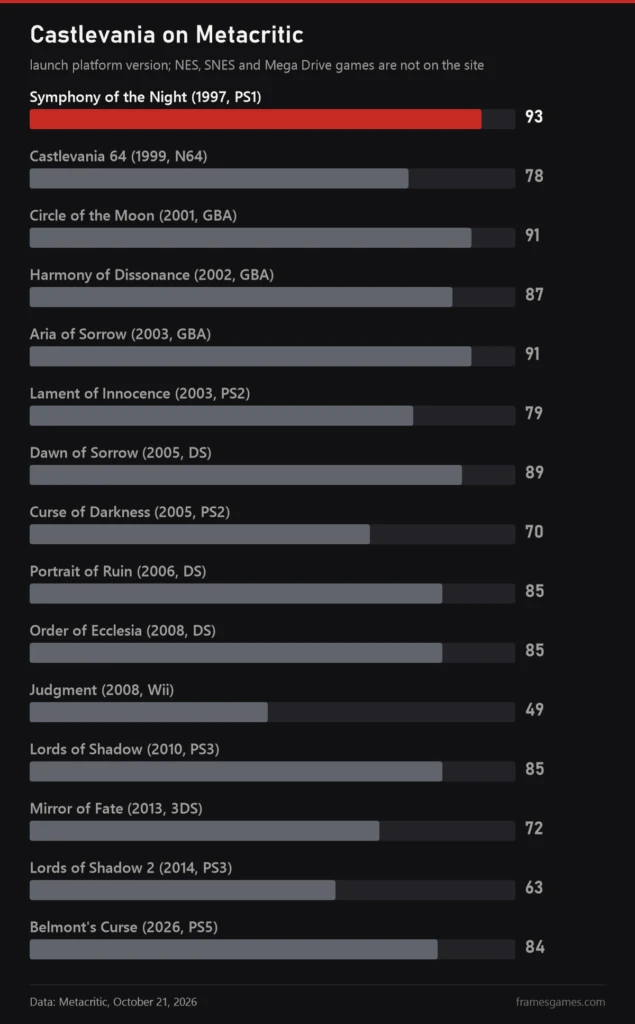
| Year (Japan) | Game | Launch platform | Metacritic |
|---|---|---|---|
| 1986 | Castlevania (Akumajo Dracula) | Famicom Disk System, NES | none |
| 1987 | Castlevania II: Simon's Quest | Famicom Disk System, NES | none |
| 1989 | Castlevania III: Dracula's Curse | Famicom, NES | none |
| 1991 | Super Castlevania IV | Super Famicom, SNES | none |
| 1993 | Rondo of Blood | PC Engine CD, Japan only | 80 (PSP, 2007) |
| 1994 | Castlevania: Bloodlines | Mega Drive / Genesis | none |
| 1997 | Symphony of the Night | PlayStation | 93 |
| 1999 | Castlevania (Castlevania 64) | Nintendo 64 | 78 |
| 2001 | Circle of the Moon | Game Boy Advance | 91 |
| 2002 | Harmony of Dissonance | Game Boy Advance | 87 |
| 2003 | Aria of Sorrow | Game Boy Advance | 91 |
| 2003 | Lament of Innocence | PS2 | 79 |
| 2005 | Dawn of Sorrow | DS | 89 |
| 2005 | Curse of Darkness | PS2, Xbox | 70 (PS2), 74 (Xbox) |
| 2006 | Portrait of Ruin | DS | 85 |
| 2008 | Order of Ecclesia | DS | 85 |
| 2008 | Castlevania Judgment | Wii | 49 |
| 2010 | Lords of Shadow | PS3, Xbox 360 | 85 (PS3), 83 (X360) |
| 2013 | Lords of Shadow: Mirror of Fate | 3DS | 72 |
| 2014 | Lords of Shadow 2 | PS3, Xbox 360, PC | 63 (PS3), 70 (X360), 58 (PC) |
| 2026 | Belmont's Curse | PC, PS5, Xbox Series, Switch | 84 (PS5), 87 (Xbox), 82 (PC), 79 (Switch) |
Where to start with Castlevania today
Most of the classics are on Steam in collections. Anniversary Collection ($19.99) covers NES, SNES, Mega Drive and Game Boy games, including the original, Dracula's Curse, Super Castlevania IV and Bloodlines. Advance Collection ($19.99) has the three GBA games plus Dracula X for SNES. Dominus Collection ($24.99) has the three DS games plus the arcade Haunted Castle and its remake, Haunted Castle Revisited. Lords of Shadow Ultimate Edition is $29.99, Lords of Shadow 2 is $39.99, Mirror of Fate HD is $14.99, Belmont's Curse is $29.99.
Symphony of the Night and Rondo of Blood are not officially on PC. Both come together in Castlevania Requiem on PS4. My pick: Dominus Collection if you want exploration and leveling, Belmont's Curse if you want something modern without the pixel dust. And play the 1986 original at least up to the giant bat. A lot of the series makes more sense after that.

Where should I start with Castlevania?
Dominus Collection or Advance Collection on Steam if you want Symphony-style castle exploration. If you want a new game, Belmont's Curse from 2026 does not require any earlier entries.
Where does Belmont's Curse fit in the Castlevania timeline?
It is set 23 years after Castlevania III: Dracula's Curse and follows Rose Belmont. It belongs to the main timeline, unlike Lords of Shadow, which is a separate continuity.
Where does the line What is a man? A miserable little pile of secrets come from?
From the English localization of Symphony of the Night. It is not in the Japanese script: translator Jeremy Blaustein borrowed it from André Malraux's Antimémoires. Michael Guinn voiced Dracula. The 2007 PSP redub dropped the line.
Which game is the Netflix Castlevania series based on?
The 2017 series draws on Castlevania III: Dracula's Curse and was written entirely by Warren Ellis. Castlevania: Nocturne followed in 2023, with season two on January 16, 2025, and its hero is Richter Belmont from Rondo of Blood.
Sources
Belmont's Curse: Game Informer, July 17, 2026, Steam page, Metacritic, SteamCharts, Hideki Hayakawa, Nikkei xTrend, July 23, 2026. Rumors: Andy Robinson, VGC, October 1, 2021, CBR on the Geekinout report, February 10, 2025.
Development history: interviews and recollections translated by shmuplations (Castlevania, Rondo of Blood, Rondo of Blood programmer, Bloodlines, Symphony of the Night, Aria of Sorrow, Harmony of Dissonance); Jack Yarwood, Film Stories, 2022; Retronauts, 2017; Destructoid on GDC 2014; Retro Gamer via Push Square, 2012; Legends of Localization; Time Extension (2023, 2026, Kinuyo Yamashita, 2026, Igarashi, 2023); Unseen64; 3DJuegos, 2023; Siliconera, 2012; Gematsu, 2010; Christian Nutt, Game Developer, 2015; Engadget, 2014; Bloodstained on Kickstarter; /Film, 2017.
Screenshots from the Steam pages of Castlevania Anniversary Collection, Advance Collection, Lords of Shadow Ultimate Edition, Lords of Shadow 2 and Belmont's Curse. Videos: the official Konami channel, and World-of-Longplays playthroughs for the older games.