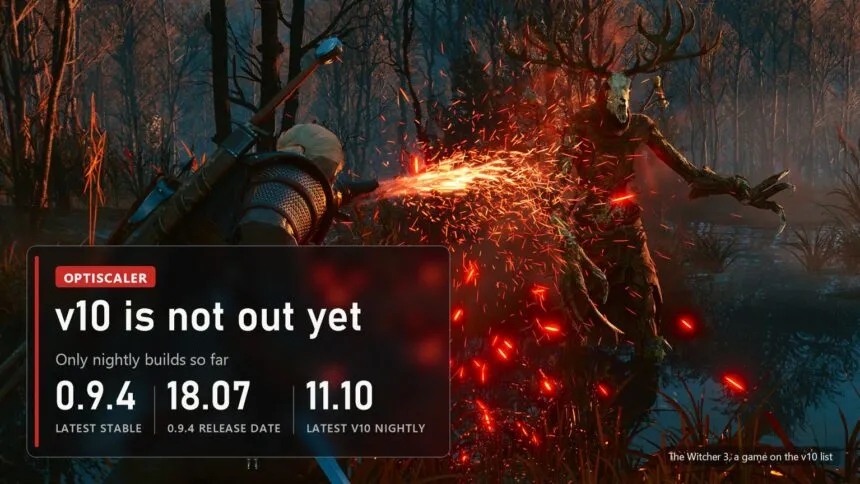
No, OptiScaler v10 isn't out yet, but it is getting close. On 16 November the team released 0.9.5 as the final release of the old 0.9 branch and said v10 is now "mature enough" to take all of their work. Until v10 ships, 0.9.5 is the stable version to install. Version 10 still only exists as nightly builds tagged pre1, built every day in the separate OptiScaler-nightly repository; the latest landed on 24 November. There is still no release date. We keep this page updated, and the log at the bottom shows what's new.
There are a lot of searches for v10 right now, and that's where the trap is. Back in the 0.9.4 notes the OptiScaler team warned that fake websites are posing as the project, and that OptiScaler has no official website at all. Everything genuine lives on GitHub only.
New since 12 October: Vulkan frame generation and FSR 4 on older cards
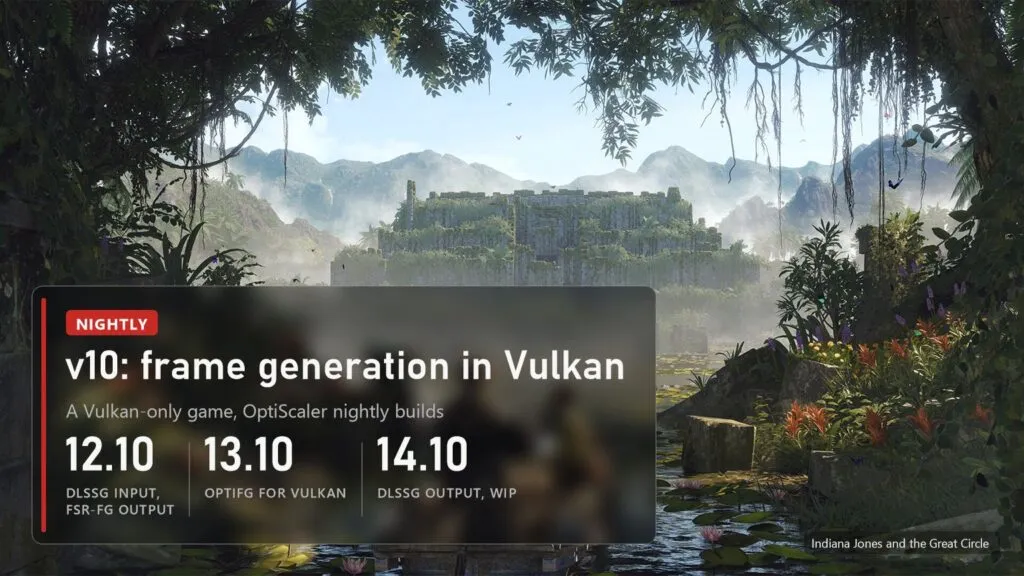
The big change of the last few days: OptiScaler's frame generation, which worked in DirectX 12 and reached DirectX 11 in v10, now works in Vulkan too. That matters for games that run on Vulkan only, such as Indiana Jones and the Great Circle and DOOM: The Dark Ages.
- 12 October. DLSSG input in Vulkan with FSR-FG output: a game with NVIDIA's built-in frame generation can hand its frames to AMD's. The same evening the team fixed the OptiScaler menu crashing with DLSSG in Vulkan.
- 13 October. OptiFG for Vulkan, OptiScaler's own frame generation driven by upscaler inputs. The same day 32-bit builds were dropped from the project to speed up compiling.
- 14 October. Real DLSSG output in Vulkan, still a work in progress. The developers warn that on Linux with the RADV driver this output crashes, while FSR-FG works. There's also a workaround for crashes with RTSS, but with it RTSS shows the frame rate before generation.
- Smaller bits. The frame generation ratio slider now applies when you release the mouse, so dragging no longer stutters, and the Quirks tab lists loaded ASI plugins.
All of this is in nightly builds only. The team last edited the official v10 changelog on 9 September and it doesn't mention Vulkan yet: the details above come from commits to the main branch.
What changed from 2 to 20 November
From the 0.9.5 release notes and commits to the main branch; the nightly of 20 November had 3,440 downloads the next morning.
- 0.9.5 closed the old branch. On 16 November the team shipped 0.9.5 as "one final release" of the 0.9 branch, which is now in maintenance mode: bug reports for it will mostly go unanswered, and all work goes into v10, which the team calls "mature enough". The same notes count 2 million total downloads, about 13,000 stars and around 720 confirmed working games.
- Neural sharpening. On 16 November the nightlies got Neural (BaBa) sharpening, a small neural network instead of the usual RCAS filter, and on 18 November a second one, OptiSharpen. Both are picked in the sharpening settings; the menu now shows which shader actually ran and its GPU time.
- XeSS in Unreal Engine games. Since 17 November OptiScaler pulls depth and motion vectors for XeSS inputs in Unreal Engine games itself.
- Unity and fixes. Frame generation settings for Unity games (14 November), a fix for Doom: The Dark Ages hanging with FSR frame generation in Vulkan (16 November), correct upscaling in Split Fiction, and the base frame rate in the overlay now only shows when frame generation is actually working.
From 15 October to 2 November: FSR 4 in Vulkan and on older cards
- FSR 4 in Vulkan. On 20 October FSR 4 upscaling and FSR 4 frame generation started working in Vulkan games, with a choice between the 4.1.2 models. The commit asks you to update the AMD driver to at least 26.10.1 first. On 28 October the bundled SDK moved to FSR SDK 2.4, which AMD released the same day with Vulkan at parity with DirectX 12.
- Live model switching. Since 19 October the FP8 and INT8 models of FSR 4 switch live from the menu, and FSR 4.0.0 and 4.0.1 work again. The version that comes with your driver is marked with an asterisk, and any other one can be tried by putting its amdxcffx64.dll into the OptiScaler folder.
- FSR 4 on older cards. On 31 October GeForce GTX 10 cards got FSR 4 through the INT8 model. The author of the original proposal ran it on a GTX 1080 Ti with the light model and calls it a smoke test, not a full check. The same day the code began handing the light model to the Radeon RX 5500 series and to Ryzen laptop chips on Phoenix, Hawk Point and Krackan Point. The RX 5700 and 5700 XT stay out: according to the comment in the code, they have no hardware INT8.
- Your own upscalers. From 28 October extra upscaler DLLs go into OptiScaler\custom\<name>\ffx or \dlss, and each folder shows up as a separate entry in the DirectX 12 upscaler list. On 29 October the same arrived for DLSS frame generation, in custom\<name>\dlssg.
- XeFG picks the multiplier itself. Dynamic MFG, added on 15 October, changes the number of generated frames on every real frame to hold a target frame rate and, if you allow it, drops to 1X, which switches generation off.
- Fixes for specific games. Phantom Blade Zero is now detected on every platform, not just Steam, BeamNG.drive got working XeSS inputs, and an XeFG crash on Intel cards in Control Resonant was fixed. The FPS overlay can now be moved, restyled and shared as a preset code.
Again, nightly builds only: the official changelog still dates from 9 September.
What v10 brings: frame generation in DirectX 11 and FSR4-FG
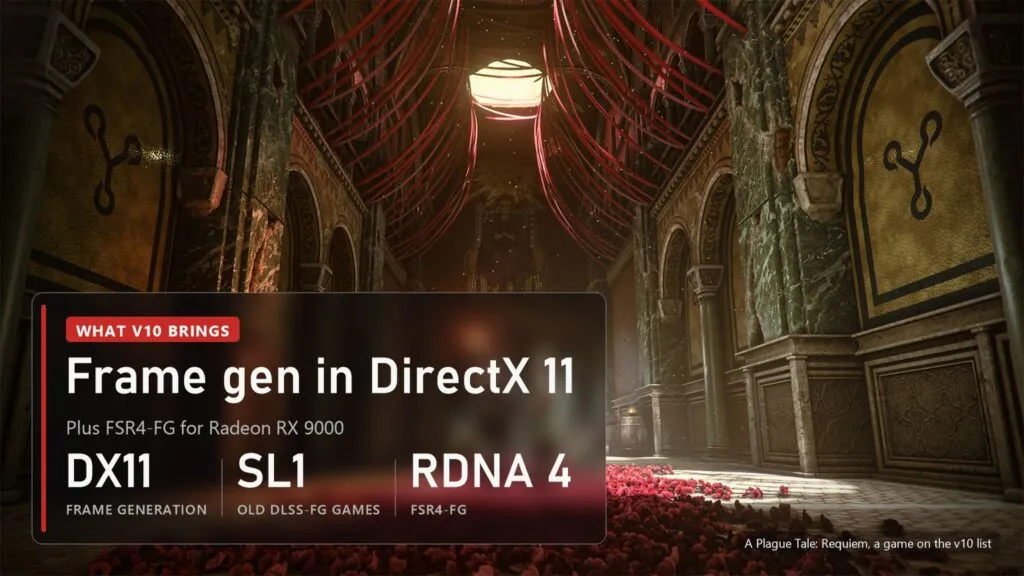
The team keeps the changelog public, last updated on 9 September. The headline items:
- Its own folder. All the upscaler and frame generation files move into an OptiScaler subfolder, so the mod no longer overwrites game files. Only OptiScaler itself, its config and the setup script stay in the root.
- Frame generation in DirectX 11. Only through OptiFG and upscaler inputs for now, with a performance cost from the DX11 to DX12 interop. The authors say there's no HUDFix for DX11 and probably never will be.
- Older DLSS-FG games. Experimental support for the first Streamline, so it hooks The Witcher 3 and A Plague Tale: Requiem properly.
- DLSSG as a frame generation output, plus a new DLSSG via Nvngx mode. Real DLSS-FG still needs an RTX 40 card or newer.
- FSR4-FG on Radeon RX 9000 via a FidelityFX upgrade: on RDNA 4, FSR 3 frame generation gets swapped for FSR 4, other cards keep the old one.
- FSR 4 INT8 on other GPUs through a new system: Fsr4ForceModel=2 in OptiScaler.ini for RDNA 3, NVIDIA and Intel. RX 6000 owners get FSR 4.1.1 without rolling back the driver, using a custom amdxc64.dll.
- Fakenvapi built in. No separate fakenvapi.dll needed. There's also a new menu input system meant to fix the overlay you can't click on, a magnifier for pixel peeping, and issue notifications.
Work happens every day. On 10 and 11 October alone, the main branch got a fix for DLSSG crashing in DirectX 11, a simulation-based frame limiter, a slider for the frame generation ratio, and the option to run Reflex or Anti-Lag 2 alongside XeFG.
Should you install a nightly build?
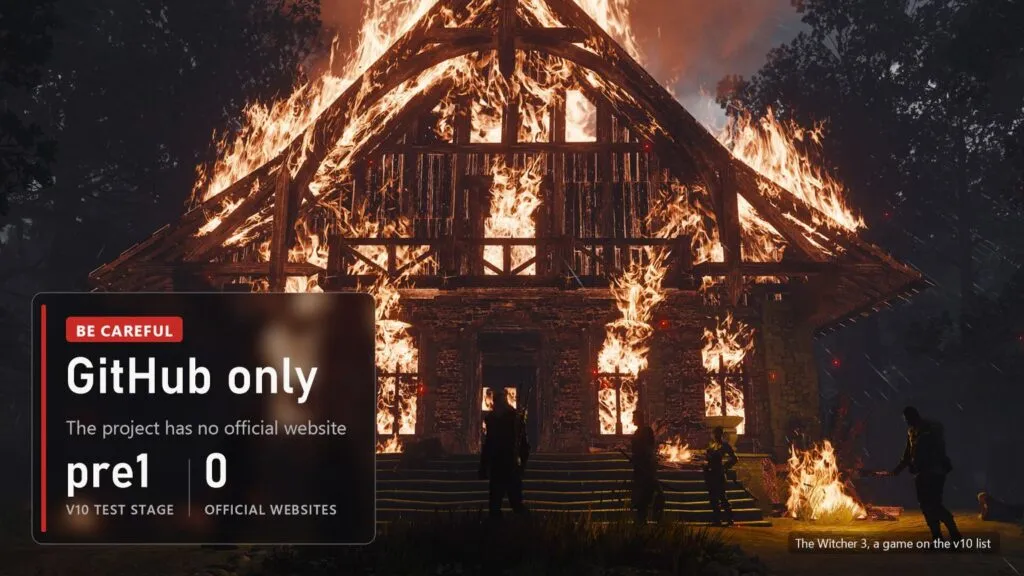
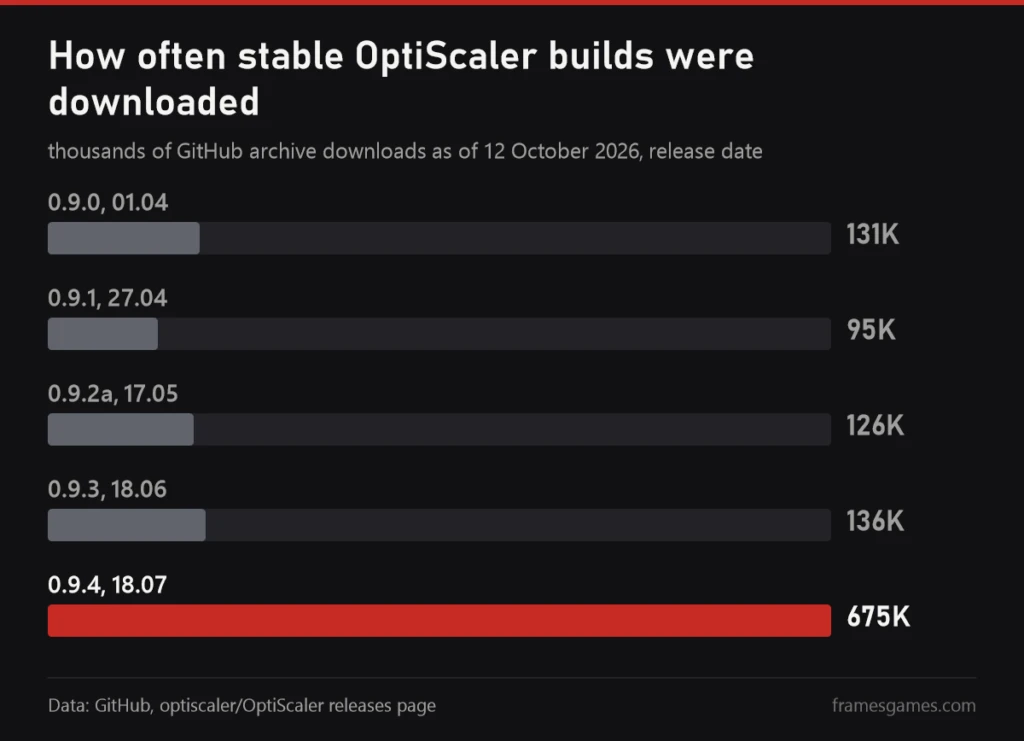
For most people, no. A nightly is the last 24 hours of code with no release testing, and the GitHub issues already include reports of things that worked on 0.9 breaking on v10, Indiana Jones and the Great Circle on an RX 9060 XT for one. The 1 November build has 3,900 downloads, so it's mostly people willing to file reports. Stable 0.9.4 is up to 826,762, and for regular play it does the job.
If you want to try it anyway, only take builds from the optiscaler/OptiScaler-nightly repository. The third-party builders on GitHub that compile v10 from source themselves aren't team repositories, and nobody checks what's inside their archives. Don't mix up the programs either: OptiScaler Client, which reached 1.0.8 in October, is made by an independent developer and is an install manager, not the mod itself. We covered how to use it in our OptiScaler Client guide. And as with any OptiScaler version, keep it away from games with anti-cheat.
When v10 goes stable, we'll update our guide on how to add DLSS and FSR 4 to any game and write up separately what changes in practice.

Update log
- 25 November 2026. Still no v10 and no new stable release; the latest nightly is from 24 November. Changes from 21 to 24 November: faster OptiSharpen (one pipeline per preset), a fix for XeLL picking the wrong GPU when ReShade is active, and no more false "missing VK dll" warning when replacing nvngx in Vulkan.
- 21 November 2026. v10 still isn't out, but 0.9.5 from 16 November is the last release of the 0.9 branch. Added what changed from 2 to 20 November: neural sharpening, XeSS inputs in Unreal Engine games, Unity frame generation settings, fixes.
- 2 November 2026. v10 still isn't out, the latest nightly is from 2 November. Added what changed from 15 October to 2 November: FSR 4 in Vulkan, FSR 4 on GTX 10 and RX 5500 cards, custom upscalers, Dynamic MFG for XeFG. Updated the download counts.
- 15 October 2026. v10 still isn't out. Added the section on frame generation in Vulkan (commits from 12 to 14 October) and updated the download counts.
- 12 October 2026. First version: stable 0.9.4, v10 in nightly builds only.
Sources
OptiScaler releases on GitHub, version 0.9.4 from 18.07.2026 and the fake websites warning. Work-in-progress v10 changelog, updated 09.09.2026. OptiScaler nightly builds, latest 11.10.2026. Main branch commits from 10 and 11.10.2026. Issue #1118 on Indiana Jones and the Great Circle with v10. PlayingTux on OptiScaler Client 1.0.8. Download counts from GitHub as of 12.10.2026. The Witcher 3: Wild Hunt and A Plague Tale: Requiem screenshots from the games' Steam pages.
Update of 15 October 2026: OptiScaler main branch commits from 12 to 15 October (DLSSG input and FSR-FG output in Vulkan, OptiFG for Vulkan, DLSSG output in Vulkan, 32-bit builds dropped), the 15 October nightly build, download counts as of 15 October. Indiana Jones and the Great Circle screenshot from the game's Steam page.
Update of 2 November 2026: OptiScaler main branch commits from 15 October to 2 November (live FSR 4 model switching on 19.10, FSR 4 and FSR4-FG in Vulkan on 20.10, FFX SDK 2.4 and custom upscalers on 28.10, Pascal support and RDNA1 INT8 checks on 31.10, with pull request #1266), AMD FSR SDK 2.4.0 release notes from 28.10.2026, nightly builds and download counts as of 2 November.
Update of 21 November 2026: OptiScaler 0.9.5 release notes (16.11.2026), main branch commits from 2 to 20 November, nightly build and downloads as of 20-21 November.
Read next