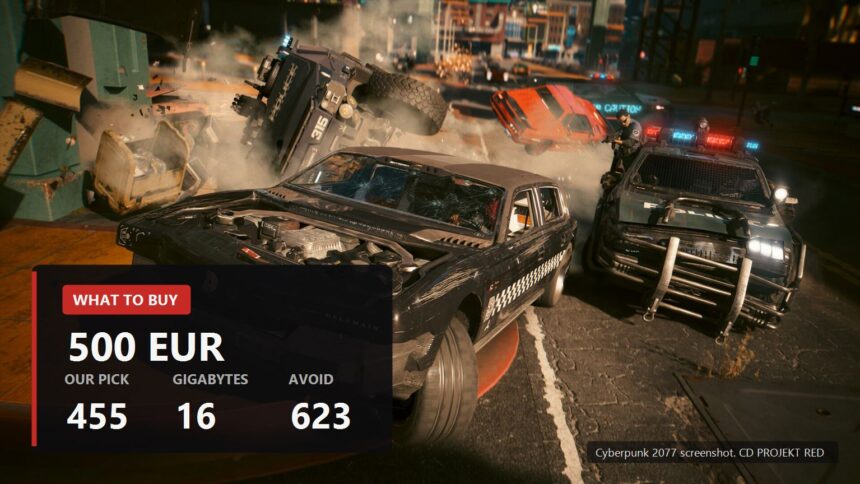
Short answer: for five hundred euro in Europe right now you buy the Radeon RX 9060 XT with 16 GB, which starts at 455. If five hundred is out of reach, the RTX 5060 at 355 or the same 9060 XT in its 8 GB version at 370. What you should not buy is the RTX 5060 Ti 16 GB at 623 euro, and the numbers below show why.
First, the thing that annoys me about these prices. The RTX 5070 launched at 549 dollars. In Germany it sells for 690 euro. The RTX 5070 Ti turns 749 dollars into 1037 euro. Twenty percent of VAT does not explain a gap like that, and it means something practical: any review that judges a card by its launch price is useless to a European buyer. What matters is the number on the shelf.
What one frame costs
Everyone can see the price, everyone can find the frame rates, and almost nobody publishes the ratio between them. We divide the lowest European price by the average frame rate in a test suite and get a number that compares cards honestly. Lower is better.

Look at the cluster between 5.90 and 6.00 euro per frame: Arc B580, RX 9060 XT 8 GB, RTX 5060 and RTX 5060 Ti 8 GB sit on top of each other, and the spread between them is rounding noise. Then the field opens up. The 16 GB 9060 XT costs more per frame because the second batch of memory adds 85 euro. And the RTX 5060 Ti 16 GB flies off to 8.49, the worst number in the whole table.
| Card | Price, euro | FPS 1080p | FPS 1440p | Euro per frame, 1440p |
|---|---|---|---|---|
| Intel Arc B570 10 GB | 249 | 63.5 | 44.3 | 5.62 |
| Radeon RX 7600 8 GB | 289 | 69.9 | 45.4 | 6.37 |
| GeForce RTX 5050 8 GB | 299 | 69.3 | 45.2 | 6.62 |
| Intel Arc B580 12 GB | 299 | 71.5 | 50.7 | 5.90 |
| GeForce RTX 5060 8 GB | 355 | 88.5 | 59.8 | 5.94 |
| Radeon RX 9060 XT 8 GB | 370 | 93.2 | 62.5 | 5.92 |
| GeForce RTX 5060 Ti 8 GB | 409 | 100.4 | 68.6 | 5.96 |
| Radeon RX 9060 XT 16 GB | 455 | 98.3 | 67.3 | 6.76 |
| Radeon RX 9070 GRE 16 GB | 539 | 120.6 | 86.6 | 6.22 |
| GeForce RTX 5060 Ti 16 GB | 623 | 105.2 | 73.4 | 8.49 |
Radeon RX 9060 XT 16 GB, 455 euro

This is the case where I recommend a card not because it wins the table, but because it will not let you down in a year. On euro per frame the 16 GB 9060 XT loses to its own little brother, no argument there. But 98 frames at 1080p and 67 at 1440p is exactly the level where memory starts to matter more than the chip does.
- 16 GB of GDDR6. Enough for high resolution textures in 2026 games and for mods.
- 150 W on AMD's own spec sheet. One eight pin connector, an ordinary case, nothing exotic about the power side.
- The gap to the 8 GB version. 85 euro. Not pocket change, but not the kind of money worth saving by deliberately buying a card that is already short on memory.
When 500 is too much: 355 or 370 euro

The RTX 5060 at 355 and the 8 GB RX 9060 XT at 370 sit next to each other and perform almost the same: 88 frames against 93 at 1080p. The Radeon is slightly faster and slightly dearer, five percent either way. If you have a 1080p monitor and no plans to load texture packs the size of a small game, either one settles the question for a couple of years.
One detail buying guides rarely mention. The RTX 5060 connects over PCIe 5.0 in x8 mode, which is right there on the spec sheet. On a recent board that changes nothing. On a motherboard with PCIe 3.0 the card gets half the lanes it wants, and part of the performance stays in the bus. Worth checking before you upgrade only the graphics card in an older machine.
Eight gigabytes: where it stops working

The cleanest way to see the problem is to take the same card in two versions. The RTX 5060 Ti exists with 8 and with 16 GB, same chip, memory is the only difference.
At 1080p the gap is five percent, which is the spread you get between two brands of the same card. At 1440p, seven percent. At 4K those same 8 GB give 28 frames against 40, and that is forty three percent apart on identical silicon. The memory ran out and the card started pulling textures across the bus from system RAM.
Nobody plays 4K on these cards, you will say, and you are right. But 4K works as a time machine here: it shows what happens at 1440p in a year or two, when games get hungrier. That is why I say pay for the 16 GB, not because the number looks nicer.
What not to buy at this money

This section usually goes missing, because it gets in the way of selling. We have no affiliate links, so here it is.
- RTX 5060 Ti 16 GB at 623 euro. The RX 9070 GRE sells for 539 with the same 16 GB and 86.6 frames at 1440p against 73.4. Cheaper by 84 euro and eighteen percent faster. I cannot find a sane reason to buy the 5060 Ti 16 GB at this price.
- RTX 3060 12 GB at 379 euro. A 2021 card doing 61.5 frames at 1080p. The new RX 9060 XT costs 370 and does 93.2.
- RTX 3070 at 409 euro. 87.2 frames, eight gigabytes and a warranty that has most likely expired. The RTX 5060 Ti does 100.4 for the same money.
- RTX 4060 Ti 8 GB at 489 euro. 88 frames at a price where a 16 GB card is sitting on the next shelf.
The rule is simple: European retail is currently full of 2020 and 2021 cards priced like new hardware. Shops need the shelf space, and a familiar number in the name still looks respectable on a product page. Check frames per euro, not the generation.
What the card costs to run for a year
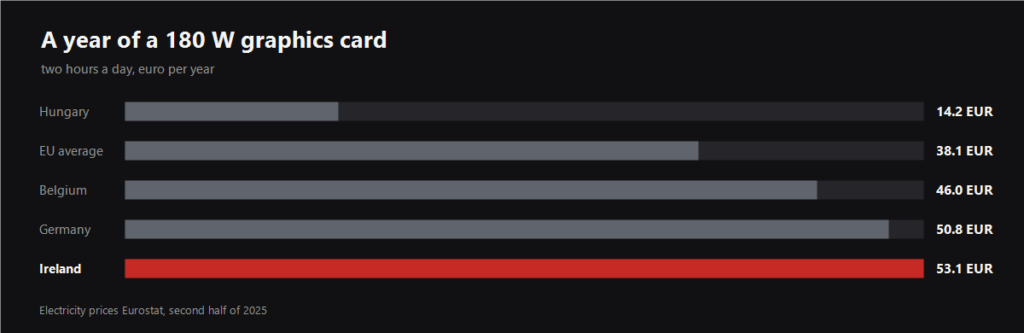
I expected more dramatic numbers here, so let us do the honest arithmetic. Between the 145 W RTX 5060 and the 180 W RTX 5060 Ti there are 35 watts. At two hours of gaming a day that is 25 kilowatt hours a year, and at the EU average of 0.2896 euro per kilowatt hour it comes to 7 euro 40 cents. Per year.
At this power level electricity is not an argument, and if someone sells you a card on efficiency in this class, they are selling you air. A 50 euro difference in the purchase price takes about seven years to pay back in power.
The interesting part is elsewhere: the same 180 W card costs 14 euro a year to run in Hungary and 53 in Ireland. Almost a fourfold spread across Europe, and that one does change how much you should care about performance per watt.
The verdict
Buy the RX 9060 XT 16 GB at 455 euro if the budget allows. Buy the RTX 5060 at 355 or the 8 GB 9060 XT at 370 if it does not, and do not lose sleep: for 1080p that is plenty. If you can wait and add a little, the RX 9070 GRE at 539 has the best frames per euro at 1440p in the whole table, and it is the only card above our budget where I will say the extra money makes sense.
Prices are captured on the first of each month. This table is from 30 August 2026 and gets refreshed in a month.
Sources
Prices: Geizhals graphics card listing, lowest offer per model on 30 August 2026, VAT included, shipping excluded.
Frame rates: Tom's Hardware GPU Benchmarks Hierarchy, average FPS across their test suite at the ultra preset, 1080p, 1440p and 4K.
Board power and power connectors: Geizhals product pages carrying NVIDIA and AMD specifications.
Electricity prices: Eurostat electricity price statistics, household consumers, second half of 2025. EU average 0.2896 euro per kilowatt hour.