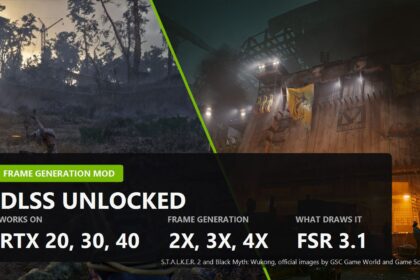
On 29 August we wrote that DLSS 5 could not be downloaded and that every comparison online was a fake. That was true when we wrote it. A day later it stopped being true: the library leaked, and over the weekend it was forced into a dozen and a half games, into DirectX 9 relics, and then into a PlayStation 2 emulator.
Officially DLSS 5 still has not shipped. This autumn, RTX 50 only. What is happening now has nothing to do with that release, and the results people are getting range from "not bad" to "the monitor lost signal after ten seconds". Both halves are worth going through.
What leaked and how it happened

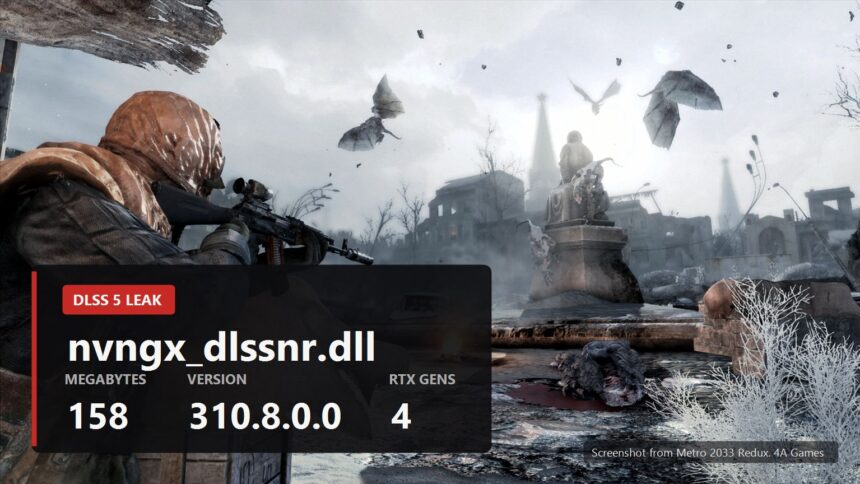
NBA 2K27 is to blame. Its early access build shipped with a file called nvngx_dlssnr.dll, 158 megabytes, identified as NVIDIA DLSSNR 310.8.0.0. NR stands for Neural Rendering, the thing NVIDIA showed at GTC in March that fills in light and materials rather than upscaling a finished frame.
The game itself has no DLSS 5 controls at all, the library was simply sitting in a folder. Modders pulled it out within hours and got it running in Control first. After that it snowballed: Cyberpunk 2077, GTA V, Skyrim, Final Fantasy VII Rebirth, GTA San Andreas. By Monday the count was past a dozen.
Worth noting that it stopped being only about games almost immediately. GitHub now has a filter for DaVinci Resolve, a node for ComfyUI and a Unity wrapper, all built on the same library.
How they got it into games that never had DLSS

The mechanism deserves an explanation, because it also explains every problem that follows.
The DLSS 5 neural add-on can only hook a game's own DLSS calls. A game without DLSS never makes those calls, so the add-on sits idle. A project called DLSS5-Feeder solves that with some nerve: it makes the calls itself. It assembles a synthetic DLSS request in DLAA mode out of whatever ReShade already has, runs a real evaluate, and writes the neural result back into the frame.
- The image is the frame ReShade is processing anyway.
- The depth buffer is also there in ReShade, ordinary effects like ambient occlusion already use it.
- Motion vectors do not exist. They are estimated from the picture itself with optical flow.
That third point is the root of everything. In a normal DLSS game the engine hands over motion vectors, because it knows exactly where every pixel moved between frames. Here they are guessed from two neighbouring images. It works, it is not accurate, and in fast motion you see it straight away.
To his credit the author dresses up none of this. The project description says plainly that it is beta software, to expect ghosting in fast motion and softness on thin moving geometry, and that the HUD gets processed along with the scene because there are no developer-supplied masks to work from.
There is one failure in the history of this project I enjoy more than the rest. Up to version 0.5.2 the recommended motion vector provider did not compile on ReShade 6.8 because of a shader error. ReShade cheerfully listed the technique as enabled, so nothing looked wrong. People spent a week running neural rendering on zero motion vectors and discussing the image quality.
PlayStation 2 and other emulators
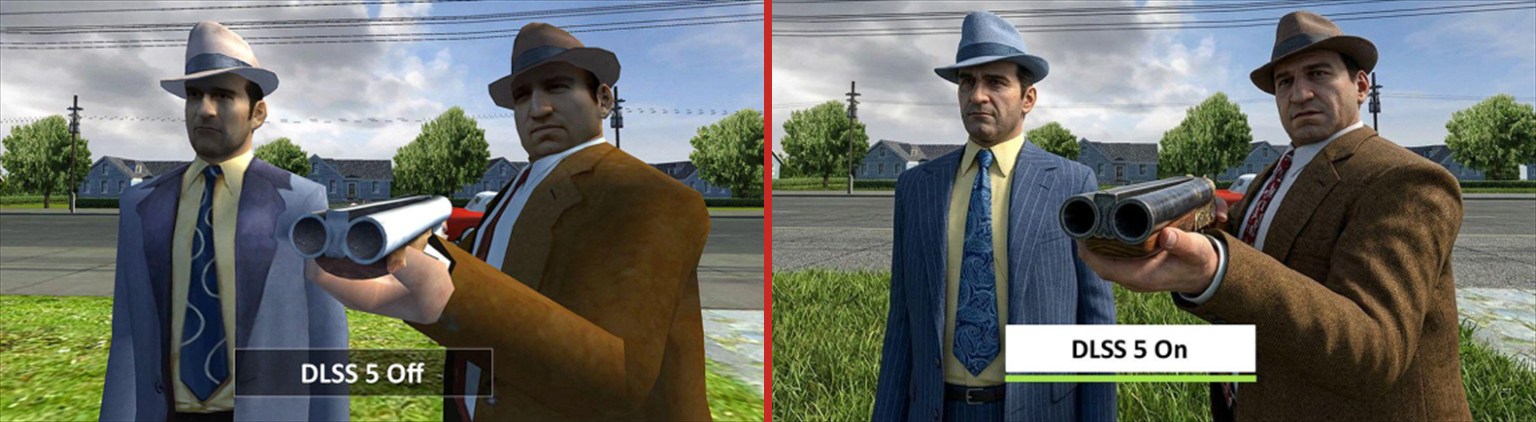
Since the method does not care where the frame came from as long as ReShade can attach to it, emulators were a matter of time. The time turned out to be a day and a half.
On 30 August an X user going by DystopianSunset posted a shot of Manhunt running in PCSX2 with DLSS 5 neural rendering on, captioned "well, DLSS 5 can work with emulators too now". A day later a Brazilian streamer known as HORAPLAY did the same, having apparently been waiting for it since March by his own older posts.
Technically there is no magic: PCSX2 is an ordinary DirectX or Vulkan window and ReShade attaches to it like it would to any game. In quality terms, though, an emulator is the worst case available, and it is worth saying why.
A PlayStation 2 frame is first stretched by the emulator from its internal resolution, picking up rasterisation artefacts of that era, dithering and interlacing on the way. Then optical flow tries to guess motion on top of that. The errors do not cancel out, they stack. The screenshot can still come out striking, because a still frame has no ghosting and no judder in it, and screenshots are exactly what everyone posts.
Where it turned out well
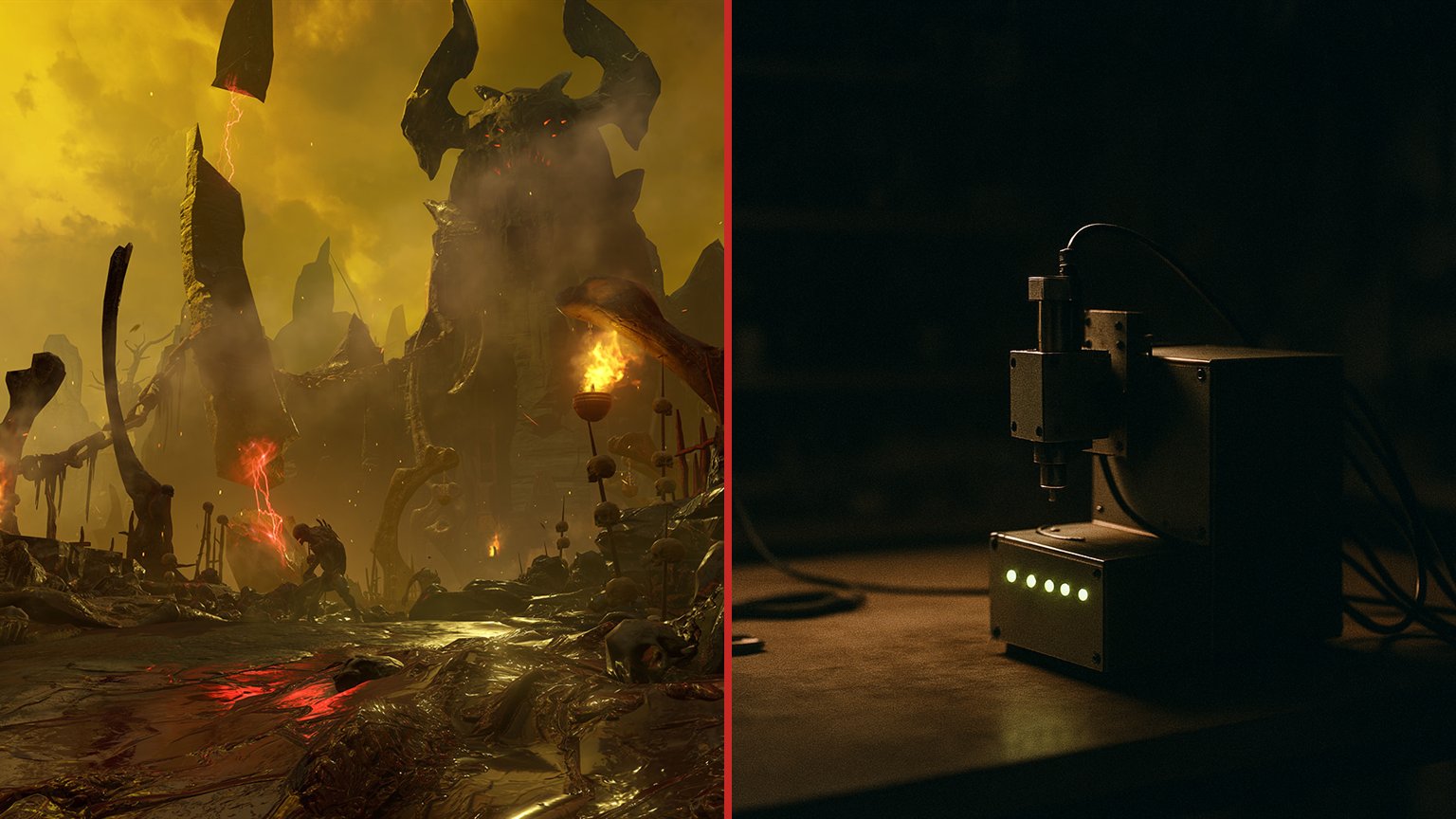
The project's own table lists seven games the author tested personally, one for each way of hooking in. That is not marketing, it is a report on what actually ran.
| Game | Bitness and API | Result |
|---|---|---|
| Metro 2033 Redux | 64-bit, D3D11 | 4K, DLAA plus neural rendering, HDR |
| The Lord of the Rings: War in the North | 64-bit, D3D12 | 4K, 120 fps |
| Splinter Cell: Blacklist | 32-bit, D3D11 | 60 fps through a separate 64-bit process |
| BioShock Remastered | 32-bit, D3D9 wrapped into D3D11 | 4K, HDR |
| Fable Anniversary | 32-bit, DirectX 9 via dgVoodoo2 | 1440p, 60 fps |
| DOOM 2016 | 64-bit, Vulkan | 4K, through cross-API interop with D3D12 |
| Worms Ultimate Mayhem | 32-bit, OpenGL | 4K, 0.13 ms per frame |
Fable Anniversary is the entry that says the most. A 2014 DirectX 9 game, running through a third party compatibility layer, gets neural rendering from a technology that has not officially shipped and is supposed to need a 2025 graphics card. Absurd, and it works.
Among the big titles it goes down most quietly where the studio was already chasing photorealism: Red Dead Redemption, Cyberpunk 2077, modern role playing games with detailed faces. The effect there is subtle, because the network has something to emphasise rather than something to replace.
A note on old cards. The community moved the build from FP8 to FP16 and it started running on RTX 20 and RTX 30. The logic is simple: only Blackwell accelerates FP8, everything handles FP16, and for Turing and Ampere that is the only way to compute anything at all. Owners of 30 series cards report respectable speed.
Where it turned out badly
The list of failures is just as long, and it is more honest than any of the enthusiasm.
- GTA V. Ran for roughly ten seconds, then the monitor lost signal entirely.
- Red Dead Redemption 2. Did not start at all, while the first game works.
- Hogwarts Legacy. Got stuck in a standby state and never activated the feature.
- Control. Runs, but on an RTX 5070 Ti at 4K that is 71 fps without neural rendering and 35 with it. Exactly half.
- Multiplayer games. The whole method rests on loading foreign libraries into the game process, which is what bans are handed out for. Nobody sane takes this into a competitive shooter.
The most interesting category of failure is not technical though. Skyrim and GTA San Andreas both start fine, which is precisely why they generate the most argument.
In Skyrim, 2011 faces become sharply more detailed and photoreal. The complaint is not that anything got harder to see, it is that the characters end up looking like different people. San Andreas has it worse: the washed out, hazy image is the game, and the network reworks the lighting and sharpens CJ's face into something you would rather unsee. The internet has already coined "yassification filter" for it, and some people put it more bluntly.
To me the argument keeps swapping out its subject. The technology does exactly what was promised, on games nobody tuned it for. The complaint is not with DLSS 5, it is with the idea of stretching photorealism over an art direction from twenty years ago. Being able to do something and being obliged to do it are different things.
What NVIDIA says, and why we are not linking to the file
The official position has not moved: autumn 2026, RTX 50 only at launch, no announced support for the 40 series. Riding the wave of clips full of mangled faces, Jensen Huang answered that the critics are "completely wrong", that DLSS 5 is under the game developer's direct control and that it is not generative AI.
Formally he is right, and that matters. In the shipping version the studio switches neural rendering on, tunes it for its own game and decides what it applies to. Everything you are looking at right now is an unfinished library torn out of somebody else's build and run with not one setting from a developer. Judging the finished technology by it makes about as much sense as judging a graphics card by a beta driver.
The file itself remains NVIDIA property and reached the internet through a publisher's mistake. There will be no links to it here and no installation instructions, the same as there were none for the stolen GTA 6 clips or the Valve archive. If you want to improve your image legally today, we have a breakdown of every working way to get DLSS, including games that never shipped with it.
And here is the genuinely funny part. In four days enthusiasts have run an unfinished technology across four generations of graphics cards, on DirectX 9, Vulkan and OpenGL, in 32-bit games and inside a PlayStation 2 emulator. NVIDIA plans to release it this autumn for RTX 50 alone. The conversation about who gets it is now going to happen with those screenshots on the table.
Sources
The leak of nvngx_dlssnr.dll from the NBA 2K27 early access build, its 158 megabyte size and NVIDIA DLSSNR 310.8.0.0 version string, and it running in Control within hours: reporting by TweakTown, Wccftech and XDA on 29 and 30 August 2026. The failures in GTA V, Red Dead Redemption 2 and Hogwarts Legacy, developer ShortFuse's builds for older cards and the move to FP16 for RTX 20 and RTX 30: TechPowerUp. The drop from 71 to 35 fps in Control on an RTX 5070 Ti at 4K: a measurement by a RenoDX modder. How DLSS5-Feeder works, the table of seven tested games, the ReShade requirements, motion vectors estimated by optical flow and the author's own warnings about ghosting, the HUD and the broken motion vector provider on ReShade 6.8: the project's official description on GitHub. Manhunt running in PCSX2: a post by the X user DystopianSunset on 30 August 2026, repeated by the streamer HORAPLAY on 31 August. DLSS 5 release timing, RTX 50 support at launch and Jensen Huang's words: statements from NVIDIA. We do not publish links to the leaked library or instructions for installing it.