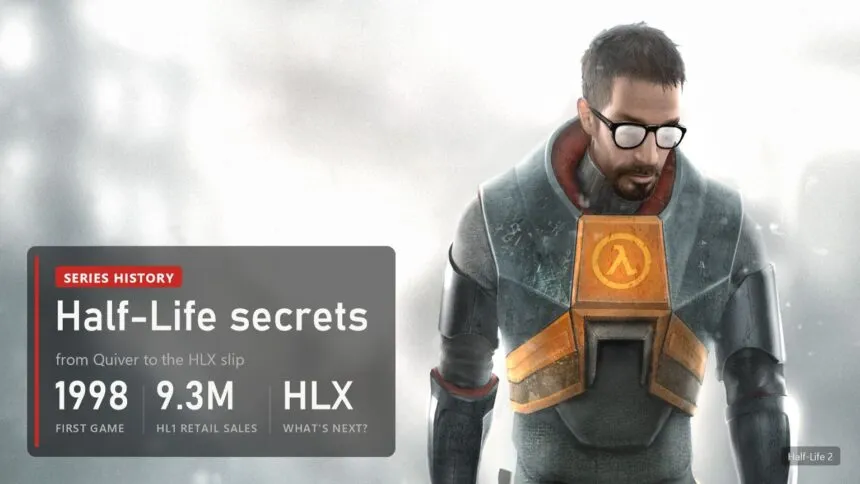
This is Half-Life from the inside, from a 1997 project codenamed Quiver to a Valve composer's HLX slip at a conference on October 21, 2026. It's what the developers themselves have said in the Raising the Bar book, in Valve's two anniversary documentaries and in interviews: how the first game was thrown away when nearly finished, who came up with the name Gordon Freeman, how Half-Life 2's source code was stolen, and why Episode Three never shipped.
- HLX: what we know as of October 2026, and the rumors that missed
- Half-Life, 1998: Quiver, Stephen King's The Mist, and a game that got thrown out
- Gordon, Barney and the G-Man: Ivan the Space Biker, a name from a car ride and a lizard voice
- Opposing Force and Blue Shift: Gearbox brought its own idea
- Half-Life 2, 2004: Prague, Jerusalem, and a plane cut after 9/11
- The Vivendi war and the stolen source code: Valve on the brink
- Episode Three: an ice gun, the Borealis and "my personal failure"
- Half-Life: Alyx, 2020: a "daunting" Half-Life 3 and a way out of limbo
- Black Mesa: a fan remake Valve itself let onto Steam
- Every Half-Life game: year, developer and score
- Where to start with Half-Life in 2026
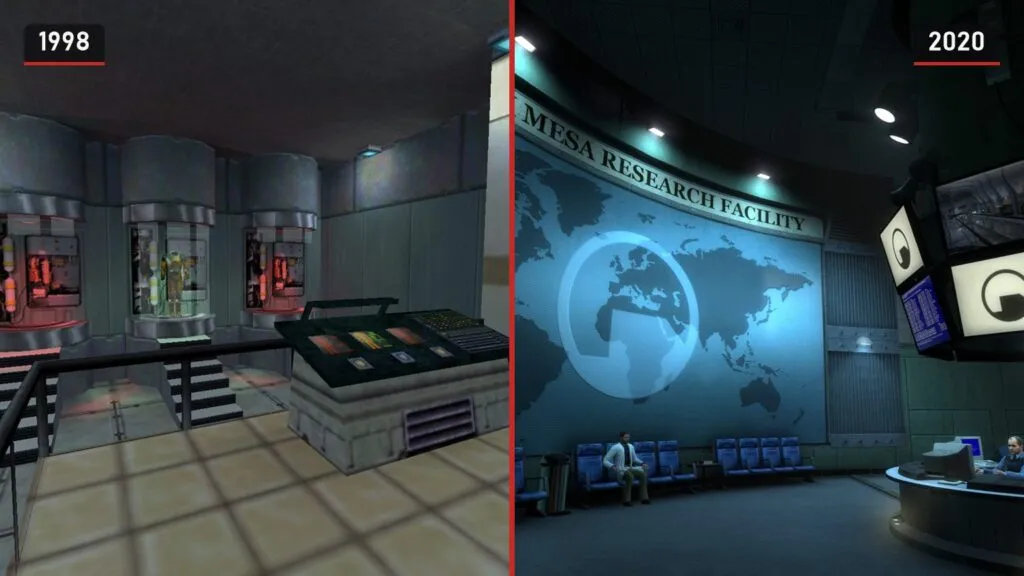
The reason to revisit it is fresh. On a GameSoundCon panel, Valve composer Mike Morasky was explaining audio in Source 2 and said: "Deadlock has their own version of HDR. HLX has its own version". Fans believe HLX is the next Half-Life. The colleague next to him whispered "nice work" on the spot and, according to PC Gamer, added at the end of the panel: "Good job, you only said HLX once".
HLX: what we know as of October 2026, and the rumors that missed
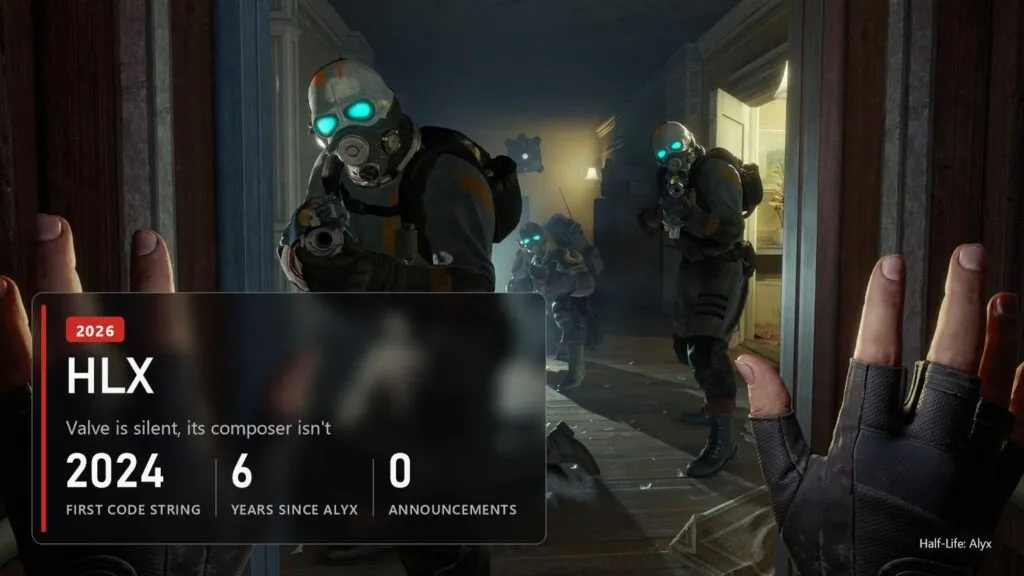
Valve has announced nothing. All there is are strings in code and insider claims, and they show how easy it is to get this wrong. We covered Morasky's slip itself; here's the short timeline:
- February 2024. The string hlx first turned up in a Counter-Strike 2 update, next to the codename Citadel, which became Deadlock. Dataminer Gabe Follower compared HLX to HLVR, Alyx's working title.
- 2025. Rumors of a game playable from start to finish, and expected reveals in summer, then in November alongside Valve's hardware, then at The Game Awards. None happened.
- 2026. The Steam Machine in June and the Steam Frame headset in September launched without a new Half-Life; the Frame came bundled with 2020's Alyx. And in June a Dota 2 update contained a variable called m_bHackWhyAreYouGuysReadingOurVariableNames, an obvious Valve joke at dataminers' expense.
What makes Morasky's slip interesting is that he talked about HLX as a live Source 2 project with its own audio setup, not a line in old files. It's still not an announcement, and Valve is good at sitting on projects for years and quietly burying them. The rest of this history has plenty of those.
Half-Life, 1998: Quiver, Stephen King's The Mist, and a game that got thrown out
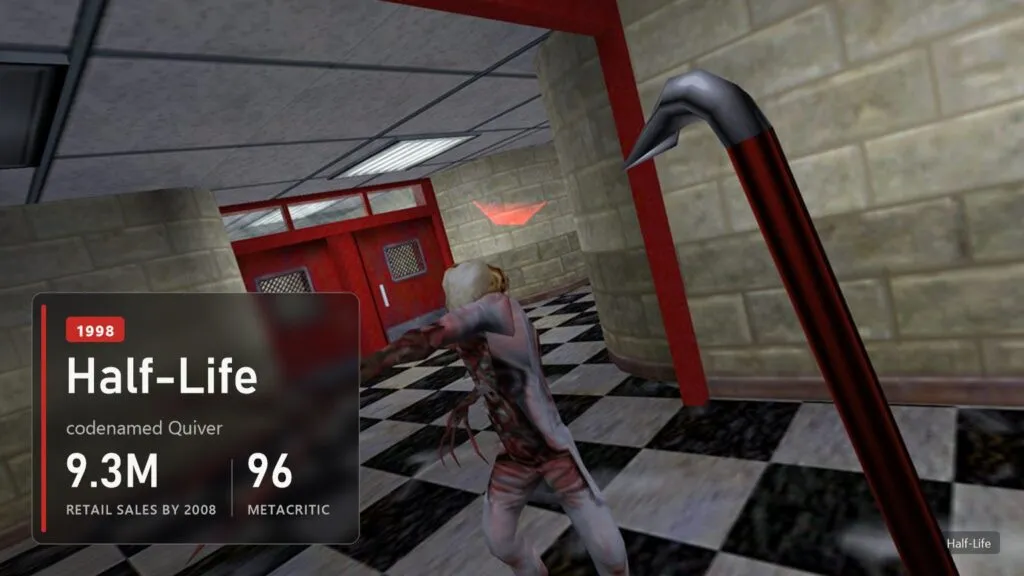
Gabe Newell and Mike Harrington, both ex-Microsoft, founded Valve in 1996. In Valve's 2023 anniversary documentary Harrington recalls getting the Quake source code on the very first day of their meeting at id Software, "without even a contract", thanks to their friendship with programmer Michael Abrash. The working title was Quiver, a reference to the Arrowhead military base in Stephen King's The Mist, where the monsters come from. The official Raising the Bar book from 2004 says so outright.
By late September 1997 the game was nearly done, but as programmer Ken Birdwell wrote for Game Developer, "there was one major problem: the game wasn't any fun". Valve told publisher Sierra it wouldn't ship it and started over. The new version came from "the Cabal": six people, four days a week, six hours a day, for five months. The design document grew past 200 pages and there were over 200 playtests. Newell later summed it up: "Late is just for a little while. Suck is forever."
- Another project gave everything to Half-Life. In parallel there was Prospero, a "literary" game with a librarian heroine. Its resources went into Half-Life, and its ideas about online distribution, a server browser and a friends list later became Steam.
- A build was sold, then leaked. Part of development, veterans say in Valve's film, was funded by selling a three-level early build to a graphics card maker. It leaked the next day.
The game came out on November 19, 1998, scored 96 on Metacritic, and by 2008, according to Valve's last official figures, had sold 9.3 million boxed copies, not counting Steam.
Gordon, Barney and the G-Man: Ivan the Space Biker, a name from a car ride and a lizard voice
 The video loads from YouTube (Google) when you press play. Privacy policy
The first hero model was called Ivan the Space Biker, with a square head because of a hard polygon limit. Artist Chuck Jones asked Harrington what Gordon should look like and was told "draw yourself", hence the ponytail on the first model. Writer Marc Laidlaw proposed Dyson Poincaré, after physicist Freeman Dyson and mathematician Henri Poincaré. It happened in Gabe's car on the way to a Japanese restaurant, and as Laidlaw writes in Raising the Bar: "Gabe immediately countered with the far more reasonable Gordon Freeman, and that was that."
- Barney happened by accident. The guard was meant as an inept enemy. AI programmer Steve Bond made him follow the player to test navigation, and that produced the first companion. Large parts of the story were rewritten in late 1997 as a result.
- G-Man is a working name. Newell pointed to the Cigarette Smoking Man from The X-Files. Actor Mike Shapiro first recorded his lines in a normal voice, then offered a "crazy lizard voice" on request, and the team fell for it.
- The photo in Gordon's locker is of a developer's daughter. It started as an Easter egg in a wrecked office and was later moved to the locker.
Valve's full 25th anniversary film is above; it runs an hour and is worth it.
Opposing Force and Blue Shift: Gearbox brought its own idea
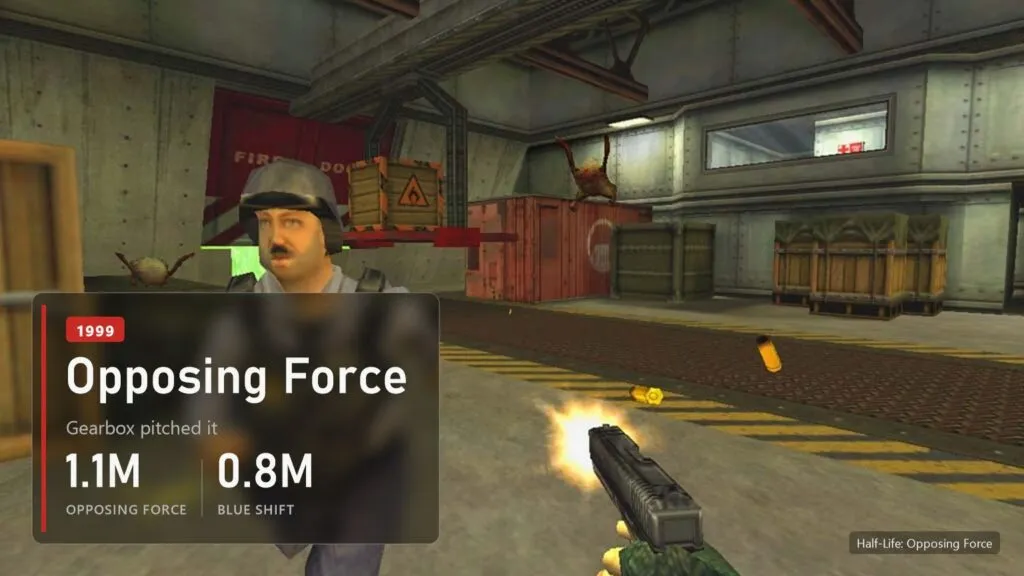
Opposing Force, where you play a soldier, wasn't Valve's idea. Gearbox founder Randy Pitchford said in a 2019 interview that he brought the pitch to Valve himself and then sold it to Sierra, which owned the rights, and that Valve barely interfered. Blue Shift, starring Barney, was conceived as a bonus for the Dreamcast version of Half-Life, but Sierra cancelled that port in summer 2001, days after Blue Shift came out on PC; that part is only backed by secondary sources. By 2008, Valve says, Opposing Force had sold 1.1 million boxed copies and Blue Shift 0.8 million.
Half-Life 2, 2004: Prague, Jerusalem, and a plane cut after 9/11
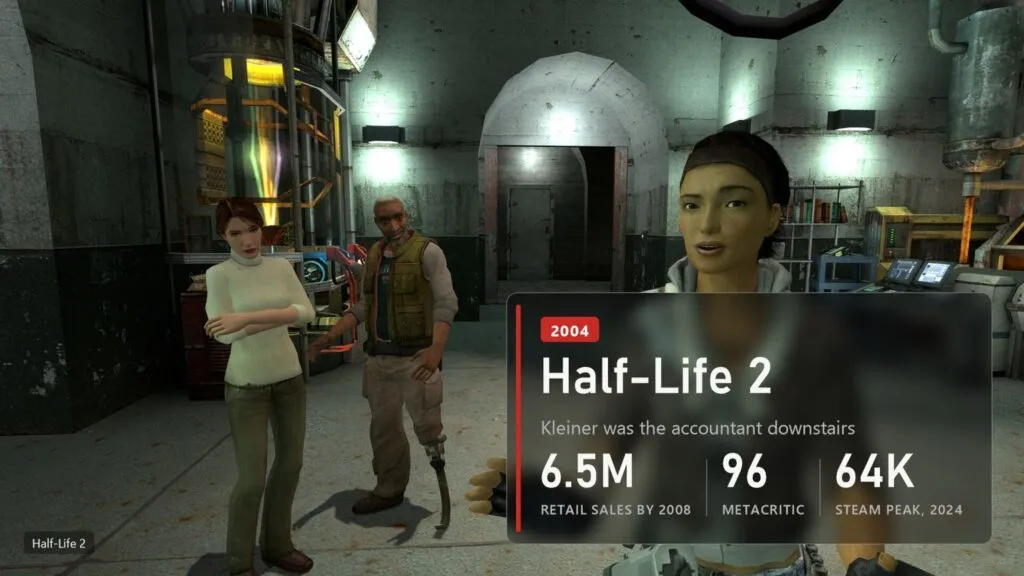
In the 2024 anniversary film, veterans describe a much broader early Half-Life 2. Valve designed several cities, including Prague, Jerusalem and Chicago, an Arctic base, an underwater base, an icebreaker and a scene with a plane flying into a skyscraper, which was cut right after 9/11. There was an Air Exchange level where Earth's atmosphere was being drained, and while it existed Alyx was the daughter of a soldier, Captain Vance. When the level went, she became Eli's daughter.
- Faces from real life. Dr. Kleiner is based on an accountant from the firm downstairs, Eli on a man holding a "need work" sign at a highway exit, and Barney has the face of Valve's COO.
- The gravity gun began as a developer tool. Object masses ran on a scale from a breadbox to a space station, and debug text labeled things like "weighs as much as a racehorse".
- Steam required even for discs. Veterans say Newell made that call personally, a rare exception to how decisions usually got made at Valve.
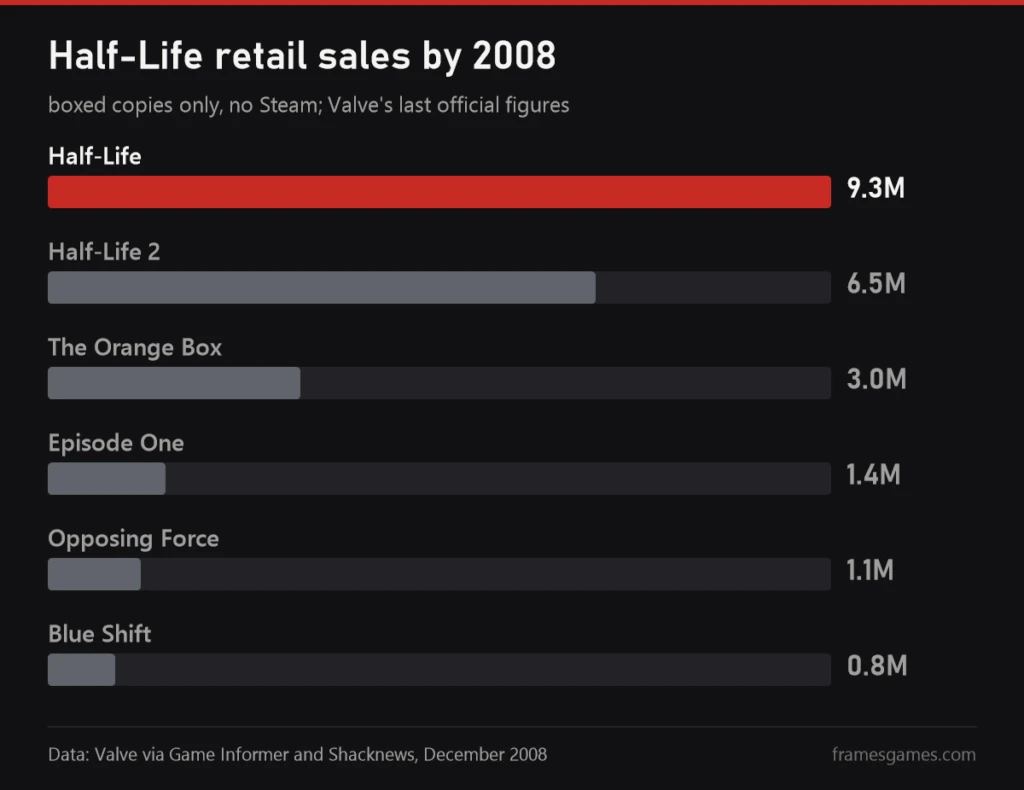
It came out on November 16, 2004, also scoring 96. And in November 2024, when Valve gave it away for three days for the 20th anniversary, Half-Life 2 set its own Steam record: 64,085 concurrent players, per SteamDB as reported by VGC.
The Vivendi war and the stolen source code: Valve on the brink
 The video loads from YouTube (Google) when you press play. Privacy policy
The most surprising part of the Half-Life 2 anniversary film isn't about the game, it's about a lawsuit. Publisher Vivendi was selling Counter-Strike licenses to Asian internet cafés, Valve filed a narrow suit, and Vivendi, in the veterans' words, "decided to start World War Three": Newell and COO Scott Lynch were named personally along with their wives. Gabe was ready to sell his house. What kept the studio going was a deal for "Counter-Strike 2", and Newell forged a knife with that name on it by hand to celebrate. "We're really kinda running on fumes at that point," Lynch recalls.
Then in 2003 Half-Life 2's source code was stolen. According to Eurogamer's 2011 account, German hacker Axel Gembe got into Valve's network through a third-party server and a "build" account with a blank password. On October 2, 2003 Newell posted on a forum: "I need the assistance of the community". In February 2004 Gembe emailed Gabe asking for a job; Valve and the FBI set up a fake interview to arrest him in the US, but German police picked him up at home on May 7, 2004. He got a two-year suspended sentence.
Episode Three: an ice gun, the Borealis and "my personal failure"
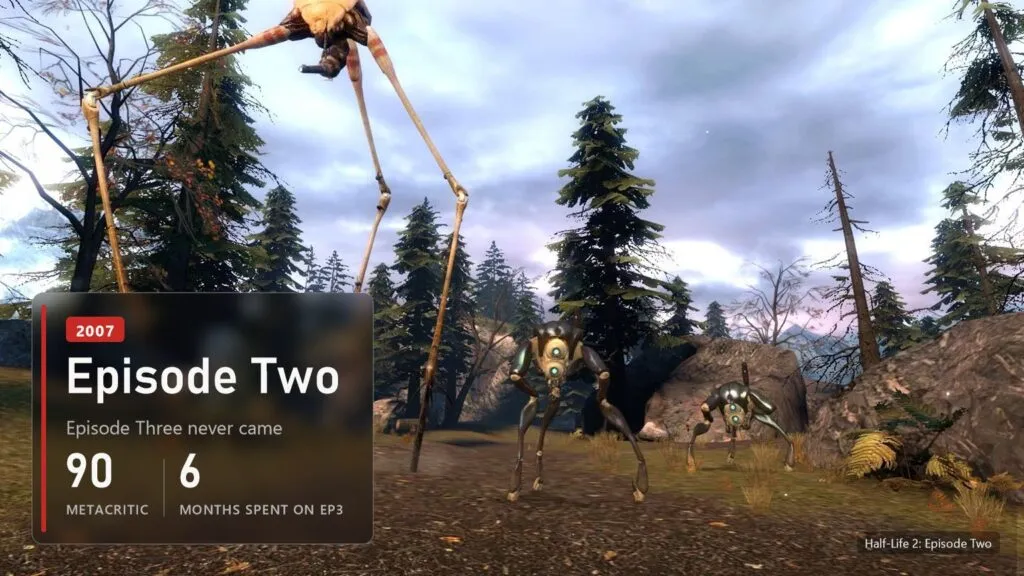
The episodes came out in 2006 and 2007, with Episode Two scoring 90. Valve's film showed Episode Three for the first time: an Arctic setting around the missing ship Borealis, an ice gun that built walls and ledges you could run along, and a blob enemy made of isosurfaces whose tech later became Portal 2's gels. The team worked on it for about six months, and then, in David Speyrer's words, "we put down episode 3 to go help Left 4 Dead". They never got back to it.
Newell called it his own mistake in the same film: "My personal failure was being stumped. I couldn't figure out why doing Episode 3 was pushing anything forward." In 2013-2014, according to The Final Hours of Half-Life: Alyx, there was another Half-Life 3 with procedural sections between scripted story beats in the spirit of Left 4 Dead, stopped because Source 2 wasn't ready. One more detail from Laidlaw: the singing vortigaunt's cough is a recording of Gabe "when he was in his Tuvan throat singing phase".
- Lamarr in space. A writer wanted to end Episode Two by launching the headcrab Lamarr into space "so everyone would cry". Gabe thought it wasn't a great idea.
- Epistle 3. In August 2017, after leaving Valve, Laidlaw posted a retelling of the third episode's plot on his site with the names flipped: Alyx became Alex, the Borealis became Hyperborea. In 2023 he told Rock Paper Shotgun "I was deranged", and that it caused problems for former colleagues.
Half-Life: Alyx, 2020: a "daunting" Half-Life 3 and a way out of limbo
 The video loads from YouTube (Google) when you press play. Privacy policy
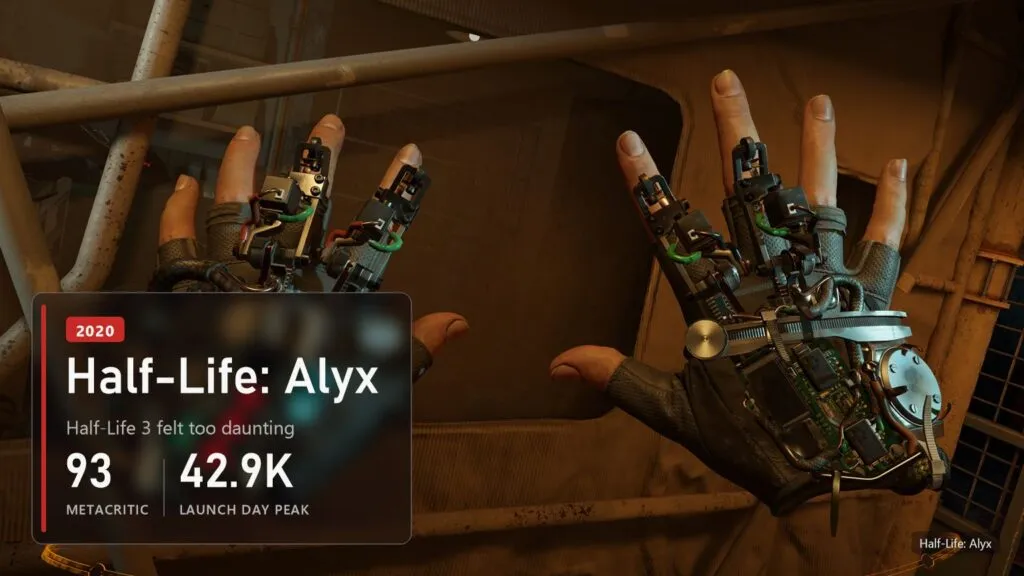
Why a VR game came instead of Half-Life 3, Robin Walker explained to Geoff Keighley in 2019: in 2016 Half-Life 3 was a "terrifyingly daunting prospect", and VR gave them a way to believe they could pull it off. Alyx came out on March 23, 2020, scored 93 and drew about 43,000 concurrent players on launch day, a record for a VR game on Steam at the time. The ending, Walker said, was designed to get fans out of the "narrative limbo" the series had been in since 2007.
Black Mesa: a fan remake Valve itself let onto Steam
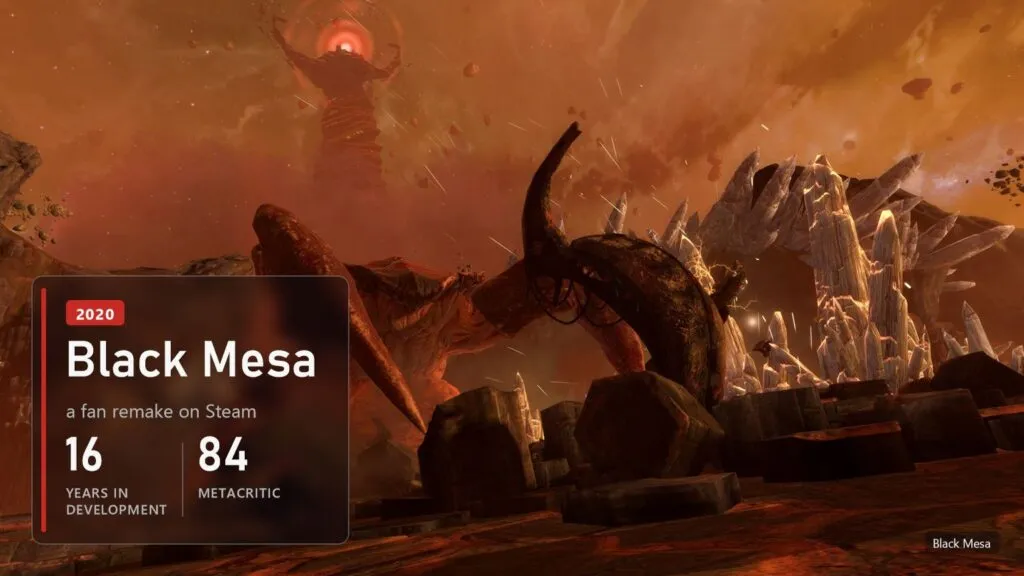
Black Mesa began in 2004 as two fan mods that later merged. In Noclip's 2022 documentary the Crowbar Collective team says Valve asked for a beta around 2010, and after Greenlight offered to let them sell it commercially. The full version arrived in March 2020, 16 years after work began, and the rebuilt Xen alone took as long as the rest of the game. Metacritic: 84.
Every Half-Life game: year, developer and score
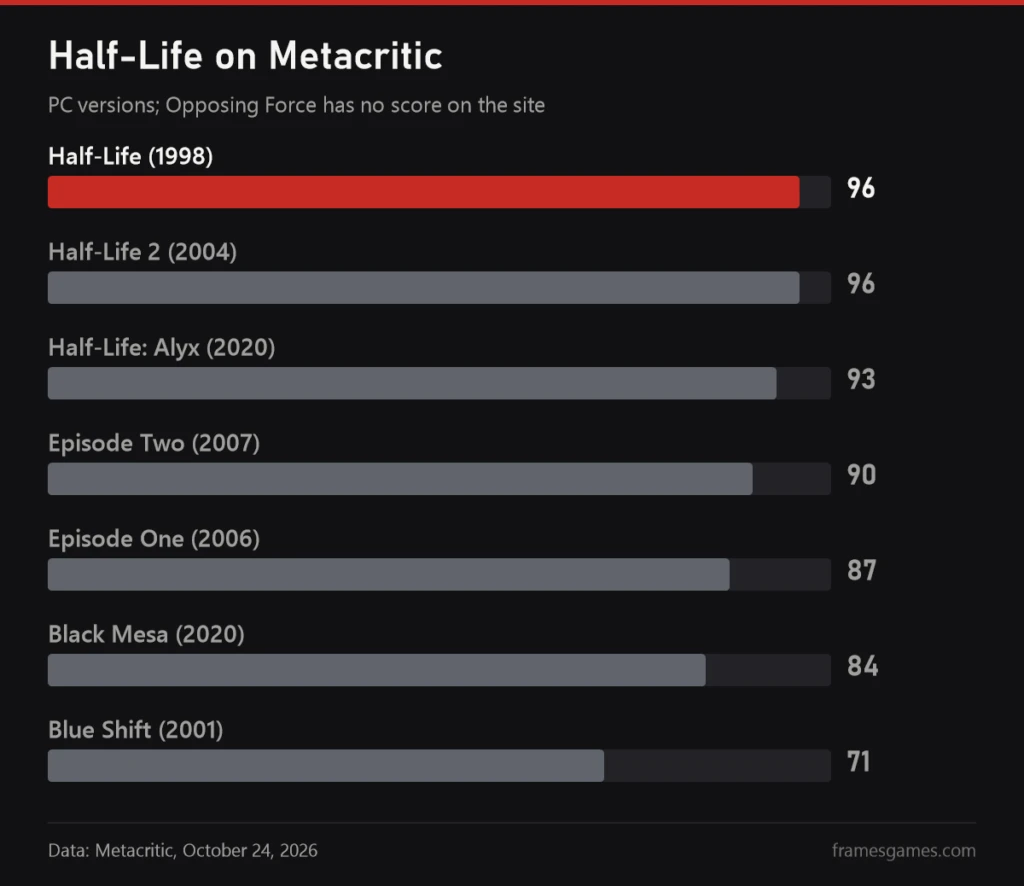
| Year | Game | Developer | Metacritic | Steam price |
|---|---|---|---|---|
| 1998 | Half-Life | Valve | 96 | $9.99 |
| 1999 | Opposing Force | Gearbox | none | $4.99 |
| 2001 | Blue Shift | Gearbox | 71 | $4.99 |
| 2004 | Half-Life 2 | Valve | 96 | $9.99 including episodes |
| 2006 | Half-Life 2: Episode One | Valve | 87 | included in Half-Life 2 |
| 2007 | Half-Life 2: Episode Two | Valve | 90 | included in Half-Life 2 |
| 2020 | Black Mesa | Crowbar Collective | 84 | $19.99 |
| 2020 | Half-Life: Alyx | Valve | 93 | $59.99, VR headset required |
| ? | HLX | Valve | not announced | n/a |
Where to start with Half-Life in 2026
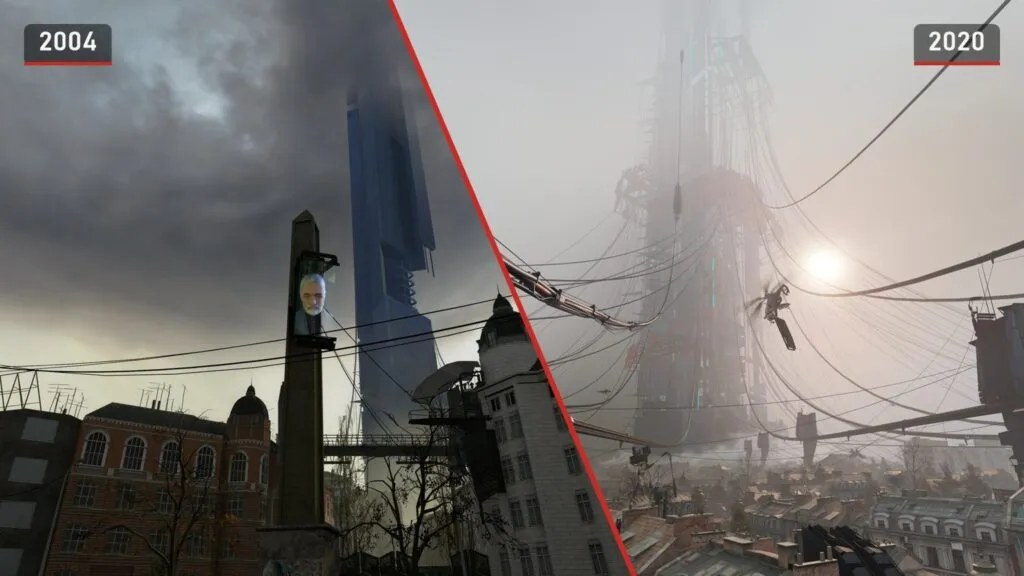
The easiest start is Black Mesa: it's the first game on a modern engine, and easier to get into than the 1998 original. Then Half-Life 2, which since 2024 comes with both episodes for $9.99. Save Alyx for last, and only if you have a VR headset: without Half-Life 2's ending, its finale loses half its meaning. Opposing Force and Blue Shift are for when you want more, at $4.99 each.

What is HLX, and is it Half-Life 3?
HLX is the internal name of a Valve project that has turned up in its games' code since February 2024 and was said out loud by studio composer Mike Morasky on October 21, 2026. Nobody has officially confirmed it's Half-Life 3, and Valve hasn't announced it.
Why did Valve cancel Half-Life 2: Episode Three?
The team worked on it for about six months, was moved to Left 4 Dead, and never came back. Gabe Newell called it his personal failure in the 2024 documentary: he couldn't see what the third episode would push forward.
Where does the name Gordon Freeman come from?
Writer Marc Laidlaw suggested Dyson Poincaré, after Freeman Dyson and Henri Poincaré. Gabe Newell immediately countered with Gordon Freeman, and it stuck. The first hero model was called Ivan the Space Biker.
What order should I play Half-Life in?
Half-Life or Black Mesa, then Half-Life 2 with Episodes One and Two, then Half-Life: Alyx. Opposing Force and Blue Shift run alongside the first game and are optional.
Sources
HLX: PC Gamer, October 22, 2026 (GameSoundCon panel), February 9, 2024 (the first string in Counter-Strike 2), September 1, 2026 (Steam Frame); VGC, May 5, 2025 and November 18, 2024 (Half-Life 2 record); Wccftech, June 22, 2026; DSOGaming and TheGamer (the 2025 reveals that didn't happen).
History: Valve's films "Half-Life: 25th Anniversary Documentary" (November 17, 2023) and "Half-Life 2: 20th Anniversary Documentary" (November 15, 2024); the book Raising the Bar (Prima, 2004); Ken Birdwell, "The Cabal: Valve's Design Process for Creating Half-Life", Game Developer, December 10, 1999; Valve sales via Game Informer and Shacknews, December 2008; Randy Pitchford, Habr interview, June 11, 2019; Simon Parkin, "The boy who stole Half-Life 2", Eurogamer, February 21, 2011; PC Gamer and VGC on the 2024 film; The Final Hours of Half-Life: Alyx via PC Gamer; Marc Laidlaw, Rock Paper Shotgun, March 1, 2023; Robin Walker interviewed by Geoff Keighley, November 21, 2019, and TheGamer, 2021; Road to VR (Alyx peak); Noclip, "Black Mesa: The 16 Year Project", 2022. Scores: Metacritic as of October 24, 2026. Prices: Steam, US. Images: official screenshots and art from Steam. Videos: the official Valve channel.