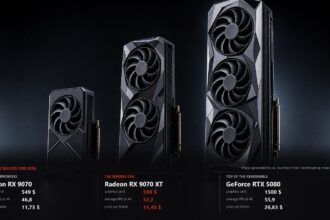

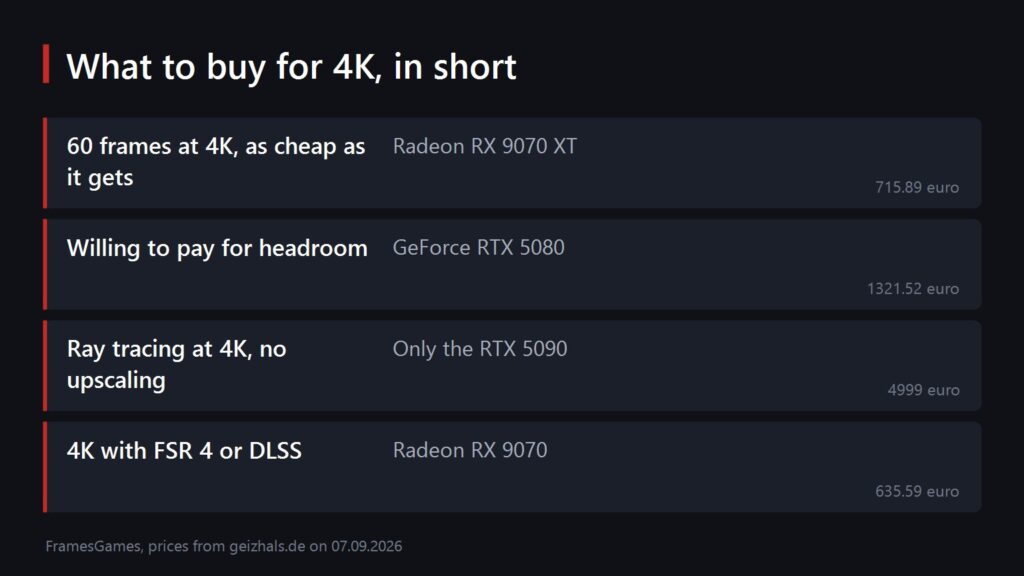
The short answer for 7 September 2026: for 4K you buy the Radeon RX 9070 XT at 715.89 euro. It delivers 65.8 frames at 4K ultra with no upscaler, and its frame is the cheapest in the whole set at 10.88 euro. If you want headroom, the GeForce RTX 5080 at 1321.52. The RTX 5090 I am not recommending at all this time, and below I will explain what happened to it.
A word about the 4K threshold itself. Sixty frames without an upscaler is cleared by exactly two cards under eight hundred euro, and both are AMD. Everything else in that budget either falls short or costs as much as two of them.
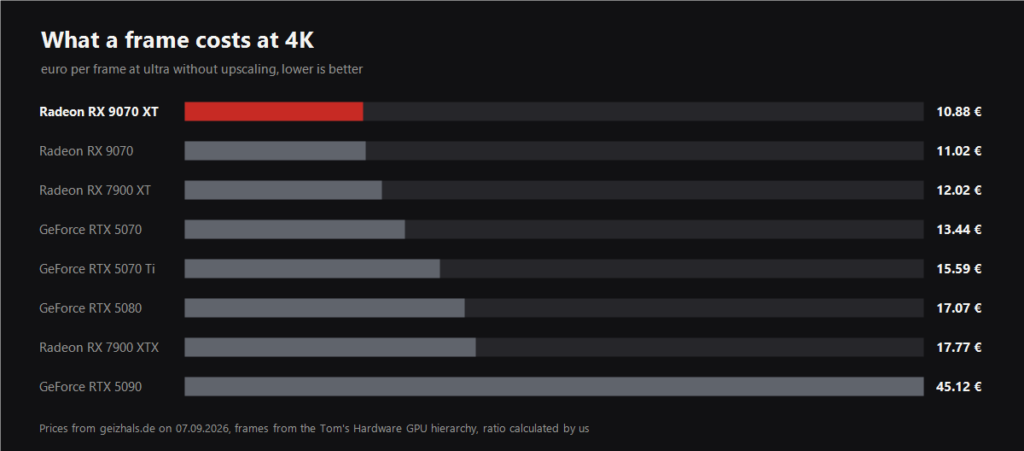
Prices and frames as of today
Prices were taken on 7 September 2026 from geizhals.de, the lowest offer per model, VAT included, shipping excluded. Frames are the averages across the Tom's Hardware test suite at the ultra preset with no upscalers, their hierarchy last updated on 24 June 2026. Euro per frame we work out ourselves: price divided by the 4K figure.
| Card | Memory | Price, euro | 4K ultra | 4K ray tracing | Euro per frame |
|---|---|---|---|---|---|
| Radeon RX 9070 | 16 GB | 635.59 | 57.7 | 25.8 | 11.02 |
| Radeon RX 9070 XT | 16 GB | 715.89 | 65.8 | 30.1 | 10.88 |
| Radeon RX 7900 XT | 20 GB | 719.00 | 59.8 | 23.1 | 12.02 |
| GeForce RTX 5070 | 12 GB | 729.90 | 54.3 | 22.7 | 13.44 |
| GeForce RTX 5070 Ti | 16 GB | 1069.29 | 68.6 | 36.7 | 15.59 |
| GeForce RTX 5080 | 16 GB | 1321.52 | 77.4 | 42.1 | 17.07 |
| Radeon RX 7900 XTX | 24 GB | 1254.36 | 70.6 | 27.3 | 17.77 |
| GeForce RTX 5090 | 32 GB | 4999.00 | 110.8 | 64.1 | 45.12 |
The important thing in this table does not jump out. Sixty frames at 4K ultra is cleared by the RX 9070 XT, the RX 7900 XT, the RTX 5070 Ti, the RTX 5080, the RX 7900 XTX and the RTX 5090. Of those, exactly two cost under eight hundred euro, and the gap between them is six frames at almost the same price.

Why the RX 9070 XT and not something dearer
Because 715.89 euro buys 65.8 frames at 4K, and the next step up costs six hundred euro more for twelve frames on top.
- 10.88 euro per frame at 4K, the best figure in the set. On the RTX 5080 that same frame costs 17.07, on the RTX 5090 forty five.
- Sixty five frames, not sixty at a stretch. That is an average across a game suite, so heavy scenes will drop lower, but there is margin above the threshold.
- 16 GB of memory. For 4K that is the sensible floor, which is exactly why the RTX 5070 with its twelve sits in the table only for comparison.
- The full RDNA 4 set: the FSR 4 upscaler, frame generation and ray reconstruction. What already supports FSR 4 we keep as a separate list.
Its price neighbour, the RX 7900 XT at 719 euro, looks tempting because of the twenty gigabytes. But it is six frames slower, and in ray tracing it collapses outright: 23.1 against 30.1. Twenty gigabytes at 4K is surplus today, sixteen is enough.
If 716 euro is too much, the step below is the plain RX 9070 at 635.59. At 4K ultra it manages 57.7 frames, so it just misses sixty. With FSR 4 on quality that stops being a problem, but honest sixty without an upscaler it does not reach.
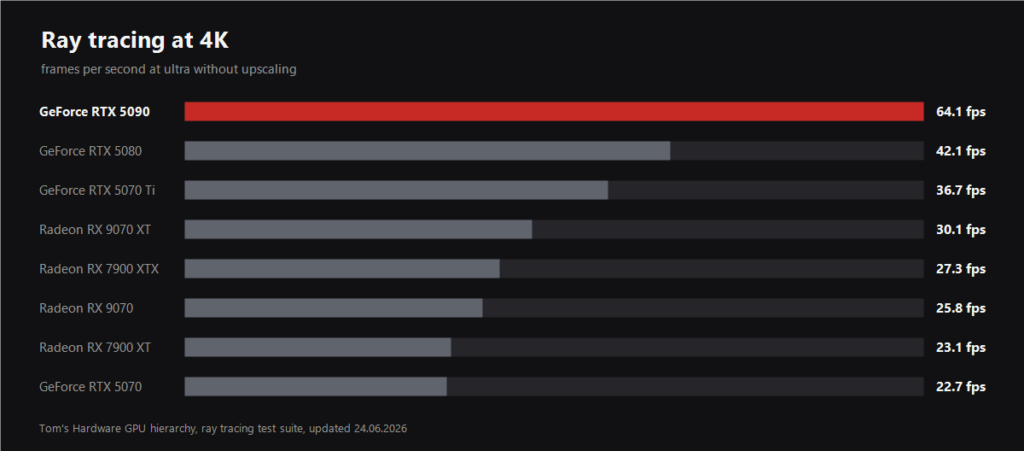
Ray tracing at 4K, and it is bleak
Everything above is rasterisation. Switch ray tracing on at 4K and the picture changes beyond recognition.
Sixty frames at 4K with ray tracing and no upscaler is reached by exactly one card out of eight. That is the RTX 5090 with its 64.1. The RTX 5080 manages 42.1, the RTX 5070 Ti 36.7, the RX 9070 XT only 30.1. On any card under five thousand euro, ray tracing at 4K means an upscaler, and that is arithmetic rather than taste.
From which follows a conclusion plenty of people will dislike. If you are building for ray tracing at 4K, the AMD against NVIDIA argument stops being about percentages: the RTX 5080 has forty two frames against thirty on the RX 9070 XT, which is forty percent more. But forty two is not playable without DLSS either, so you will turn the upscaler on in both cases, and with it the gap partly closes.
My own view is plain. Ray tracing at 4K today is an option for one card at five thousand euro and for everybody else with an upscaler. Paying six hundred euro extra to get forty two frames instead of thirty, when you will be playing through DLSS anyway, makes little sense.
The RTX 5090 at 4999 euro, and what moved in two days
The 5090 needs its own paragraph, because the number looks like a typo. Its official recommended price is 1999 dollars. In German retail on 7 September it sells for 4999 euro, roughly two and a half times the official tag.
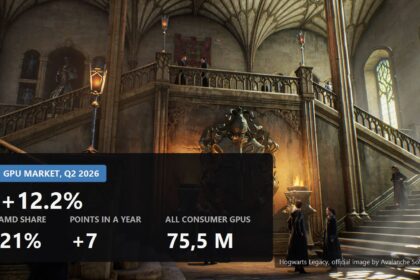
This is not one greedy shop. It is the global memory shortage that is pushing up every component, the same one visible in the Jon Peddie Research report for the second quarter that we went through separately. A card carrying 32 gigabytes of GDDR7 takes that hit harder than anything else.
Now the short distance. Our previous price snapshot was 5 September, for the roundup under a thousand euro. In two days NVIDIA gave a little back: the RTX 5070 Ti fell from 1090 to 1069.29 euro, the RTX 5070 stayed put. AMD moved the other way: the RX 9070 XT dropped from 747 to 715.89, while the plain RX 9070 rose from 627 to 635.59.
Twenty euro here, thirty there, across two days. That is noise rather than a trend, and exactly one conclusion follows: check the price on the day you buy, not a week after an article. The full roundup for the budget under a thousand euro, with the 1440p analysis, sits in the neighbouring piece.
Sources
Frames at 4K ultra and in ray tracing, plus the official recommended prices: the Tom's Hardware GPU hierarchy, updated 24 June 2026.
Retail prices: geizhals.de, lowest offer per model, taken on 7 September 2026.
Market conditions and the memory shortage: the Jon Peddie Research report for the second quarter of 2026.