A developer going by Uzbekunknown has published dlss-nr-on-intel on GitHub: an independent reimplementation of the Neural Rendering pass from DLSS 5 that runs on the integrated Intel Arc 140V graphics of a Lunar Lake system. The repository opened on 12 September 2026 under the Apache 2.0 licence and is still being updated.
There is no Nvidia hardware here, no NGX interface and no CUDA. The network runs on Intel's XMX matrix units through the Vulkan cooperative matrix extension, and the pass is injected at the moment the frame is presented, so it attaches to anything that presents through Vulkan, including Windows games running under Proton.
What it costs in frames
The author does not hide the numbers, he publishes measurements. Below are his own figures from 18 September: this is the full round trip a game waits for, not the graph time alone.
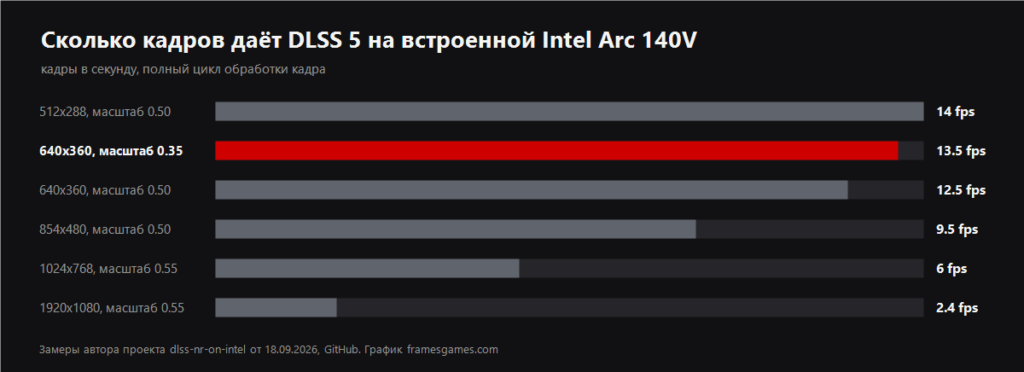
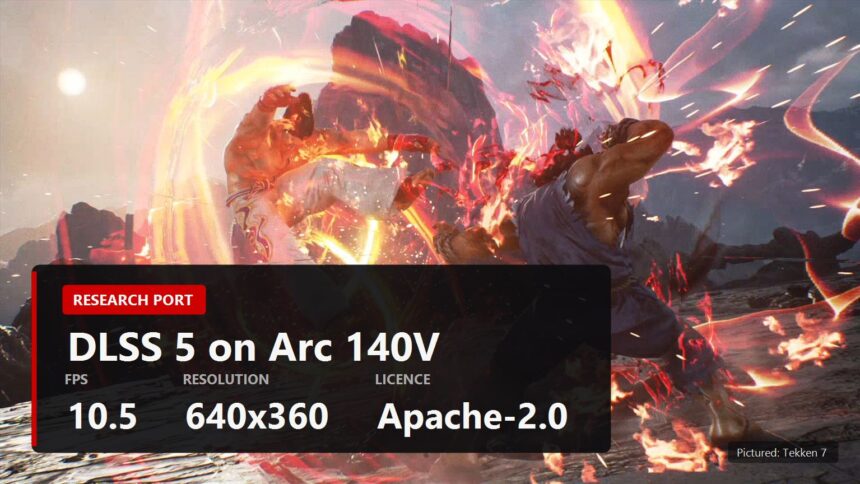
In a live Tekken 7 fight at 640x360 the result was 10.5 frames per second. That is the cost of the pass itself on integrated graphics, and it grows with resolution: at 1080p only 2.4 frames are left. The author states outright that this is a research port rather than a finished product, and advises setting the game small, because the cost follows the frame size more than the render scale.
What it does to the image
Three games with different engines and interfaces were tested: Tekken 7 on Unreal Engine 4 and D3D11, Dead or Alive 5 Last Round on D3D9, and Mortal Kombat 1 on D3D12 through VKD3D-Proton. The results differ. In Tekken 7 and Dead or Alive 5 the character gets darker and gains texture, fabric most of all, while the background is barely touched. In Mortal Kombat 1, where faces are already finely rendered, the small detail actually goes down, and what changes instead is the colour, with the warm filter and the glow on the skin taken out.
One more detail, stated in the repository itself: the write-ups and analysis for the project were produced by a neural network. According to Tom's Hardware, nearly all of the code was written with AI agents too.
There is not much practical use for this port today: ten frames is a photo mode, not a game. The point is elsewhere. A pass that Nvidia keeps on its own hardware and its own libraries was reproduced from the outside, run on somebody else's integrated graphics, and all of the code is public. If you want the down-to-earth version of this topic, adding modern upscalers to games that do not support them, we have a detailed OptiScaler guide.