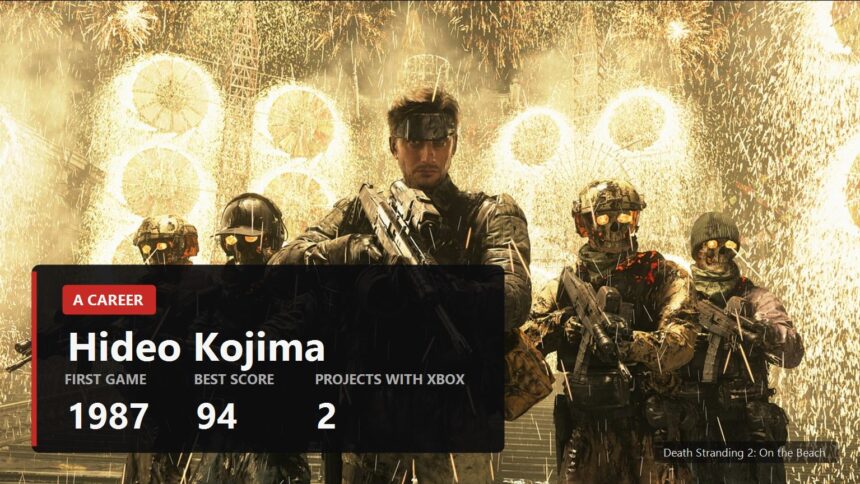
The news that PHYSINT is now published by Xbox rather than Sony read like an ordinary business item at first. Then it struck me that the man in question has spent forty years being stopped from finishing his ideas, and finishes them anyway. So let us walk the whole road of Hideo Kojima, from MSX cassettes to a deal with Microsoft.
One note up front: the dates and scores below were checked against Metacritic and Steam, and anything that reads like an opinion is one.
MSX, where hiding was a budget decision
Kojima joined Konami in 1986 and landed in the wrong job. He wanted to make films and got an eight bit MSX2 computer that could hold a laughably small number of objects on screen at once.
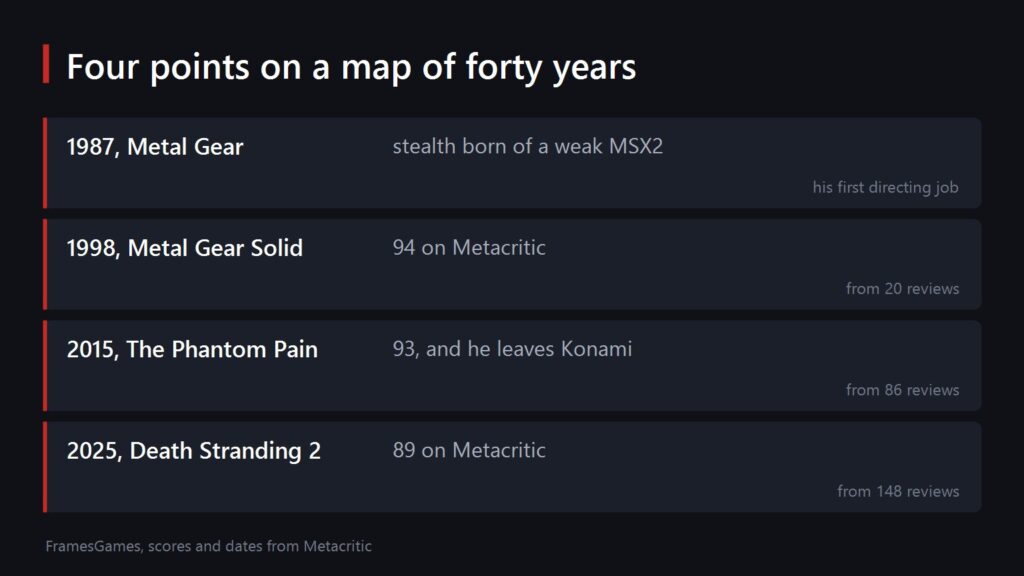
The first Metal Gear, in 1987, came out of that limit. The machine could not run an action game with a crowd of enemies on screen. So the enemies had to be avoided. Stealth was not a genre here, it was a way around the hardware, and that is probably the clearest illustration of how his head works.
Then came two things fewer people know than should. Snatcher in 1988, a cyberpunk detective story built on menus with an open bow to Blade Runner. And Policenauts in 1994, which took the same shape into space. Both are almost devoid of action and full of dialogue measured in tens of hours. The films he was not allowed to shoot, he shot inside games.
PlayStation and the parts that changed everything
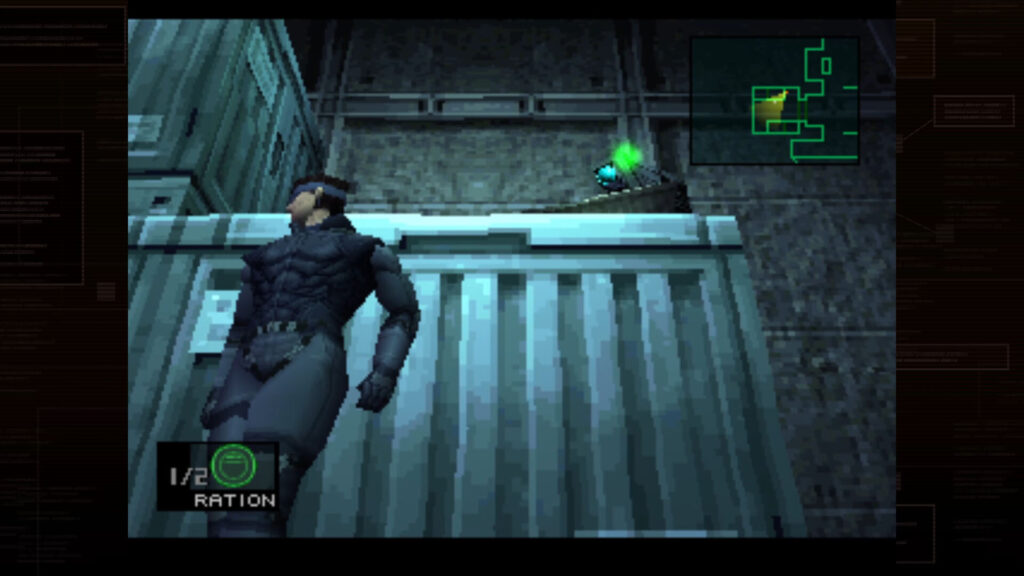
Metal Gear Solid came out on 21 October 1998 and holds 94 on Metacritic. There were only twenty reviews back then, it was a different era, but the score still stands.
That is not the important part. The important part is that the game taught the industry things that now look obvious: long staged scenes, radio conversations instead of text on screen, bosses you cannot beat head on. Psycho Mantis reading your memory card and asking you to move the controller to the other port is still on every list of great moments in games, and nobody has really done it since.
After that came a sequel whose lead was not the man promised in the trailers, a third part about surviving in a jungle with a half hour of silence in a duel against an old sniper, and a fourth that closed the story and in places turned into a film with occasional gameplay. You can argue forever about which is best. I am on the side of the third.
Peace Walker, the best thing on the PSP
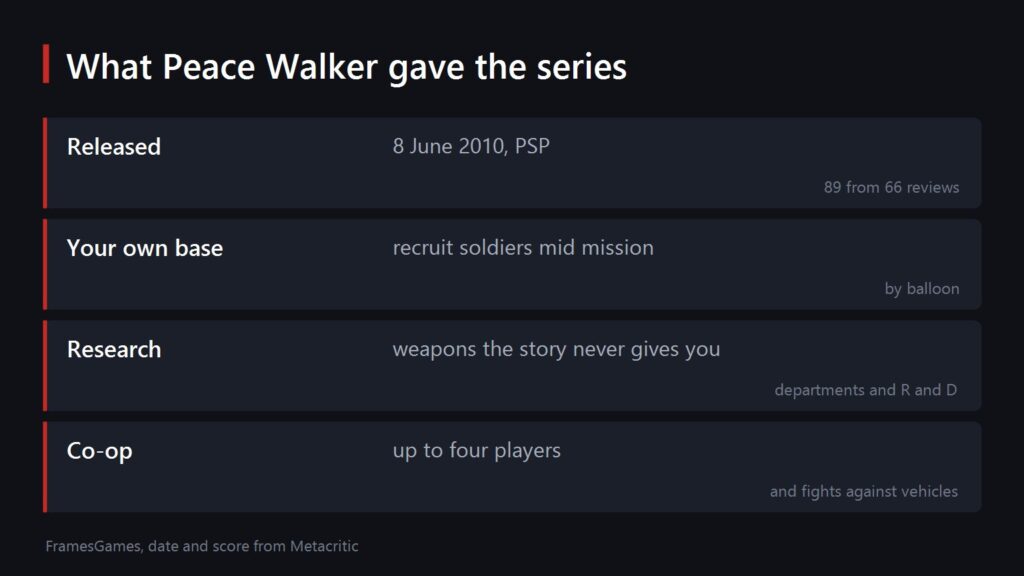
Metal Gear Solid: Peace Walker came out on 8 June 2010 on the PSP and scored 89 from 66 reviews. For a handheld that is not merely high, it is the level of the big releases of its day.
And it earned it. Peace Walker did what nobody expected from a portable entry: it turned the series into a game about running your own base. You recruit soldiers in the middle of a mission, literally sending them into the sky on a balloon, assign them to departments, push research forward and build weapons the story never hands you. Between missions you are not resting, you are managing.
Add four player co-op, separate fights against armour that are brutal alone, and a structure of short missions that fits a commute perfectly. Everything the fifth game would later unfold on big hardware was first assembled here, on a machine with one stick. If I had to pick one underrated Kojima game from the whole list, this is it.
Metal Gear Solid V: 93 points and half a game
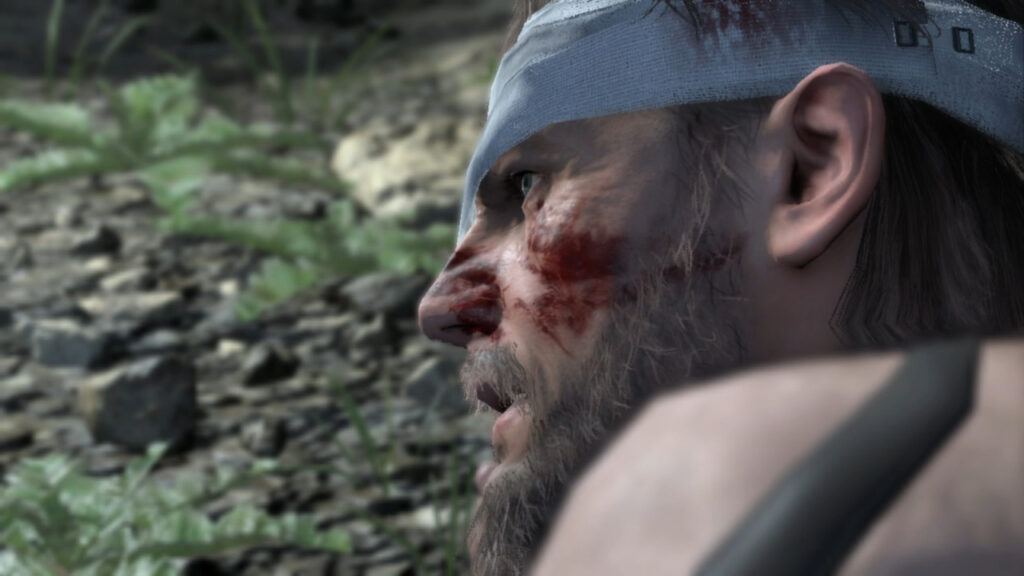
The Phantom Pain arrived on 1 September 2015 and scored 93 from 86 reviews. Mechanically it is still one of the best stealth games that exist: any task can be solved a dozen ways and none of them feels like the wrong one.
Now the fair criticism. The second act is visibly thinner than the first, some of its missions are repeats of earlier ones with added difficulty, and the story breaks off without finishing a thread it started itself. A game where everything is thought through down to the last bullet ends with the feeling that you were handed a draft of the final chapter.
Around the same time Kojima left Konami and in December 2015 founded the independent Kojima Productions. The timing needs no commentary, and I am not going to inflate it either: neither side published details about the reasons. What is left is what you can see in the game, and what you see there is unfinished work.
P.T.: twenty minutes that rewrote a genre
A year before that came the thing whose influence on the industry outweighs almost everything else on this list. On 12 August 2014 a free demo from an unknown developer appeared on the PlayStation 4 store under a two letter name, P.T.
Inside was one short L shaped corridor with a door at the end. You walk it and arrive in the same corridor. And again. And again. Each loop something changes: a crack in the wall, a photograph, a sound from the bathroom, and sometimes nothing changes at all, which is the worst of it. No weapon, no health, no interface. Just you, the corridor, and the knowledge that there is a way out and you do not know it.
At the end it turned out to be a teaser for Silent Hills, made by Kojima and Guillermo del Toro, with a protagonist wearing Norman Reedus's face. Silent Hills was cancelled and P.T. itself was pulled from the store on 29 April 2015, in a way that stopped even people who had already downloaded it from getting it again.
And here is what happened next. Nearly every first person horror game of the past decade grew out of those twenty minutes in one way or another: a closed space instead of a large world, no weapon as a rule, fear built on repetition rather than on a monster in frame. People spent years taking it apart, rebuilding it on PC, and they are still finding meanings in it. A demo you cannot buy turned out to be more influential than most released games.
There is nothing to illustrate this section with, by the way, and that is part of the same story. No official material for P.T. survives, its page was erased, and everything circulating online was captured by players. So straight on to what Kojima did instead.
Death Stranding: a game about carrying boxes
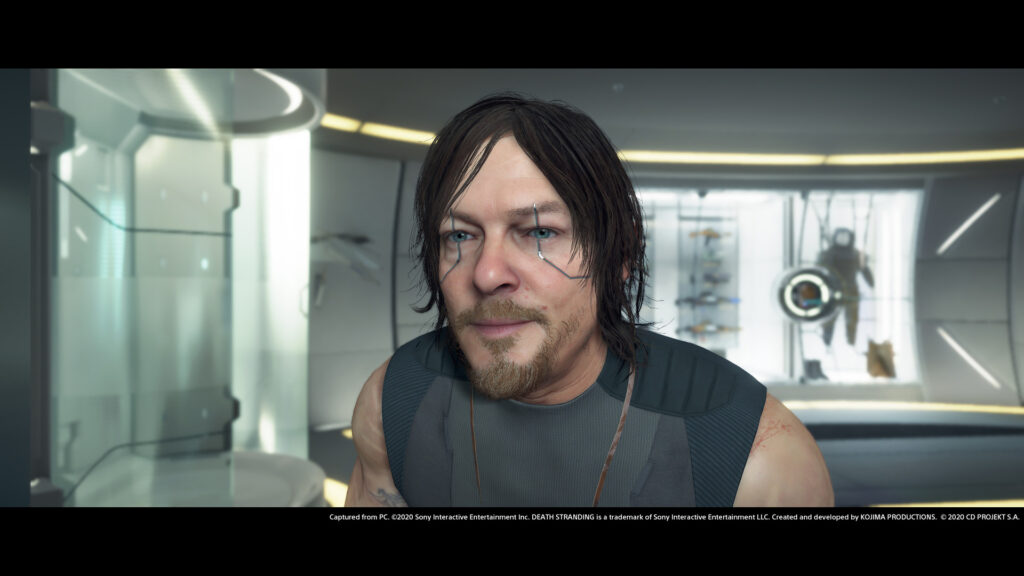
The first Death Stranding came out on 8 November 2019 and gathered 82 from 111 reviews, while the player average came out mixed. This is the rare case where the split is honest: the game really is about carrying cargo from A to B while watching your balance and trying not to fall into a river.
Whoever got into it came out a hundred hours later thinking they had never played anything like it. Whoever did not gave up in the third hour. Arguing is pointless, both positions are earned.
The sequel, On the Beach, arrived on 26 June 2025 on PlayStation 5 and scored 89 from 148 reviews. It reached PC on 19 March 2026, ported by Nixxes.
And here my numbers run out and the personal part begins. Death Stranding 2 is the most beautiful game I have played. Not the most technically advanced, beautiful, and the reason is the light. Morning in a canyon there does not look like a well staged scene, it looks like drone footage over a real gorge. Shadows fall correctly, dust in the air behaves like dust, and when the sun goes behind a rock the whole picture changes rather than the brightness being nudged. I kept catching myself stopping to look, and it has been a very long time since that last happened to me.
What comes next, and where Microsoft fits
The studio currently has two announced projects and both are with Xbox. The horror game OD, about which little is known, and PHYSINT, an action espionage game originally built in partnership with Sony. On 9 September Xbox announced that it will publish PHYSINT, and that the partnership now extends to film and television as well.
What exactly happened on Sony's side has not been stated officially by either company, so we went through the details in a separate news piece, keeping the announcement apart from the reporting around it. Kojima Productions stays independent; this is not an acquisition.
Look at the whole forty year canvas at once and the same line keeps appearing. He was not allowed to make films, so he made stealth on an MSX. Silent Hills was cancelled, and what remained was a demo that changed a genre. He was not allowed to finish the fifth game, so he left and made a game about a courier that people mocked before release. Now his publisher has changed midway, and again he carries on.
I do not know what PHYSINT is, and nobody outside the studio does yet. But going by this list, the thing to worry about is not the game. It is the patience of everyone waiting for it.
Sources
Release dates and average scores: the games' Metacritic pages, checked on 11 September 2026. Metal Gear Solid 21.10.1998, 94 from 20 reviews. Peace Walker 08.06.2010, 89 from 66. The Phantom Pain 01.09.2015, 93 from 86. Death Stranding 08.11.2019, 82 from 111. Death Stranding 2: On the Beach 26.06.2025, 89 from 148.
PC release dates: the games' Steam pages. Death Stranding 14.07.2020, Death Stranding 2: On the Beach 19.03.2026.
P.T.: the demo appeared on the PlayStation 4 store on 12 August 2014 and was removed on 29 April 2015; Silent Hills was in development under Kojima and Guillermo del Toro with Norman Reedus in the lead, and the project was cancelled.
The PHYSINT deal: the Xbox Wire post of 9 September 2026.
Game screenshots: the Steam pages of Metal Gear Solid Master Collection, Metal Gear Solid V: The Phantom Pain, Death Stranding and Death Stranding 2: On the Beach.