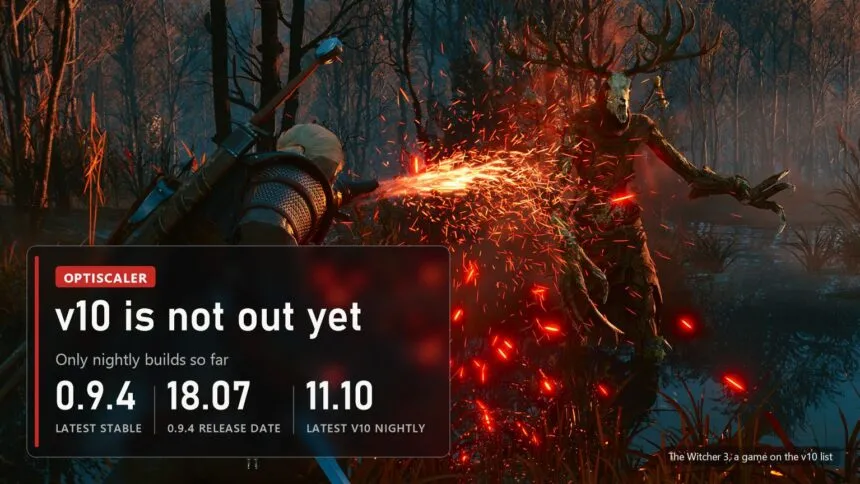
No, OptiScaler v10 isn't out yet. As of 12 October 2026 the latest stable version is 0.9.4, released on 18 July. Version 10 only exists as nightly builds tagged pre1: the team builds them every day in a separate OptiScaler-nightly repository, and the latest one landed on 11 October. The developers haven't given a release date, either in the repository or in the GitHub discussions.
There are a lot of searches for v10 right now, and that's where the trap is. Back in the 0.9.4 notes the OptiScaler team warned that fake websites are posing as the project, and that OptiScaler has no official website at all. Everything genuine lives on GitHub only.
What v10 brings: frame generation in DirectX 11 and FSR4-FG
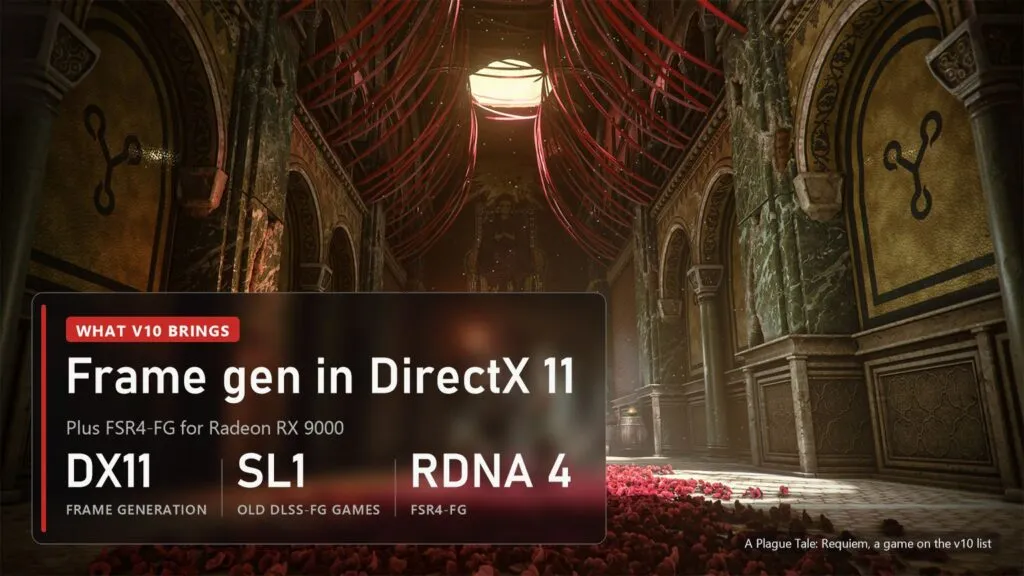
The team keeps the changelog public, last updated on 9 September. The headline items:
- Its own folder. All the upscaler and frame generation files move into an OptiScaler subfolder, so the mod no longer overwrites game files. Only OptiScaler itself, its config and the setup script stay in the root.
- Frame generation in DirectX 11. Only through OptiFG and upscaler inputs for now, with a performance cost from the DX11 to DX12 interop. The authors say there's no HUDFix for DX11 and probably never will be.
- Older DLSS-FG games. Experimental support for the first Streamline, so it hooks The Witcher 3 and A Plague Tale: Requiem properly.
- DLSSG as a frame generation output, plus a new DLSSG via Nvngx mode. Real DLSS-FG still needs an RTX 40 card or newer.
- FSR4-FG on Radeon RX 9000 via a FidelityFX upgrade: on RDNA 4, FSR 3 frame generation gets swapped for FSR 4, other cards keep the old one.
- FSR 4 INT8 on other GPUs through a new system: Fsr4ForceModel=2 in OptiScaler.ini for RDNA 3, NVIDIA and Intel. RX 6000 owners get FSR 4.1.1 without rolling back the driver, using a custom amdxc64.dll.
- Fakenvapi built in. No separate fakenvapi.dll needed. There's also a new menu input system meant to fix the overlay you can't click on, a magnifier for pixel peeping, and issue notifications.
Work happens every day. On 10 and 11 October alone, the main branch got a fix for DLSSG crashing in DirectX 11, a simulation-based frame limiter, a slider for the frame generation ratio, and the option to run Reflex or Anti-Lag 2 alongside XeFG.
Should you install a nightly build?
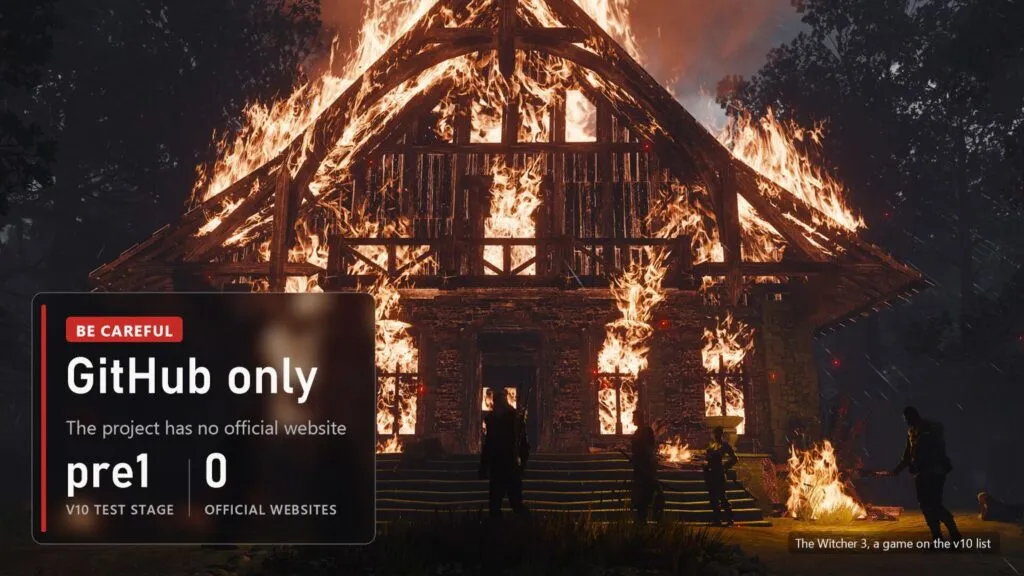
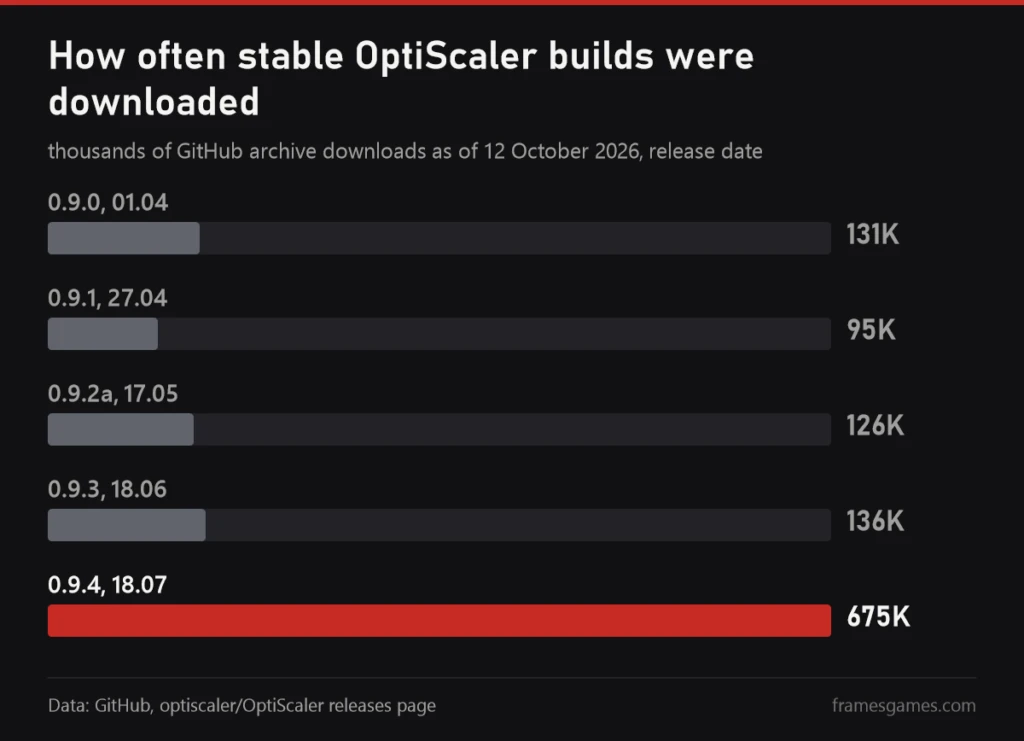
For most people, no. A nightly is the last 24 hours of code with no release testing, and the GitHub issues already include reports of things that worked on 0.9 breaking on v10, Indiana Jones and the Great Circle on an RX 9060 XT for one. The 11 October build has 1,239 downloads, so it's mostly people willing to file reports. Stable 0.9.4 has 674,944, and for regular play it does the job.
If you want to try it anyway, only take builds from the optiscaler/OptiScaler-nightly repository. The third-party builders on GitHub that compile v10 from source themselves aren't team repositories, and nobody checks what's inside their archives. Don't mix up the programs either: OptiScaler Client, which reached 1.0.8 in October, is made by an independent developer and is an install manager, not the mod itself. We covered how to use it in our OptiScaler Client guide. And as with any OptiScaler version, keep it away from games with anti-cheat.
When v10 goes stable, we'll update our guide on how to add DLSS and FSR 4 to any game and write up separately what changes in practice.
Sources
OptiScaler releases on GitHub, version 0.9.4 from 18.07.2026 and the fake websites warning. Work-in-progress v10 changelog, updated 09.09.2026. OptiScaler nightly builds, latest 11.10.2026. Main branch commits from 10 and 11.10.2026. Issue #1118 on Indiana Jones and the Great Circle with v10. PlayingTux on OptiScaler Client 1.0.8. Download counts from GitHub as of 12.10.2026. The Witcher 3: Wild Hunt and A Plague Tale: Requiem screenshots from the games' Steam pages.