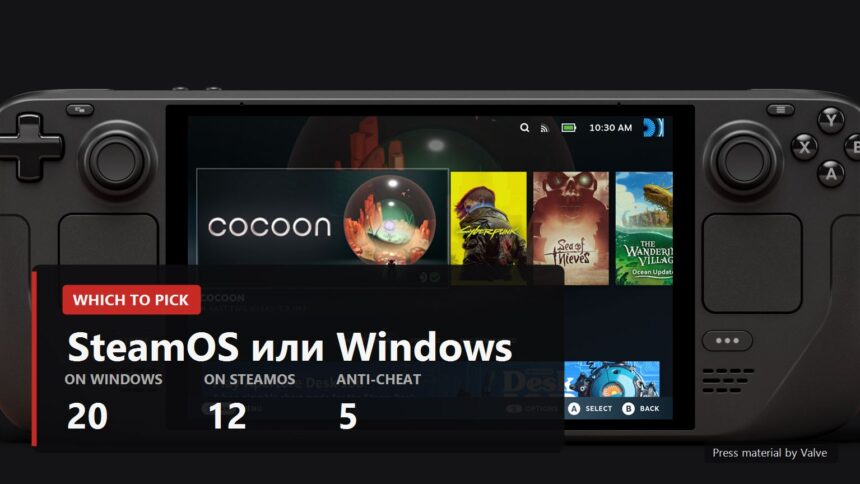
The SteamOS versus Windows argument on a handheld usually gets fought over interface polish and how fast the thing wakes from sleep. I would start from the dull end instead: the list of games that simply refuse to launch on SteamOS. The list is short, specific, and settles the question faster than any amount of talk about shells.
First count what you actually play
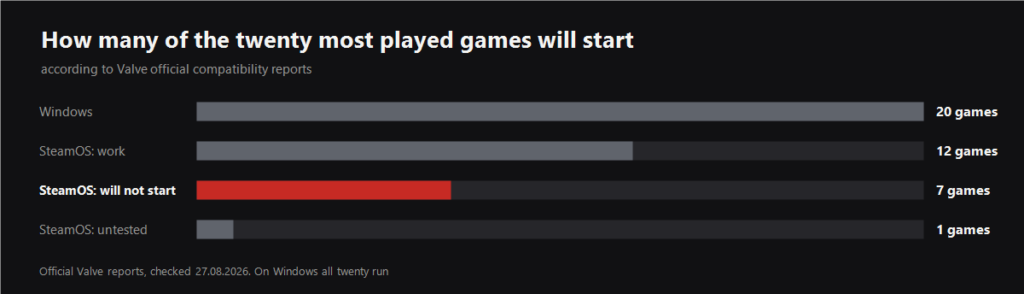
I took the twenty most played Steam games as of 27 August 2026 and read Valve's official compatibility reports. On Windows all twenty run, it is their native system. On SteamOS twelve officially work, seven are unsupported and one was never tested. And here is the part that matters more than the totals: of those seven, five fail on anti-cheat and only one on performance.
The game by game breakdown, with community ratings and the reason for each refusal, sits in a separate piece. The conclusion is what counts here. If your five favourites include PUBG, Apex, Rainbow Six Siege, Battlefield 6 or EA SPORTS FC, the discussion is over and you want Windows. No setting works around it, because the decision belongs to the game developer rather than to the operating system.

What SteamOS gives you

- Sleep and instant resume. Press the power button, the screen goes dark, a second later you are exactly where you left off. On Windows this works some of the time and depends on the drivers of your particular handheld.
- Per game power profiles are built in. Frame limit, refresh rate and power limit are remembered separately for each game, with no third party software involved.
- Nothing spins in the background. No system update mid match, no antivirus deciding to wake up, no vendor panel sitting on four hundred megabytes of memory.
- The store and the library are the interface. Controller navigation was designed through to the end rather than bolted onto a desktop.
One honest note about battery: the system itself does not save any. The settings do, and SteamOS just makes them easy to reach. The difference is not in hours of runtime, it is in how long you spend getting those hours.
What Windows gives you
- Every game, no exceptions. Including the five anti-cheat titles that are the reason people buy a Windows handheld in the first place.
- Any store or subscription. Game Pass, EA, Ubisoft, Epic and GOG all work normally, with no shims and no workarounds.
- The software you already know. Your own tuning utilities, overlays, capture tools, mods with complicated installers.
You pay for that in fiddling. Windows on a seven inch screen is still Windows: small windows, pop up notifications, drivers you install by hand, and a sleep mode that occasionally decides not to wake.
Valve now scores three platforms separately
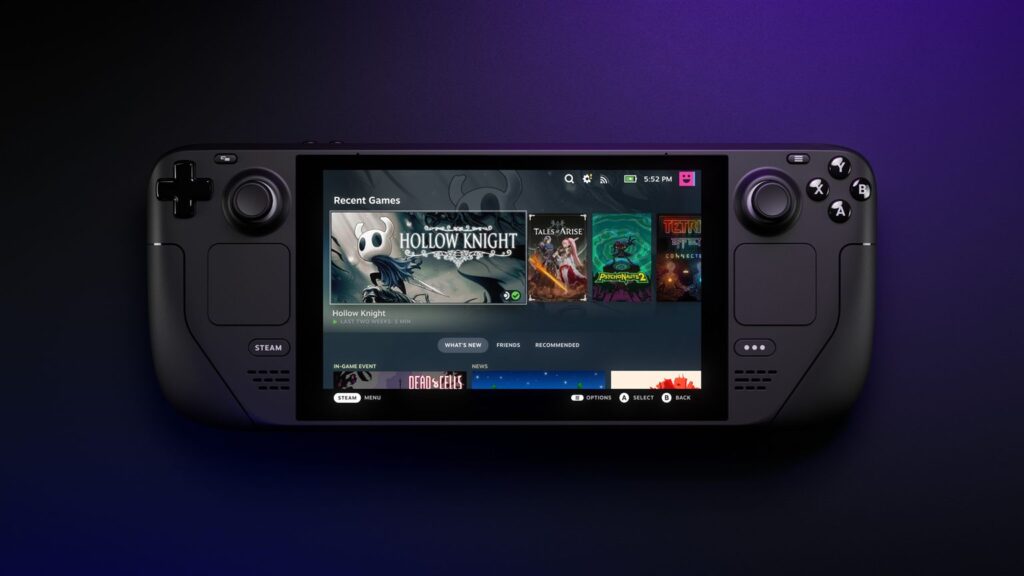
A detail you only notice if you query the compatibility report directly. There used to be one verdict, for the Steam Deck. There are three now: one for the Deck, one for SteamOS in general, and a separate one for Steam Machine. And they test different things.
The Deck gets four checks: controller layout, button glyphs, interface legibility and performance on default settings. SteamOS on somebody else's hardware gets a far shorter list, essentially one question, does the game start. Which makes sense, since Valve has no idea what screen or what power budget you have. The side effect is that in the general SteamOS column not a single one of the twenty earns the top tier, and everything Verified on Deck drops a step. That is a difference in method rather than in quality, so it is not worth worrying about.
SteamOS left the Deck behind a while ago
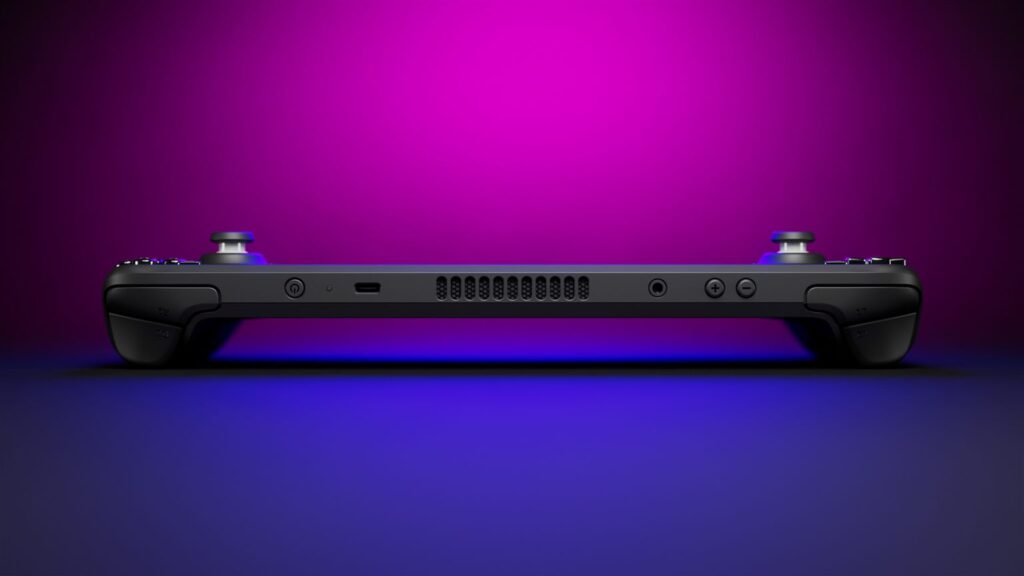
This is no longer a one device system. In the SteamOS 3.8 release notes Valve is fixing other people's handhelds in plain sight: a bug where some third party handhelds ignored input while a button was held, and initial gamepad support added for the MSI Claw 8 EX AI+. The same notes carry a Steam Machine firmware section and a "Great on Machine" shelf in the library.
The practical takeaway is simple. If you are eyeing a handheld that Valve did not build and wondering about SteamOS, the odds improve with every update. Check your exact model though, rather than trusting the trend.
How to decide in five minutes
- Write down five games you genuinely play. Not the ones sitting in your library, the ones you launched in the past month.
- Check each in the compatibility block on its store page. If even one fails on anti-cheat and you care about it, take Windows and spare yourself the grief.
- If all five pass, take SteamOS. Sleep, per game power profiles and the absence of background noise show up on the very first evening.
- For a third party handheld, check your specific model. Support arrives device by device, not all at once.
I lean towards SteamOS and I am not hiding it. But to somebody who spends evenings in Siege with friends I will honestly say install Windows, because no amount of interface comfort outweighs not being able to join the match. And whichever you pick, the first settings after buying are the same, and they are collected in a separate guide.
Sources
Valve's official compatibility reports, queried per game on 27 August 2026: they carry separate verdicts for Steam Deck, SteamOS and Steam Machine. Most played list: Valve's own Steam Charts data for the same date. Quotes about third party handheld fixes and MSI Claw 8 EX AI+ support: SteamOS 3.8 release notes on the SteamOS news page on Steam.