
People are writing about DLSS 5 as though you could go and download it. You cannot: NVIDIA showed the technology at its GTC conference on 15 March and promises a release in autumn 2026. Here is what the official statements actually say, how this differs from the upscaler you know, and, more usefully, what you can switch on today while the fifth version is not out.
What DLSS 5 is, and why it is not just another upscaler
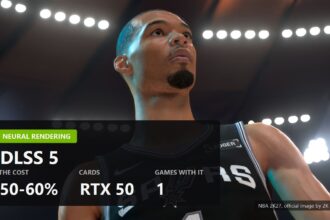
NVIDIA's wording: DLSS 5 introduces a real-time neural rendering model that infuses pixels with photoreal lighting and materials. Jensen Huang called it the GPT moment for graphics, blending hand-crafted rendering with generative AI.
Translated out of presentation language: earlier versions of DLSS took a picture the engine had already drawn and rebuilt it at a higher resolution. The fifth version steps in earlier, into the calculation of light and materials itself. That is why NVIDIA frames it as the first major shift since ray tracing arrived in 2018 rather than the next number in a name.
How well it works is too early to judge. What the public has seen is a preview at a conference, no independent measurements exist, and a promise of "GPT, but for graphics" deserves the usual marketing discount.
When, and on which cards

- Release: autumn 2026. NVIDIA has not given a firmer date.
- GPU requirements have not been published. The claim that RTX 40 cards are excluded is circulating widely, but NVIDIA has not confirmed it, and we do not print that sort of thing as fact.
- Launch titles, from NVIDIA's own list: Starfield, Resident Evil Requiem, Hogwarts Legacy, Assassin's Creed Shadows, AION 2, Delta Force, Phantom Blade Zero, Where Winds Meet and others.
How it will be installed
DLSS has never had a separate installer and the fifth version will not either. The routine has been the same for years: a current driver plus the NVIDIA app, with the feature itself switched on in a game's graphics settings. Nothing is downloaded by hand, and if a third party site offers you a "DLSS 5 installer", that is not what it is.
What you can switch on right now: DLSS 4.5
While we wait for the fifth version, gamescom brought an update that works today and on every GeForce RTX card without exception. It is the second generation of the transformer model for Ray Reconstruction: 35 percent more compute and 20 percent more parameters at comparable performance, trained on a larger dataset, with better temporal stability in motion.
The steps, per NVIDIA's own instructions:
- Open the NVIDIA app, go to Settings, then About.
- Opt into Early Access releases. Without that the option will not appear.
- Go to Graphics, then Driver Settings, find DLSS Override and the Model Presets section.
- Switch it to Custom, then in the Ray Reconstruction dropdown pick Recommended or Preset F.
- Press Apply. Then launch a game that supports Ray Reconstruction and enable it in the graphics settings as usual.
Supported games NVIDIA names include 007 First Light, CONTROL Resonant, Gears of War: E-Day, AION 2, Black State, CINDER CITY and a handful more.
My advice is simple: do not wait for autumn to improve anything. The transformer model update is a visible gain in image quality for free on any RTX card, and DLSS 5 will arrive on its own with a driver, at which point there will be numbers to argue about.
Sources
The DLSS 5 announcement, the description of the technology, timing and game list: NVIDIA's official post from GTC 2026. The transformer model update, supported cards, game list and the steps to enable it: NVIDIA's gamescom 2026 post. Checked 29 August 2026. As of that date NVIDIA has published no GPU requirements for DLSS 5.
Update, 1 September 2026. What follows was true when this piece went out on 29 August. On 30 August the DLSS 5 neural rendering library escaped along with an NBA 2K27 early access build, and some of the clips are now shot on real code, unfinished though it is and without a single setting from a developer. What was actually run, where it went well and where the screen died after ten seconds, is covered separately: DLSS 5 leaked and now runs everywhere, even on PS2 games. The rule below still stands, though: the overwhelming majority of clips captioned "DLSS 5 On" are still drawn with a sharpness slider.
DLSS 5 comparisons online: almost all fake, but since 30 August not all
YouTube already carries videos labelled "DLSS 5 Off" and "DLSS 5 On", where the two halves of a frame differ in sharpness and light. You can watch them, you just cannot believe them: the technology is not on sale, no driver ships it, and the people making those videos do not have it either. Usually it is one frame with the sharpness and contrast pulled down on the left half and pushed up on the right.
A simple test for the future: if a video compares a version that has not shipped, the comparison does not exist. Real numbers arrive when the driver does, and outlets with test benches and a published method go through it.