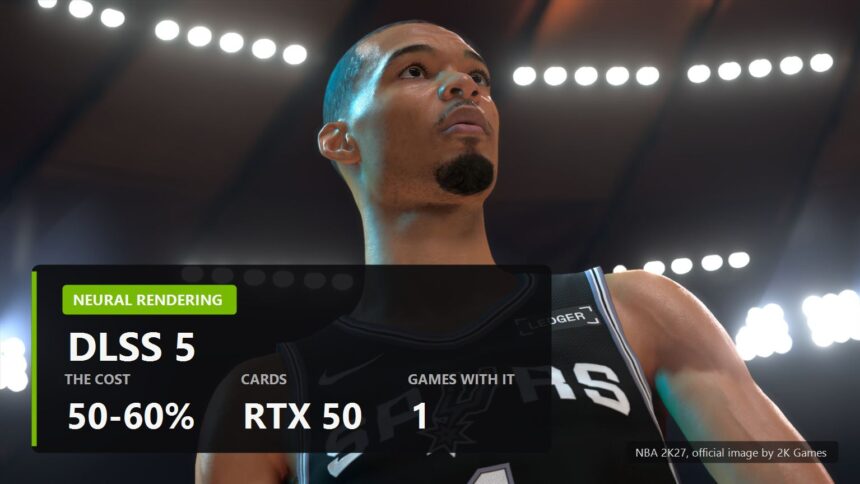
DLSS 5 is out. It arrived on 3 September in NBA 2K27, and the first week produced the one number nobody was putting on a slide: turning it on costs you 50 to 60 percent of your frame rate. That figure is not from an angry forum thread. It is NVIDIA's own.
- What shipped on 3 September
- The cost, from NVIDIA itself
- How to read the numbers on the slides
- Which card runs it, and at what resolution
- The RTX 5090 runs out of watts before it runs out of cores
- The RTX 40 series is getting it, later
- Why there is so much anger about it
- What this means if you are buying or upgrading
Here is everything the week actually established: what shipped, what it costs, how to read the marketing charts, which card runs it at which resolution, why a RTX 5090 can run out of power before it runs out of compute, and what happens to the RTX 40 series.
What shipped on 3 September
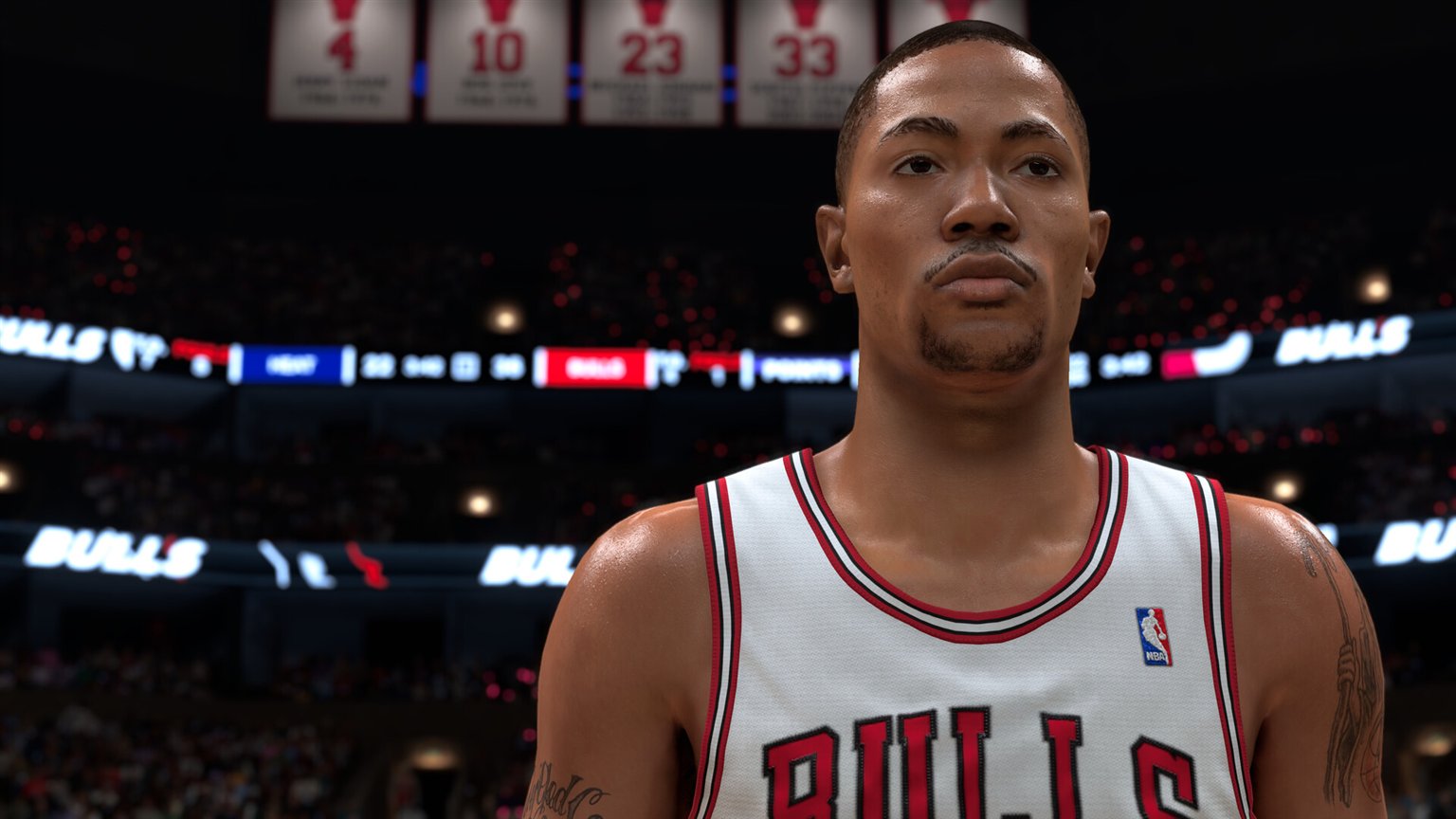
One game, NBA 2K27, and one hardware tier. DLSS 5 works on every GeForce RTX 50 series card, desktop and laptop, plus GeForce NOW. Nothing older is supported at launch.
What it does is different from every DLSS before it. Previous versions took the frame the engine drew and made it bigger or made more of it. DLSS 5 takes the game's colour and motion vectors and has a neural model add lighting and materials on top, anchored to the scene's 3D content. NVIDIA calls it 3D-Guided Neural Rendering. Jensen Huang called it the GPT moment for graphics, which tells you how the company wants it read.
Announced partners run long: Bethesda, Capcom, NetEase, NCSOFT, Tencent, Ubisoft, Warner Bros. Games and others, with Starfield, Hogwarts Legacy, Assassin's Creed Shadows, Resident Evil Requiem, Phantom Blade Zero and The Elder Scrolls IV: Oblivion Remastered on the list. None of them have it yet. Today the list of DLSS 5 games is one game long.
The cost, from NVIDIA itself
At the technical preview an NVIDIA engineer was asked twice, in different words, what enabling DLSS 5 costs. The answer: on average, across 50 series GPUs, across all resolutions, about 50 to 60 percent.
Two things follow from that, and both matter more than the headline.
- It does not vary much between games. There is no per-game tuning. The model is the model, and it charges the same toll in a basketball game as it will in an open world.
- NVIDIA publishes it as a time, not a percentage. Roughly 8 milliseconds per frame. At 60 frames per second you have 16.7 milliseconds to work with, so the model wants about half of your entire frame budget before the game has drawn anything.
That is why the feature is Blackwell-only for now. It is not a driver lock, it is a compute bill.

How to read the numbers on the slides
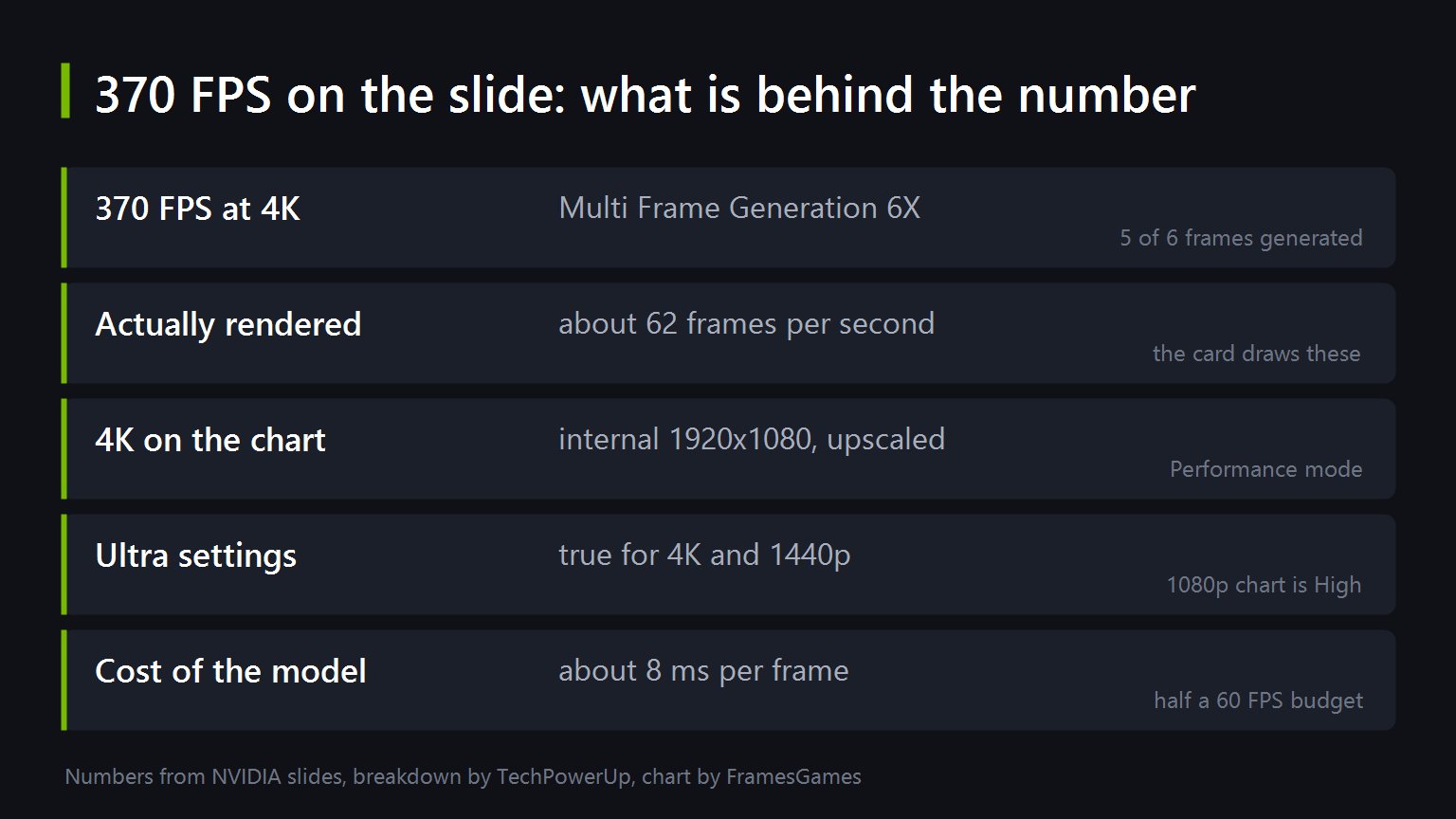
NVIDIA's performance charts for NBA 2K27 show an RTX 5090 at 370 FPS in 4K with DLSS 5 on. That number is real and it is also almost entirely generated.
| What the slide says | What is behind it |
|---|---|
| 370 FPS at 4K | Multi Frame Generation 6X, so five of every six frames are generated. Around 62 frames per second are actually rendered. |
| 4K | Super Resolution in Performance mode: the game renders at 1920x1080 and the result is upscaled to 3840x2160. |
| Ultra settings | True for the 4K and 1440p charts. The 1080p chart is High settings, which the slide's own footnote confirms. |
None of this is fabricated. It is simply a number that answers a different question than the one most people are asking. If you want to know what your monitor will show, 370 is the answer. If you want to know what your card is drawing, the answer is 62.
Which card runs it, and at what resolution
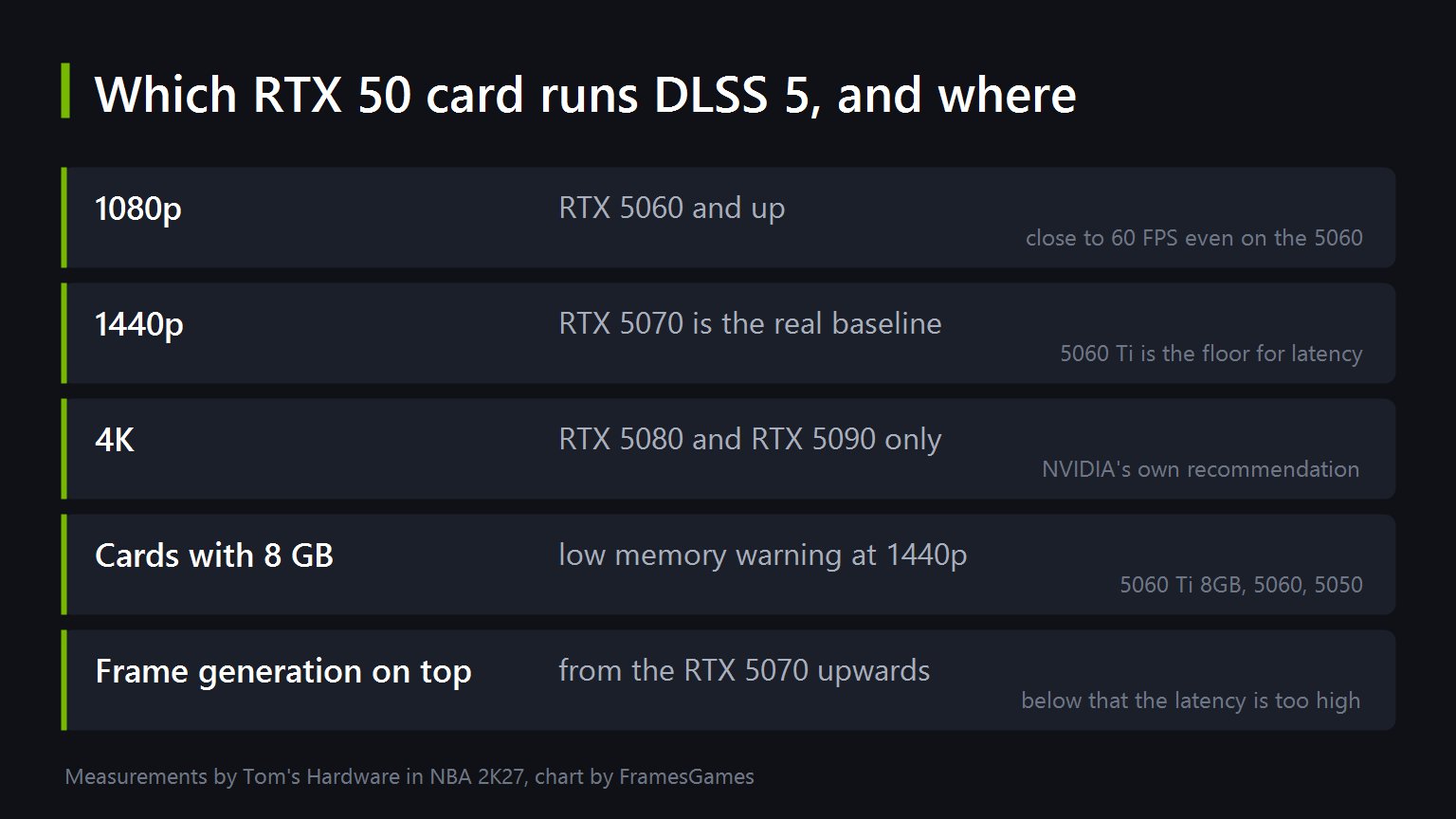
Tom's Hardware ran the whole RTX 50 lineup through NBA 2K27 with DLSS 5 on and off. The practical picture is clearer than the percentages.
- 1080p is open to everyone. Even an RTX 5060 holds close to 60 frames per second with DLSS 5 on. Above the RTX 5070 the game is processor-bound without it, so the card has headroom to spend.
- 1440p wants an RTX 5070. An RTX 5060 Ti is the floor for acceptable input latency, and the 5070 is where the experience stops being a compromise.
- 4K is for the RTX 5080 and 5090. That is NVIDIA's own recommendation and the measurements agree. An RTX 5070 Ti is already straining, with latency too high to add frame generation on top.
- 8 GB cards hit a wall before they hit a limit. The RTX 5060 Ti 8GB, RTX 5060 and RTX 5050 throw a low memory warning at 1440p with these settings, and the frame generation model may not fit alongside DLSS 5 at all.
Worth keeping in mind: the model started life needing an RTX 5090 to run at all and now runs on an RTX 5060. NVIDIA also confirmed it is not yet quantised for Blackwell's own number format, so the bill should come down further.
The RTX 5090 runs out of watts before it runs out of cores

This is the strangest finding of the week. Testing the leaked build across Cyberpunk 2077, Hogwarts Legacy and Control, the limit on a Founders Edition RTX 5090 turned out not to be compute.
- Founders Edition, one 12V-2x6 connector. Frame rate down 42 to 49 percent, and the card sitting on its 575 watt ceiling the whole time.
- MSI Lightning Z, two connectors and a 1000 watt limit. Smaller drop, steadier one percent lows, and a lot more power drawn. In Hogwarts Legacy it went from 480 to 720 watts with neural rendering on, half again as much.
A flagship card underprovisioned on power for a feature from the same company is not a good look, and the 12V-2x6 connector has had enough scrutiny this generation already. Two caveats: this used a community injection method rather than NVIDIA's official path, and it was measured before the official release. The cost still matched NVIDIA's published 8 millisecond figure closely.
The RTX 40 series is getting it, later
On 4 September, one day after launch, NVIDIA confirmed a DLSS 5 port for the RTX 40 series. Until then the assumption was that Ada Lovelace had been left behind for good.
The confirmation comes with an order of priority attached. RTX 40 is secondary. The company is still tuning the model on RTX 50 so that it does not wreck frame rates there, and only after that does the older generation get attention. No date, no word on whether it arrives with the full feature set.
Read that against the compute bill above and the arithmetic is uncomfortable. If half an RTX 5080's frame rate is the price on the hardware the model was built for, the same model on a RTX 4070 has to give something up.
Why there is so much anger about it

The hostility did not start this week. The announcement video from March sits at 83.7 percent dislikes: 82,515 against 16,107 likes on more than 1.5 million views. The game demonstrations did worse, with the Resident Evil Requiem clip at 14.9 percent positive.
The objection is not about frame rates. It is that a neural model repaints faces and materials that artists made deliberately. The clearest example was Grace from Resident Evil Requiem, whose face came out changed. Capcom's answer was that the studio got the design right. Developers at Capcom and Ubisoft said they learned what their own games looked like with DLSS 5 at the same time as the public did. Jensen Huang said gamers were completely wrong, because the technology is controllable and artistic intent stays intact.
Now that a shipped game exists, that argument moves from trailers to something people can turn on and look at.
What this means if you are buying or upgrading
Nothing about DLSS 5 changes a purchase this month. One game supports it. The technology is real, the visual jump in that game is real by the accounts of people who have run it, and the price is half your frames on hardware that already costs more than it should.
What is worth doing today is the boring version: make sure the upscaling you already have is set up properly, because Ray Reconstruction generation two is out and free, and DLSS can be added or updated in almost any game without waiting for a patch.
We will come back to this when the second game ships, because one title is not a pattern.
Sources
The release on 3 September in NBA 2K27, support for all GeForce RTX 50 series desktop and laptop cards plus GeForce NOW, the description of 3D-Guided Neural Rendering, the partner and game list and the quotes from Jensen Huang and Todd Howard come from NVIDIA's own announcement and press release. The figure of 50 to 60 percent, the absence of per-game tuning, the 8 millisecond per frame cost, the breakdown of the 370 FPS figure into Multi Frame Generation 6X and roughly 62 rendered frames, the Performance mode upscaling at 4K and the note that the model is not yet quantised: TechPowerUp's DLSS 5 technical preview and its question session with NVIDIA. The results across the whole RTX 50 lineup in NBA 2K27, the low memory warnings on 8 GB cards and the recommendation of an RTX 5070 as the 1440p baseline: testing by Tom's Hardware. The 42 to 49 percent drop on a Founders Edition RTX 5090, the 575 watt ceiling and the jump from 480 to 720 watts on an MSI Lightning Z: the same testing, reported by TechPowerUp on 2 September, measured with a community injection method on the leaked build. The confirmation of an RTX 40 series port and its secondary priority: NVIDIA, reported 4 September. The dislike counts on the announcement video and the game demonstrations, the statement from Capcom and the reaction from Jensen Huang: TechPowerUp's reporting from March 2026. The arithmetic converting 8 milliseconds into a share of a 60 FPS frame budget is ours.