
Digital Foundry has taken apart the 26 minute Grand Theft Auto VI showcase and put a line in the headline they do not throw around: perhaps the most impressive showcase of real-time rendering we have ever seen. Richard Leadbetter calls the scale of the achievement singular for the whole console generation and compares it to the Apollo programme. Oliver Mackenzie says he has never seen anything more convincing rendered in real time.
The analysis is not a hymn, though. It also names the price paid for that picture, and one thing DF does not expect to be fixed by launch.
What it was captured on, and at what resolution

- A base PlayStation 5, not a Pro. Which means the Pro version should look better: stronger graphics and PSSR upscaling available.
- Internal rendering around 1440p, and by the look of this trailer without dynamic resolution scaling.
- It reaches 4K through a plain spatial upscale. DF found no strong evidence of modern temporal methods such as FSR 2 or TAA upscaling.
- Thirty frames, and they hold steady. Single dropped frames are rare, nothing like the dips GTA 4 and GTA 5 were remembered for on older consoles.
Thirty frames is no longer a guess

This is the single most important line of the analysis. The video Rockstar handed to Netflix and YouTube is itself a 30 frames per second asset. As a showcase decision that is arguable, because a console outputs at 60 and such a video only represents the game honestly if the thirty are perfectly locked. Which is exactly why the conclusion is firm: the game targets 30 fps, and in DF's words that now looks 100 percent confirmed.
Higher frame-rate modes, according to reports from people who spoke to Rockstar, will be considered as post-launch updates. Not promised. Considered.
And 60 fps on current consoles DF calls extremely unlikely, with the graphics not being the obstacle. The processor is. To fit inside 16.7 ms instead of 33.3 you have to find both GPU and, above all, CPU time, and the simulation is eating it: crowds, traffic, physics, NPC routines. You can only claw that time back by cutting the world down.

What genuinely astonishes
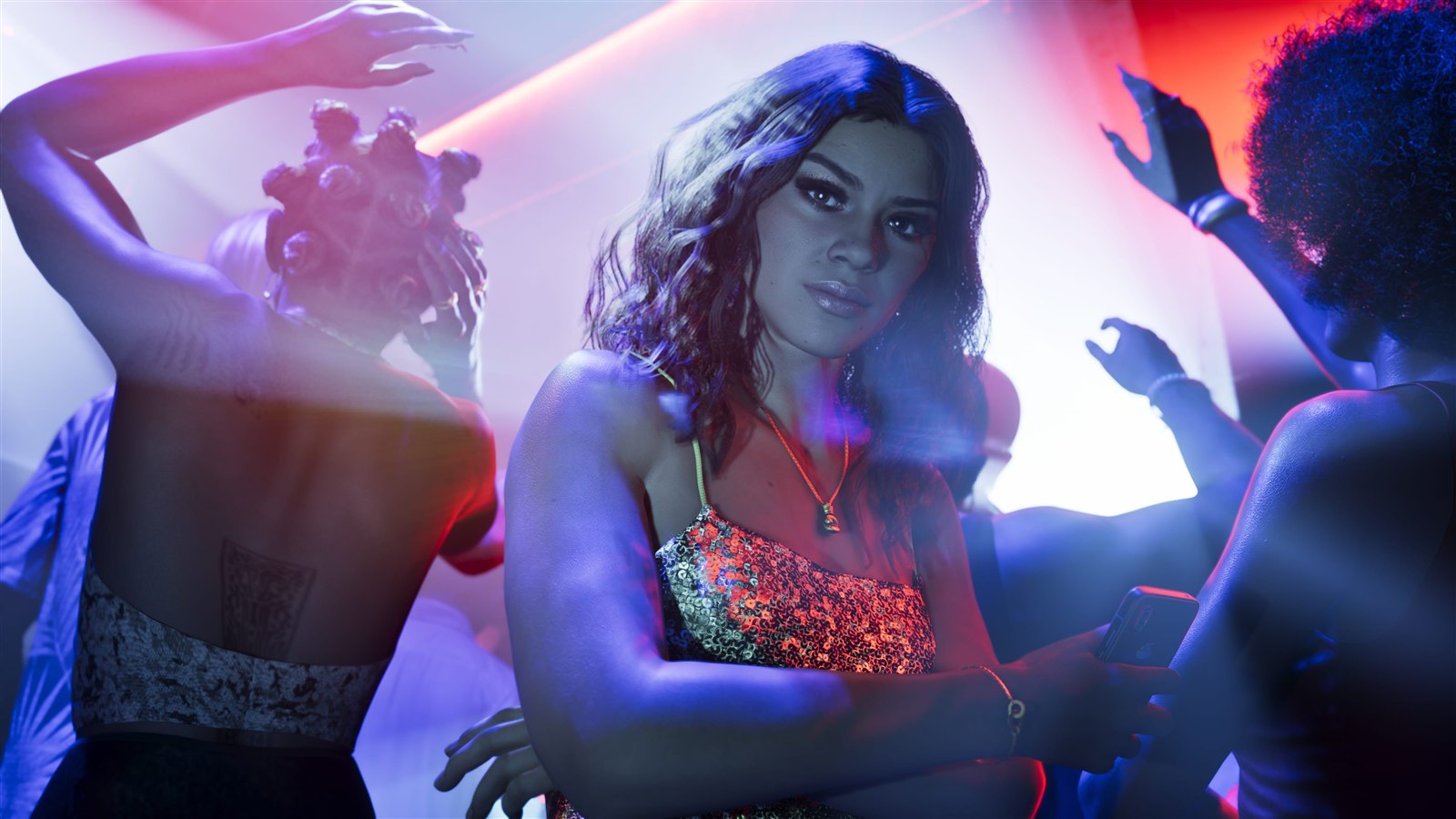
The headline achievement, in DF's reading, is the characters rather than the city.
- Hair. Simulation and shading have jumped a generation, and equally for straight, wavy and curly hair. Lucia's moves from root to tip with delayed follow-through and a snap back you almost never see in games, and it works in gameplay, not only in cutscenes.
- Skin. Highlights track believably, sweat and make-up read as real, and bodies in hot, humid rooms look slick in a way real-time rendering rarely manages.
- Global illumination is ray traced, and this is where ray tracing is genuinely indispensable: light bounces with proper occlusion and colour bleeding, and baking that into a world this dense and this changeable is not realistic.
- Reflections are ray traced too. Characters show up in them even where screen-space data would not be enough. Things reflect that are not in the frame at all.
- Shadows, by contrast, mostly are not. Rockstar refined classic shadow maps with variable softness instead, and any ray-traced shadows appear to be used surgically, in particular close-ups.
On simulation separately: crowds in clubs and on beaches are large, there are plenty of vehicles, and individual characters clearly carry more of their own behaviour than in previous open worlds. But DF states the caveat plainly: the trailer is curated, and how the system behaves once chaos starts cannot be judged from it.
What it cost, and what happens on PC

There is a price for a picture like this, and it is paid in sharpness.
- The plain upscale to 4K softens the image, with visible aliasing on geometry and shimmer on fine detail.
- Ray traced reflections are noisy and smear in motion. Frozen side by side they can lose to older screen-space reflections in places, and win once the camera settles.
- Ordinary mirrors are still planar reflections, as in previous Rockstar games. Where the old trick is cheaper and looks no worse, it stayed in the toolbox.
- Ray tracing noise is visible in some shots, as you would expect from a solution squeezed onto console hardware.
Now the part that usually falls out of the retellings, even though it is the most interesting observation in the whole analysis. Even at a steady thirty, animation and camera pans stay uneven: some frames move further than others, and that makes the presentation feel worse than it measures. DF calls it a long-standing quirk of the RAGE engine, suspects a mismatch between animation timing and frame updates, and does not expect it to be resolved for launch.
The PC forecast is measured. Resolution will be higher there, modern upscalers like DLSS will help, ray counts and draw distances can go up. But a world of this complexity was tuned around four Zen 2 cores aiming at 30 frames, so hitting 60 will be genuinely hard, and it will take a top-tier processor, one of the recent Ryzen chips with 3D cache.
The short version: Rockstar chose world density and material quality over sharpness and smoothness. Going by this analysis the choice was deliberate and polished to the end, not something that happened by accident.
Sources
The technical analysis by Digital Foundry, "GTA 6: An Extended Look Analysis" on digitalfoundry.net, by Richard Leadbetter and Oliver Mackenzie. Every figure and judgement above comes from there. The showcase went out on 27 August 2026 on Netflix, YouTube and Rockstar's own site, running 26 minutes. The Digital Foundry mark on the cover belongs to that publication and is used to identify the source.